de Beaumont Rares
debeaumontrares@gmail.com
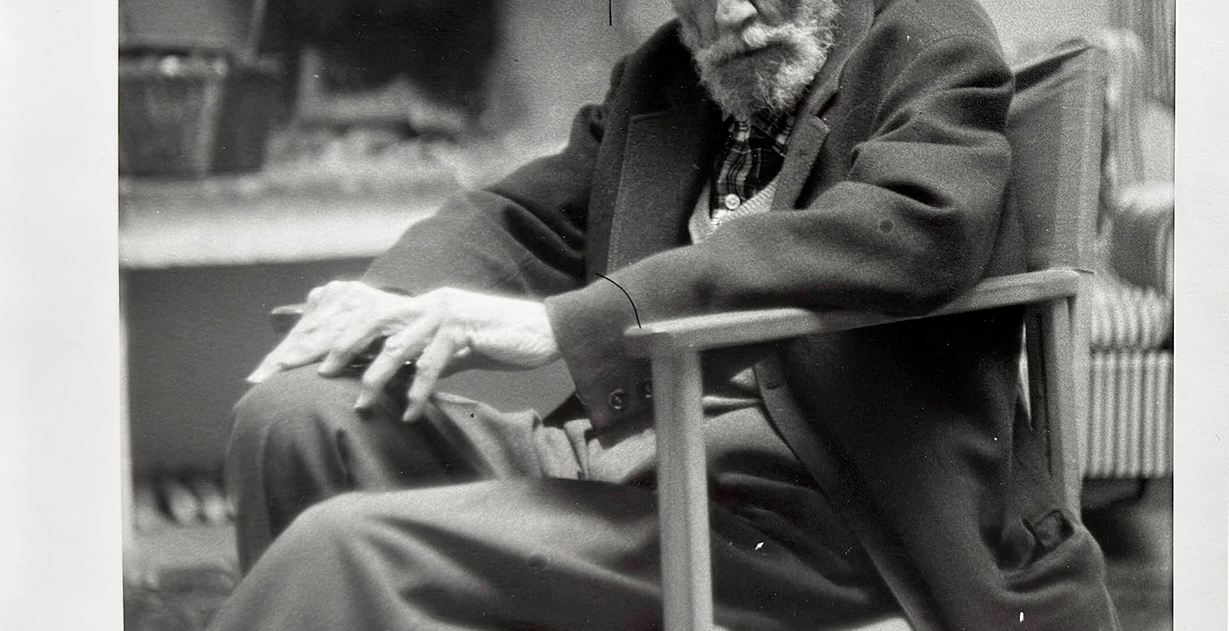
Ezra Pound, X
Pound and Poundiana; proofs, private press, unpublished scholarship, and a unique photograph.
4 October 26
tap to cycle
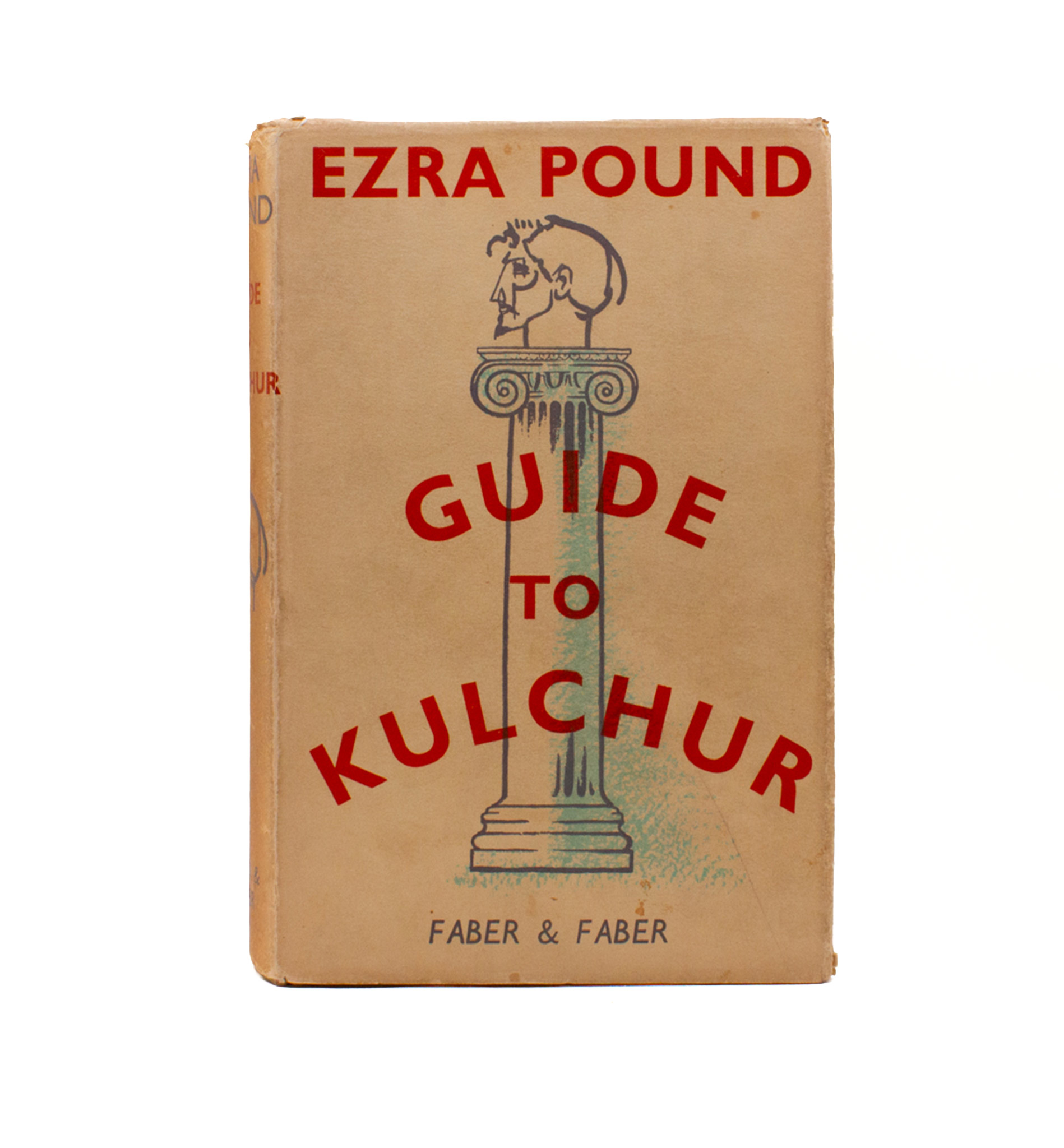
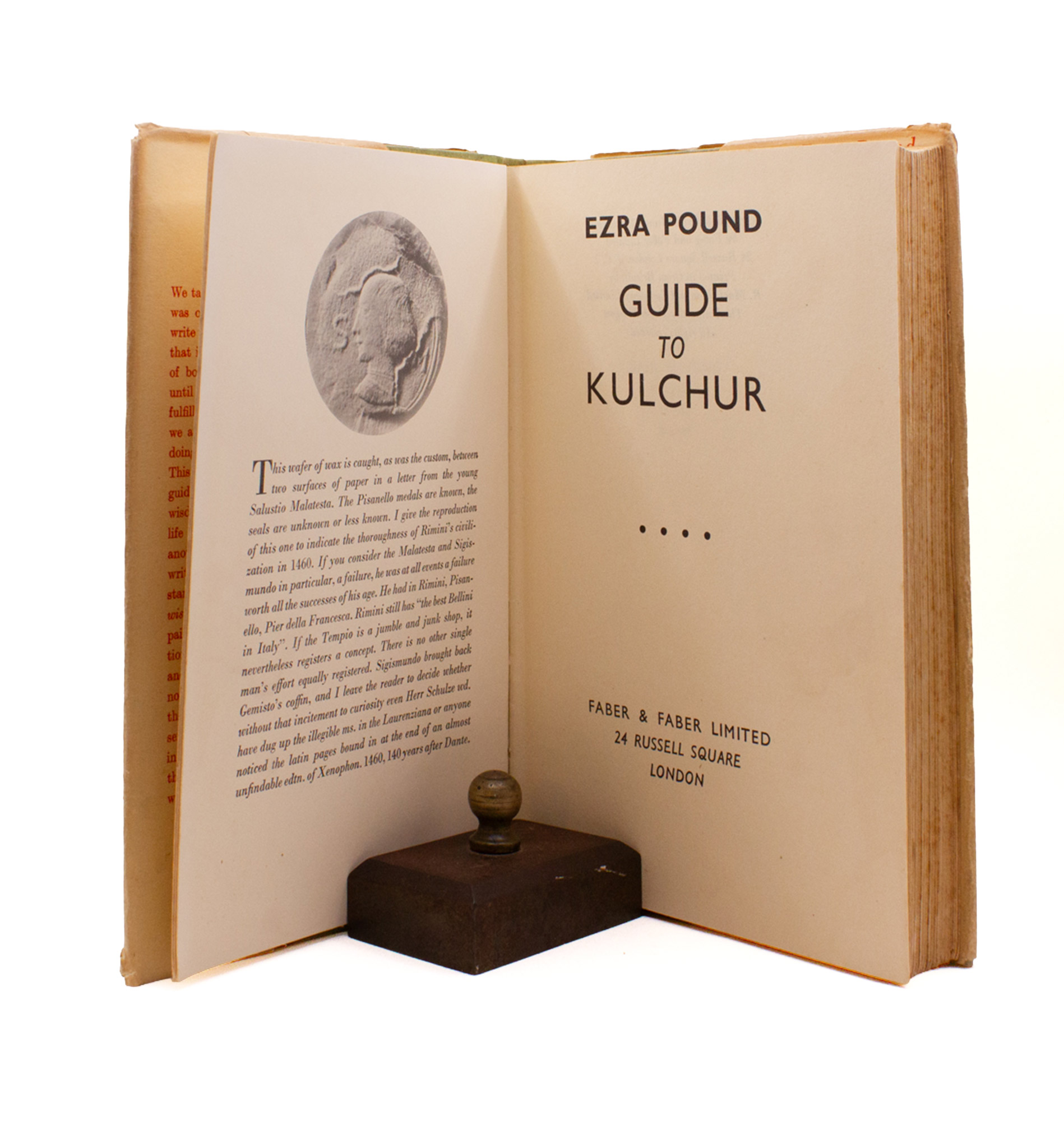
Guide to Kulchur
Ezra Pound
Published London: Faber & Faber, 1938
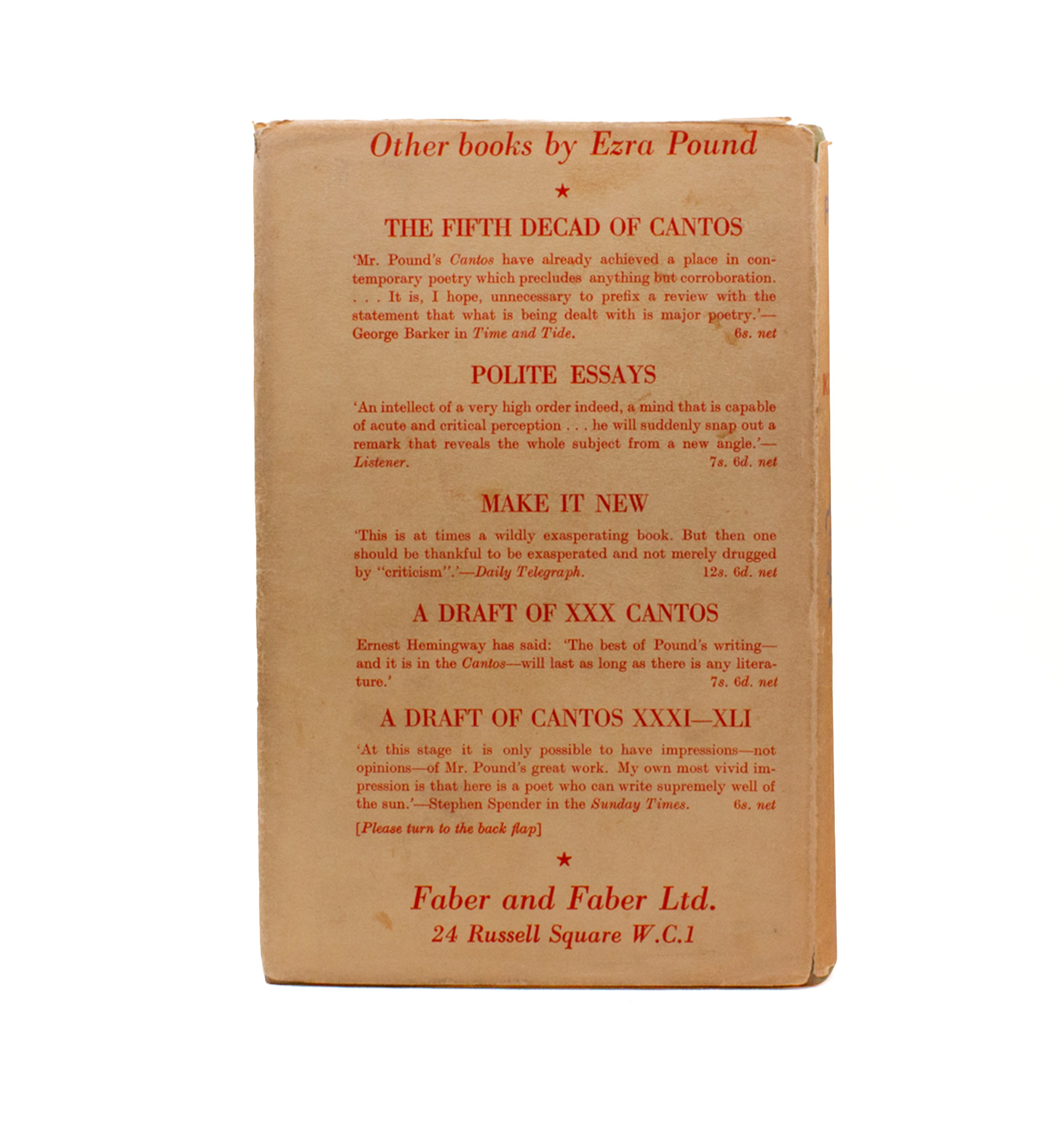
359pp.; 20.9 x 13.9 cm. Green cloth boards lettered in gold on spine. Cream dust-jacket printed in grey, red and green.
Essays on culture, an education for those “who want to know more at the age of fifty than I know today.” A book that was censored pre-publication by Faber for potential libel, a sign of its contemporaneity and Pound’s increasingly polarised stance.
First edition, one of around 700 copies published by Faber, a further 230 bombed and 520 used for the American issue. This copy retaining a beautiful jacket entirely unrubbed and unbroken; short loss to top and tail of spine, spine darkened with a little staining; price-clipped at a high angle as seems to be the way with this edition. Cloth with a little discolouration at edges and a very short tear at the top of the spine; bookseller’s pencil to the ffep. Gallup A45a.
tap to cycle
Photographs of Ezra Pound
Camerphoto Epoche
Published Venice: Camerphoto Epoche, c. 1965
Agfa-Gevaert Brovira BN 111. 6 square, 13.1 x 12.6 cm each; 8 rectangular, 17.7 x 12.1 cm each; 1 large, 29.5 x 13.8 cm.
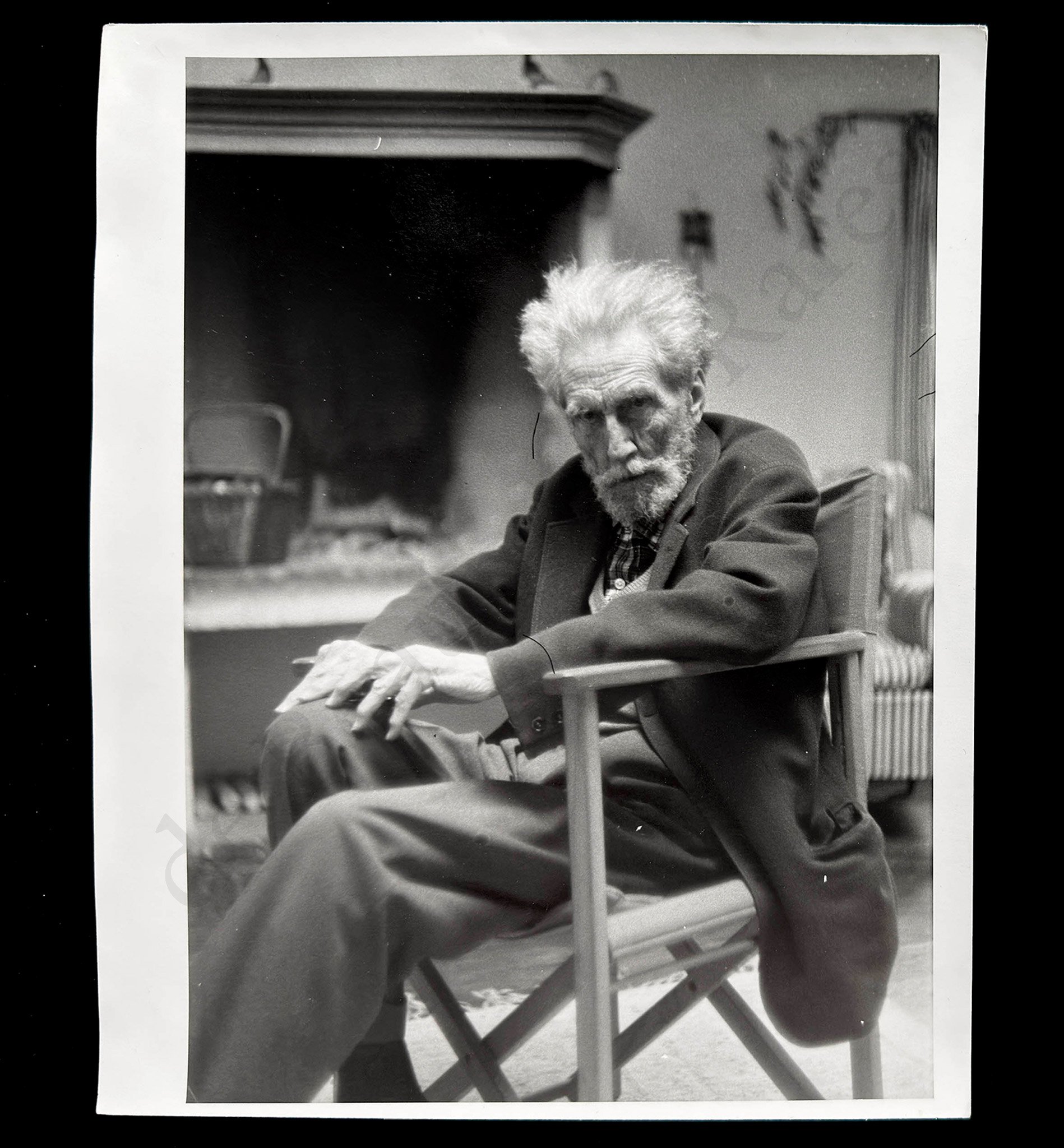
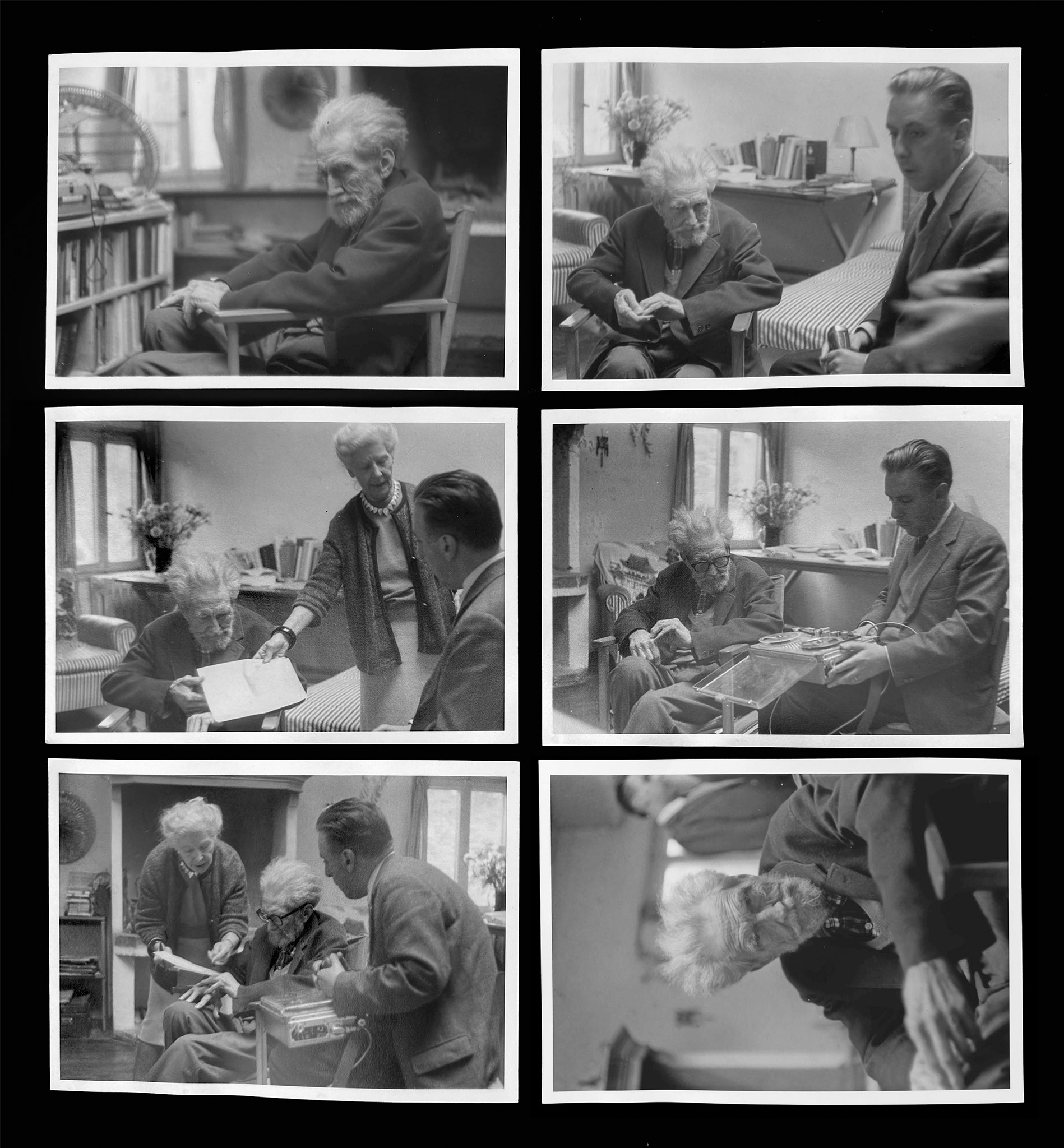
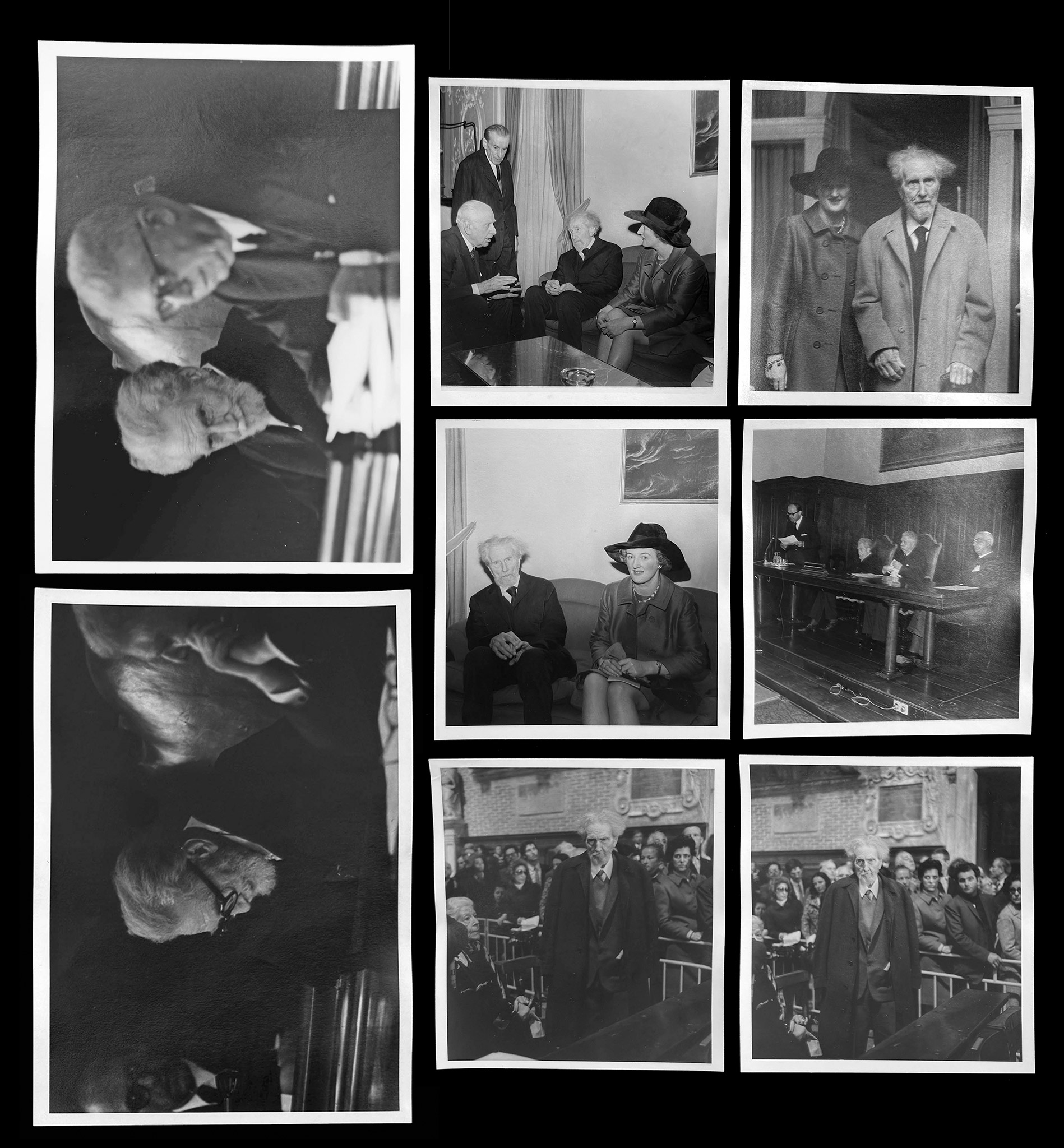
An archive of photographs of Ezra Pound taken by Cameraphoto Epoche in Venice, on two occasions in the 1960’s, all printed on a historic carta barytata from the negatives.
The first group of photos capture Pound, Rudge, and Emilio Isgrò at Pound and Rudge’s home in the Dorsoduro, Venice, 121 Calle Querini. Isgrò adjusts a reel-to-reel, preparing to interview Pound, while Rudge passes Pound papers presumably to read from, as will be the case some years later when Passolini interviews Pound in the very same room.
Isgrò, an artist and poet in the verbo-visual tradition, was from 1960 to 1967 the editor of the cultural supplement of the Venetian daily review Il Gazzettino, which provides us with a more accurate date for these photographs than the commonly ascribed date of 1969 (vide Getty, etc.) which is likely the Cameraphoto archival date. Though later Isgrò will discuss his driving to Padua to intercept EP for an interview, there is no record of this scene other than these photos, though the lower grade barytata on which six smaller prints are produced further suggest use by press. The large print, however, has been pulled on a high grade barytata and is of significant quality. Not only has this photograph, depicting Pound in his chair with both hands upon one knee, never been published, but its negative has been lost, making this print the only known copy.
The second group of photographs capture the 7th Dante Centenary held at the Fondazione Giorgio Cini on the island of San Giorgio Maggiore in 1965. An homage to Dante was held in the Palladian Cenacolo, hosted by Prof. Vittore Branca, pictured at the lectern, while Eugenio Montale and Pound spoke on Dante, and an unpublished speech by T. S. Eliot on Dante was read. Olga Rudge can be seen seated to the left while Pound stands to face the camera. The young lady in the wide-brimmed hat is Valerie Eliot, widow of T. S. Eliot who had died January 4 of that year. There are in total eight photographs of this event, six of square format and two rectangular.
Of the rectangular format prints, one is gently yellowed, and others have orange stains to the edges; only the one with EP looking in the direction of Eugenio Montale has this same orange very briefly over the subject. All of the square format prints are lightly stained by this bromine-like substance, with four of the six having some amount on the subject (the two portraits of EP with Valerie Eliot unaffected); one of these stamped to the rear, “Specialista Leica.” The large format print shows a few artefacts from the negative, but has been kept well out of sunlight and remains in exceptional condition.
The agency’s four photographers, Claudio Gallo, Duilio Stichter, Celio Scapin and Walter Stefani, operated anonymously under the name of Cameraphoto, whose negatives are today considered national heritage by the Italian State.
tap to cycle
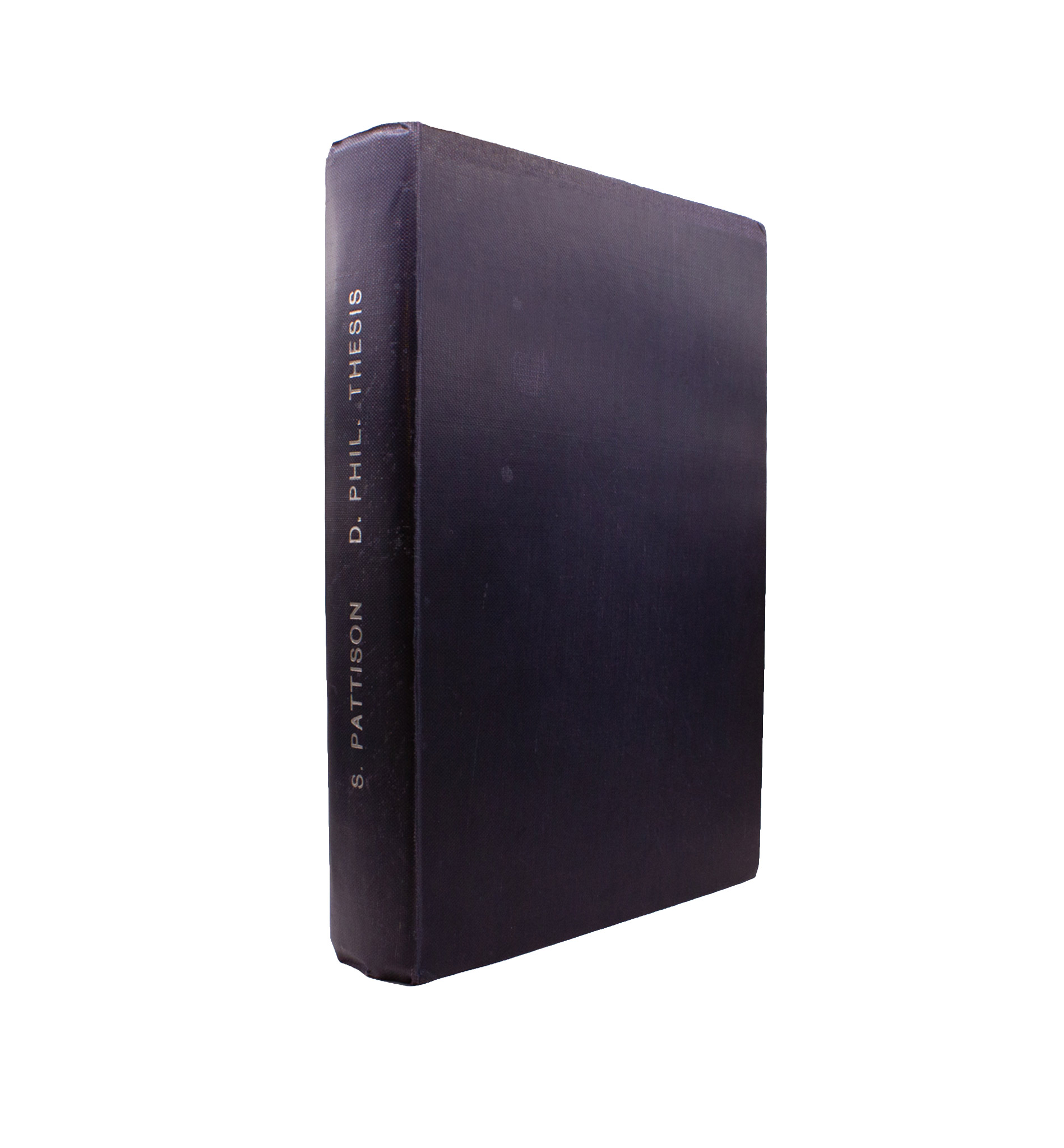
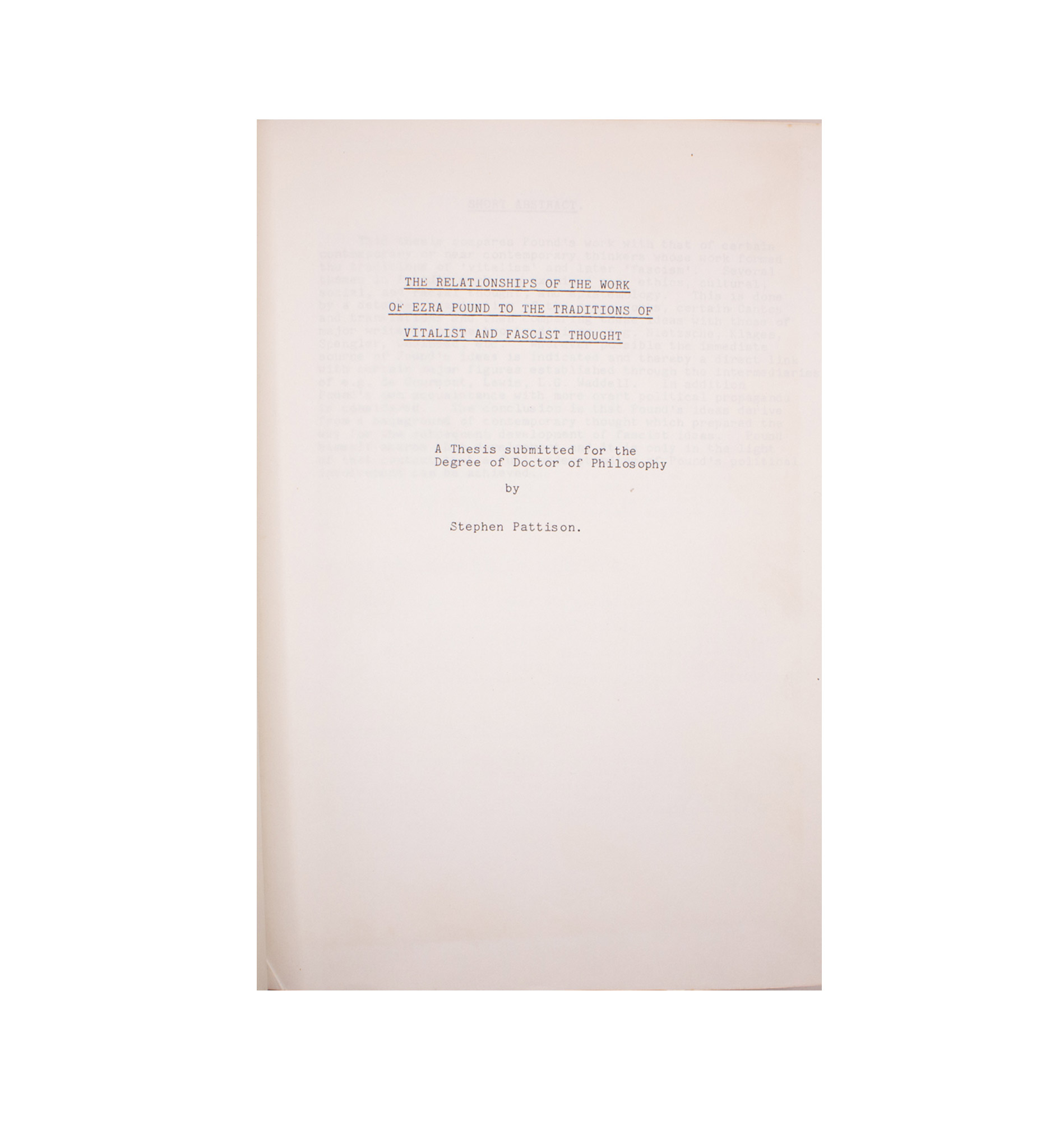
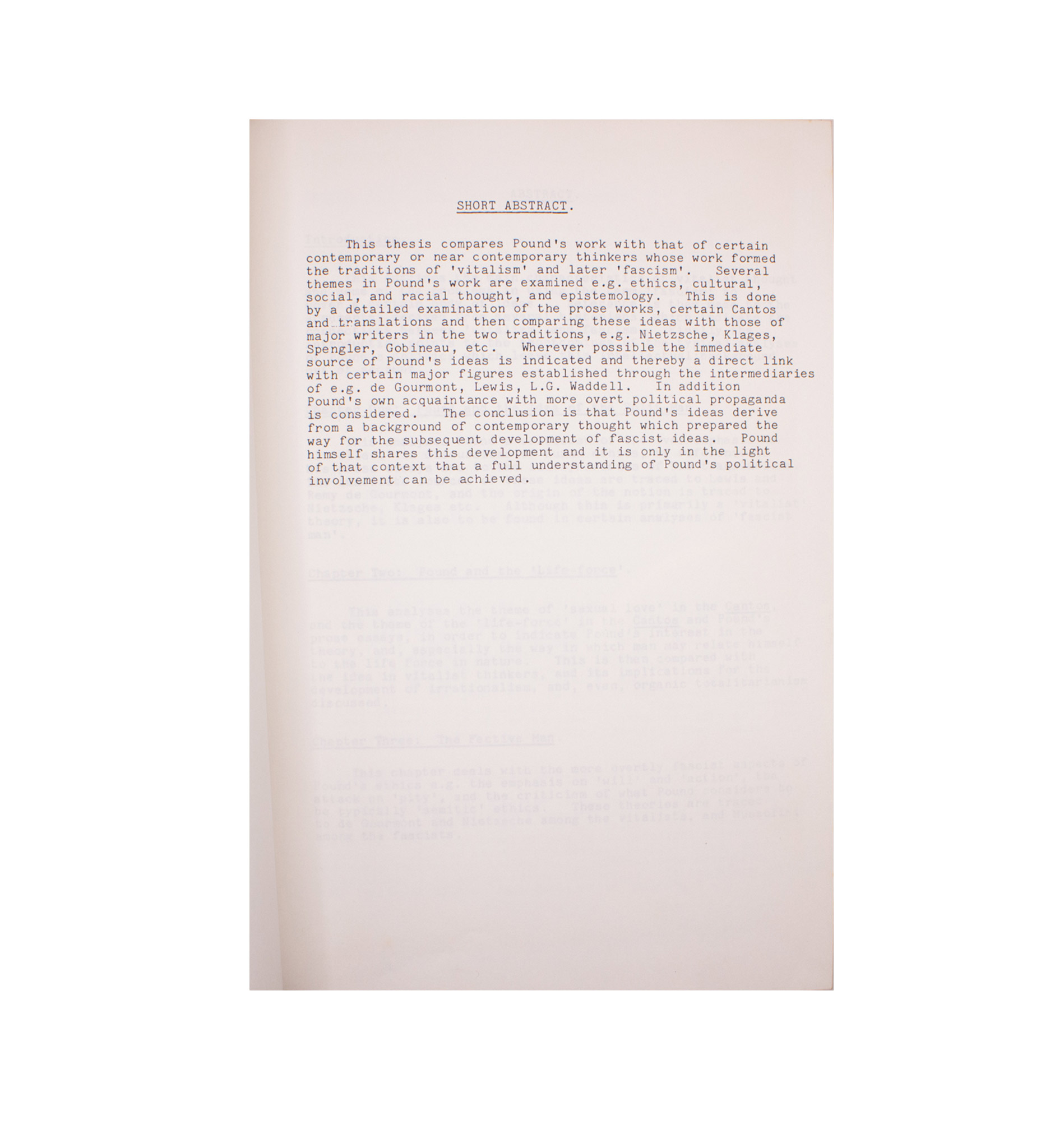
The Relationships of the Work of Ezra Pound to the Traditions of Vitalist and Fascist Thought
Stephen Pattison
Published University of Edinburgh, [n.d., c. 1978-1982]
405ll.; 31 x 22 cm. Blue cloth boards stamped in silver up spine.
Stephen Pattison’s D. Phil thesis at the University of Edinburgh, on the intersection of Vitalism and Fascism found in Pound. Unpublished. Printed recto’s only, double spaced. Light wear to cloth.

tap to cycle
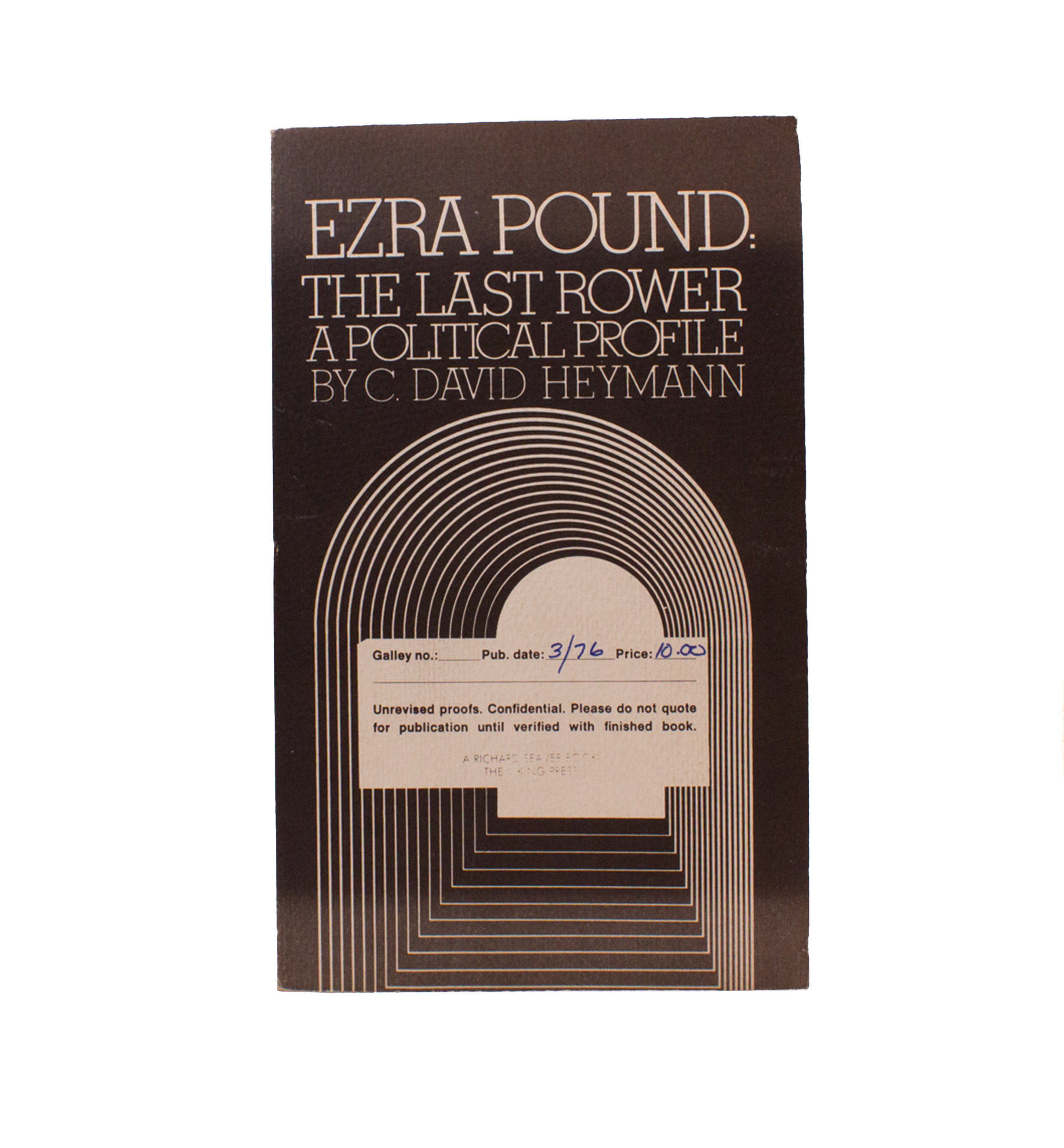
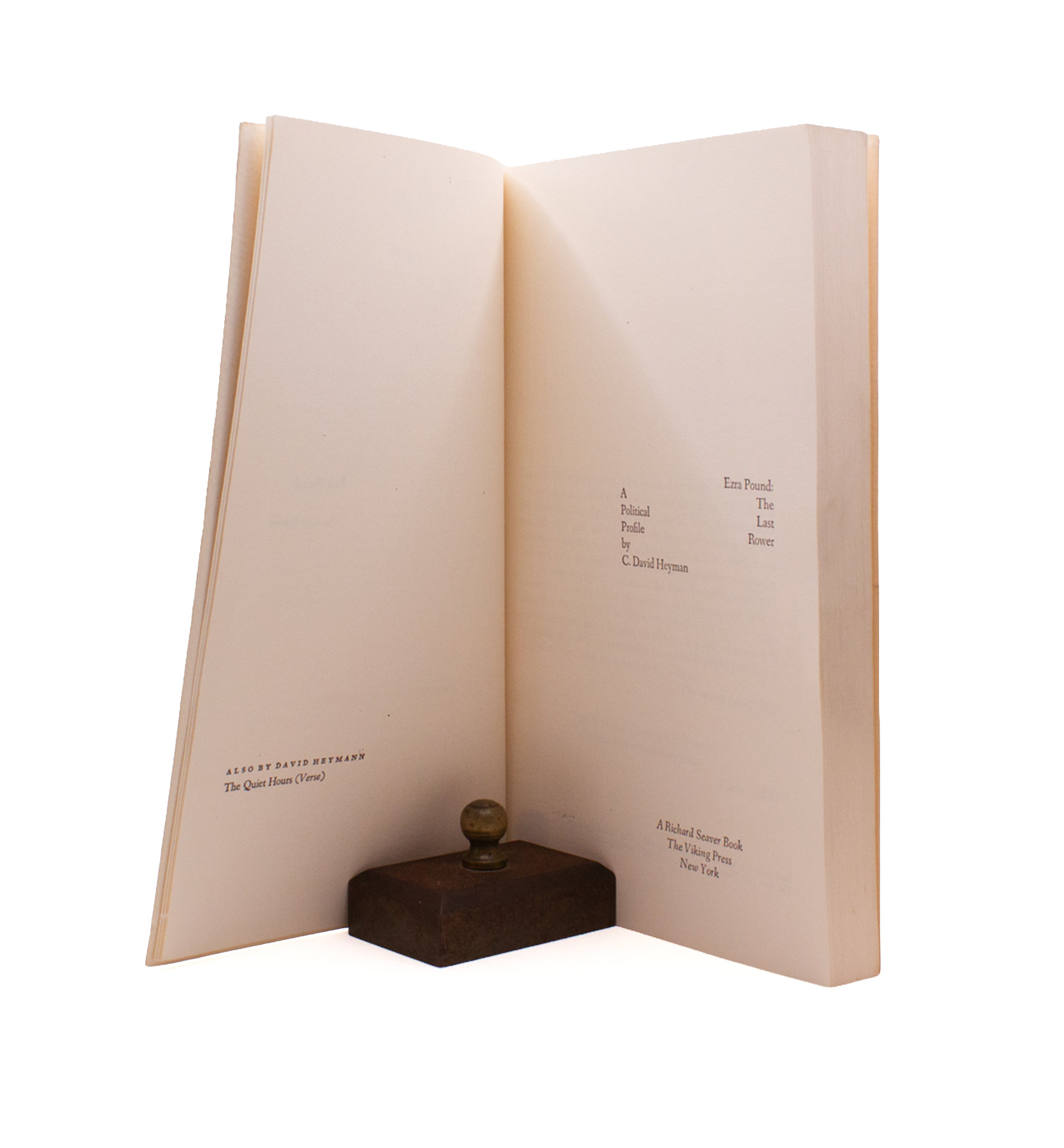
Ezra Pound: The Last Rower, A Political Profile; Proof Copy
C. David Heymann
Published New York: The Viking Press, A Richard Seaver Book, 1976
xiv, 324pp.; 23.5 x 14.4 cm. Heavy white paper wraps printed in black.
Unrevised proof for David Heymann’s The Last Rower. One correction on p. i, the author’s biography, from “professor” to “lecturer.” Otherwise with occasional marginal scores in pencil throughout. Dated and priced in ink to front cover, and titled in ink down spine.

tap to cycle
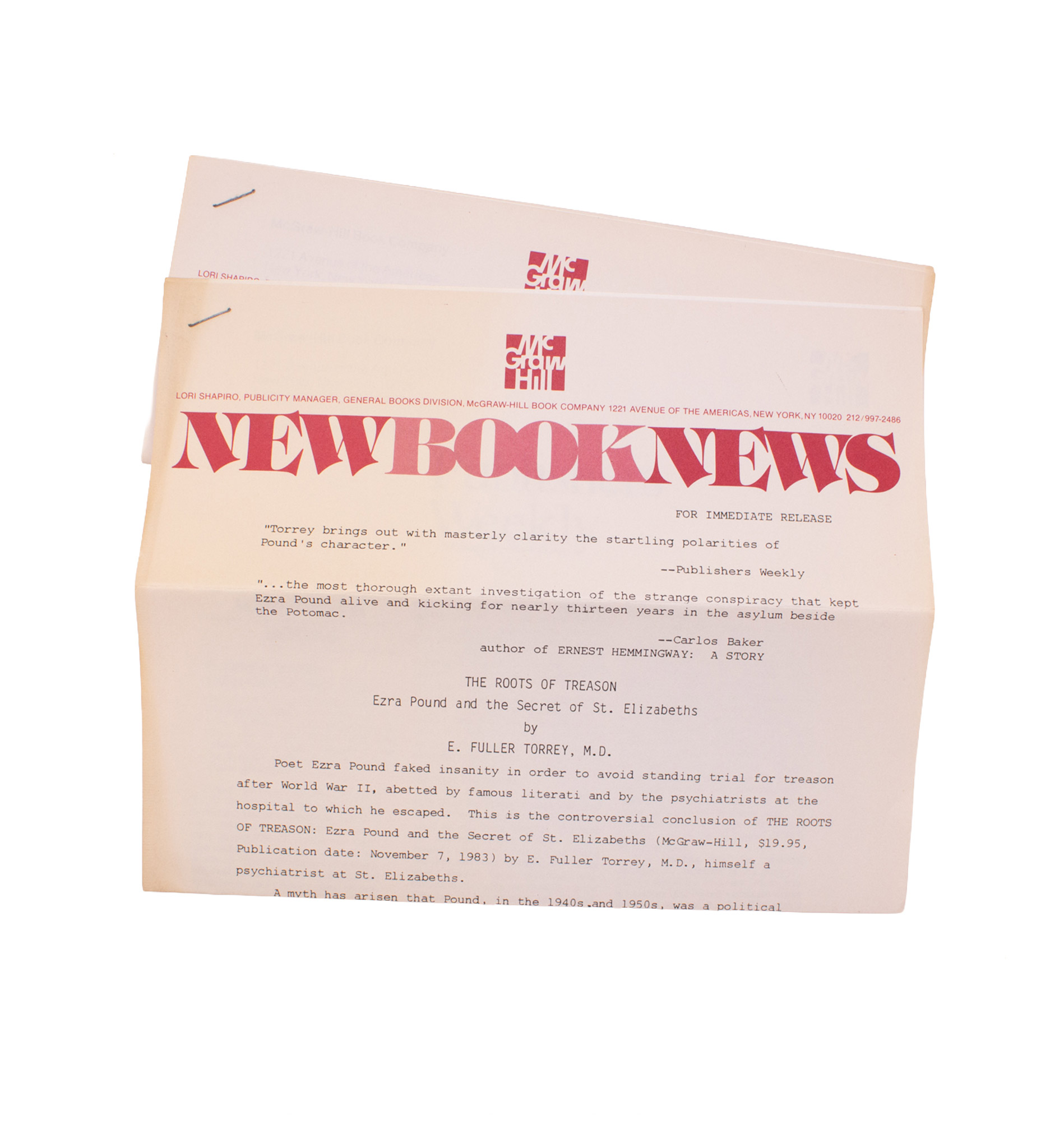
The Roots of Treason; Uncorrected Proof Copy
E. Fuller Torrey
Published McGraw-Hill Book Company, 1983
330pp.; 21.3 x 13.7 cm. Blue paper wraps printed in black.
Uncorrected proof copy, without any particular manual correction; the only annotations to be found were applied to previous sheets from which this copy is scanned. Accompanied by two copies of the publisher’s press-release. Fading to spine and top half of front cover.
tap to cycle
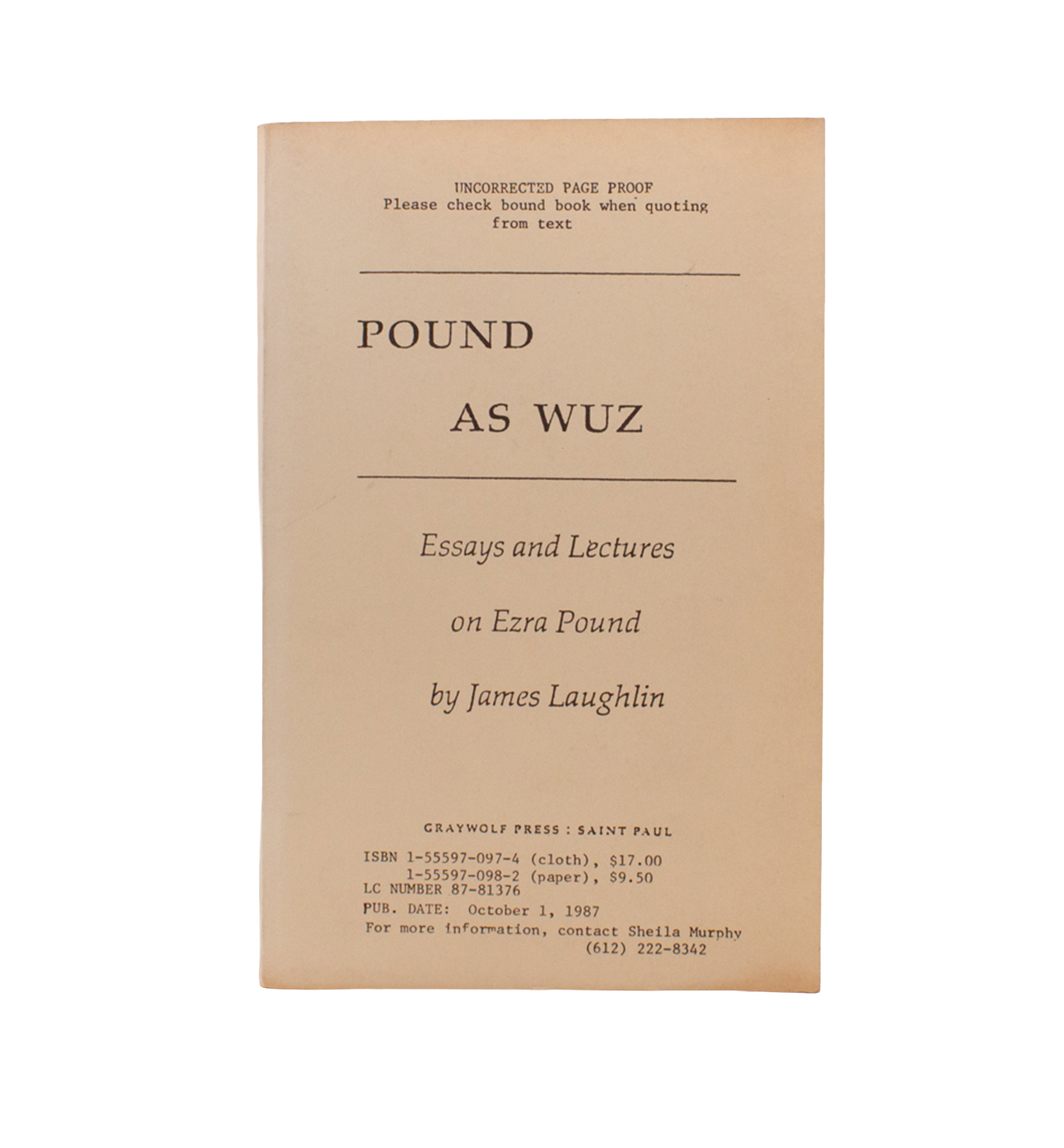
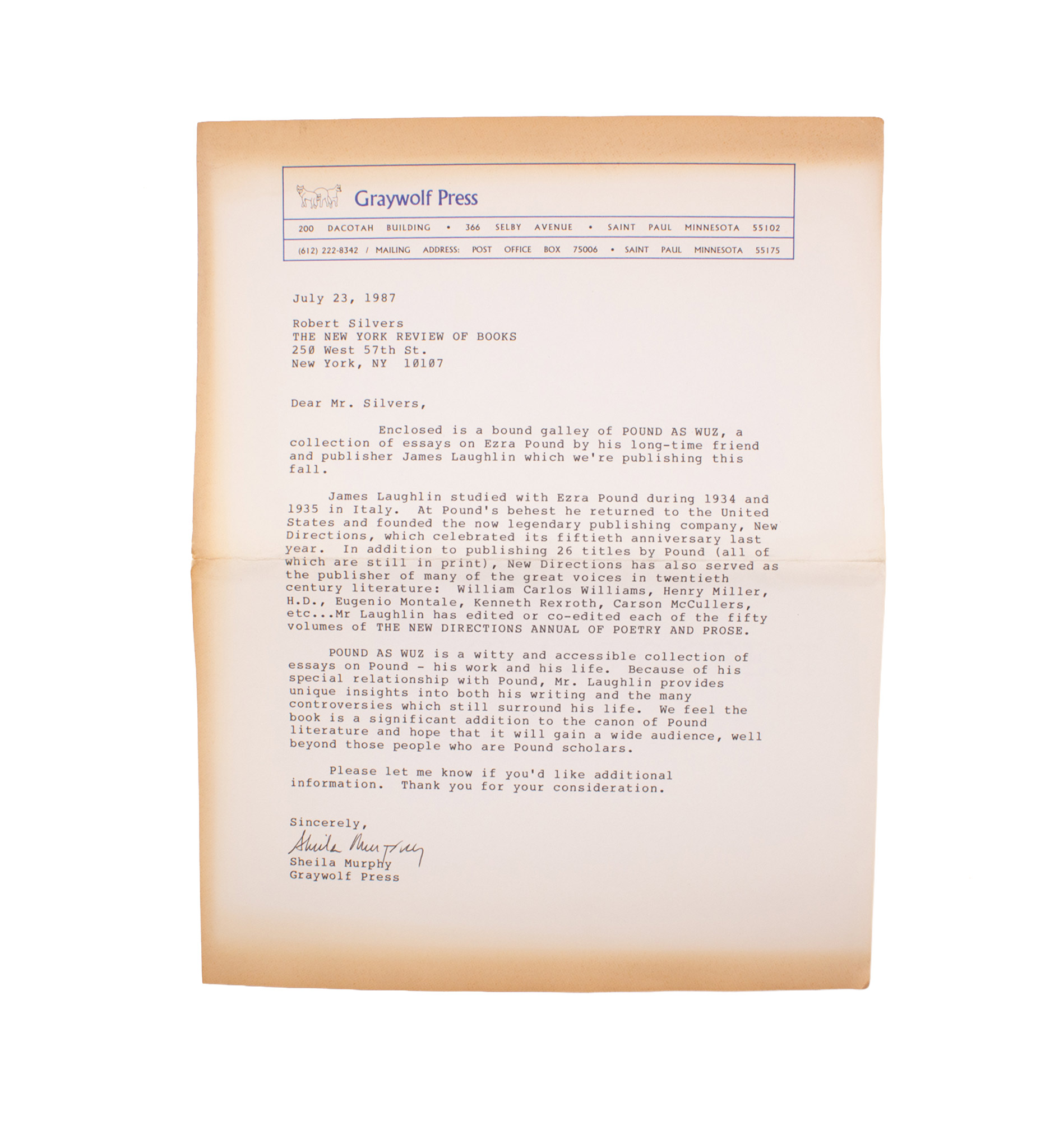
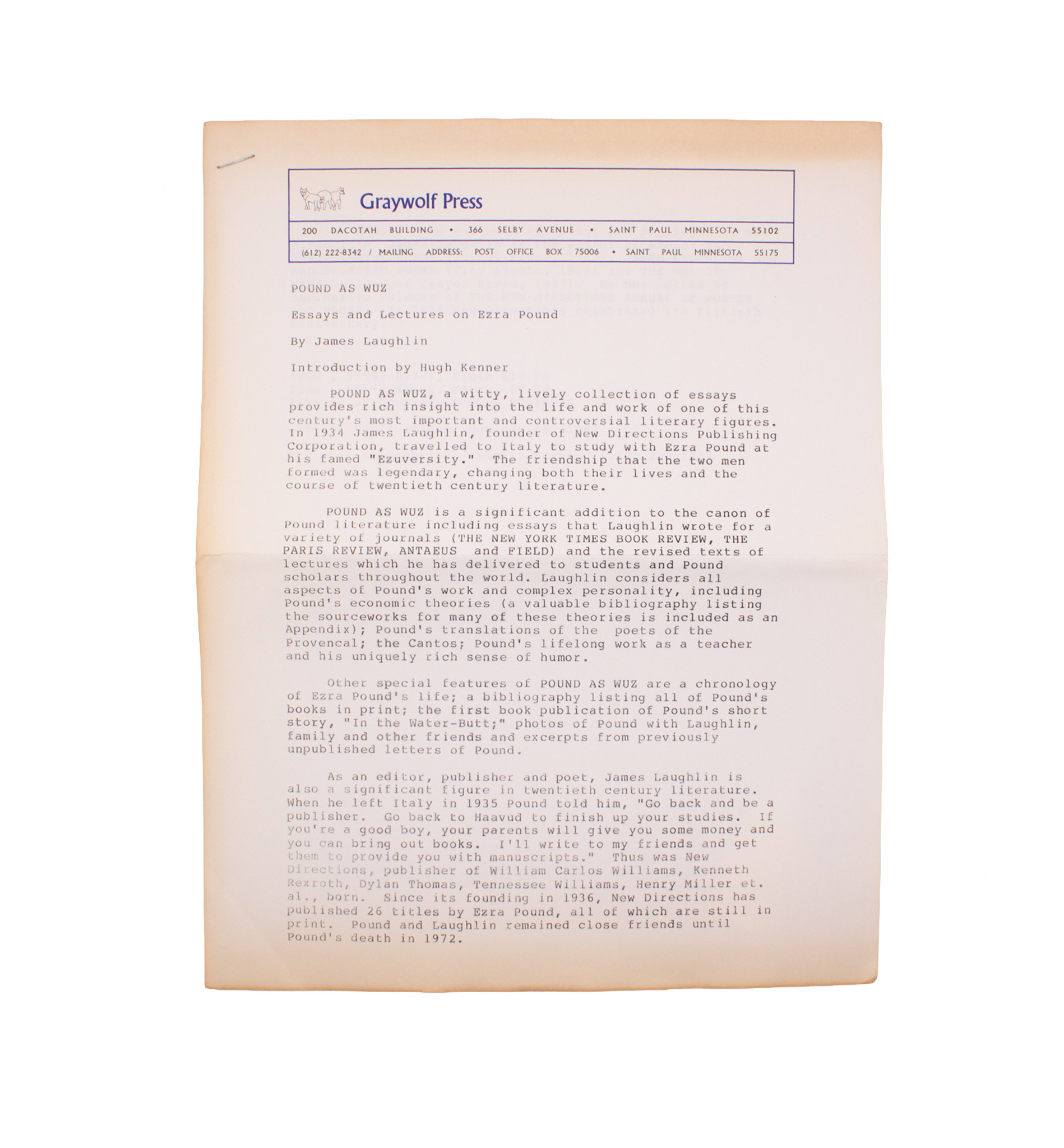
Pound as Wuz; Uncorrected Proof Copy
James Laughlin
Published Saint Paul: Graywolf Press, 1987
189pp.; 21.1 x 13.6 cm. Cream paper wrappers printed in black.
An uncorrected proof copy of Laughlin’s Pound as Wuz, without manual annotation. Used as a very advanced review copy, and sent to Robert Silvers of The New York Review of Books by Sheila Murphy of the Graywolf Press on July 23, 1987, with a typed and signed letter to that effect, together with a further two page press-release.
tap to cycle
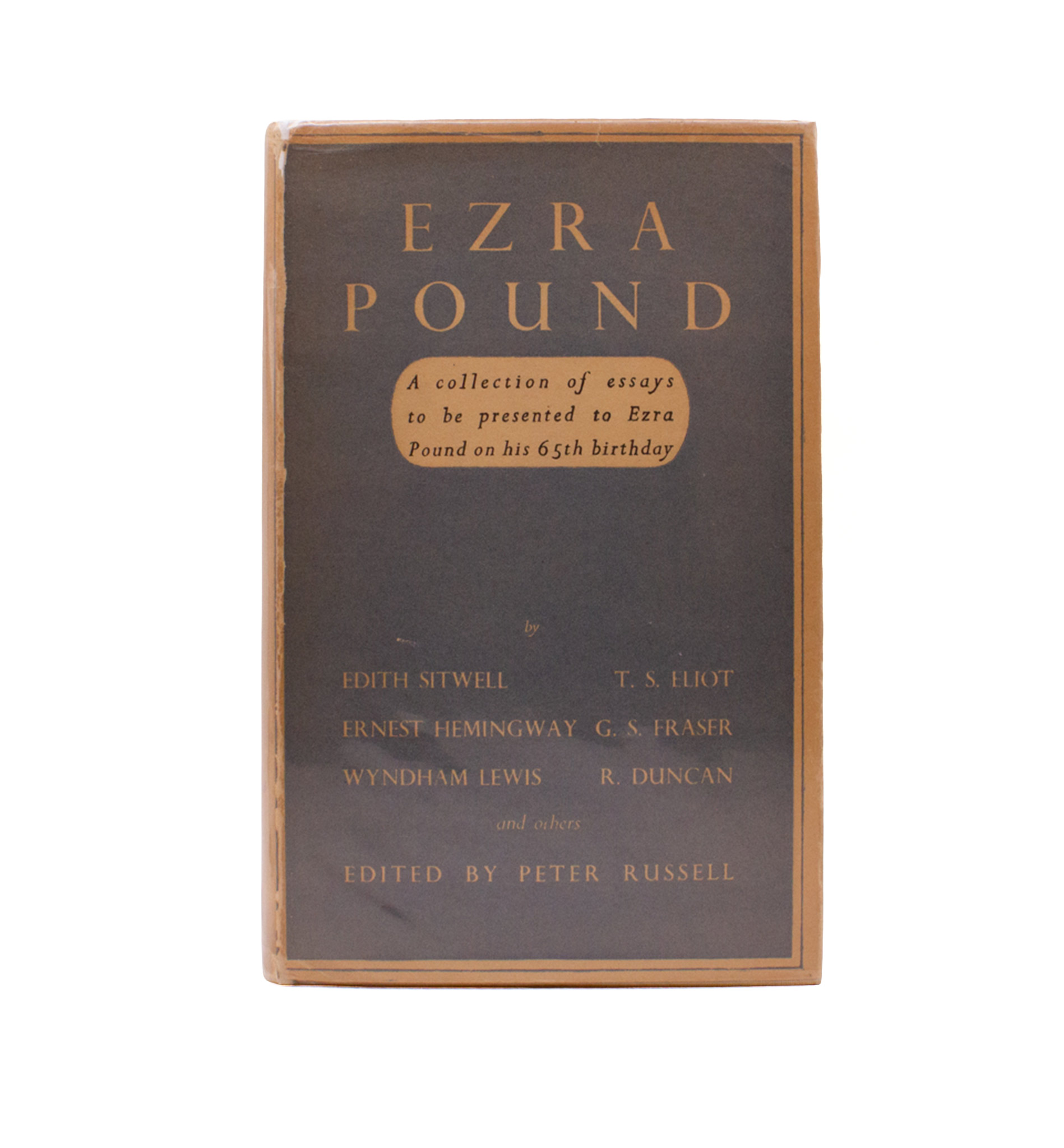
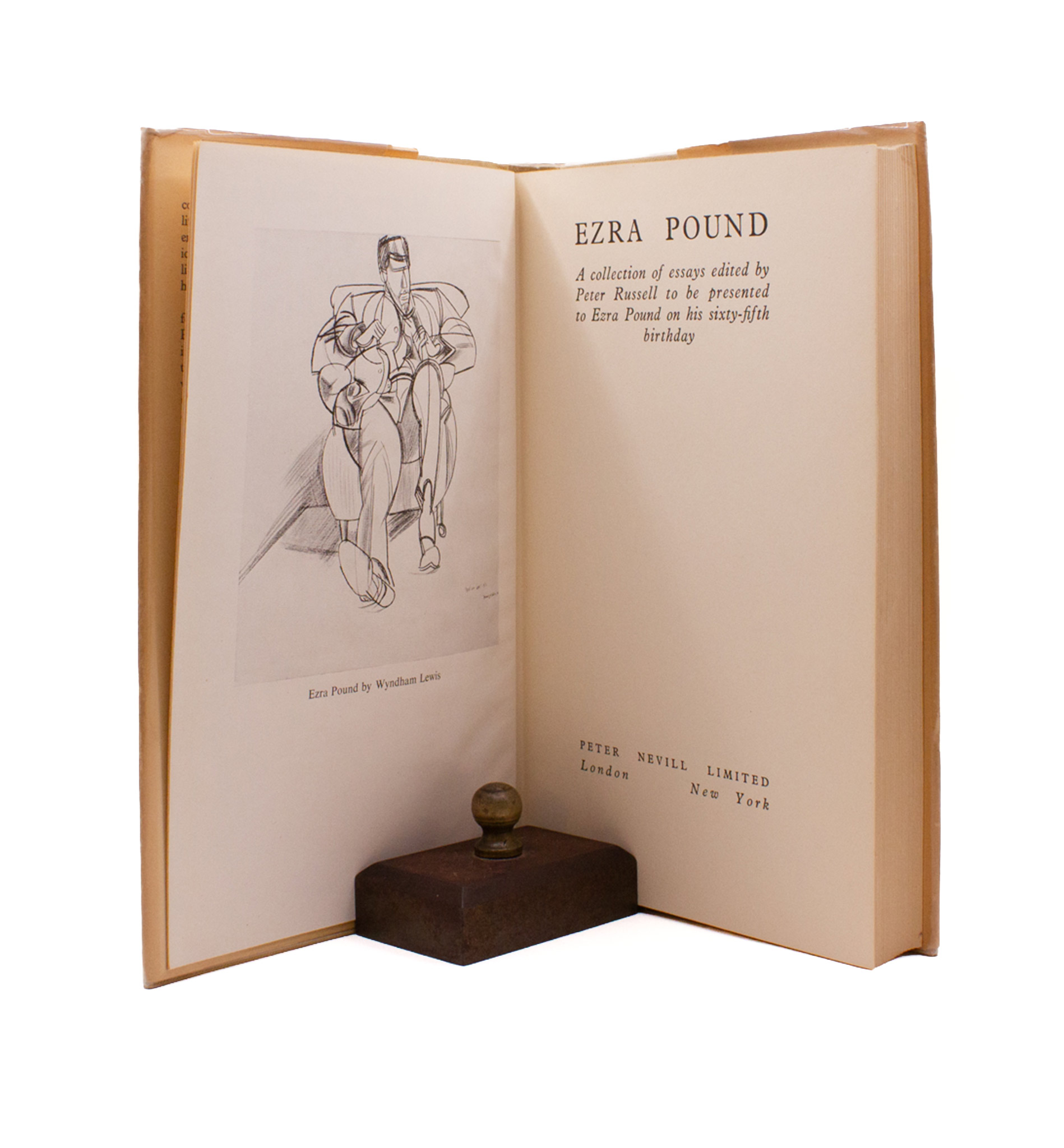
Ezra Pound: A Collection of Essays
Peter Russell, editor
T. S. Eliot, Hugh Kenner etc., contributors
Published London and New York: Peter Nevill Limited, 1950
268pp.; 22.1 x 15.6 cm. Sage green cloth printed in black on spine. Cream dust-jacket printed in blue and black.
“There are essays on Pound’s philosophy, Pound and Milton, Pound’s conception of banking and economics, the Italian background to The Cantos, Pound’s idea of style, and Pound as a letter writer and translator.”
Edited by Peter Russell, who at this same time was publishing Pound’s Money Pamphlets: in contrast to Faber, Russell was time unafraid of propounding EP’s non-literary ideas in the UK. As Russell claims, “every aspect of Pound’s energetic career and theories is covered.”The book itself is near fine, just lightly bumped at spine ends and corners. The jacket is in the main clean and straight, and well presenting. Light rubbing along the spine edges, with a little wear top and tail of the spine. A few spots to the spine, and a strange, small symbol in red ink. A dash of green to the rear cover, only lightly browned.
The complete list of contributors as follows: T. S. Eliot, Edith Sitwell, Allen Tate, Ernest Hemingway, George Seferis, Hugh Kenner, John Drummond, Charles Madge, D. S. Carnes-Ross, Ronald Duncan, Marshall McLuhan, G. S. Fraser, Henry Swabey, Hugh Gordon Porteus, Max Wykes-Joyce, Brian Soper, John Heath-Stubbs, and Wyndham Lewis.


tap to cycle
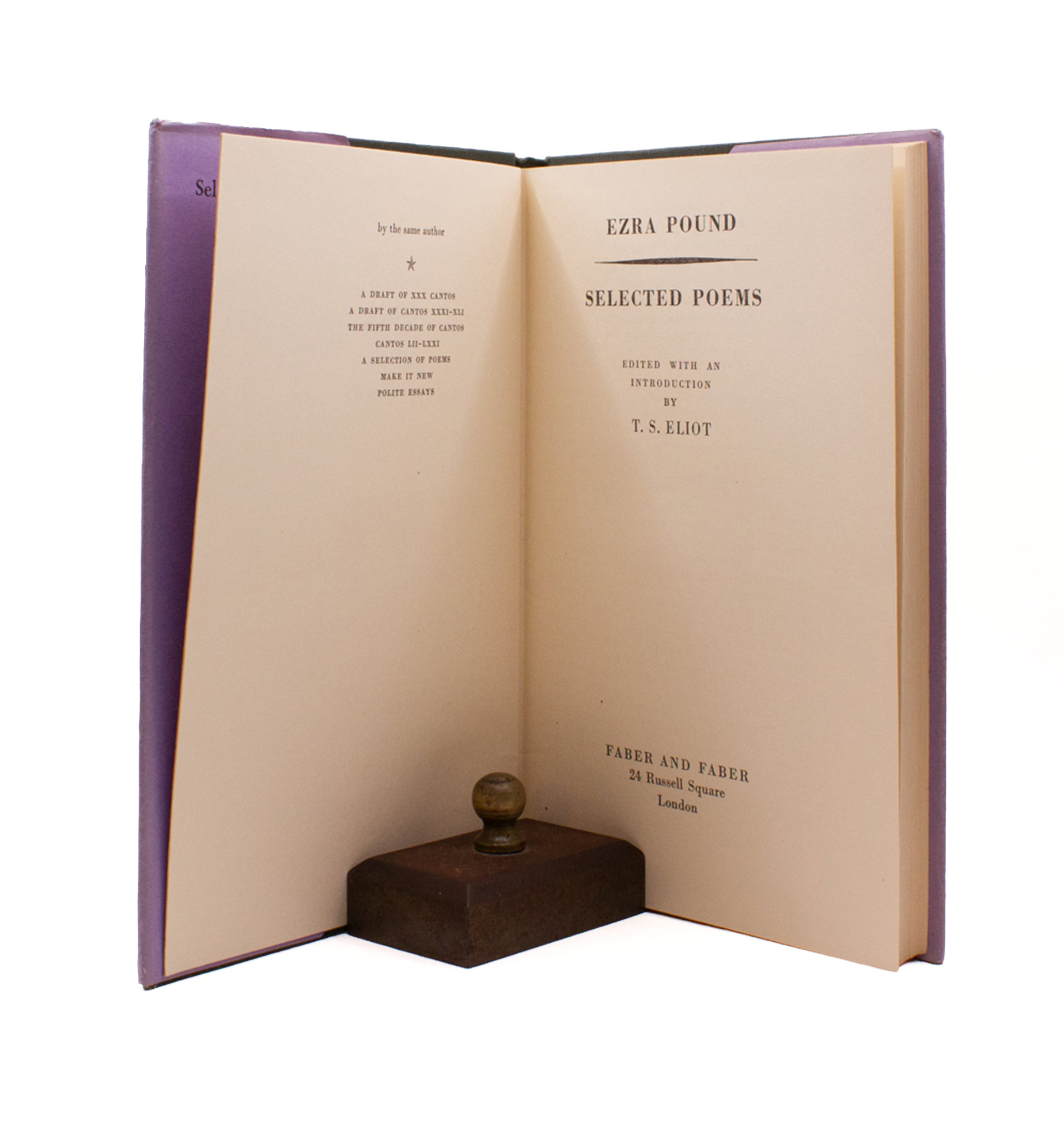
Selected Poems
Ezra Pound
T. S. Eliot, introduction
Published London: Faber and Faber, 1952
199pp.; 20.9 x 14 cm. Dark green fine grain cloth, stamped in gold to spine. Purple dust-jacket printed in black and red.
Second impression of Faber’s New Edition (1949), following the first edition of 1928 which was originally published by Faber & Gwyer; this impression not quite mentioned in Gallup. See Gallup A30b.
This copy with the ownership inscription in pencil of one “A. R. Mann” dated 1954 to fpd, their rather involved pencil annotations throughout, especially to H.S.M. A remarkably fine copy, in a beautiful, unclipped jacket.
tap to cycle
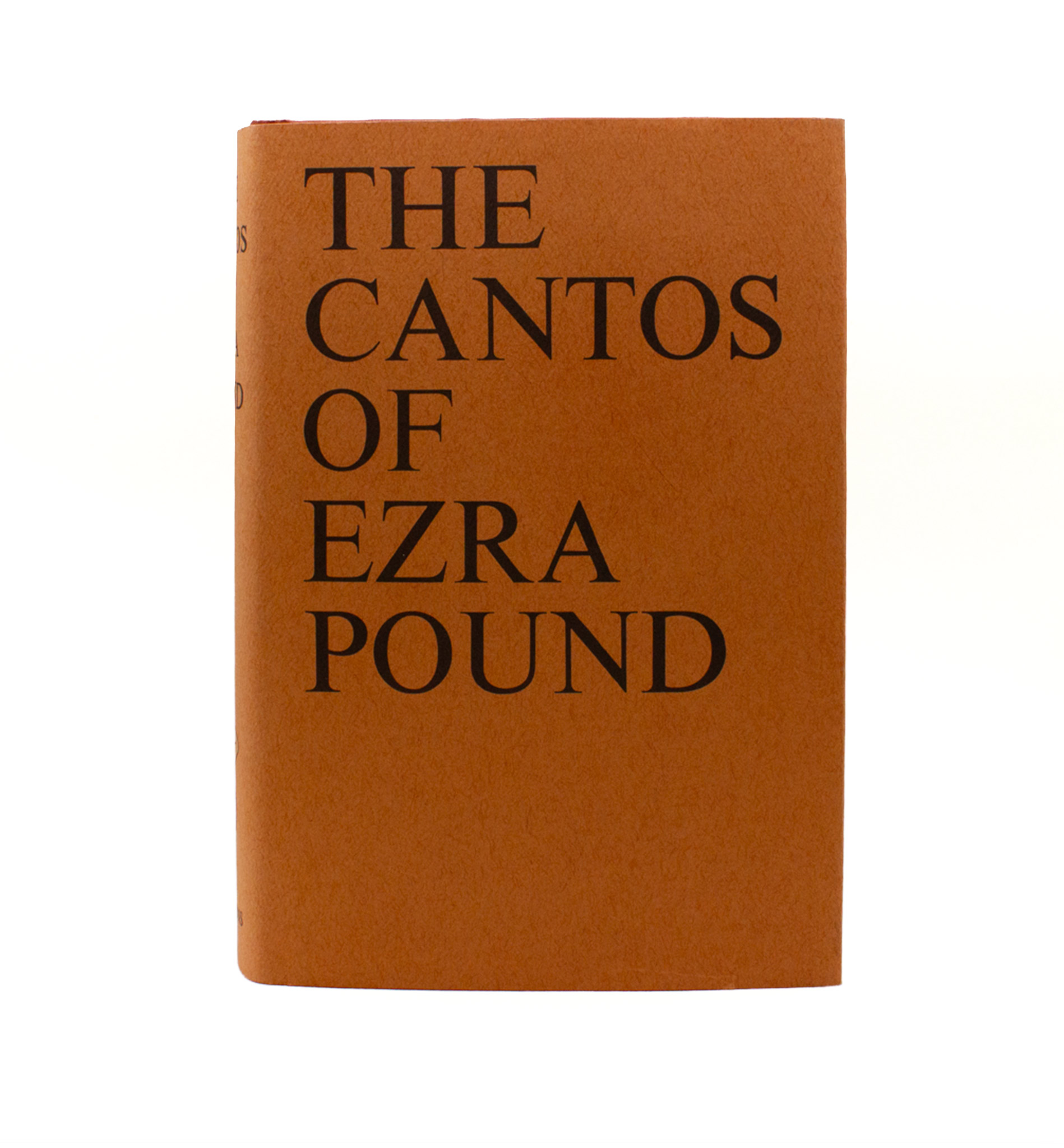
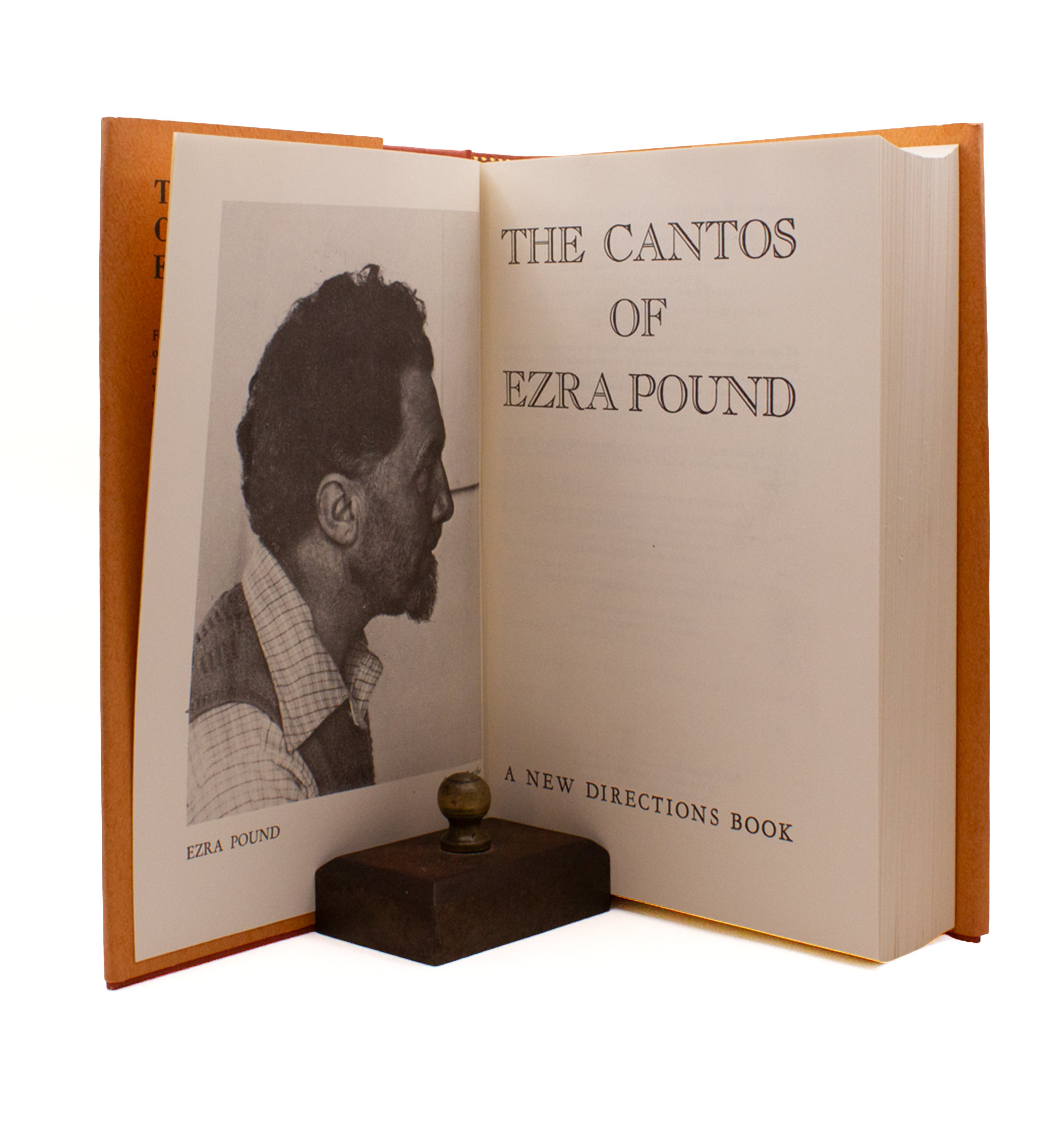
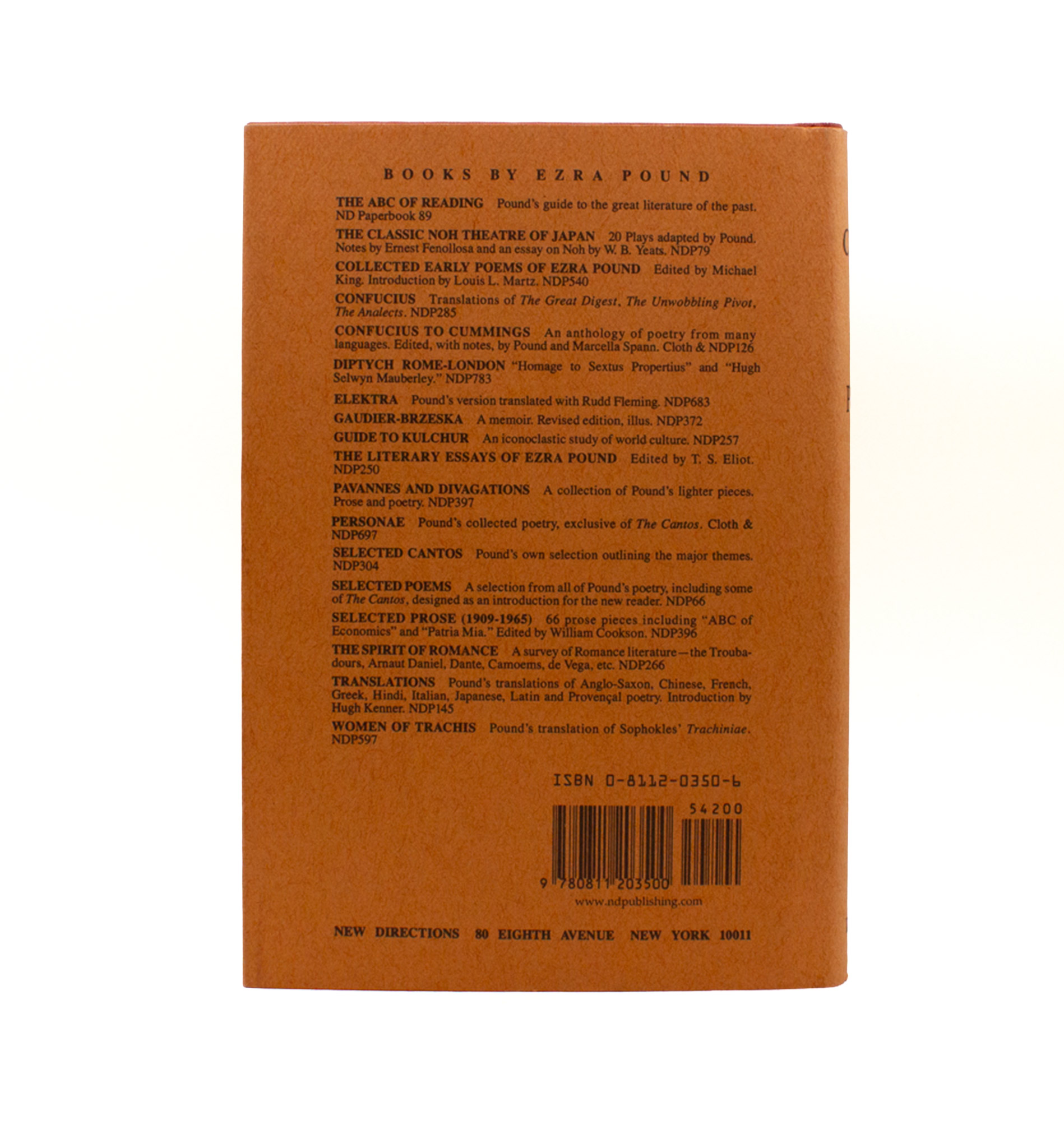
The Cantos
Ezra Pound
Published New York: New Directions, [1996]
824pp.; 21.1 x 14.5 cm. Red cloth boards lettered in black to spine. Orange dust-jacket printed in black.
Fifteenth printing. A decidedly more modern edition of The Cantos, printed on a glossier stock, probably the thinnest complete edition, with a particularly stiff jacket and the ND. Gaudier-Brzeska design printed to the spine for the first time. Contains the Italian Cantos, the Fragment, and Pound’s English translation to Italian Canto 72 first introduced in the thirteenth printing. Fine.

tap to cycle
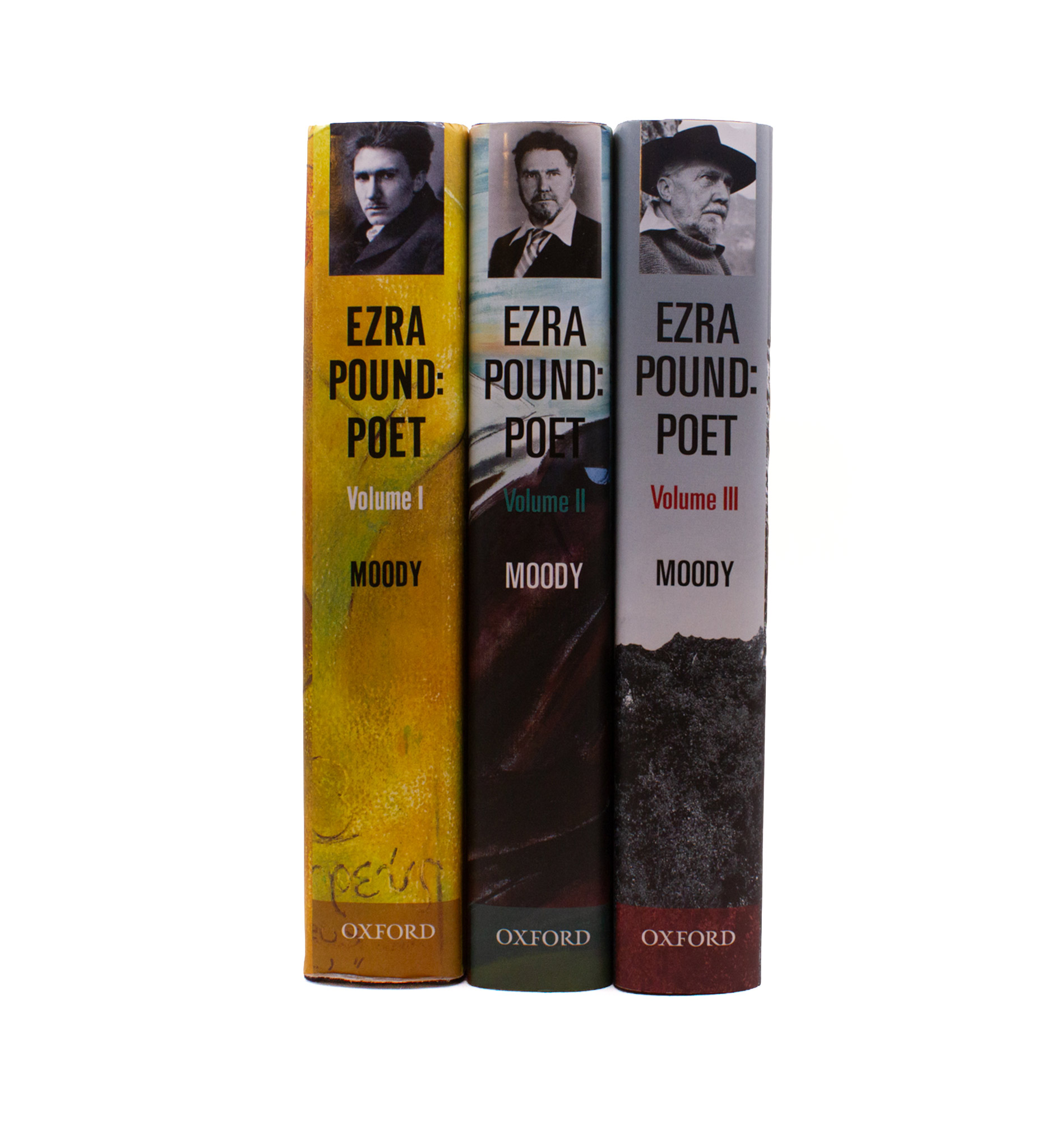
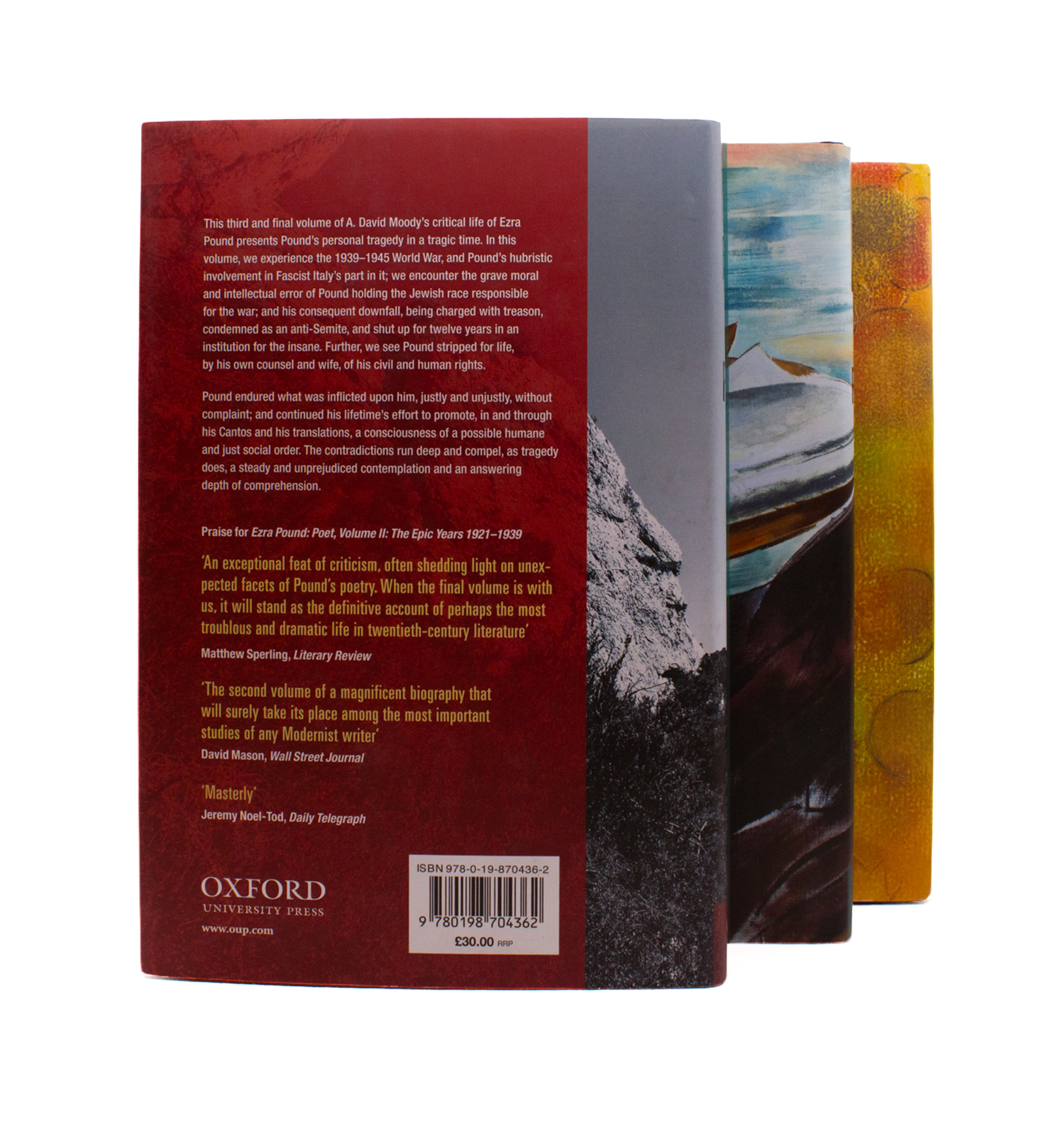
Ezra Pound: Poet; a complete set
A. David Moody
Published Oxford University Press, 2007-2015
3 vols.; 24.1 x 16 cm each. Black paper covered boards lettered in gold on spine, with illustrated dust-jackets.
A complete set of Professor A. David Moody’s Pound biography, the standard, and a must have. All first, hardcover editions. A very near fine set.

tap to cycle
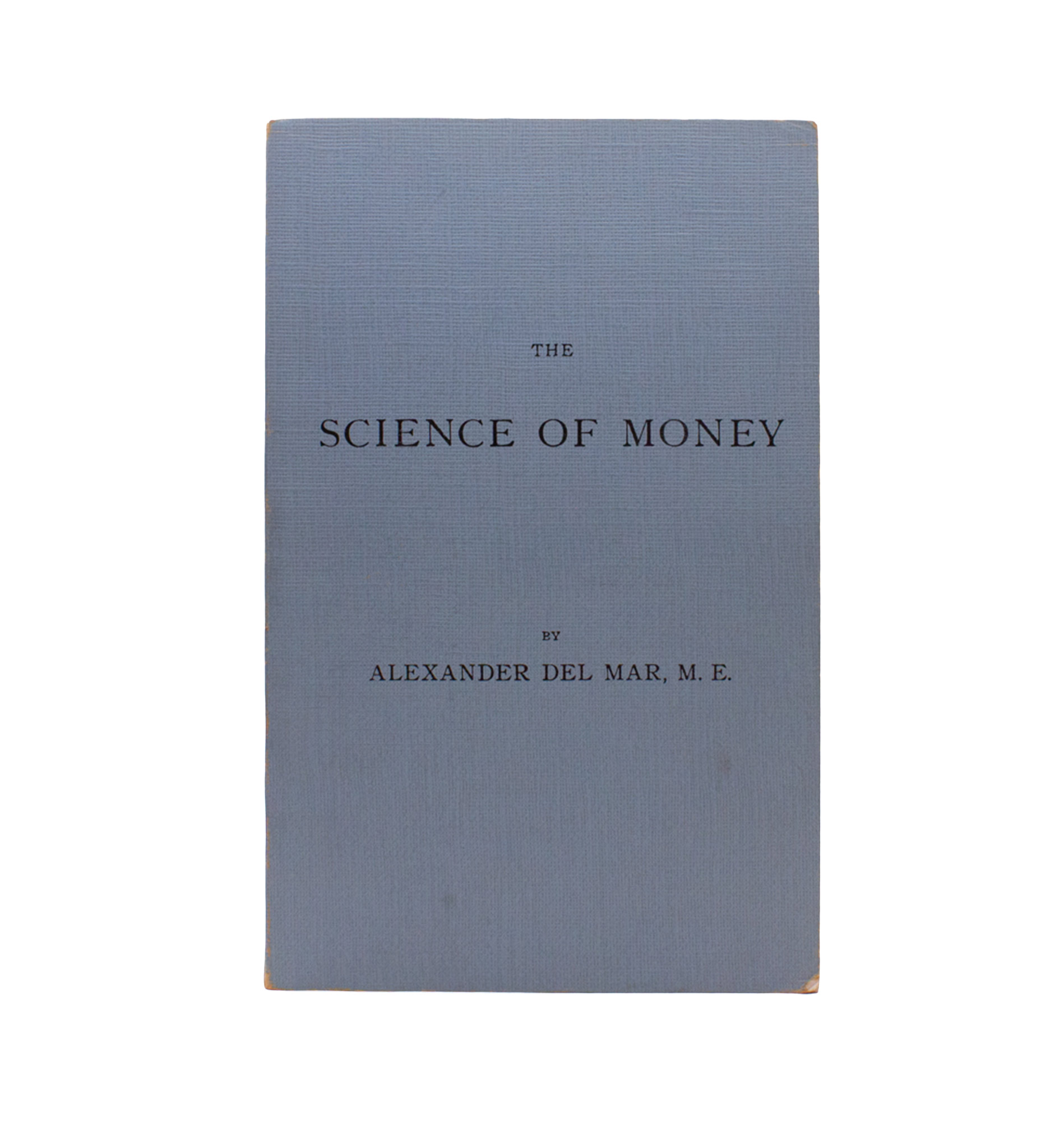
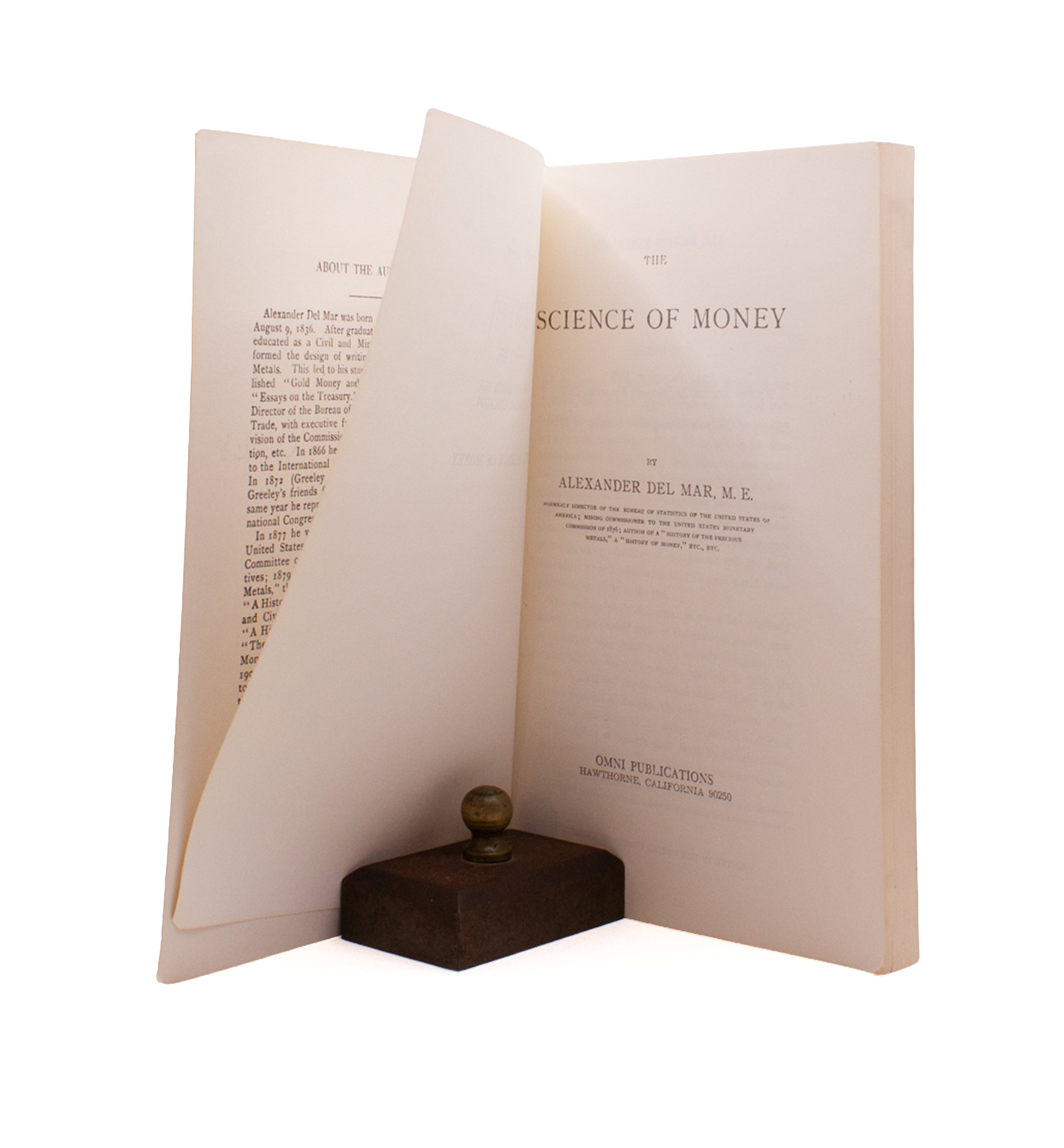
The Science of Money
Alexander del Mar
Published California: Omni Publications, 1967
205pp.; 21.6 x 13.7 cm. Pale blue paper wraps printed in black.
One of political economist Alexander del Mar’s books on the history of money and monetary policy, an addition to the two books of del Mar’s published under Pound’s editorship by the Square $ Series, published here by the spiritual successor to the Square $ Series, Omni Publications. A uncommon edition. This copy in particular with the ink annotation “From Wm Hable” and a stamp, “RECEIVED Jan 23 1976 / The Foundation For Economic Education” to half-title. Light wear to wraps. Slightly messy marginal scores on very few pages.
tap to cycle
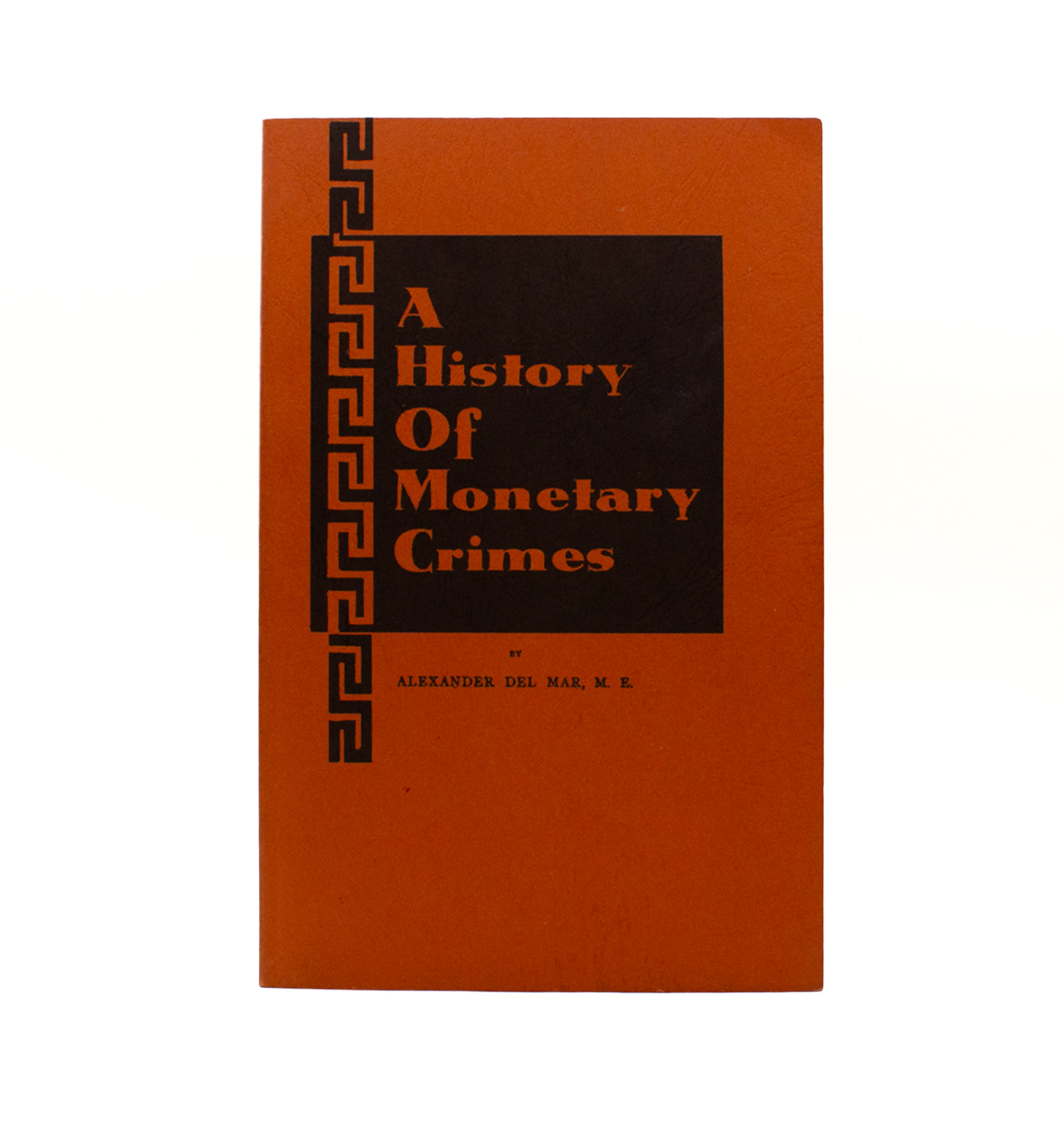
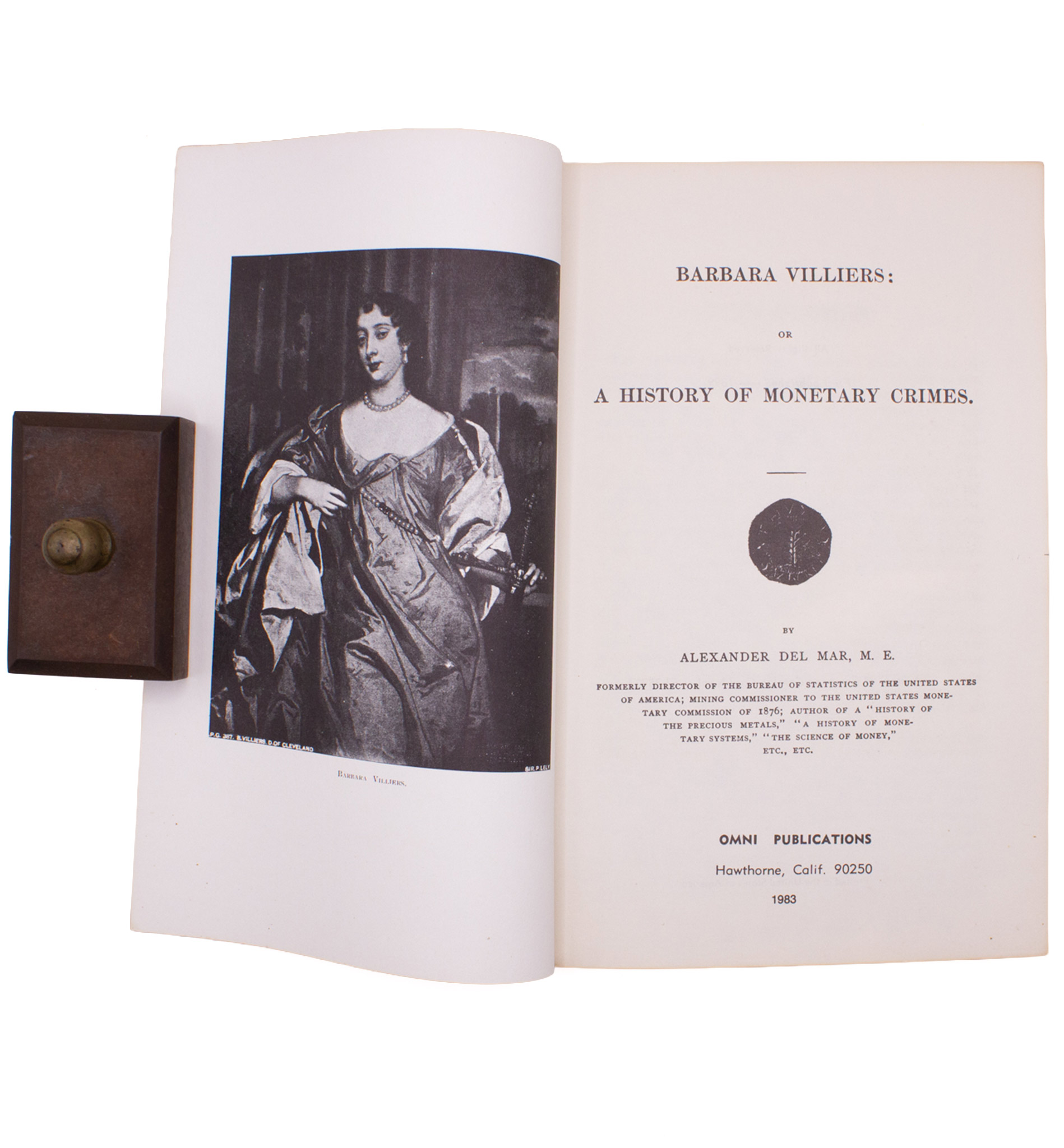
Barbara Villiers, or A History of Monetary Crimes
Alexander del Mar
Published California: Omni Publications, 1983
101pp.; 21.6 x 14 cm. Orange paper wrappers printed in black.
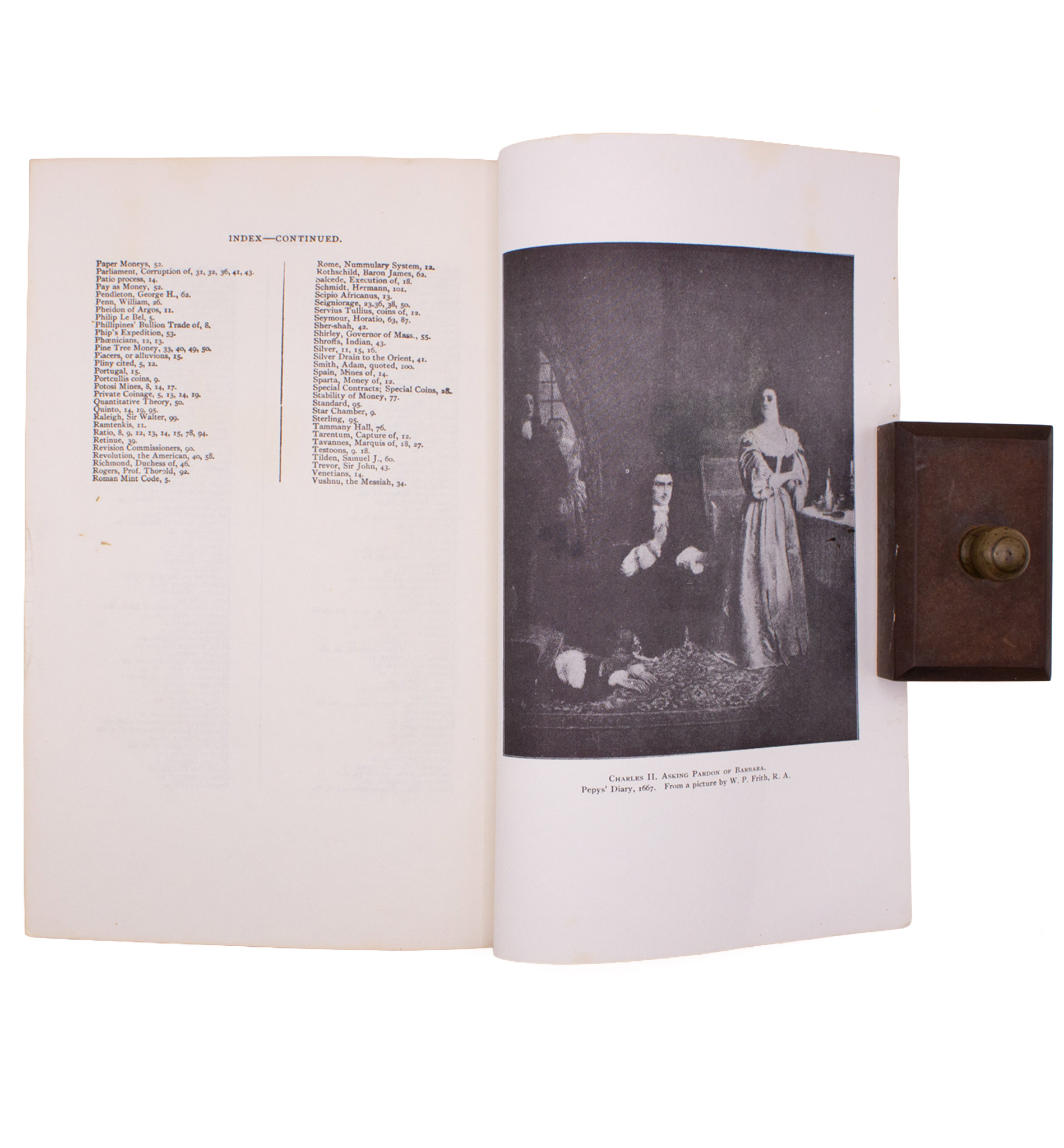
An Omni reprint of one of the del Mar titles Pound included in the Square $ Series, published by the lively duo Kasper & Horton. Tells of the acquisition of the right to mint coin by the East India Company, and all the benefits afforded Barbara Villiers, by Charles II; with an amusing illustration of “Charles II. asking pardon of Barbara” to rear. Some light marks to the covers and a bump to the fore-edge for a few pages around p. 80.
tap to cycle
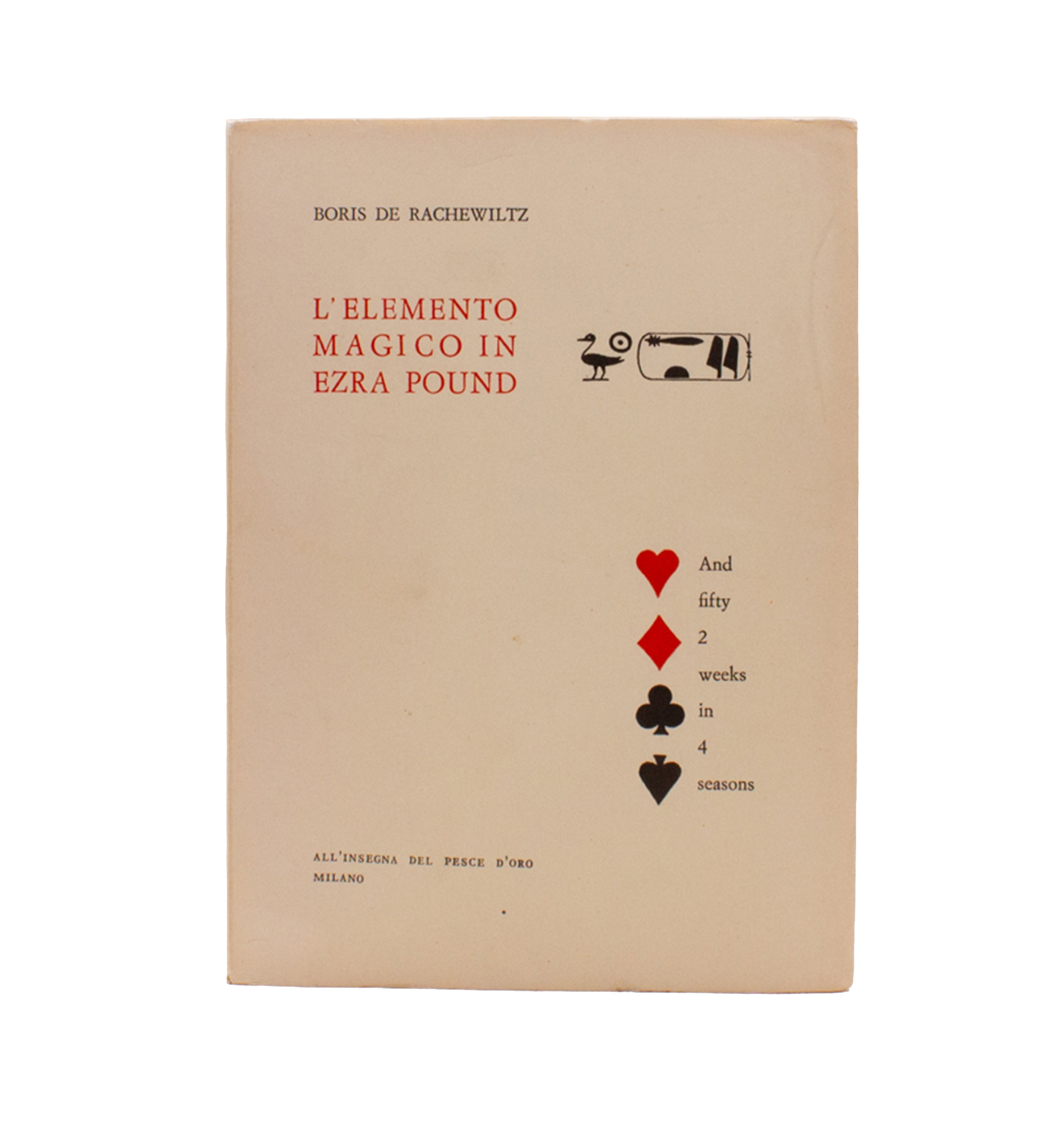
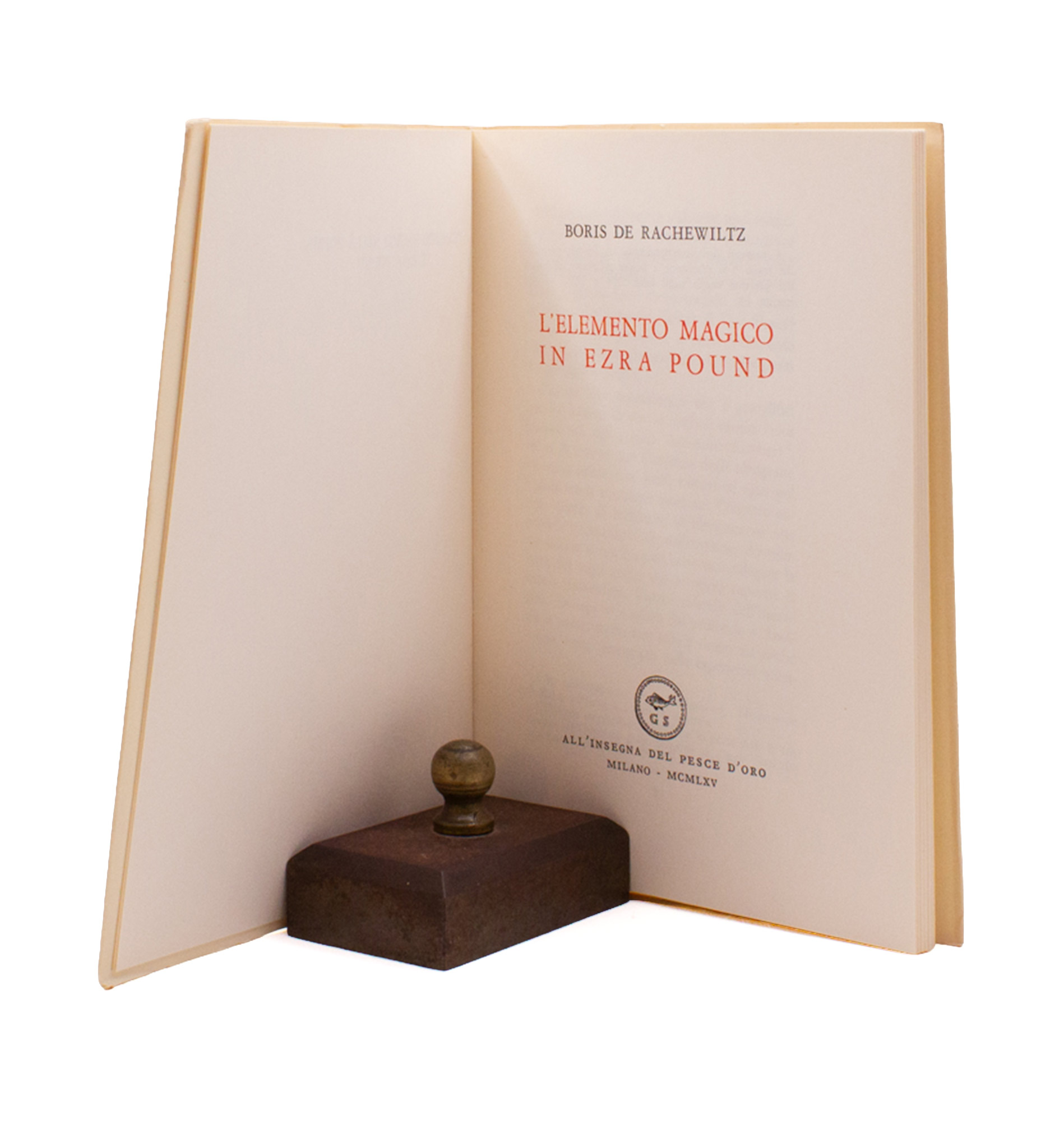
L’Elemento Magico in Ezra Pound
Boris de Rachewiltz
Published Milan: All’Insegna del Pesce d’Oro, 1965
85pp.; 17.9 x 13 cm. Cream oversized paper wrappers printed in red and black.
Always a great essay by EP’s son-in-law, the Egyptologist Boris de Rachewiltz, who spent long hours walking and talking with Pound after his return from St. Elizabeths. de Rachewiltz’s interest in Egypt rubbed off on Pound, and much of it found its place in The Cantos, leaving de R. thus in a unique position to examine them.
In Italian. One of 1000 copies, this number 652. Light scratches and a couple of marks to the covers, but overall quite nice. With the oft-found bookseller’s price sticker, “L. 1.200” to the rear flap.
tap to cycle
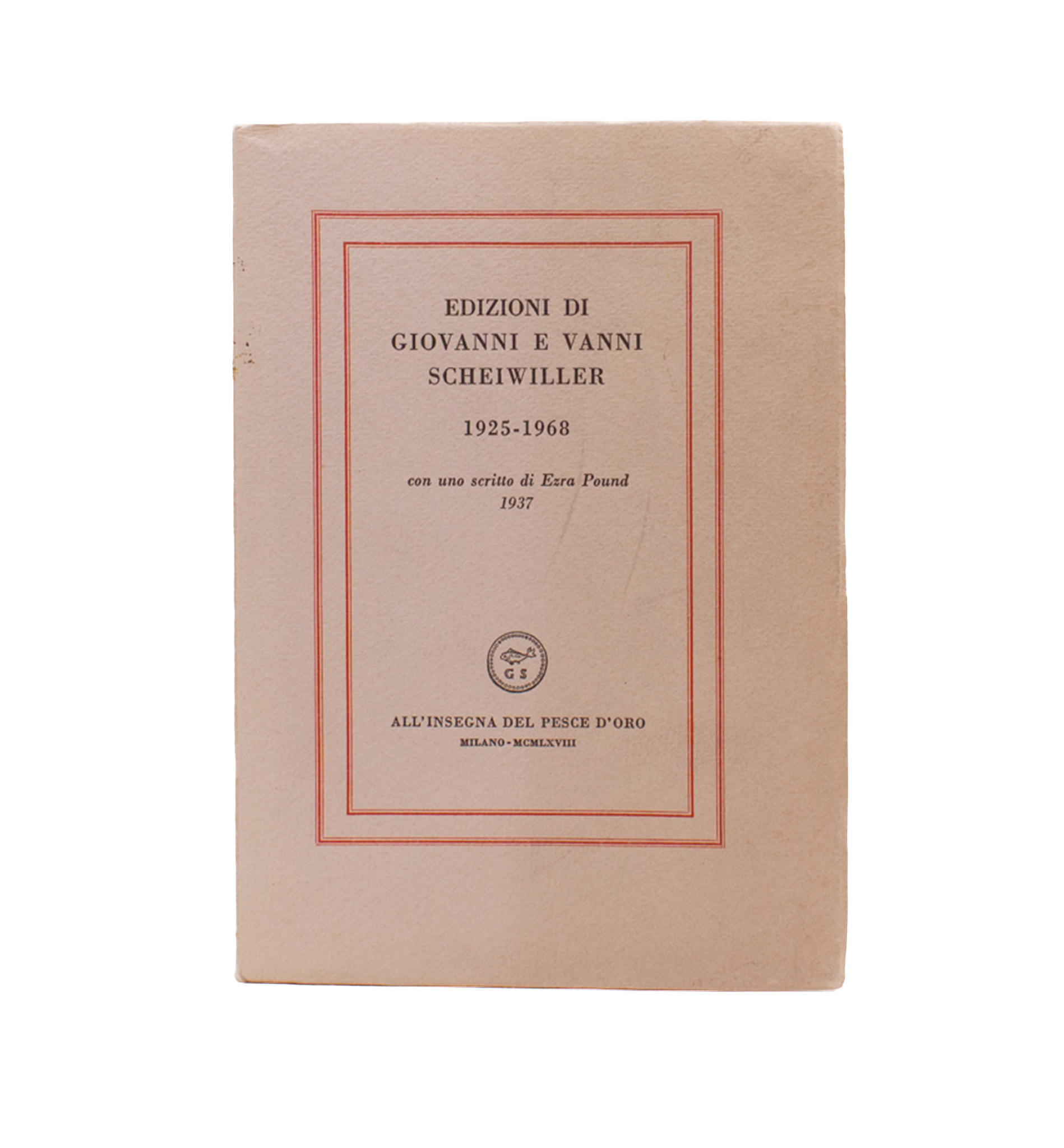
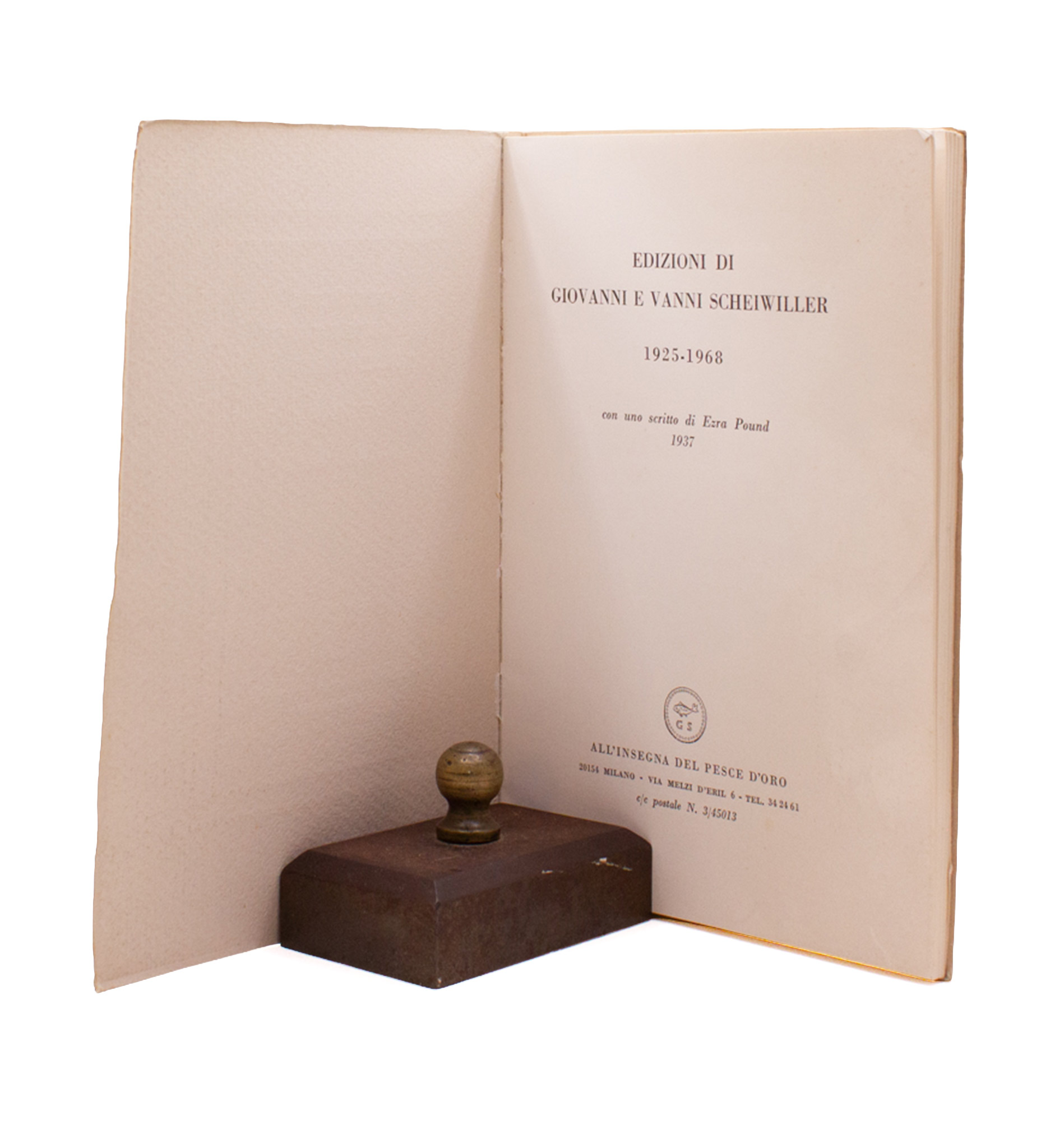
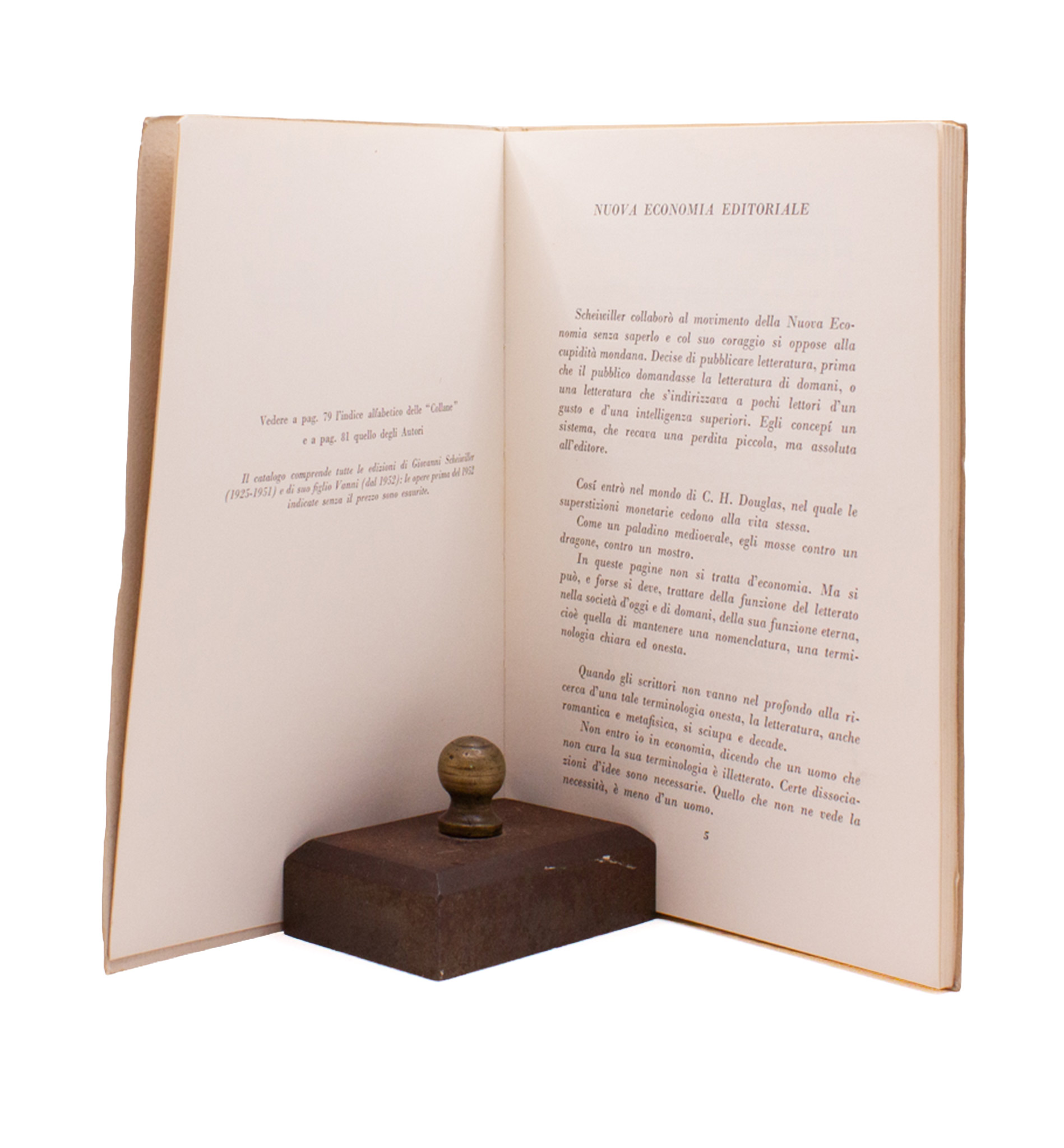
Edizioni di Giovanni e Vanni Scheiwiller, 1925-1968
Ezra Pound, contributor
Published Milan: All’Insegna del Pesce d’Oro, 1967
88pp.; 17.2 x 12.2 cm. Grey paper wraps printed in red and black to front, back, and up spine.
A catalogue of Scheiwiller editions from 1925-1968, with a brilliant essay by Pound praising Vanni Scheiwiller dated 1937. With the price-list of Litografie di Giuseppe Viviani laid-in towards the rear, as desired. A very good copy, some light marks to the covers but overall clean and straight.
tap to cycle
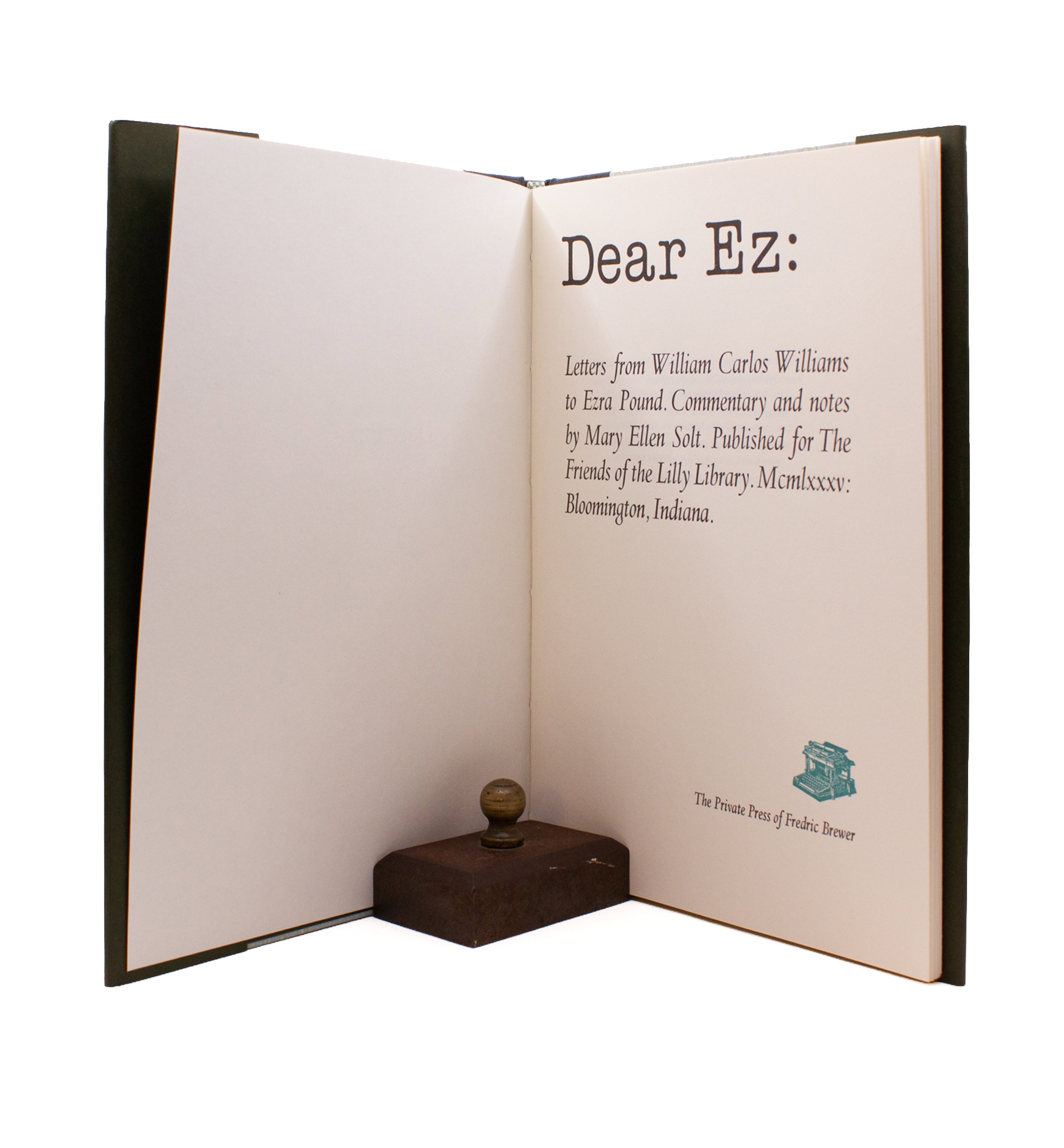
Dear Ez: Letters from William Carlos Williams to Ezra Pound
Mary Ellen Solt, editor
Published Bloomington, Indiana: The Private Press of Frederic Brewer for The Friends of the Lilly Library, 1985
54pp. in two sections; 23.5 x 17.2 cm. Linen backed, marbled-paper covered boards, stamped in green down the spine. A dark green dust-jacket printed in dull-silver to front and down spine; the same used for endpapers.
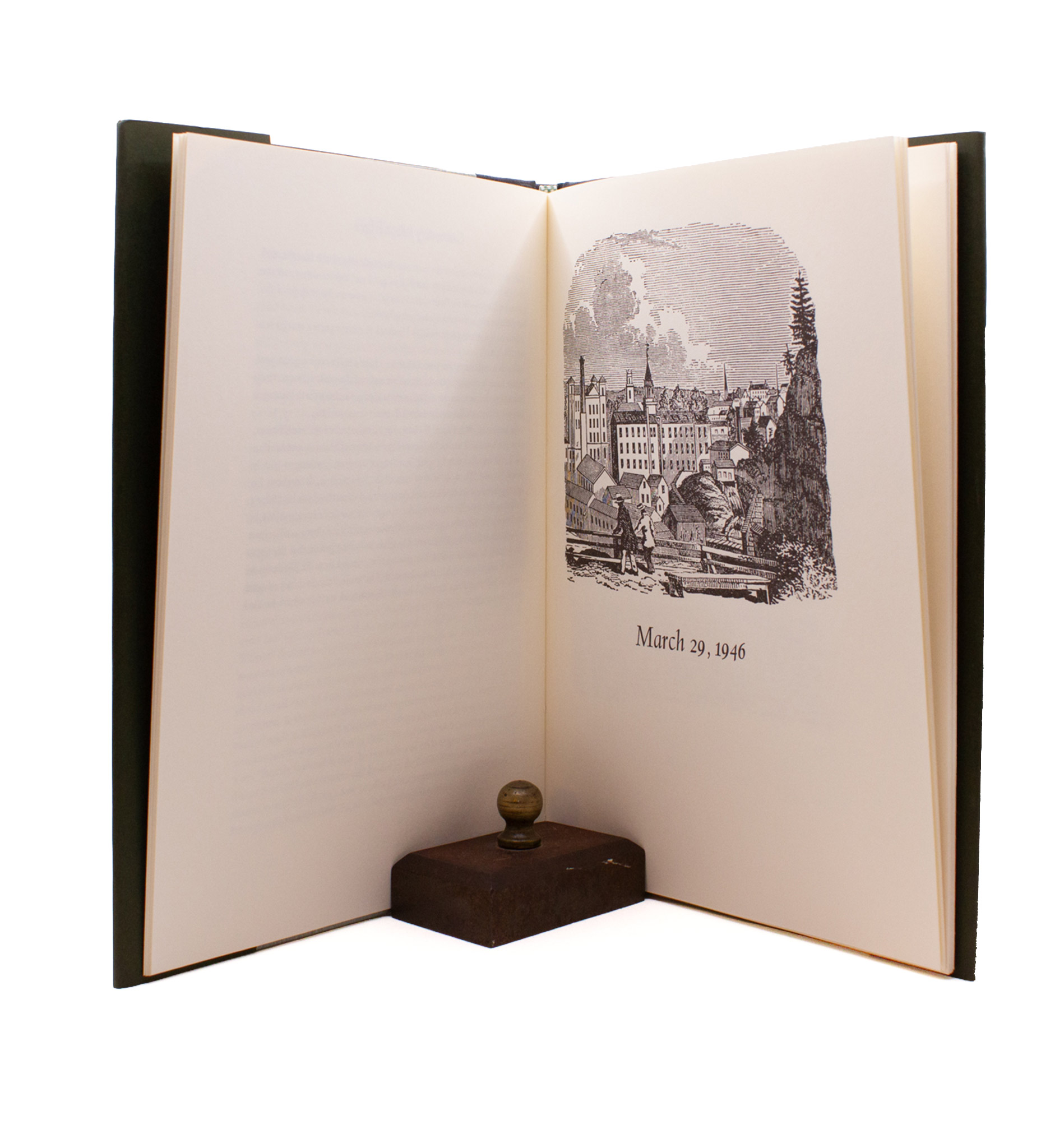
Seven letters from WCW. to EP, dating from 1946 to 1951, a time at which their friendship reached its fullest maturity. With a commentary and brief editorial notes by M. E. Solt. A pleasing private press production, each letter preceded by a woodblock of two men overlooking the town of Patterson.
An amusing colophon reading in part, “The press: a hand-cranked Vandercook SP-15 that provided the proprietor with hundreds of hours of quirky bedevilment… The proprietor, faced with few upper case Ws, is thankful that the poet was not named William William Williams.”
One of 203 copies, this numbered 83. Fine in like jacket, flawed only by a light crease appearing above the gutters.