de Beaumont Rares
debeaumontrares@gmail.com

Contemporaries, I
Books from the poets of London and Paris who shared, or struggled to share, the scene.
11 January 26
tap to cycle
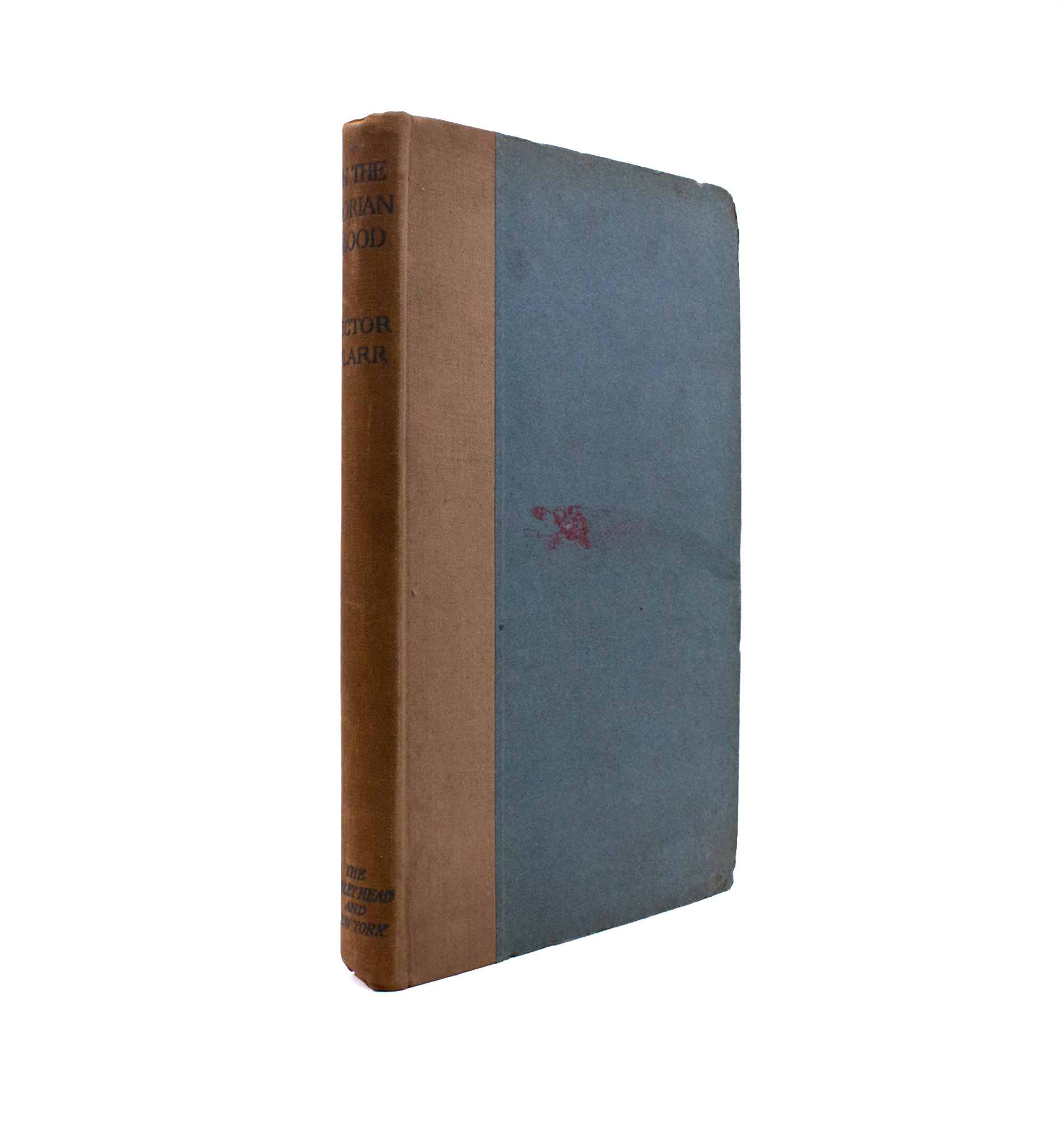
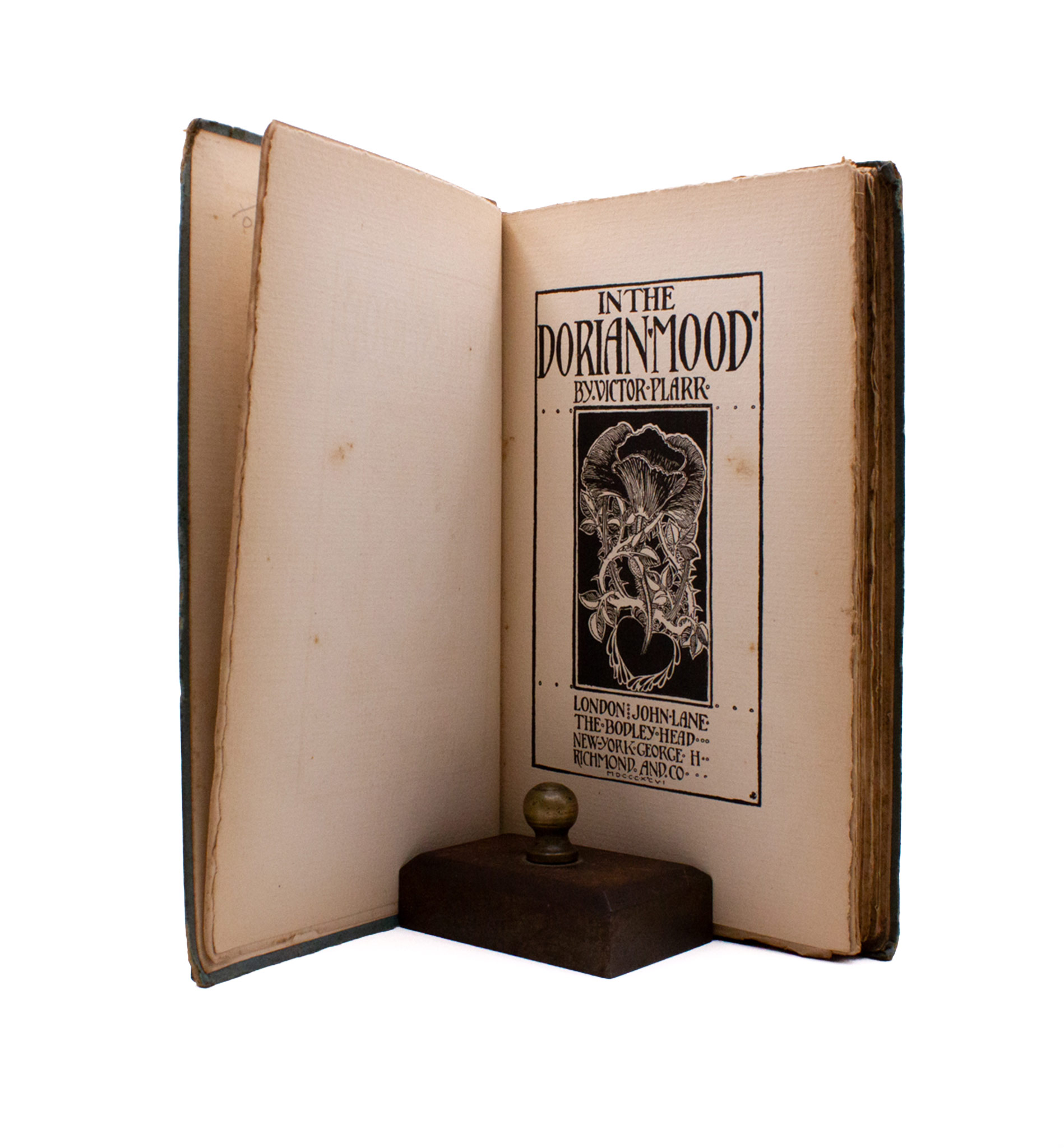
In The Dorian Mood
Victor Plarr
Published London: John Lane, The Bodley Head, 1896
111pp.; 20 x 12.8 cm. Blue paper covered, linen black boards, lettered in blue on spine.
From the library of A. David Moody
“SIENA MI FE, DISFECEMI MAREMMA”
Among the pickled foetuses and bottled bones,
Engaged in perfecting the catalogue,
I found the last scion of the
Senatorial families of Strasbourg, Monsieur Verog.
For two hours he talked of Gallifet;
Of Downson; of the Rhymers’ Club;
Told me how Johnson (Lionel) died
By falling from a high stool in a pub …
But showed no trace of alcohol
At the autopsy, privately performed—
Tissue preserved—the pure mind
Arose toward Newman as the whiskey warmed.
Dowson found harlots cheaper than hotels;
Headlam for uplift; Image impartially imbued
With raptures for Bacchus, Terpsichore and the Church.
So spoke the author of “The Dorian Mood,”
M. Verog, out of step with the decade,
Detached from his contemporaries,
Neglected by the young,
Because of these reveries.
Monsieur Verog’s first book of verse, and in other faculties librarian at King’s College (1890-1896) and the Royal College of Surgeons of England (1897-1929) where he wrote the biographies of 300 Fellows of the Royal College of Surgeons. Plarr was a founding member of The Rhymers’ Club which had passed into legend by the time Pound arrived in London.
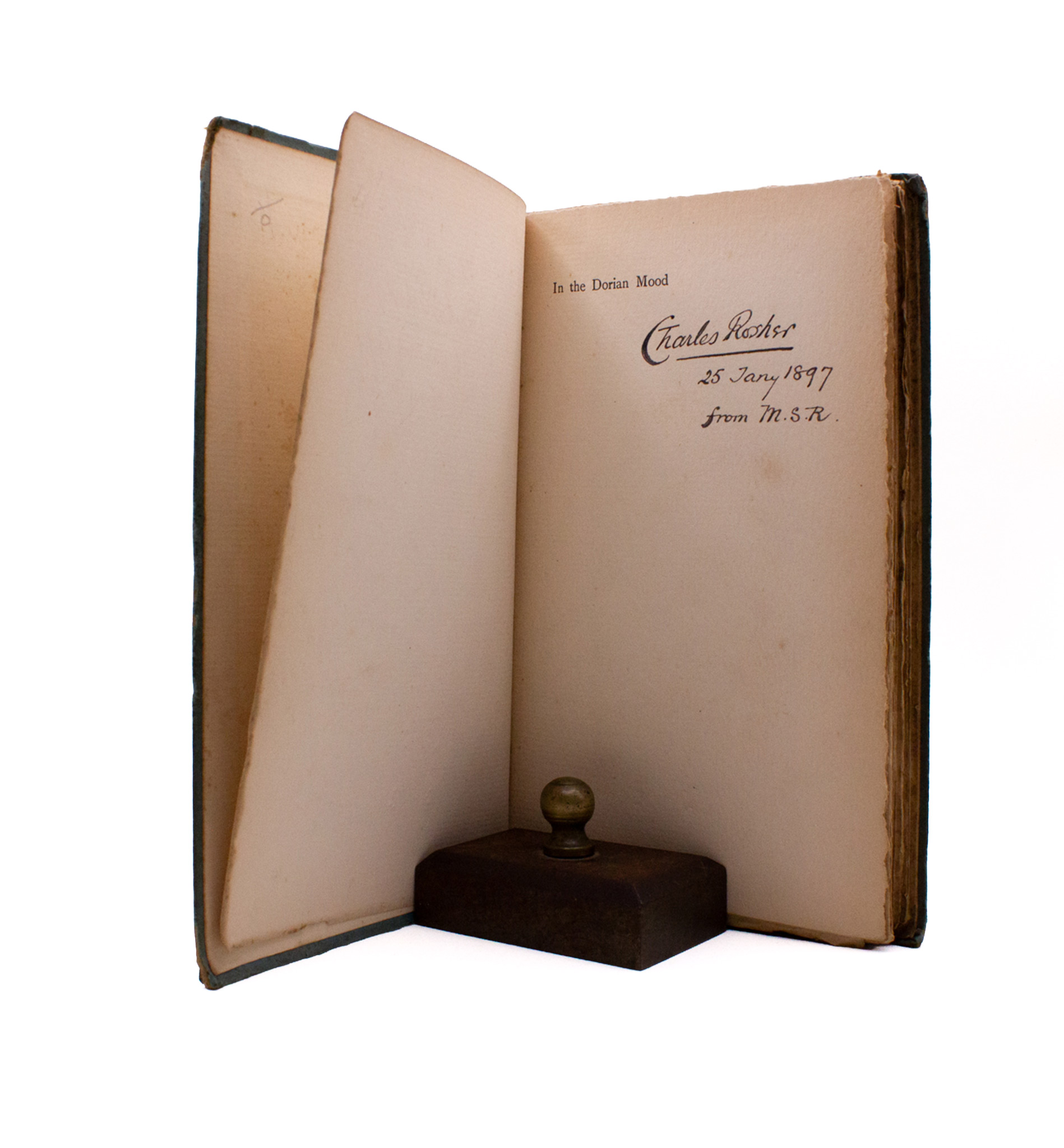
First edition, with a contemporary ink gift inscription to half-title, “Charles Rosher / 25 Jan[uar]y 1897 / from M.S.R.” and with a further ownership inscription to rpd, “Charles Rosher / 6.3.27.” Charles Henry Rosher (1858-1936) was a poet and occultist, and “Magus of Fire” in the Rosicrucian Hermetic Order of the Golden Dawn whose members included Florence Farr, Maud Gonne, and William Butler Yeats.
Light shelf-wear and splitting of the paper over the bumped corners; a red (wax?) stain to front cover; light spotting to endpapers and pastedowns, otherwise fine throughout. With a small laid-in note from A. David Moody reading, “cf. ‘M. Verog’ in ‘H. S. Mauberley.’”
tap to cycle
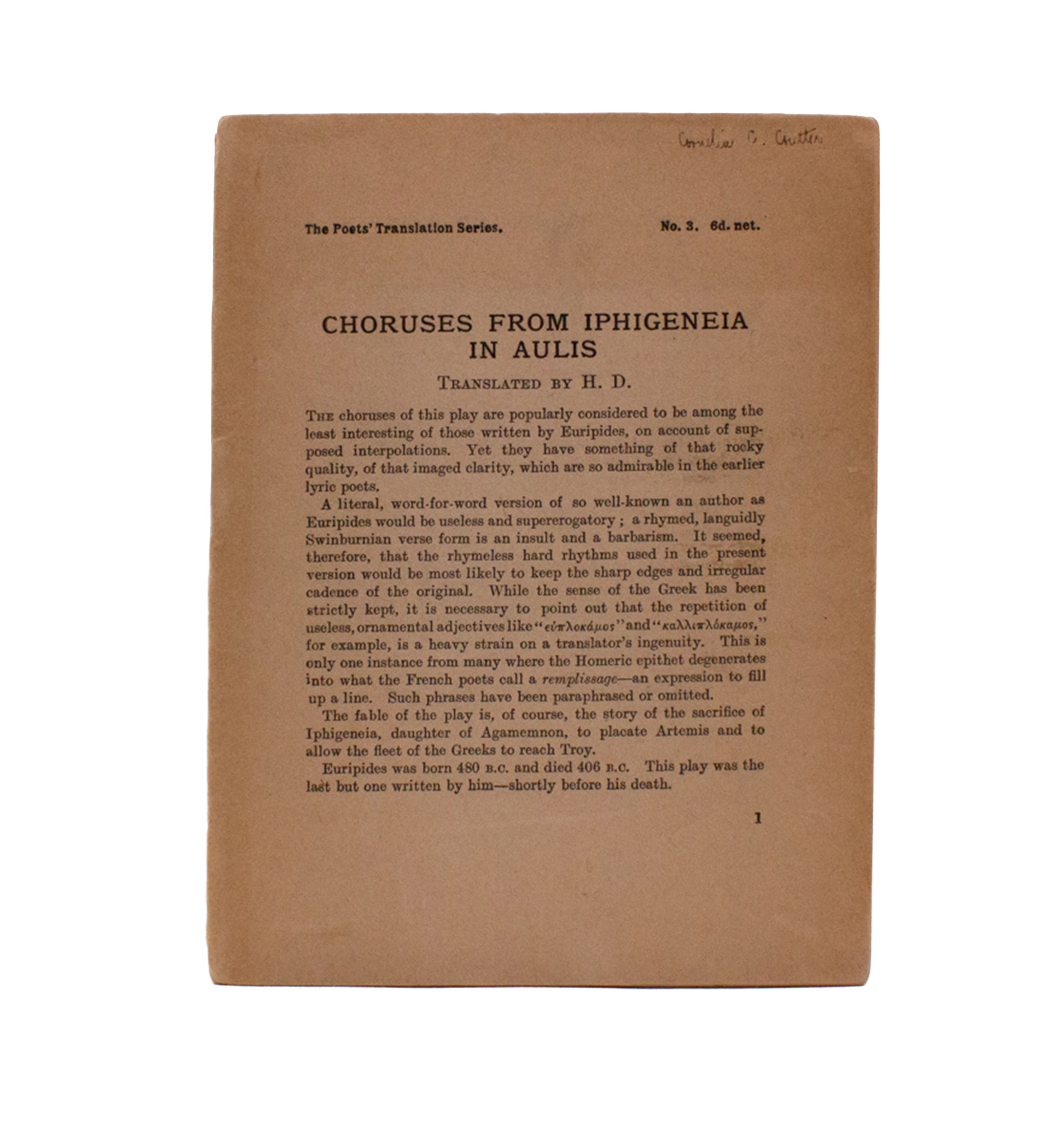
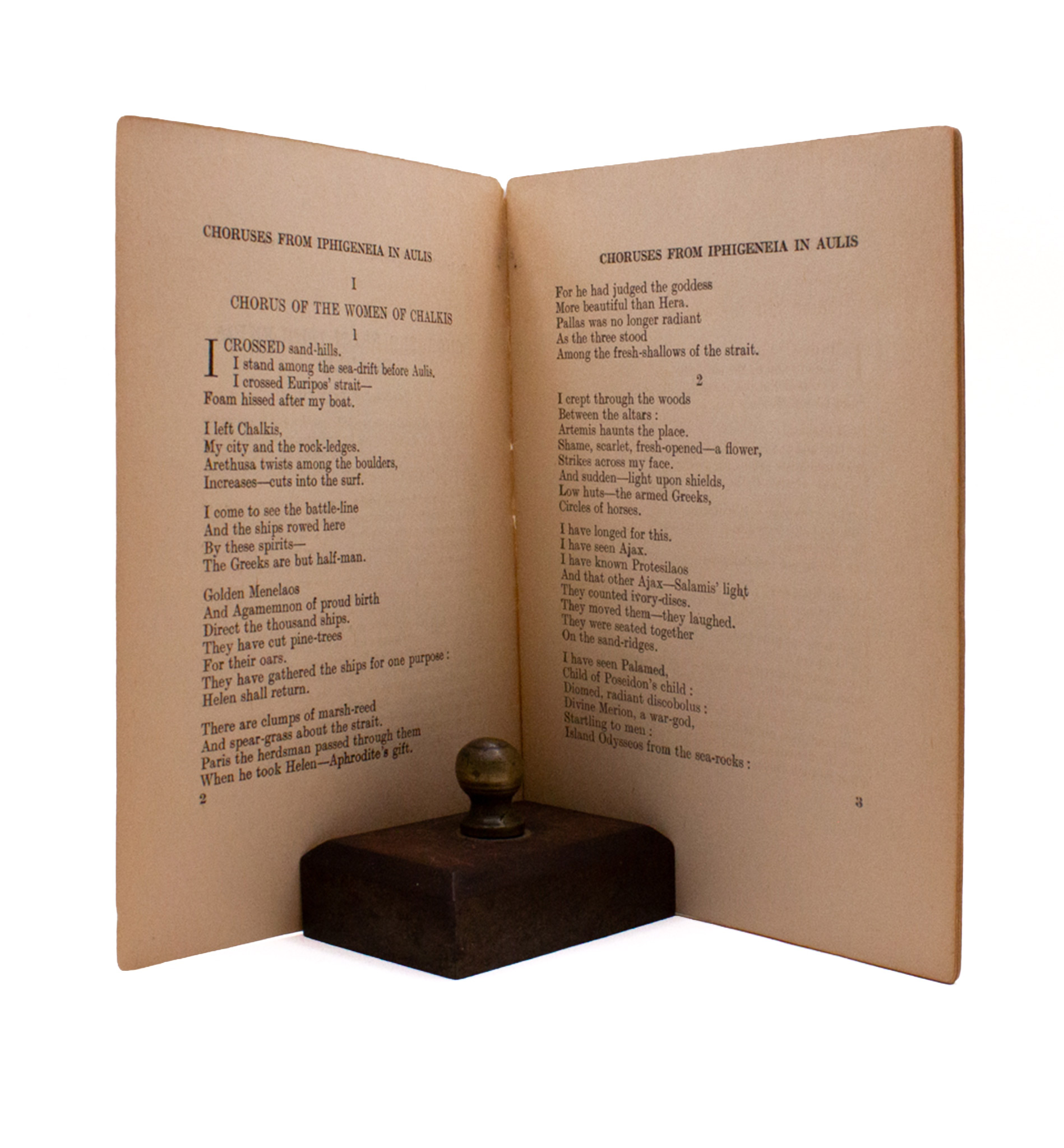
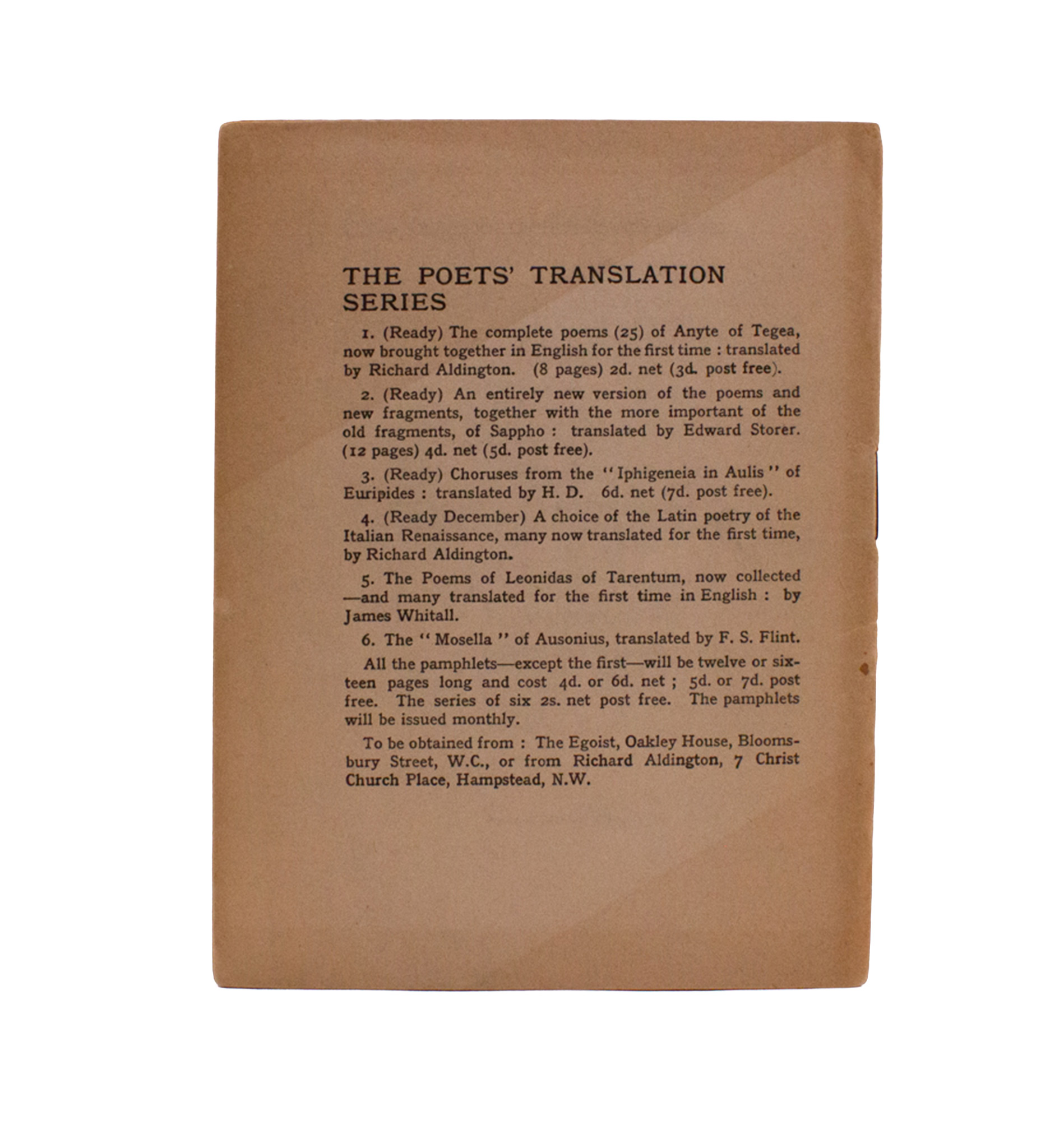
Choruses from Iphigeneia in Aulis
H.D.
Published London: The Egoist, [1916]
20pp., including covers; 16.3 x 12.4 cm. Cream wove paper printed in black; a single staple.
H.D.’s first solo publication, her translation of the Homeric sequence of Iphigeneia’s sacrifice, which first appeared in the Egoist the previous year. Number 3 of The Poets’ Translation Series. Very neat ink ownership of “Cornelia G. Crutter(?)” to upper right of front page. First and last pages split up to staple; last page (i.e. back cover) partly sunned, otherwise a fine copy. Boughn A1a.
tap to cycle
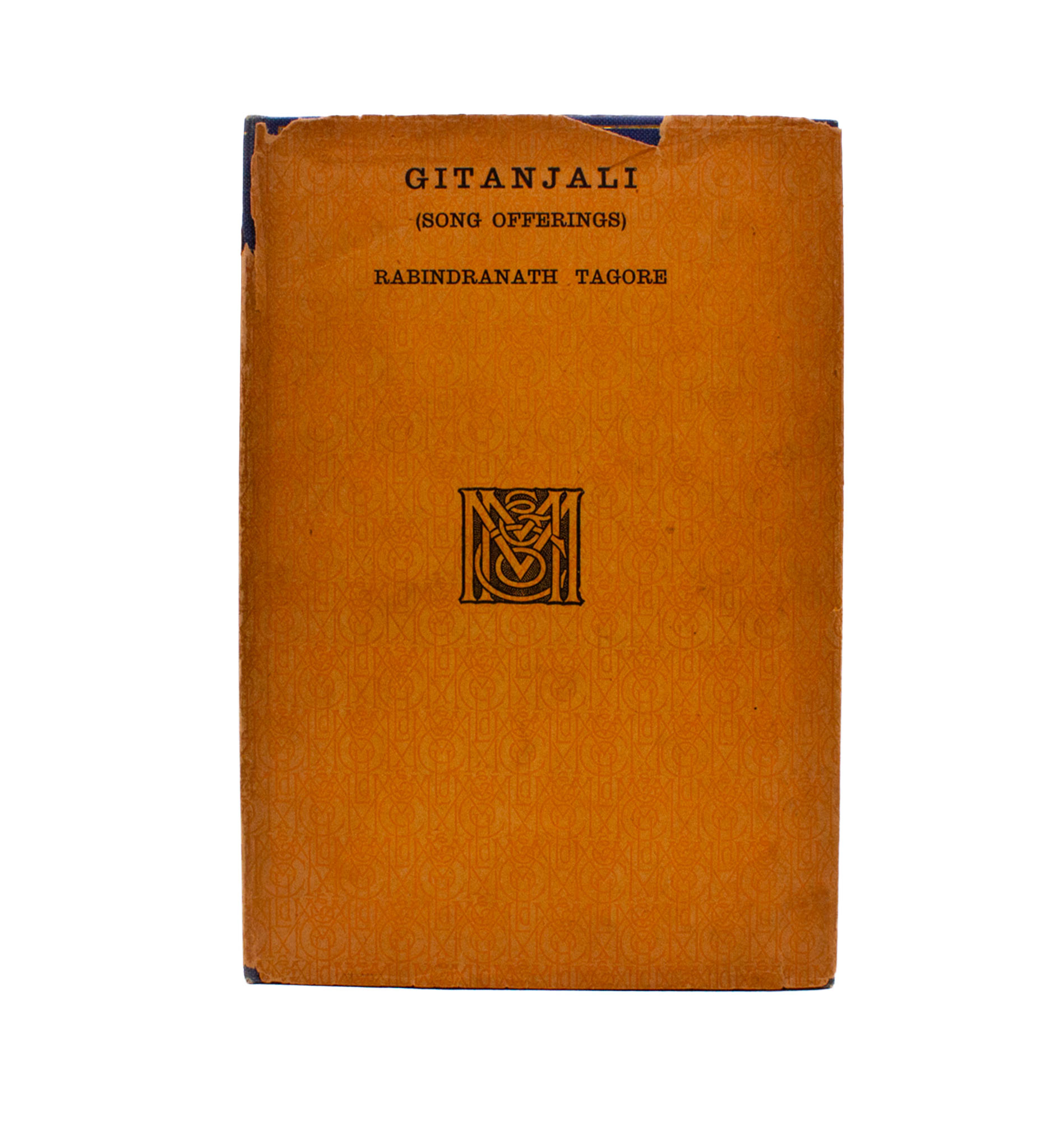
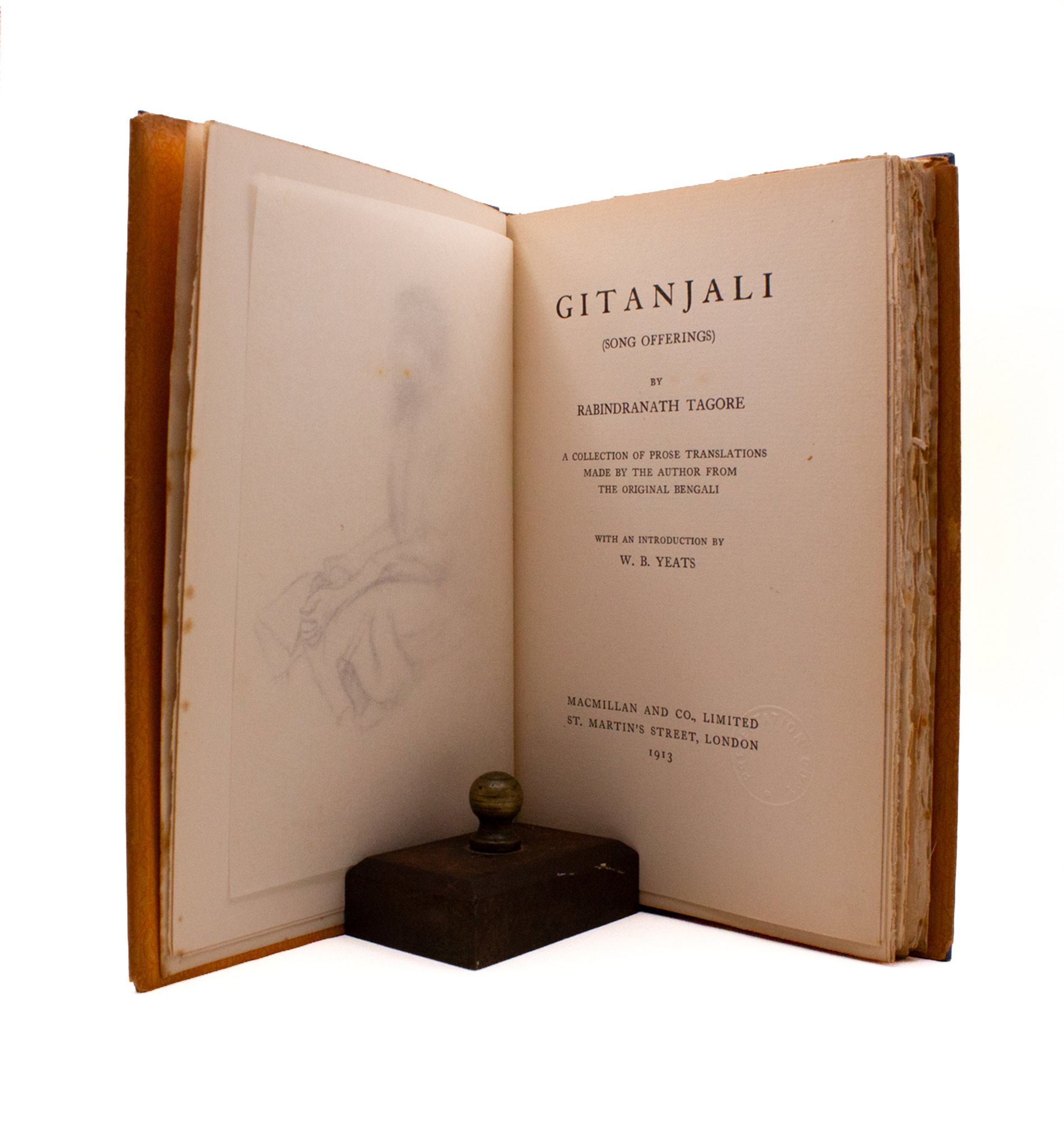
Gitanjali
Rabindranath Tagore
William Butler Yeats, introduction
Published London: Macmillan and Co., Limited, 1913
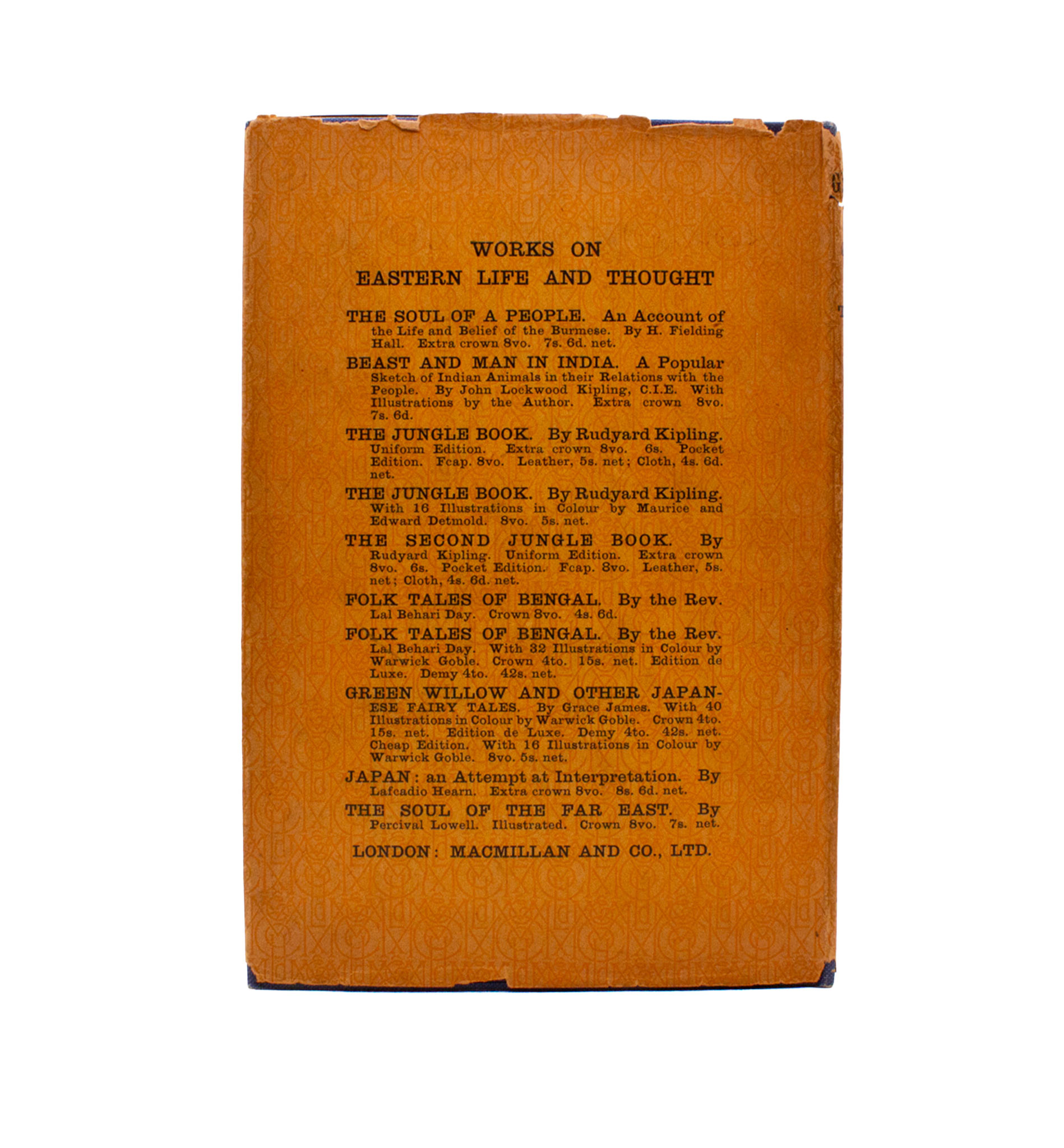
101pp.; 20 x 13.7 cm. Blue cloth boards to front and spine. Orange patterned dust-jacket printed in black.
William Butler Yeats was one of the first to champion Tagore on his arrival in London in 1912, writing in his introduction, “I have carried the manuscript of these translations about with me for days, reading it in railways trains, or on top of omnibuses and in restaurants, and I have often had to close it lest some stranger would see how much it moved me.” Pound, who at the time was somewhat courting Yeats, vied to lavish Tagore with higher praise, writing in the Fortnightly Review, March 1913, that the only “fitting comparison” for Tagore’s poetry was “the Paradiso of Dante.” Though the journals showed high praise, Tagore was published in private, subscriber-only, limited runs by the India Society, all of which was made propaganda for what Pound described as “the cleverest boom of our day.” Though Pound later denigrated Tagore’s work, he was certainly swept up at the time, Richard Aldington describing him as “infernally smug” everytime he came from seeing Tagore. But Yeats’s reaction, preserved in this introduction, was lasting; for its beauty, the introduction inspired a poem in Marianne Moore, “To William Butler Yeats on Tagore.”
First trade edition, after the 1912 India Society publication, of a volume crucial to Tagore’s awarding the Nobel Prize in Literature. A selection by Yeats, translated by Tagore from the original Bengali. With the publisher’s circular “Presentation Copy” crimp to the title page. Occasional soft foxing to prelims. Scare in the original jacket well preserved with a break at the top of the spine (the lost title laid-in), now within mylar.


tap to cycle
The Crescent Moon
Rabindranath Tagore
Nandalall Bose, Asit Kumar Haldar, Abindranath Tagore, Surendranath Ganguli, illustrators
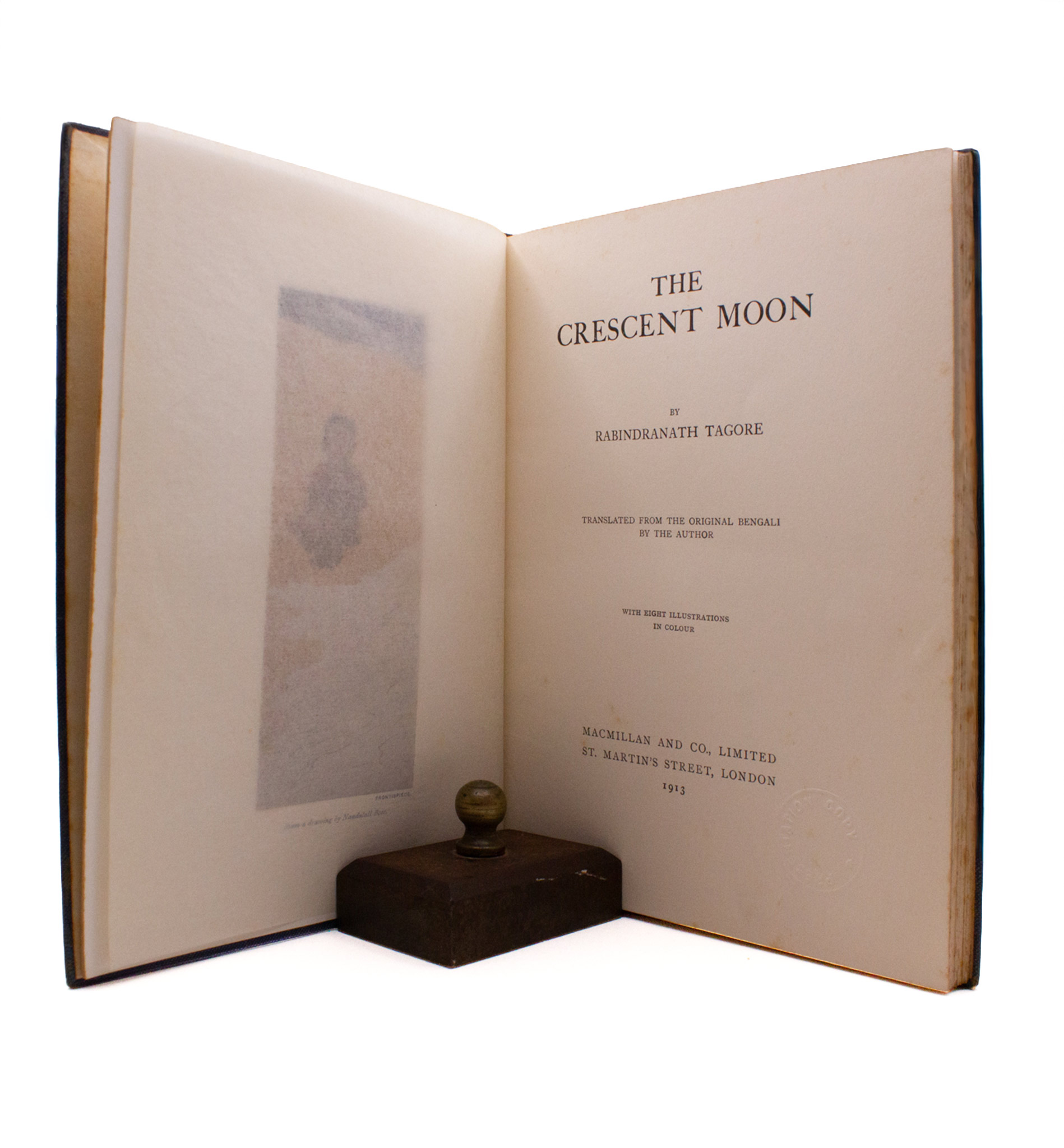
Published London: Macmillan and Co., Limited, 1913
82pp.; 20.5 x 15.6 cm. Blue cloth stamped in gold to front and spine.
First edition, with the publisher’s circular “Presentation Copy” crimp to title page. From the library of W. H. Livens, military inventor and spiritualist, with his pencil ownership inscription to ffep. Original cloth with design by Thomas Sturge Moore, who had copies of Tagore’s original manuscripts and helped with revisions; light rubbing around corners and fading to spine, but largely a fine copy.
tap to cycle
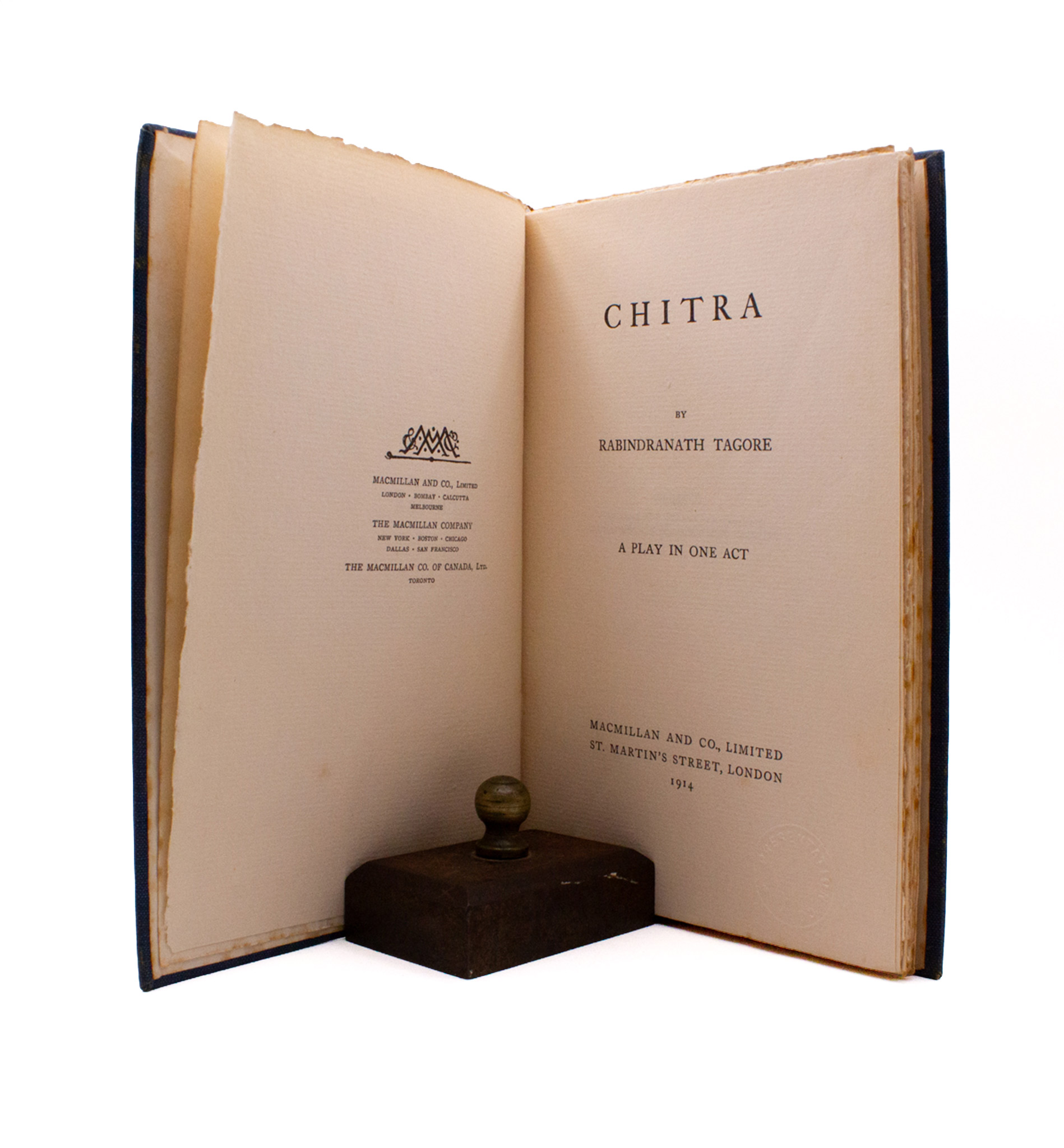
Chitra
Rabindranath Tagore
Published London: Macmillan and Co., Limited, 1914
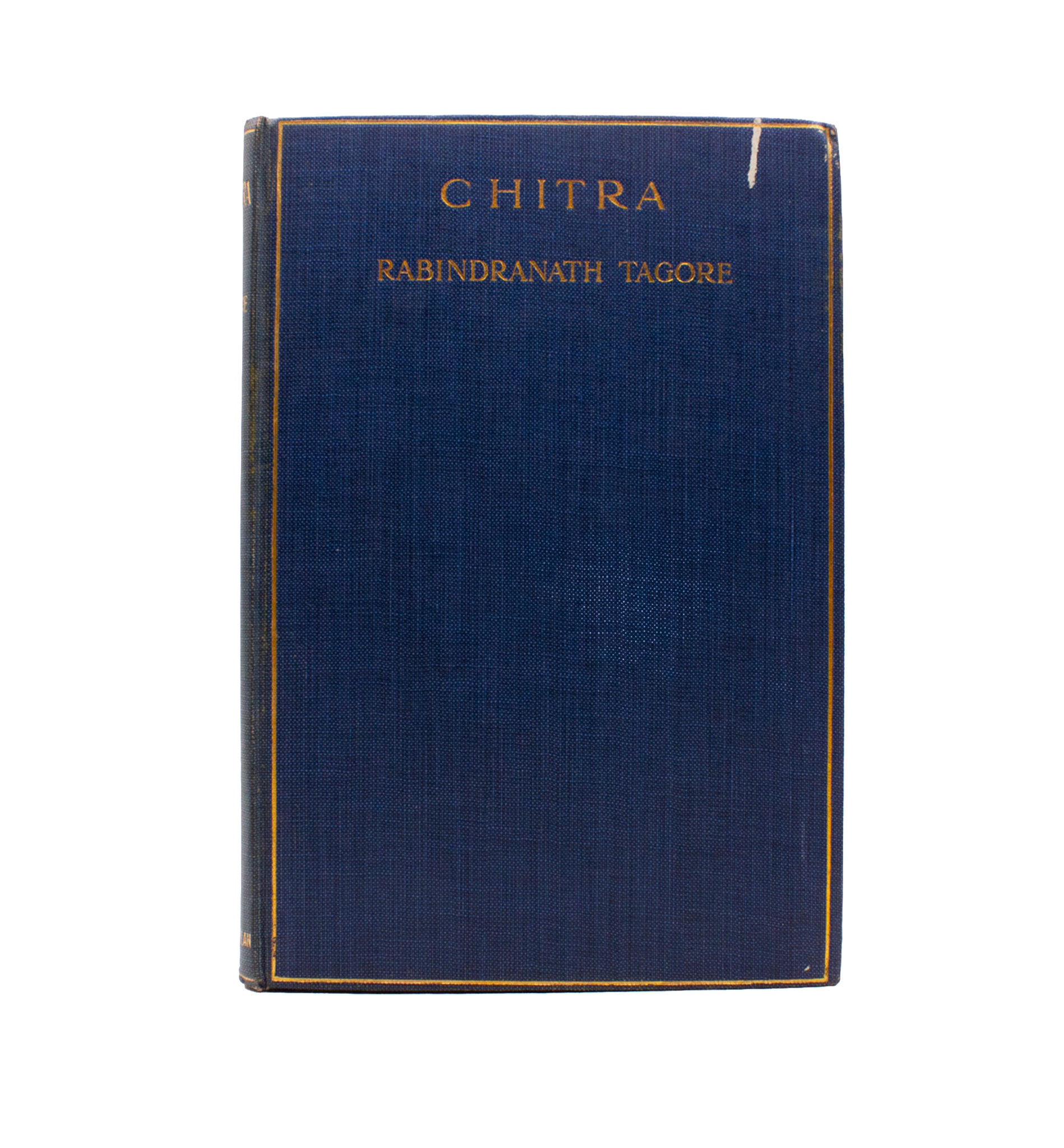
58pp.; 19.6 x 13.7 cm. Blue cloth boards stamped in gold to front and spine.
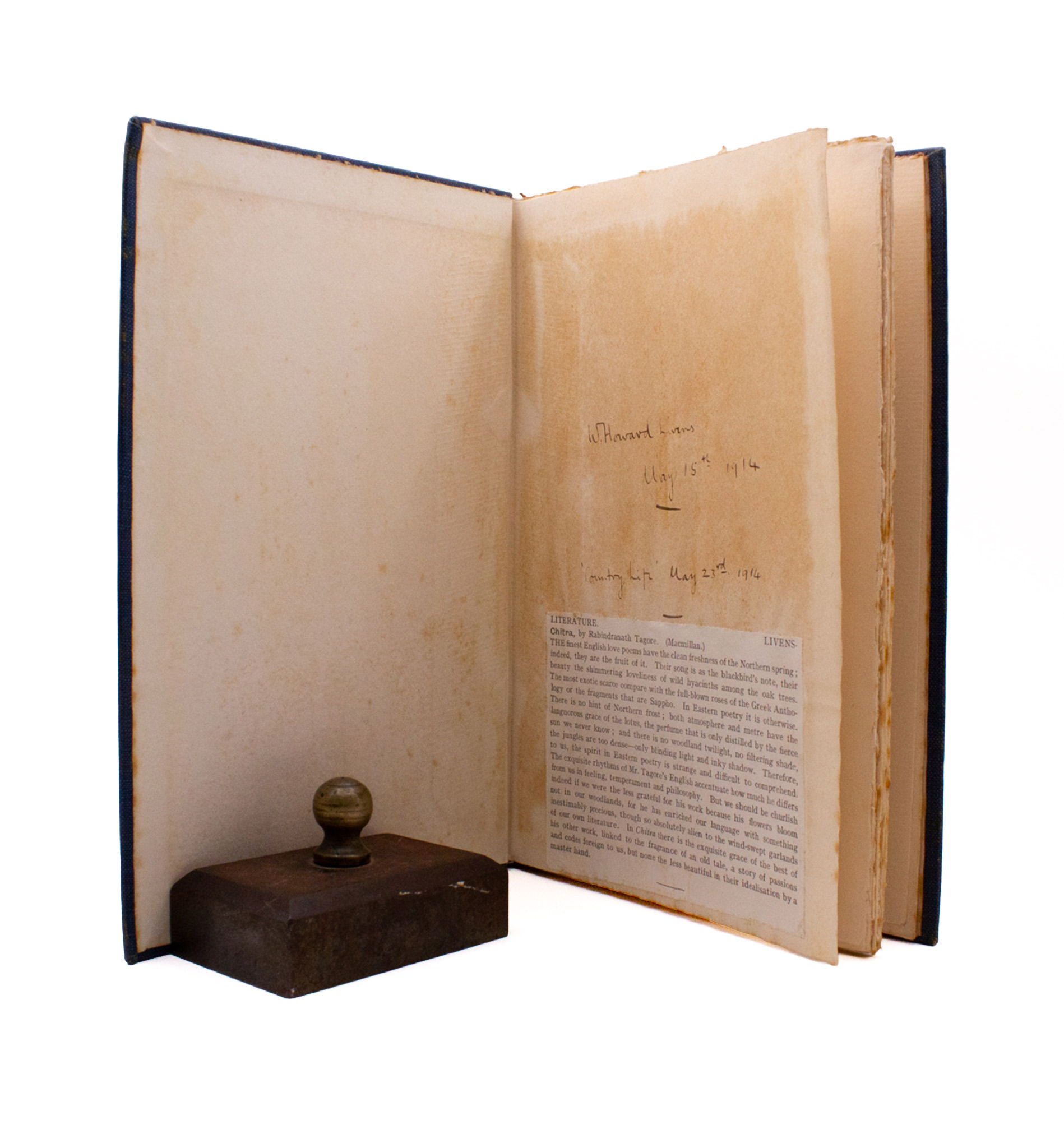
First trade edition, after 500 by the India Society, with the publisher’s circular “Presentation Copy” crimp to title page. From the library of W. H. Livens, with his ink ownership inscription dated “May 15th 1914” to ffep, alongside a review of Chitra by Livens from Country Life, May 23rd 1914 pasted in. Slight rippling to ffep on account of the glue; dash of white paint to front cover, otherwise a fine copy.



tap to cycle
Gitanjali and Fruit-Gathering
Sir Rabindranath Tagore
W. B. Yeats, introduction
Nandalal Bose, Surendranath Kar, Abanin Dranath Tagore, Nobendranath Tagore, illustrators
Published New York: The Macmillan Company, 1918
221pp.; 19.8 x 13.5 cm. Blue cloth boards stamped in gold to front and spine.
First collected edition, with Yeats’s original 1912 introduction. With an unidentified monogram “CB” dated June 1923 to ffep, alongside a blank bookplate designed by “DW.” Extensive poetic inscription to rfep and rpd in the same hand. Light rubbing to cloth around spine, but a fine copy.
tap to cycle
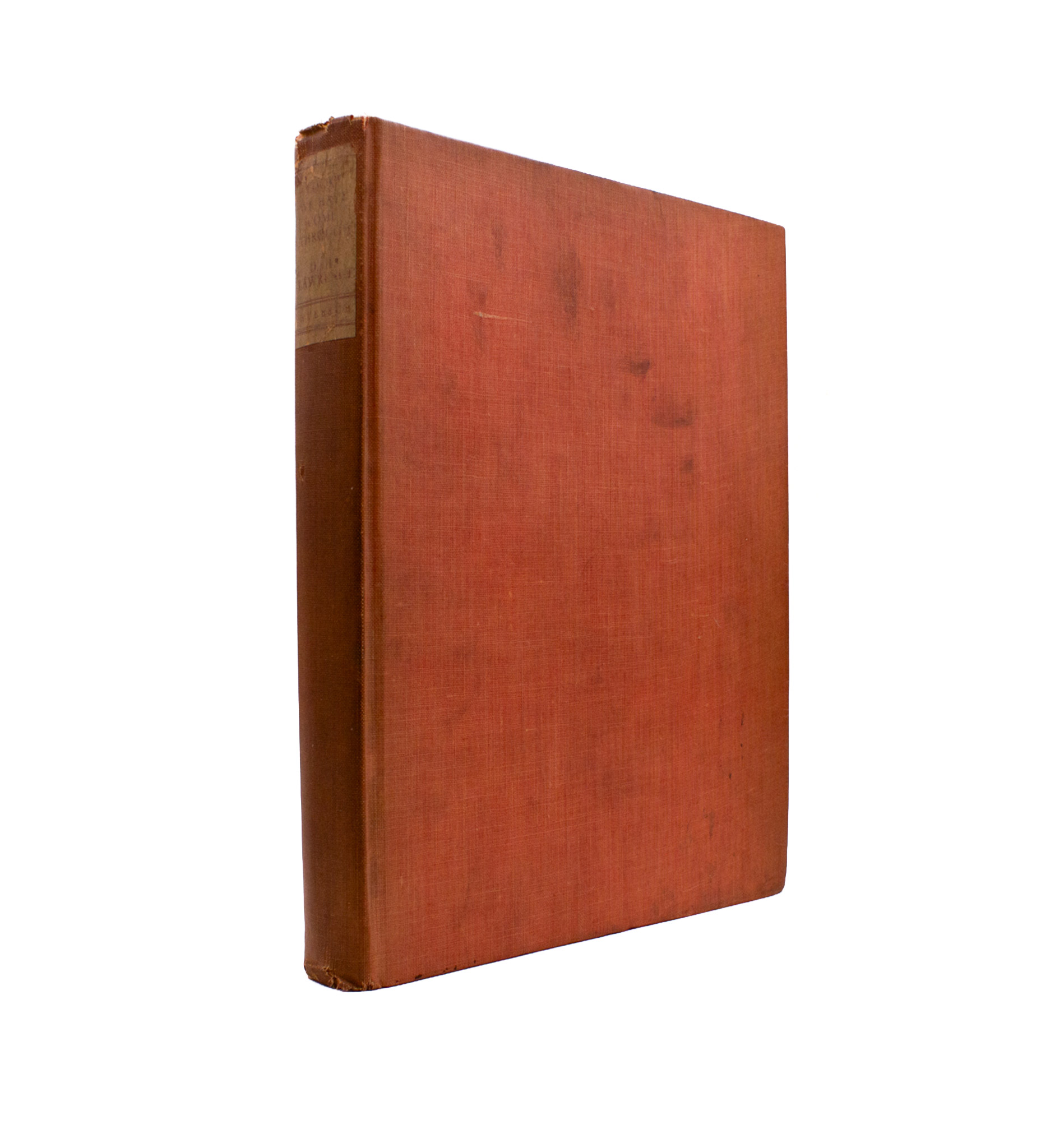
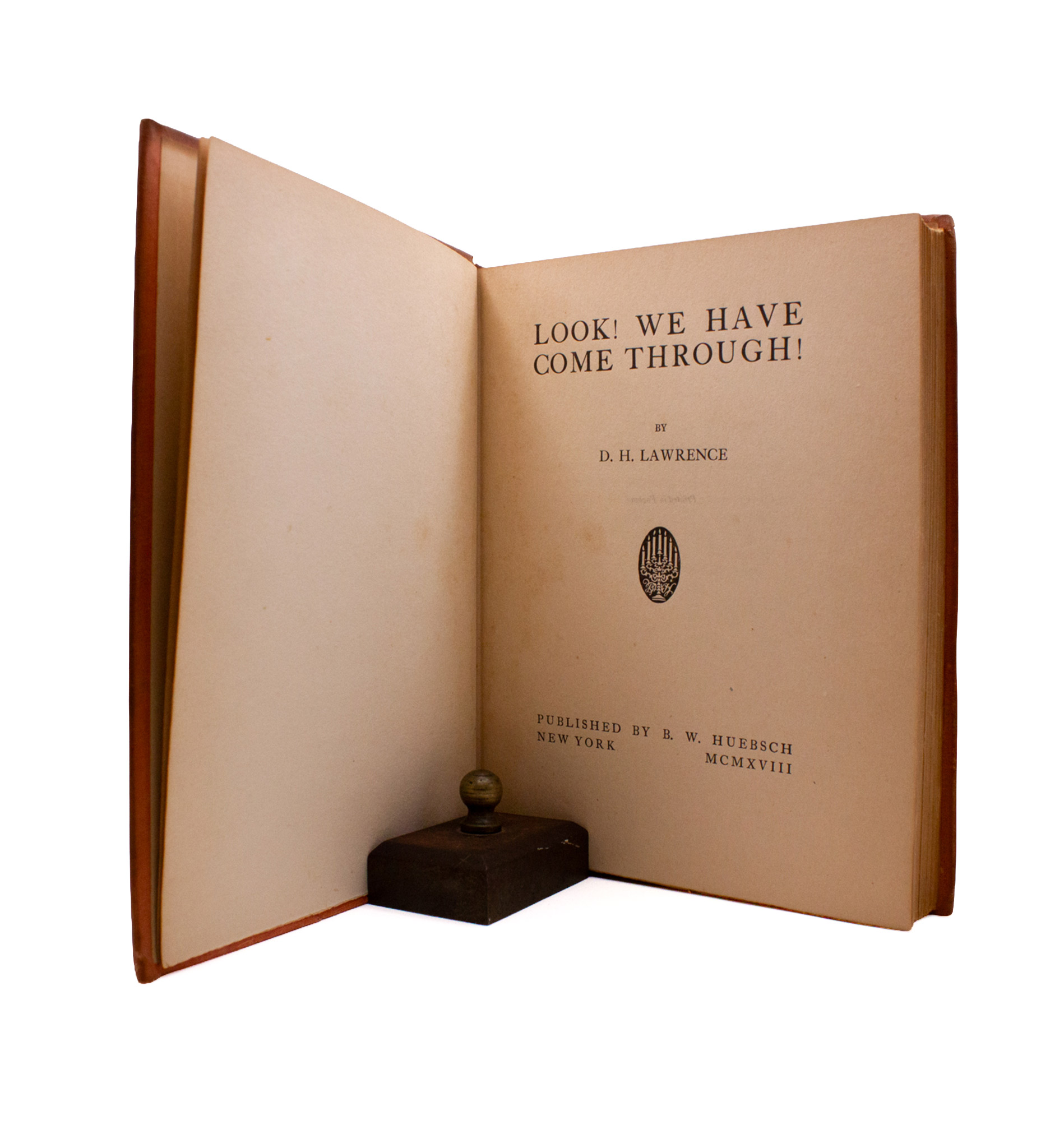
Look! We Have Come Through!
D. H. Lawrence
Published New York: B. W. Huebsch, 1918
162pp.; 22.1 x 17.5 cm. Pale red cloth boards; paper label printed in red pasted to spine.
Poems not to be read singly but as “unfolding one from the other in organic development, the whole revealing the intrinsic experience of a man during the crisis of manhood, when he marries and comes into himself,” or, “the sixth lustre of a man’s life,” but which Conrad Aiken criticises as the poet-novelist “all too often forgetting that the passage from the novel to the poem is among other things a passage from the cumulative to the selective. Sensations and impressions may be hewed and hauled in prose; but in poetry it is rather the sort of mood which, like a bird, flies out of the tree as soon as the axe rings against it, that one must look for. Mr Lawrence has, of this sort, his birds, but he appears to pay little heed to them; he goes on chopping.” (The Dial, 9 August 1919.) Which you’d say is the Imagist objective straight failed, though we know D. H. Lawrence (poet) des Imagistes.
But there are two set of poems in this book. The first are those written in-situ, each underscored with their place of composition, and for the most part being written while travelling with Frieda Weekley (neé von Richthofen, now Lawrence), mother already to three children, with whom Lawrence had eloped. They are written as the two (then one) walked across the Alps from Germany to Italy following Lawrence’s arrest and subsequent release under suspicion of espionage. The second set of poems, interspersed, expand on the first or fantasise small fictions of ladies and knaves, and are much worse, revealing Lawrence’s poor grasp of verse form (such as Aiken describes: irrelevant, painful, banal appendages only there to satisfy some weak cheap metre or rhyme). It’s these poems which seem to have directed the form of the book, probably being written symbiotically with it. The first set of poems, however, if extracted, are good: they contain the flight of birds, and still they make the (very beautiful) novel of the marriage and self-becoming. If they alone were printed (save the last few), this volume would be well read.
First American edition, one of 500 copies (half of the set of 1000 sheets produced by Chatto & Windus, of which 500 constituted the first 1917 English edition). Contemporary ink ownership inscription to ffep of Katherine McClintock Ellis dated April 1919 and annotated later in pencil, “Pre-College Division Julliard”; Ellis (1896-1982) was the director of the pre-college program at the Julliard School of Music in New York. Bookseller’s label, The Wayfarers Book Shop, to fpd. With two pencil scores by the title of 6 poems, and two further scores highlighting verse. Boards aged and a little grubbied, small breaks top and tail of spine, occasional foxing with an outburst on spread 80. Paper label on spine faded and lightly cracked. Detailed but not indexed under Roberts A10a.

tap to cycle
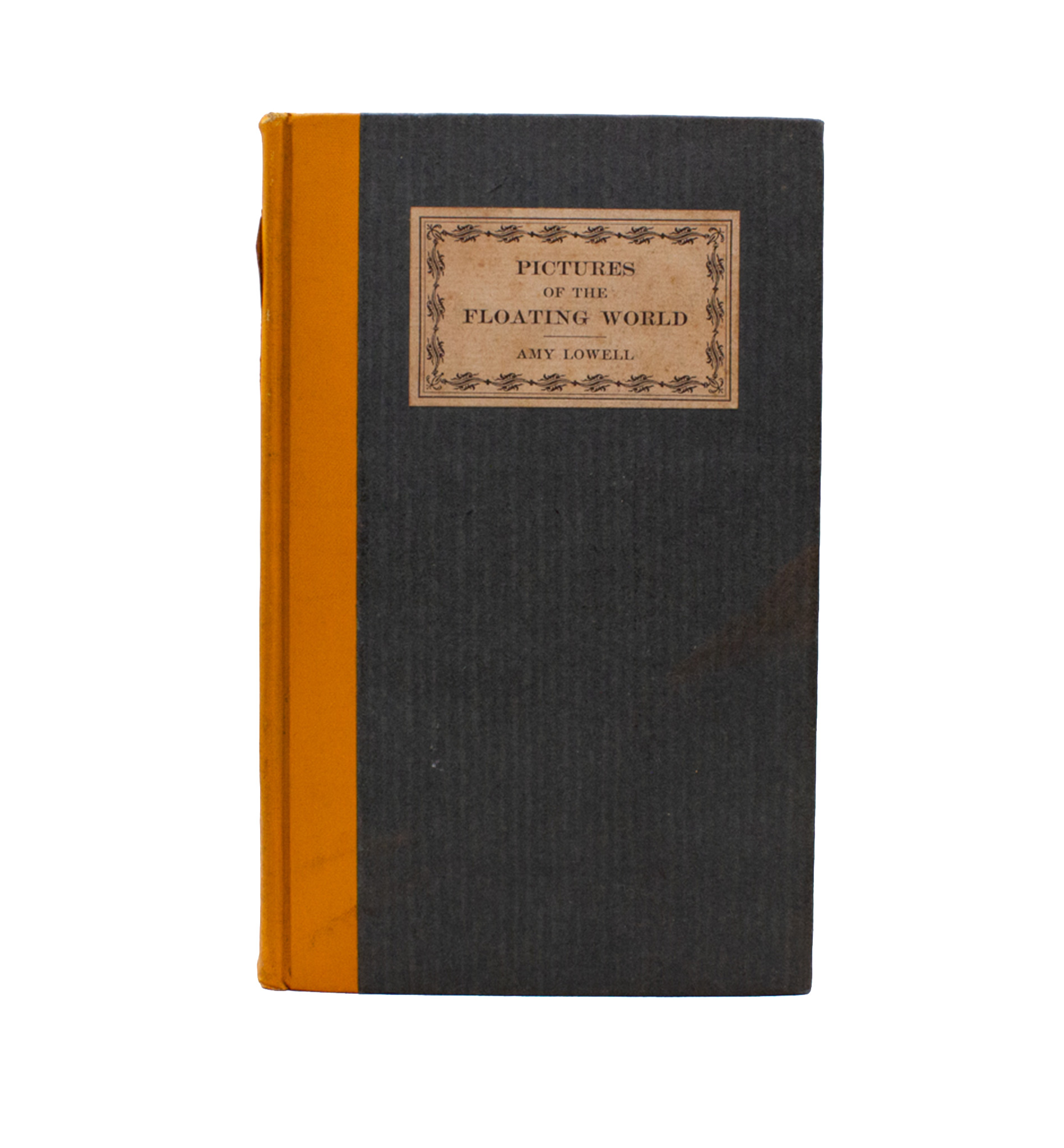
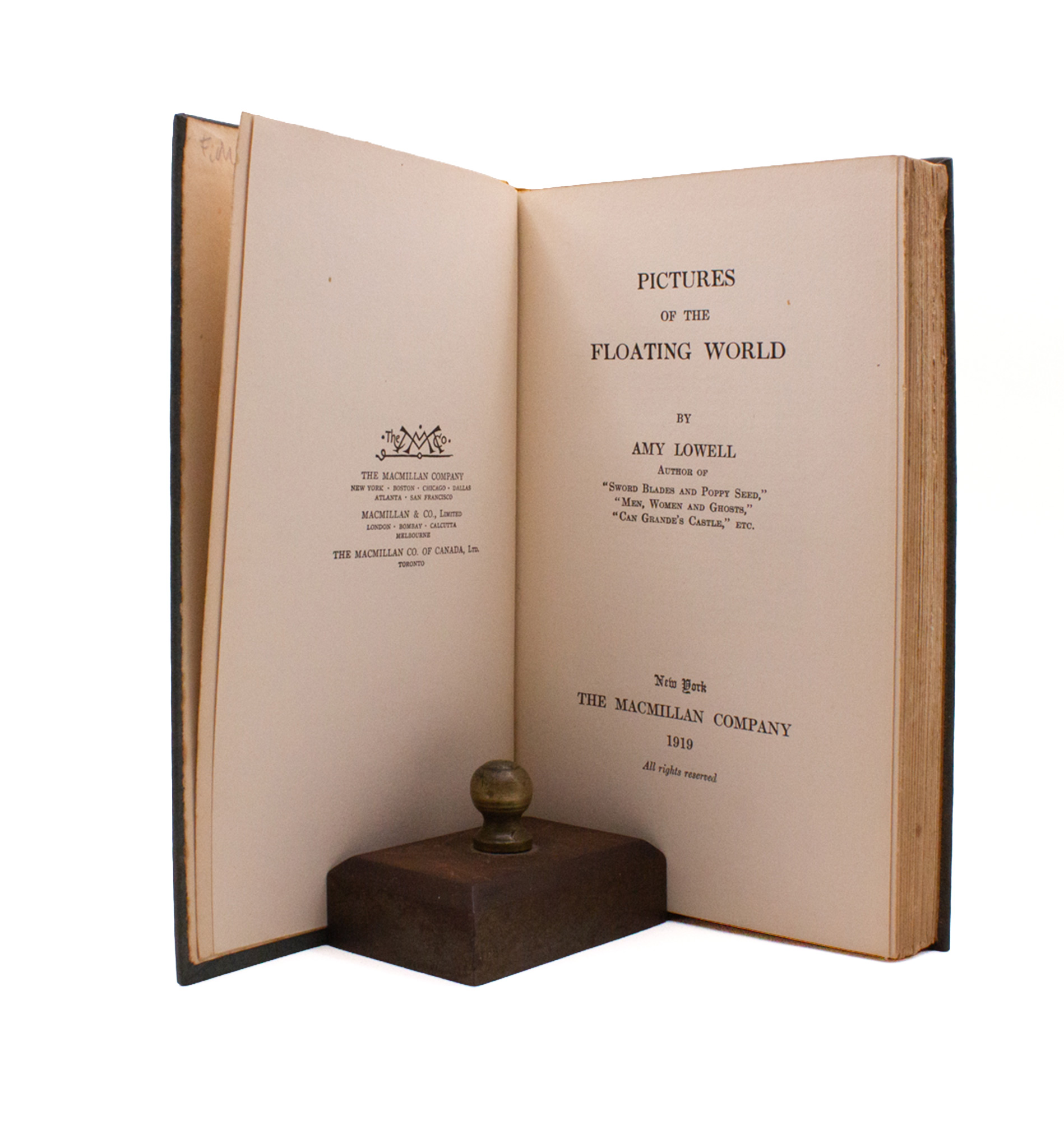
Pictures of the Floating World
Amy Lowell
Published New York: The Macmillan Company, 1919
257pp.; 18 x 11.5 cm. Blue paper covered, orange cloth backed boards. White paper labels printed in black to front and spine.
From the library of A. David Moody
On discovering Imagisme in Poetry, Amy Lowell travelled to London with her partner Ada Dwyer Russell, where she invited EP to her apartment overlooking Green Park and, while driving him about town in her automobile, made various promises to fund anthologies of the Imagistes. Though Pound did not consider Lowell an Imagiste, her poem “In a Garden” was included under his editorial in Des Imagistes. By the time of the anthology’s first appearance in The Glebe, the group had already begun to disentangle. Pound, who refused to democratise criticsm, was forced out, declaring Imagisme dead, threatened to sue Lowell for using the anglicised term Imagism, and resorted to denunciations of Amygism. Imagism flourished after Pound, the three qualifications of Imagiste verse by Pound spreading into six, with verse as equally unpointed.
First edition, first printing, light marks to paper and cloth backing; label a little lost at the edges; spotting to pastedowns and endpapers but otherwise fine inside, and very good out.

tap to cycle
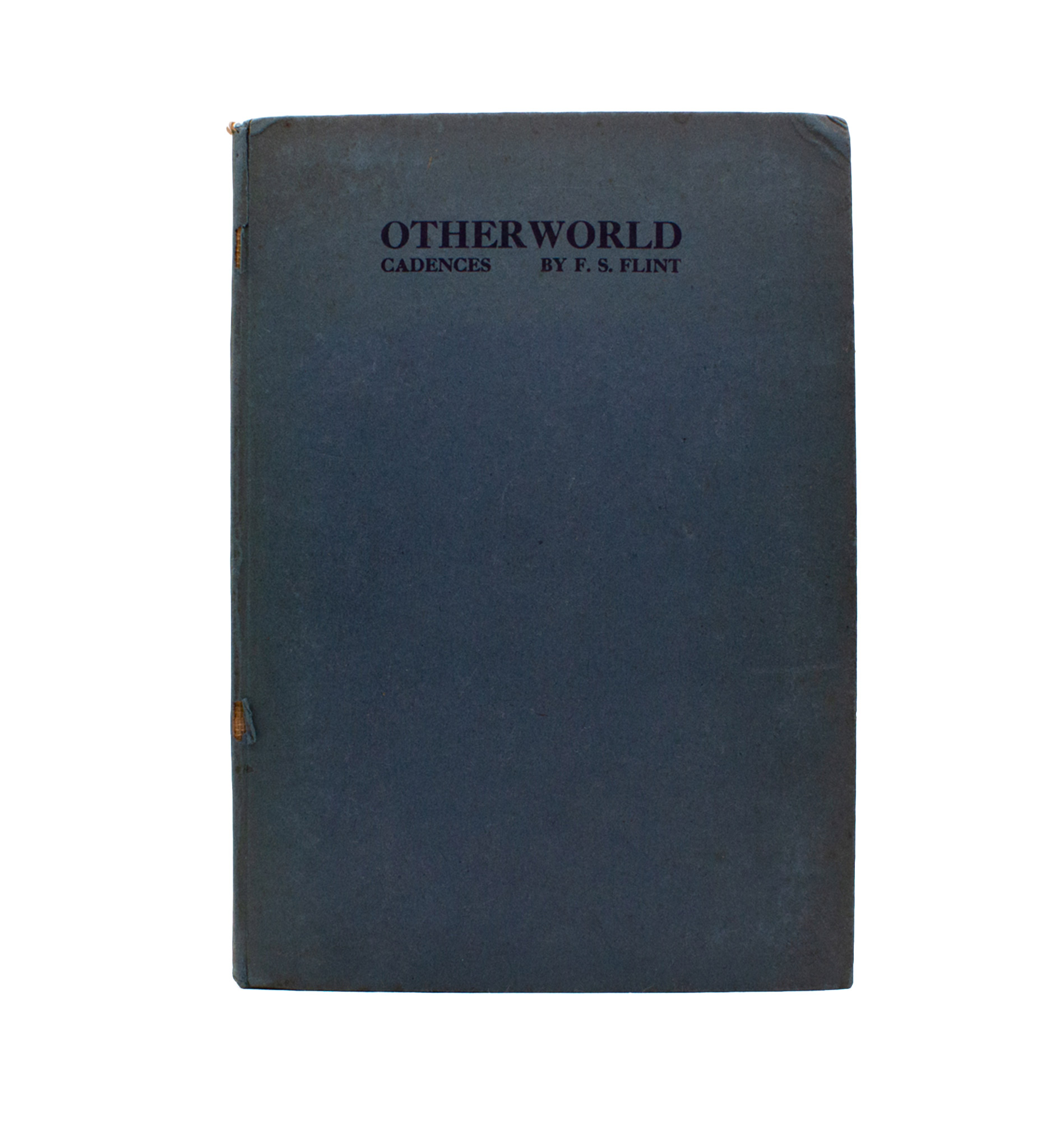
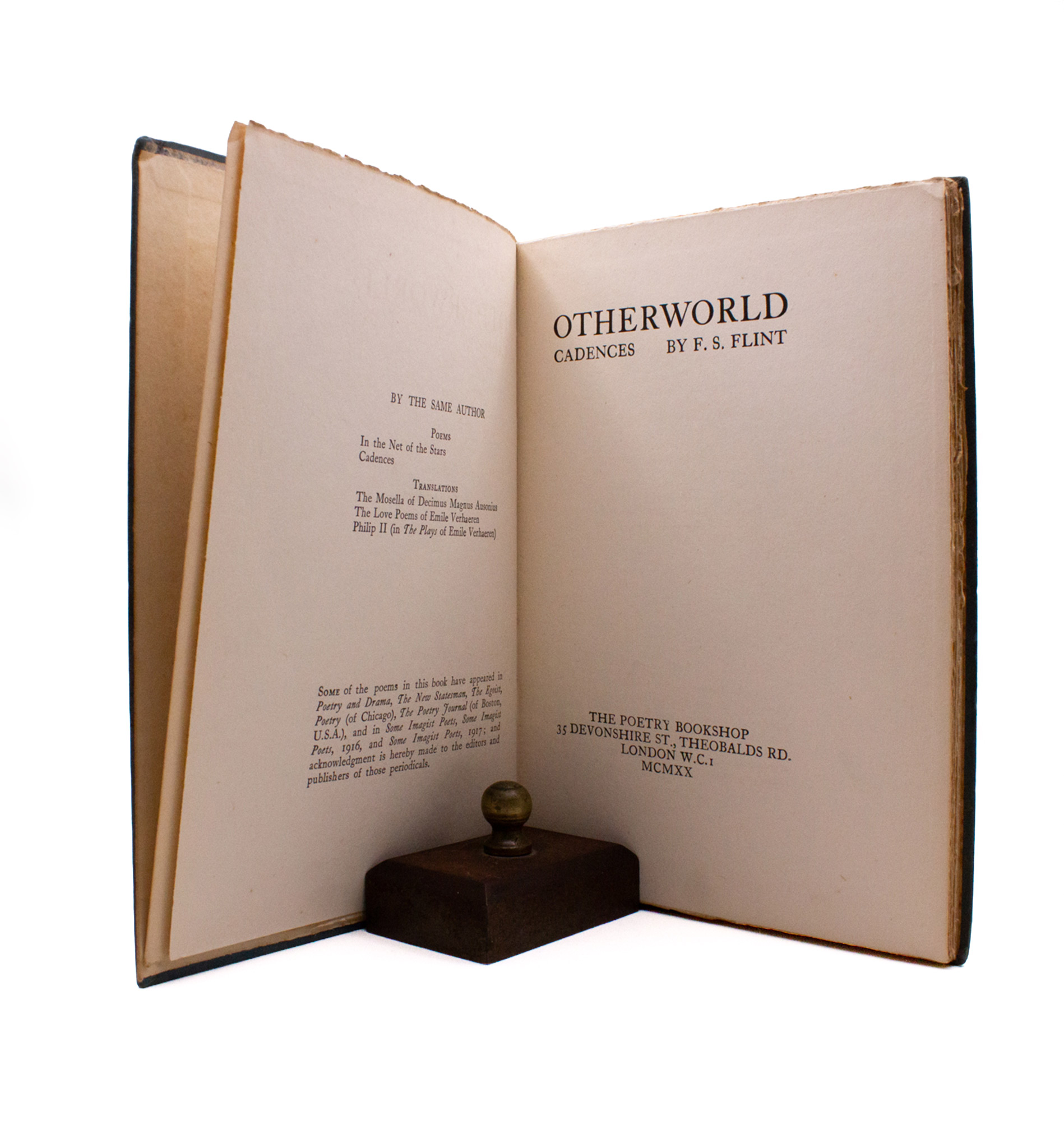
Otherworld: Cadences
F. S. Flint
Published London: The Poetry Bookshop, 1920
66pp.; 20.4 x 14.6 cm. Blue paper covered boards printed in black to front and up spine.
From the library of A. David Moody
F. S. Flint was a member, alongside Pound, of T. E. Hulme’s “School of Images.” Hulme, “wanting an intuitive poetry freed from cliché and from convention [called] for the abolition of metre and regular forms of verse; and [for] a language of direct visual images ‘which would hand over sensations bodily.’ And ‘the poet’, he argued, ‘must continually be creating new images’, because the life force in images quickly dies out as they become received associations.” (Quite Lucretian; Moody, Vol. I)
In Poetry, March 1913 Flint and Pound published Imagisme and A Few Don’ts by an Imagiste, Flint later featuring in Pound’s 1914 editorial Des Imagistes; but by 1915 their friendship had soured, and Flint claimed Pound had contributed nothing to the discussions under Hulme but had stolen the whole school of Imagisme from the meetings.
“You have not been a good comrade, violà!”
In 1915 Flint published his second volume of poetry, Cadences (London: Poetry Bookshop) whose cover image of a swan headed the renewal of his 1909 poem, “A Swan Song” into an unrhymed ‘cadenced’ version, the method of composition the collection was based upon. Flint found that an unformed verse whose thread lay in the cadence of words was a technique in poetry as old as Chaucer and Cynewulf which had been lost to dead formal variation, and claimed to not have discovered anything new except to have rediscovered a verse essentially human.
This is Flint’s second book of cadences, and his third and final volume of poetry (Flint was to go on to become an economist). For poets who defaulted to formal verse at the time, Flint’s cadences may have been relieving, but to we who have seen what poetry is capable of it is little more than an unusual approach to the same pavement. Lacking for me is the thing, but this may be Flint’s rebellion, writing instead a rambling day.
First and sole edition. Light marks to the paper with two breaks along the front gutter; top corner bumped; endpapers browned but clean throughout.
tap to cycle
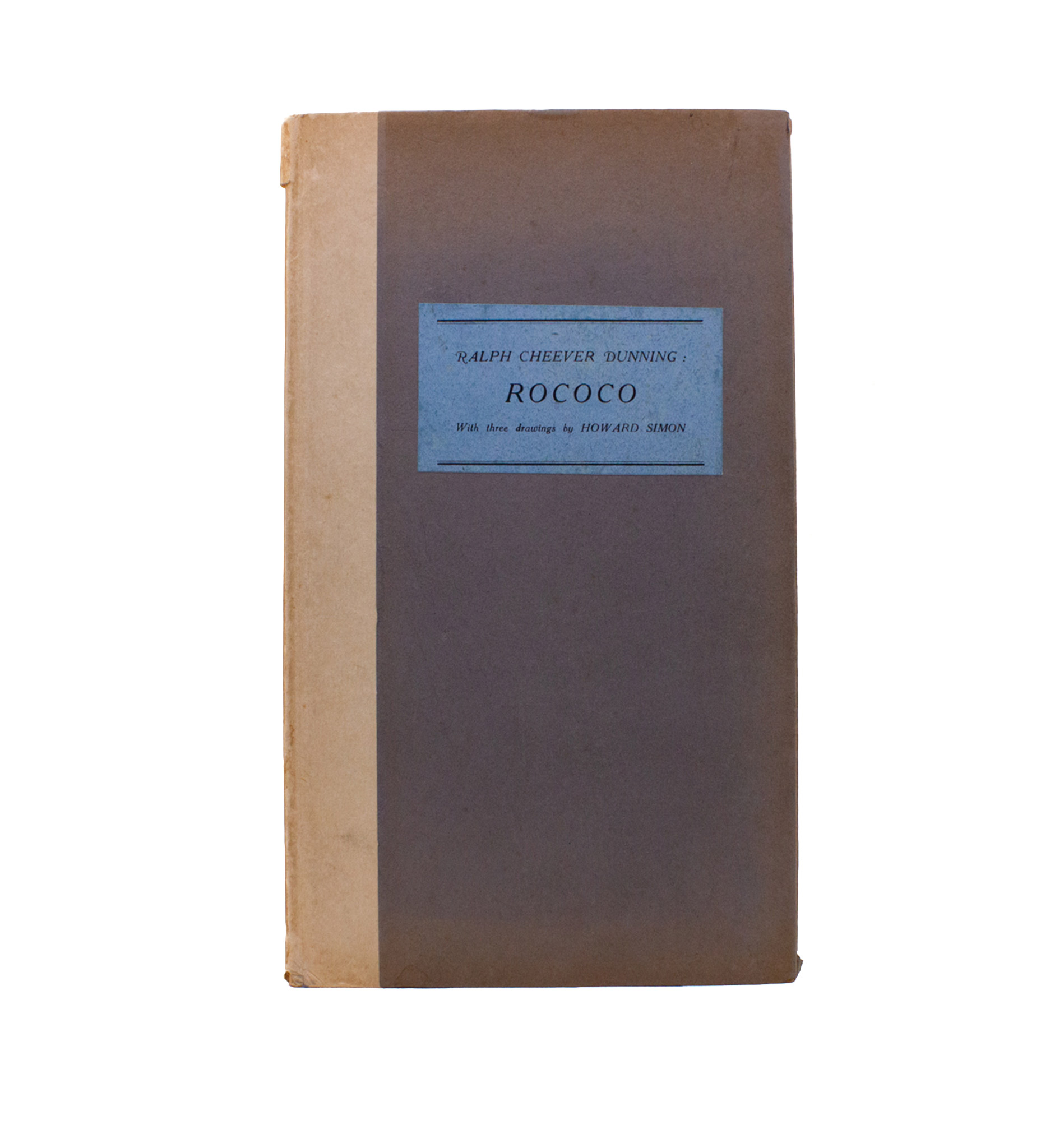
Rococo, a poem
Ralph Cheever Dunning
Howard Simon, illustrator
Published Paris: Edward W. Titus, 1926
22pp.; 22.7 x 13.2 cm. Original blue-grey three-quarter boards lettered in gold up a white parchment spine. Blue paper label printed in black to front.
From the library of A. David Moody
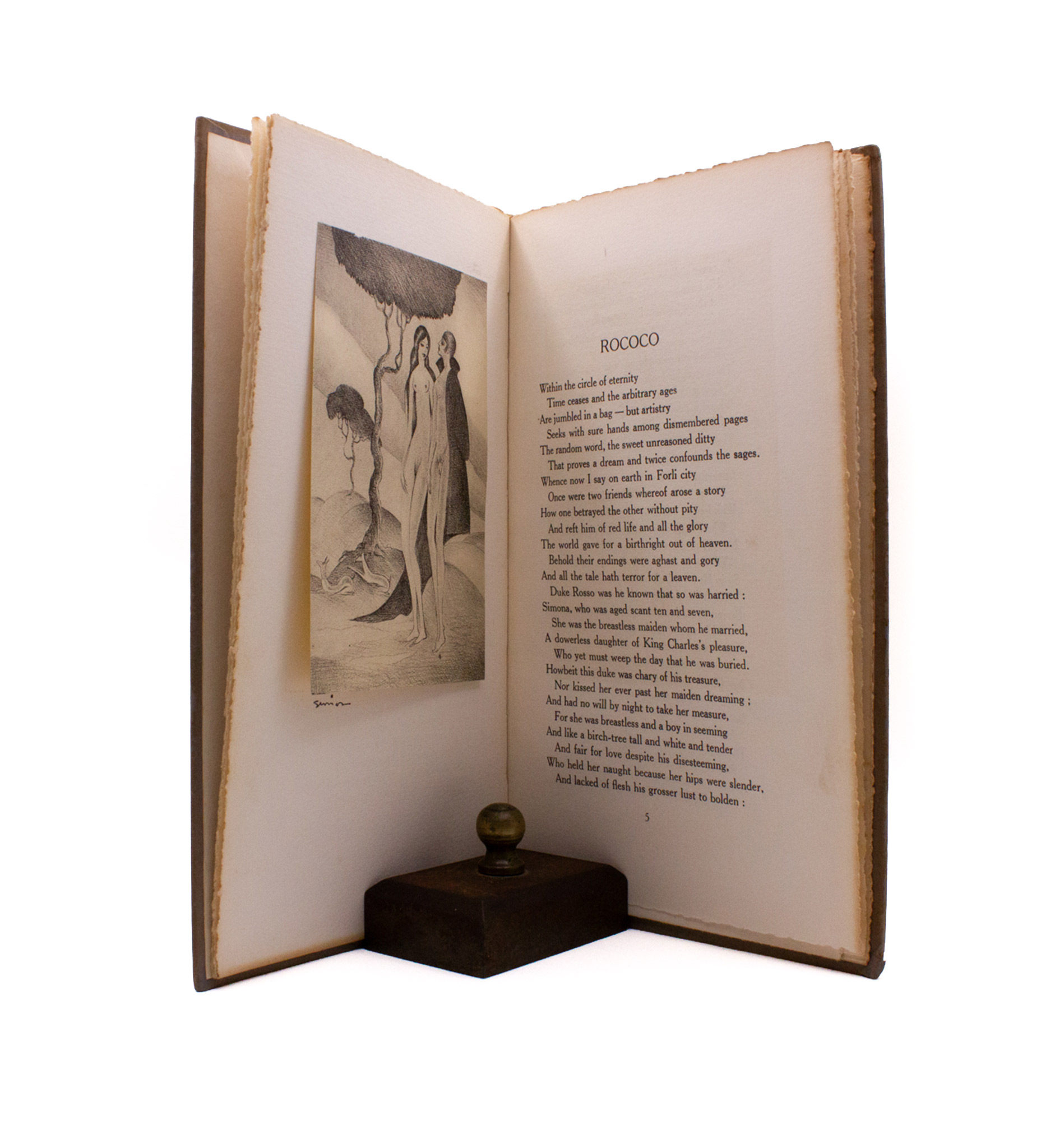
The second of only three volumes of poetry to be published by Dunning during his lifetime and since. A Detroit native, Dunning (1878-1930) moved to Paris in 1905 where he dedicated his time to only a small group of poems, composed in the style of the late Victorian era, publishing his first collection of poems Hyllus: A Drama in 1910 (London: John Lane, The Bodley Head). Around 1924 Ezra Pound ‘discovered’ Dunning, a recluse and an addict, and ensured his publishing in the journals of the day; I have read even that EP supplied Dunning with drugs, which, considering Pound’s mansarde et potage, one might believe. After Dunning received the Helen Haire Nevinson Prize from Poetry, A Magazine of Verse in 1925 the literati of the Left Bank began to heatedly debate Dunning’s poetry. The push for vers libre, as had been happening for 20 years, had left the public finally numb to any vers à la Victorien; Dunning’s advance of a style yet older struggled to be received, though it reads with a precision worthy of the Ancient Mariner.
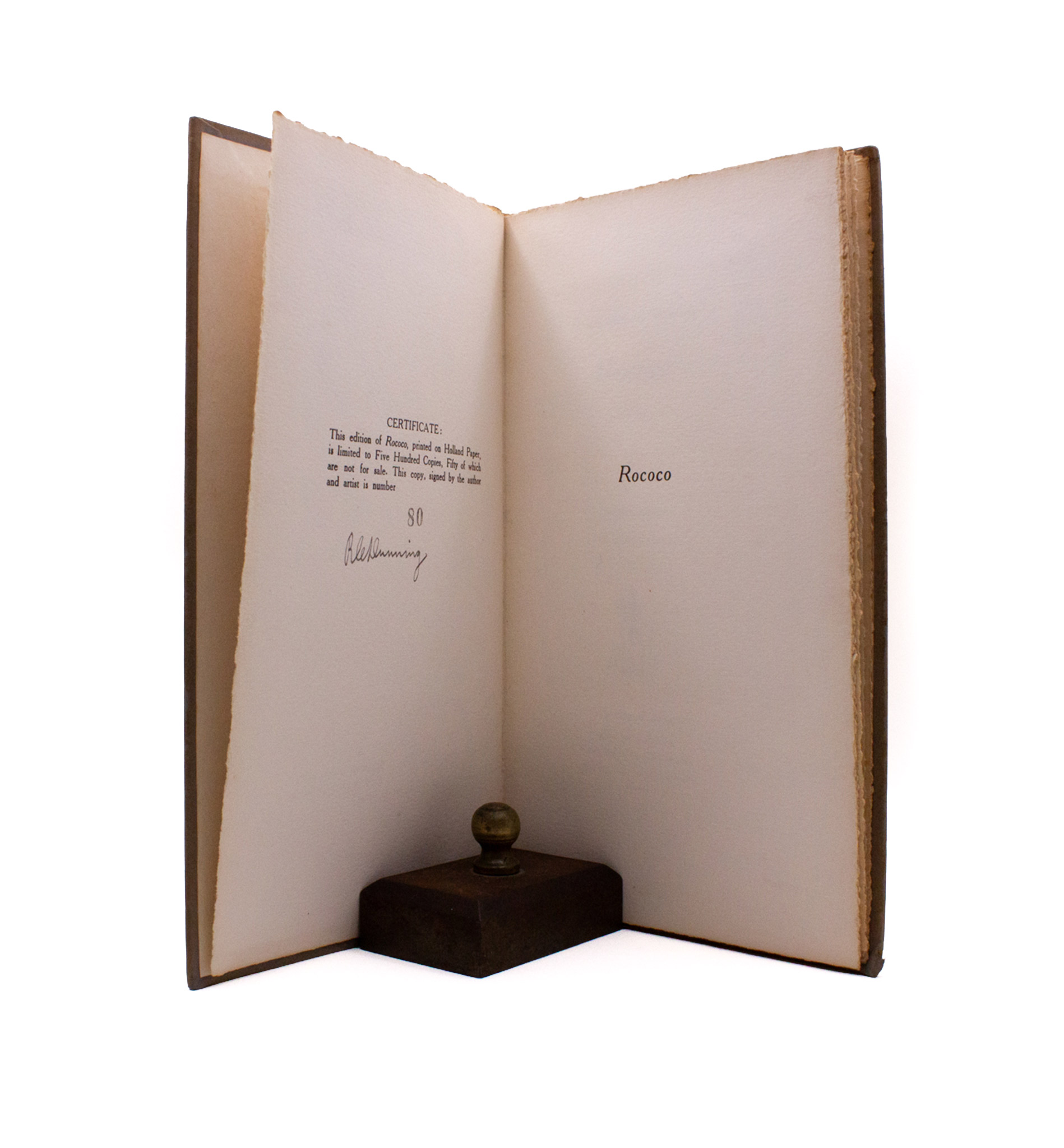
This book was the inaugural volume of The Black Manikin Press, one of the key expatriate presses of Paris in the 1920’s later to print Anaïs Nin, D. H. Lawrence, Djuna Barnes, Henry Miller and more. No. 80 of 500 copies all printed on Holland, the first fifty not for sale, with three illustrations by Howard Simon. Signed by Dunning on the limitation page and by Simon under the frontispiece. Spine mottled with a small break at top (nothing lost); light fading to the edge of the boards; endpapers browned spilling over to adjacent blanks where cut short; stock otherwise fine throughout. No bibliography has been composed for Dunning.
tap to cycle
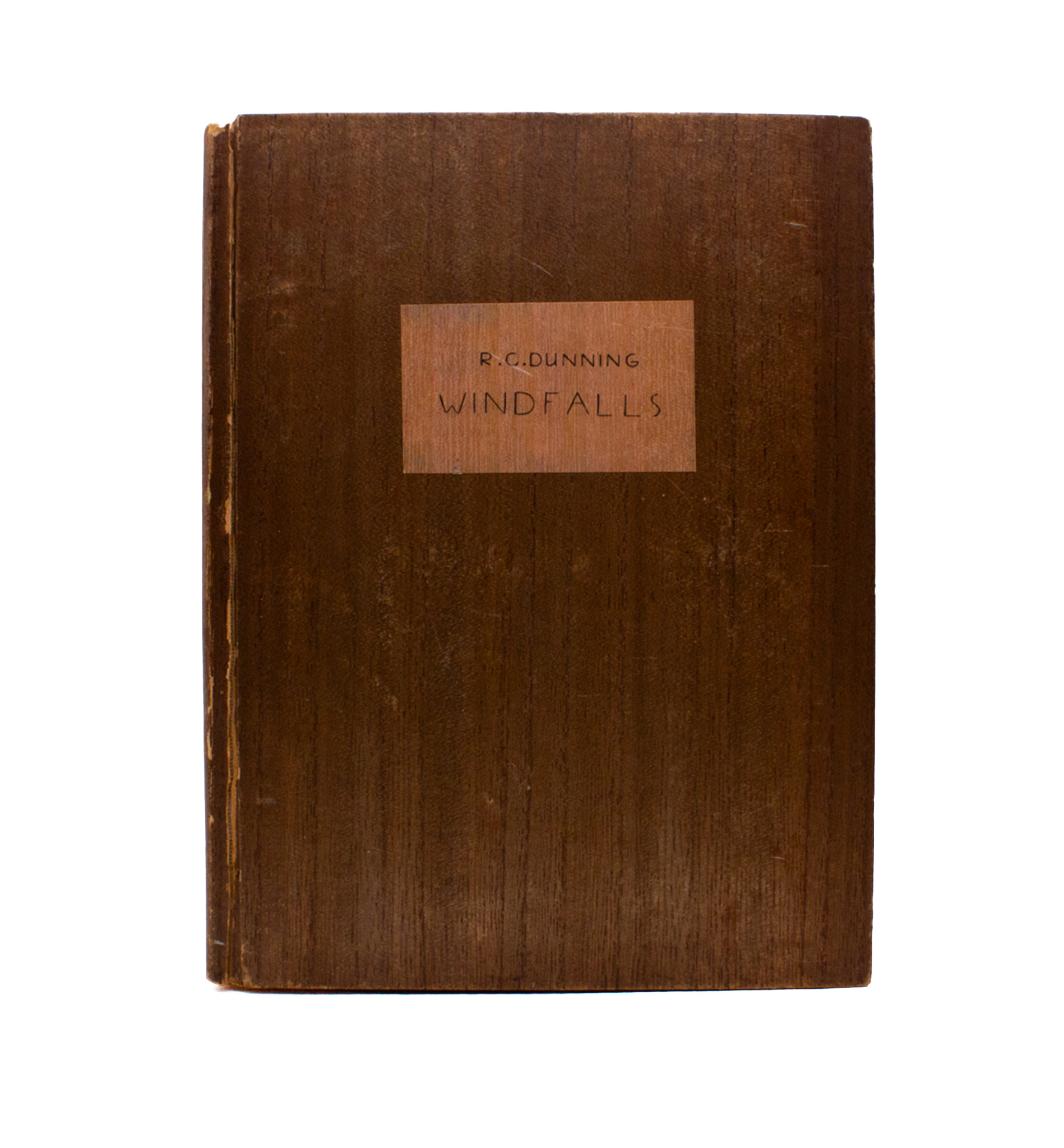
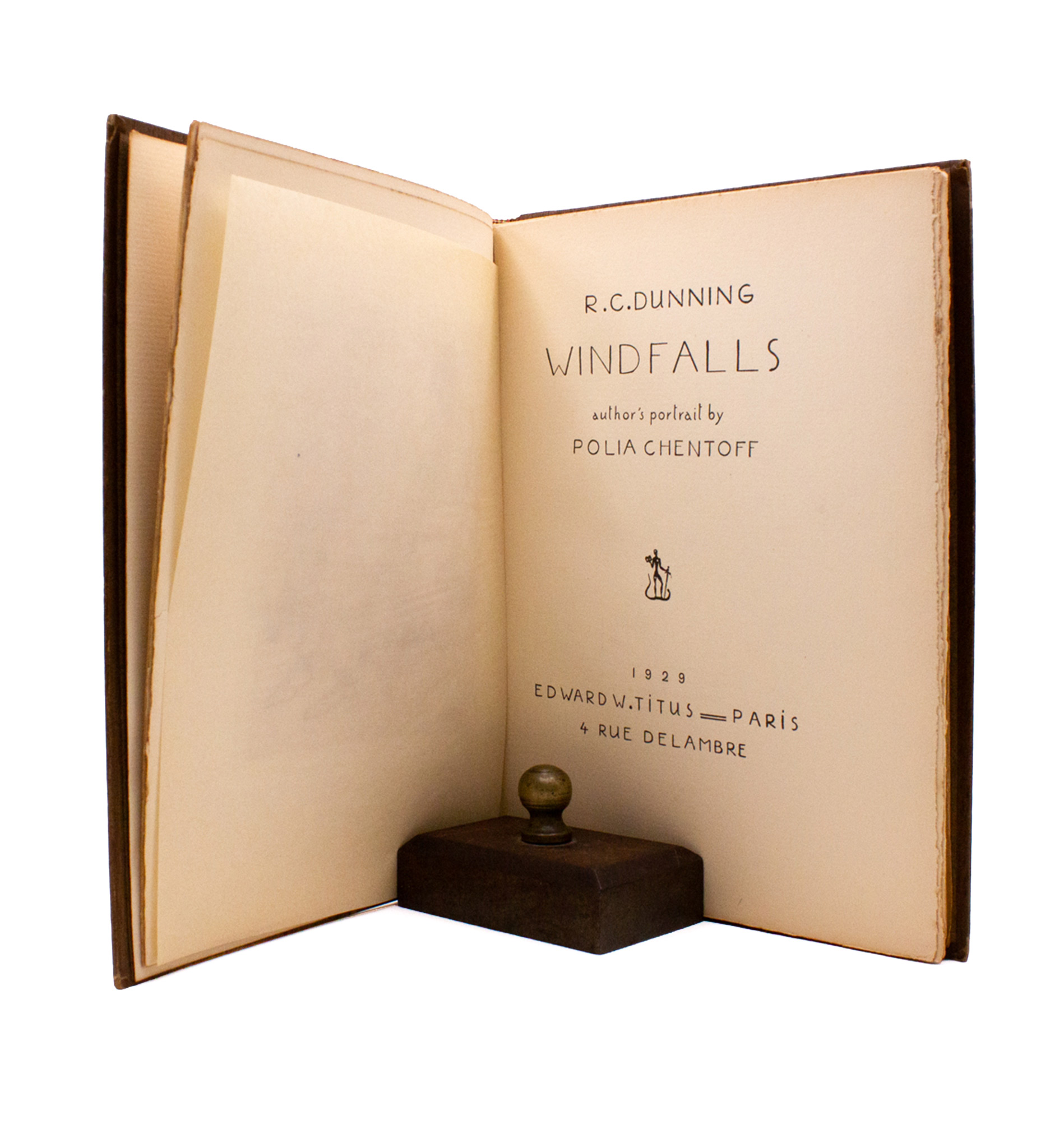
Windfalls
Ralph Cheever Dunning
Published Paris: Edward W. Titus, 1929
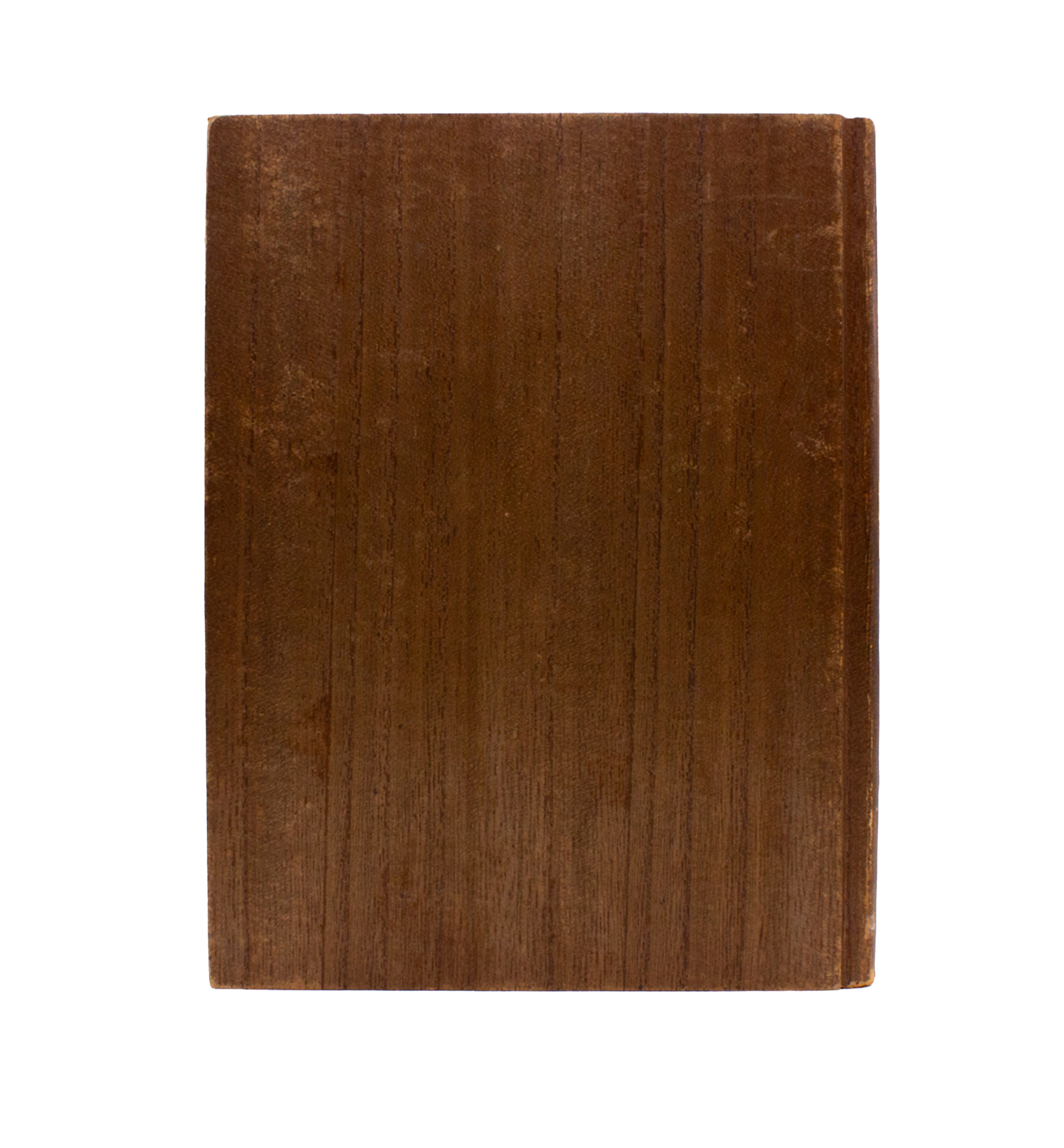
56pp.; 19.5 x 15 cm. Wood veneer paper over boards. Blond wood verneer paper labels printed in black to front and down spine. Brown paper endpapers and pastedowns.
From the library of A. David Moody
The third and final volume of poems to be published by Dunning before his death in Paris, 1930. A long-term opiate addict, Dunning was rarely seen in public, and only then at the busiest cafés with a glass of milk and book. His addiction caused an aversion to food, and though he was suffering from tuberculosis, Hemingway said of his death that he simply “forgot to eat.” After Rococo (a single poem), Windfalls was the release of years of poetry under a deathly susurrus.
THE PENALTY
Bleed, O my heart, bleed slowly but take care
That no one hears thy bleeding. In the night —
Let not thy bedfellow divine thy plight.
Bleed softly, O my heart, and in the glare
And heavy silence of high noon, beware
Of good Samaritans — walk to the right
Or hide thee by the roadside out of sight
Or greet them with the smile that villains wear.
Bleed slowly and bleed softly, O my heart,
Go hide in nameless mountains of the north
Or deep in the monstrous cities play thy part,
O Bleeding Heart whereby the world’s aflood —
But shun all congregations loving blood
Lest some fool on a banner bear thee forth.
First edition, no. 106 of 500 copies (the first 25 on Japon). With a frontispiece portrait of the author by Polia Chentoff, printed by Martin Kaelin. Letter Press by Imprimerie Crété, “both of Montparnasse.” Beautifully clean throughout, with ten small pencil scores highlighting poems on the contents page, and slight printer’s shadow to the poem of p.11, Drowned. One section (from frontis to p.12) loosened off spine without damage. Front gutter cracked, the binding remaining sound. Boards lightly rubbed. Paper label on spine complete if a little rubbed. Again, I find no bibliographical records, and very little scholarship.

tap to cycle
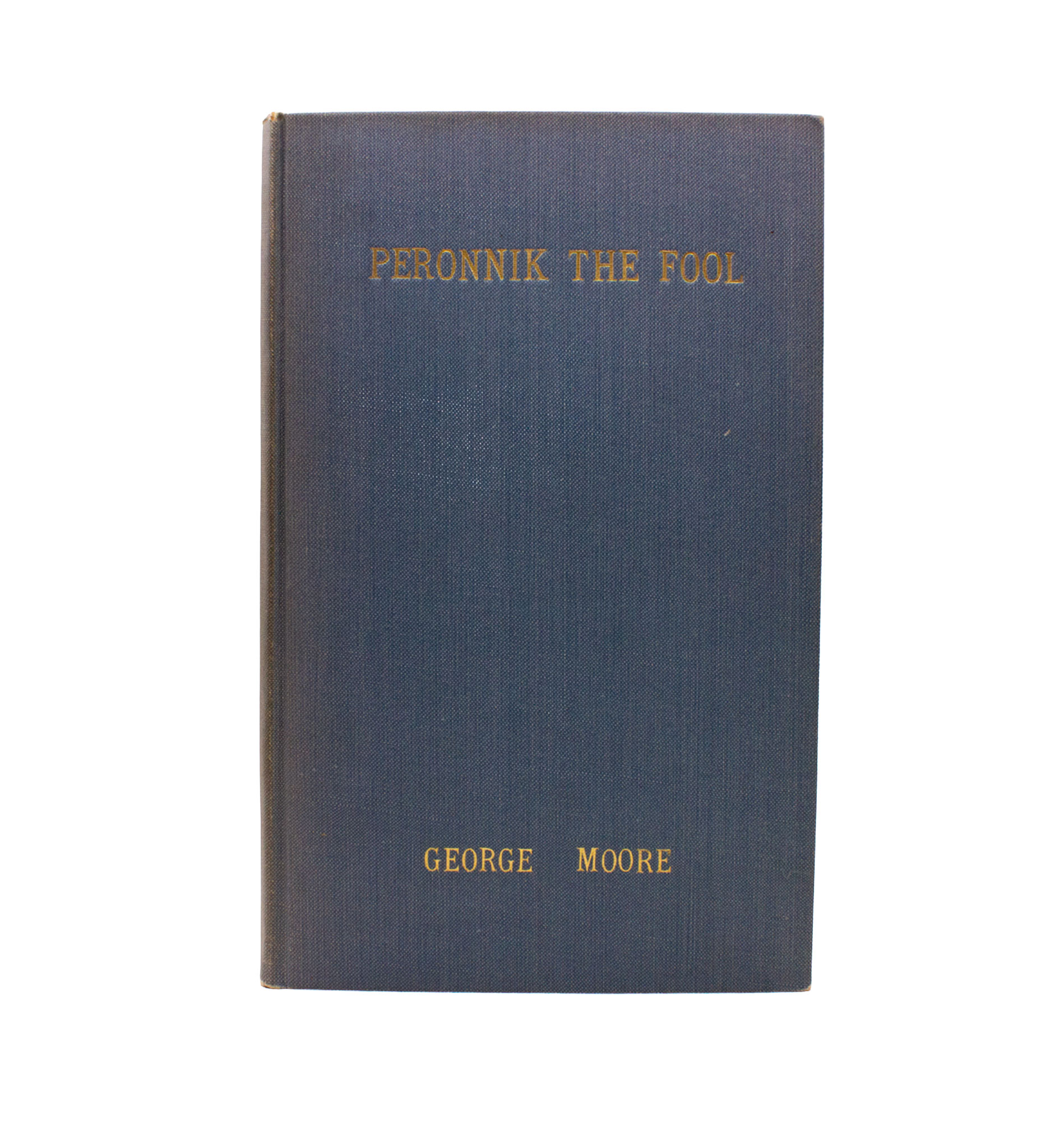
Peronnik The Fool
George Moore
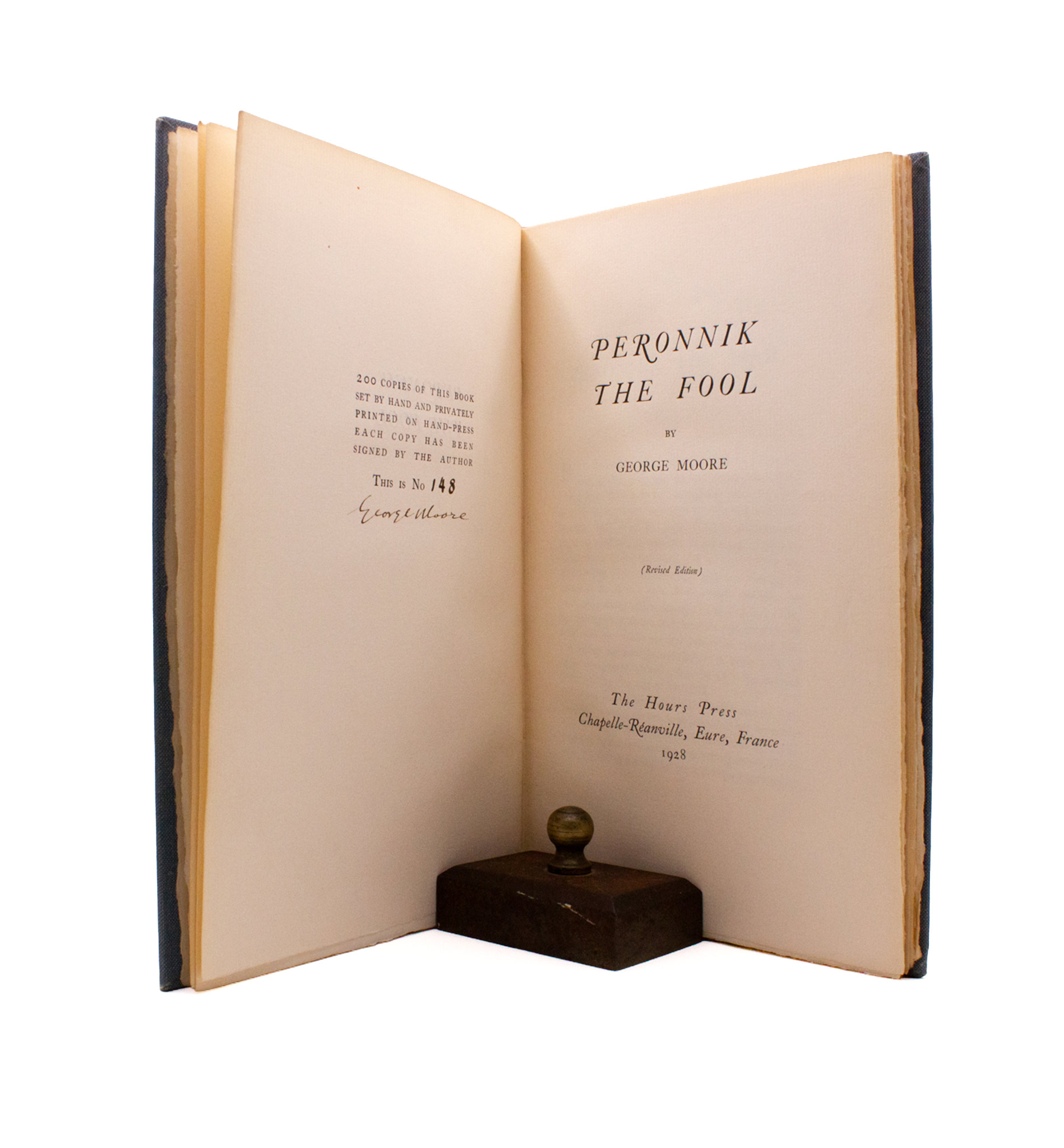
Published Chapelle-Réanville: The Hours Press, 1928
63pp.; 23 x 14.7 cm. Blue cloth boards stamped in gold to front.
December 11, 1928, by Nancy
Cunard and Maurice Lévy
and is the first volume of
THE HOURS PRESS.
In the summer of 1928, Nancy Cunard and her companion, the surrealist poet Louis Aragon, began to convert a Norman farmhouse in Réanville, fifty miles from Paris, into a home, and the stable some twenty-five yards away into a printery. For £300, Bill Bird of The Three Mountains Press (which shared its premises at 27 Quia d’Anjou, Île Saint-Louis with Robert McAlmon’s Contact Editions) had agreed to sell & ship his Mathieu press and all accompanying equipment and accessories to Cunard, as well as sending Maurice Lévy, an experienced printer, to help. Lévy expected to find a “submissive young English woman obediently awaiting his arrival to begin her studies,” and instead found, “[flying] in the face of accepted conventions and long-established rules” Cunard and Aragon already turning out sheaves of announcements and stanzas of Lewis Carroll’s The Hunting of the Snark. (Aragon was later to translate the Snark into French over four or five days, and the published edition remains one of the most desirable publications from The Hours Press.)
George Moore, Cunard’s “first friend,” who was close to her mother, Lady Cunard, and had known Nancy for 30 years, insisted that a revised edition of Peronnik the Fool be granted the honour of the first book published by The Hours Press. The book was printed by Nancy Cunard who worked on it alone during a heatwave, the result of which was an uneven press with the sheets coming out heavily indented at the top and bottom, and she imagined Moore’s voice, “Come, now! This is not printing. This is Braille.”
This copy carries the story of the amateur printer through time: the varied pressures across pages, lighter type, darker type, type carrying through the page, the uneven spacing, and shadow of offsetting. Moore made no mention of such, only commenting on the margins. After four revisions of the title page, the book was published and within ten days had paid for itself. A near fine copy with only light rubbing to the spine edges, and similar to the top and tail of the spine and corners. Some pencil unfortunately erased on the ffep. No. 148 of 200 copies, signed on the limitation page by the author.

tap to cycle
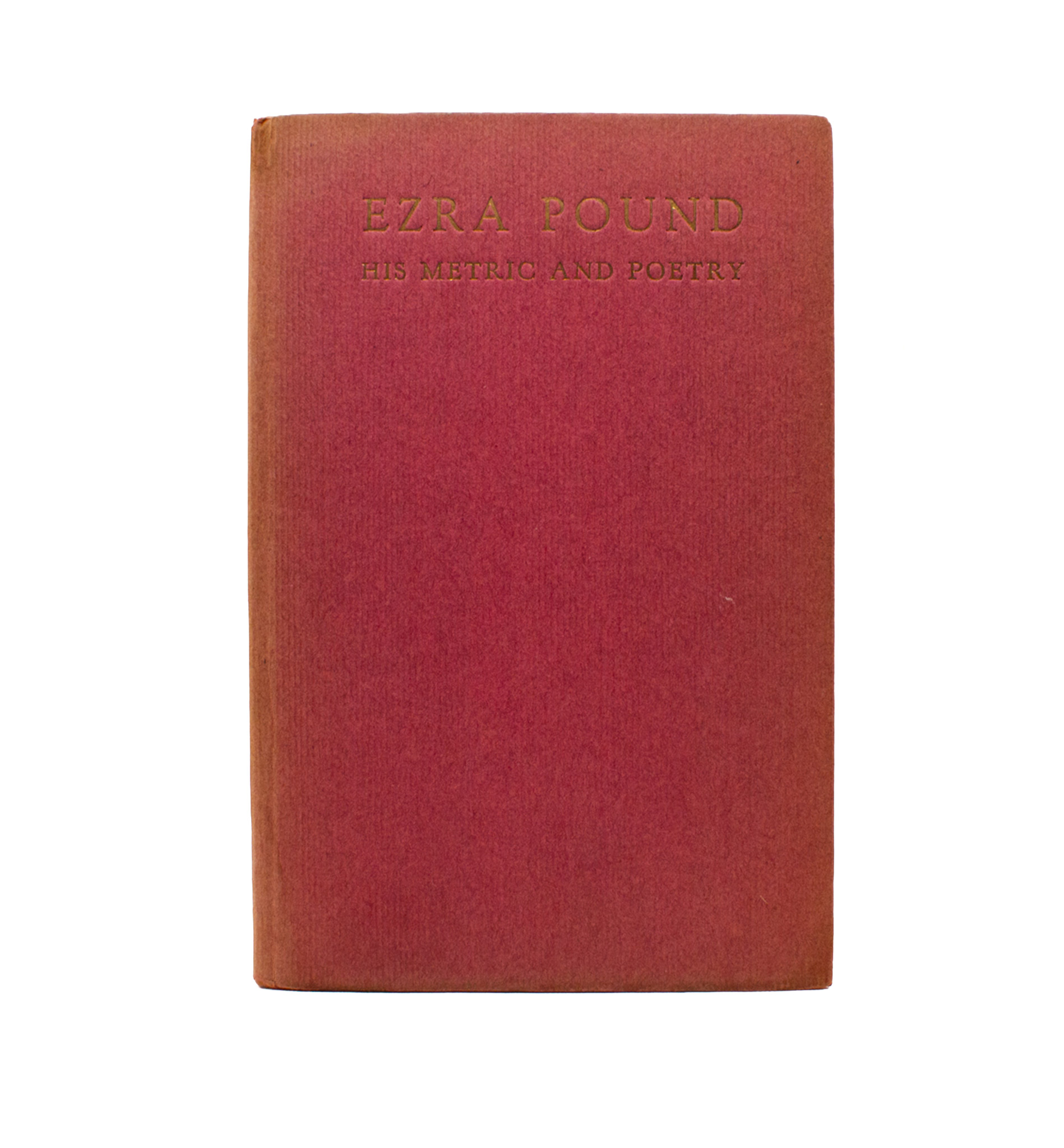
Ezra Pound, His Metric and Poetry
[T. S. Eliot]
Published New York: Alfred A. Knopf, 1917
31pp.; 19.5 x 13 cm. Rose paper boards lettered in gold on front cover.
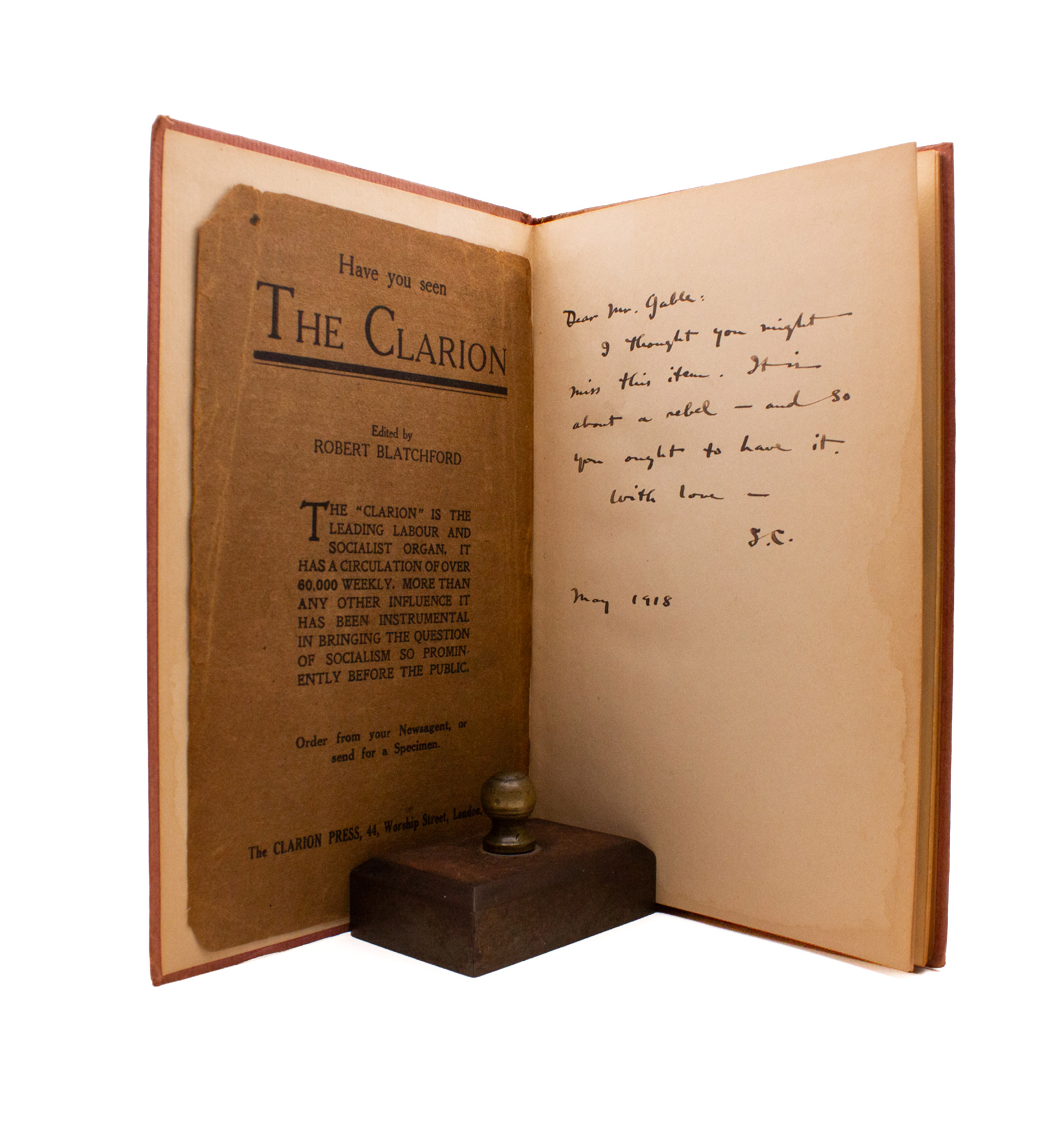
T. S. Eliot’s anonymously published essay on Pound, his second book, with frontispiece by Henri Gaudier-Brzeska and a partial bibliography provided by Pound. One of 1000 copies, this one with a brilliant gift inscription in ink to ffep, dated May 1918 to a Mr. Gable (unidentified) from Sydney Cockerell, museum curator, publisher, secretary to William Morris and renowned collector of Kelmscott Press books, intricately connected to the Socialist movement, reading “I thought you might like this item. It is about a rebel — and so you ought to have it.” Together with an advert for The Clarion, a socialist newspaper edited by Robert Blatchford laid in. A beautifully preserved copy, without any of the usual breaking of the paper boards, lightly sunned to the extremities; light stains along the fore-edges of the endpapers, but nowhere else; two pencil scores highlighting,
Be against all forms of oppression,
Go out and defy opinion.
to p.24. Gallup B17.
tap to cycle
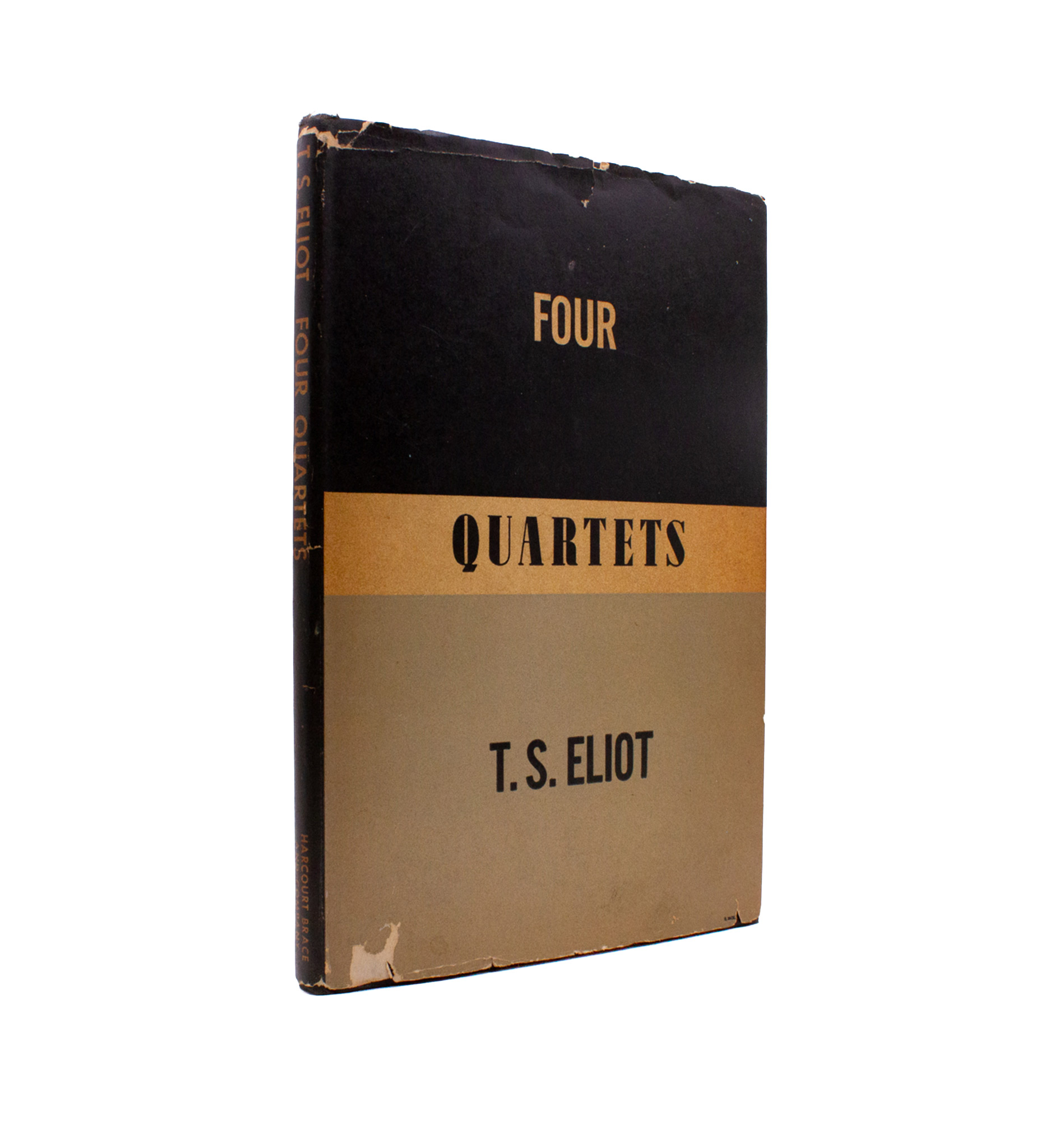
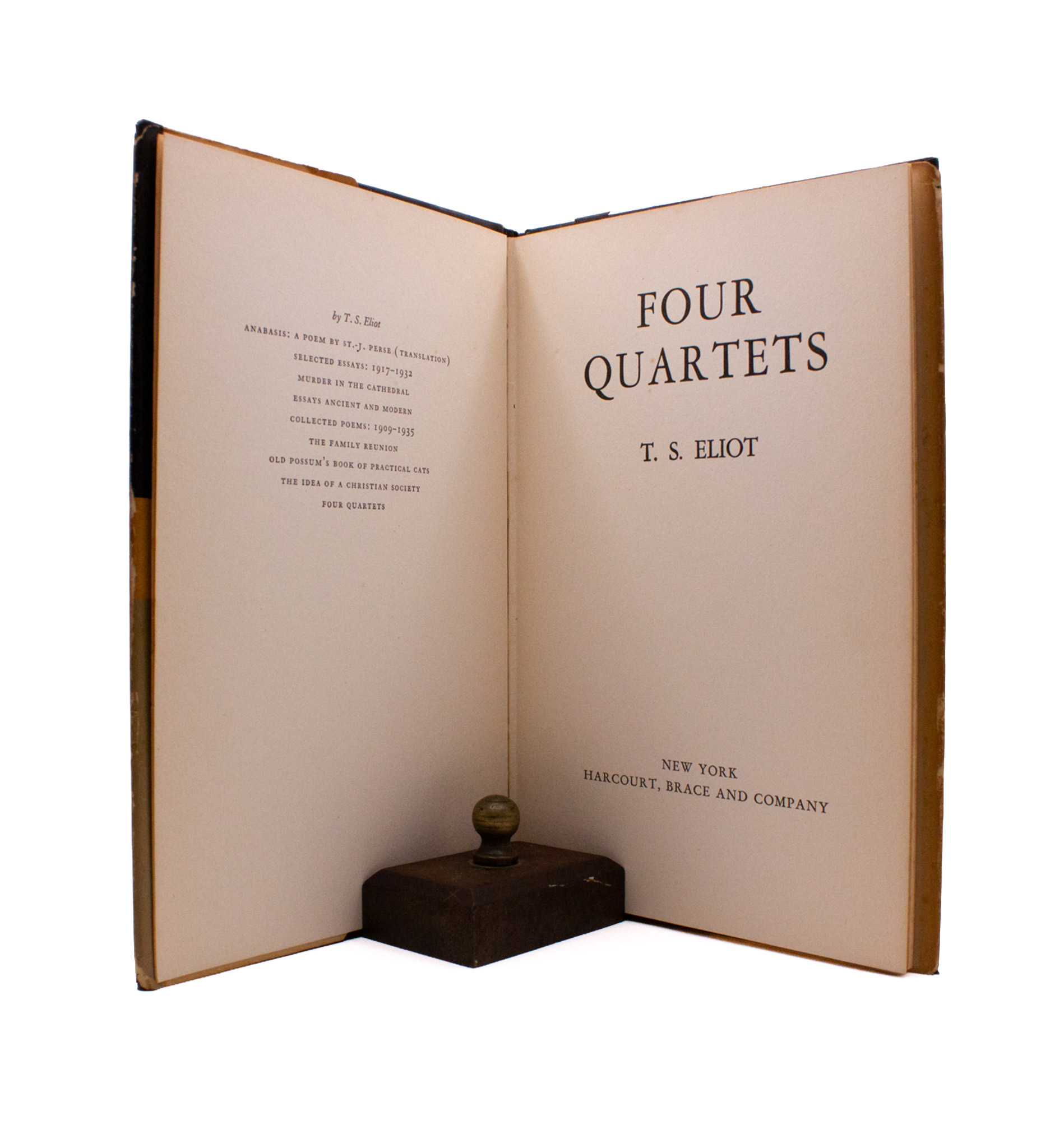
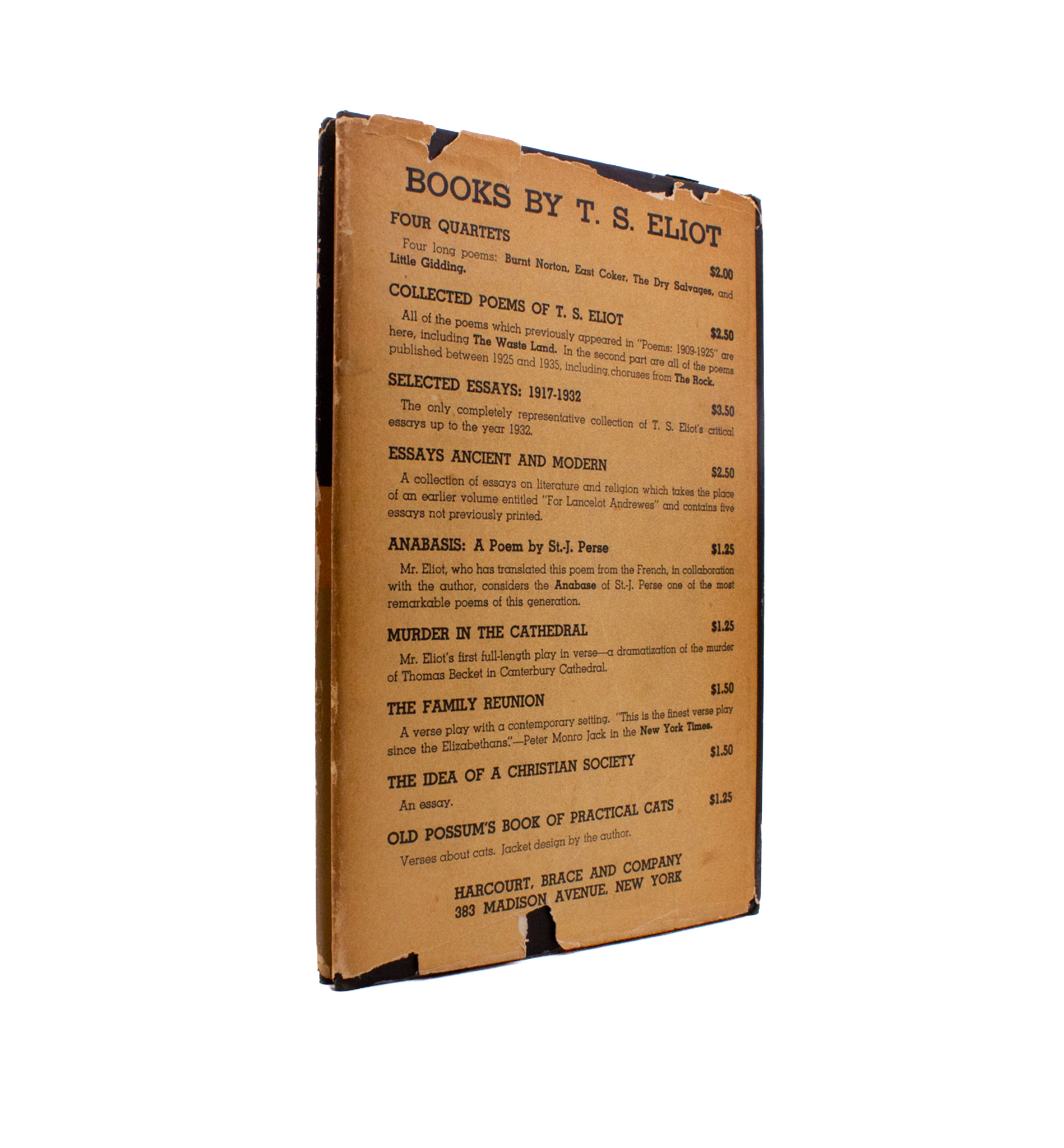
Four Quartets
T. S. Eliot
Published New York: Harcourt, Brace and Company, 1943
39pp.; 22.1 x 14.8 cm. Black cloth boards stamped in gold down spine. Tan paper dust-jacket printed in white, black and green.
First edition, first impression of T.S.E’s Four Quartets, with “first American edition” to the copyright page. One of 788 copies to escape the publisher before the run was destroyed because of the misalignment of the text resulting in uneven margins. With the pencil ownership inscription of “Lallie Edie” to second front-facing blank and “Polly Langford Edie” to rfep. Neatly annotated in pencil throughout. Light and contained stain to the top of p.17, but leaves beautifully fresh. Endpapers and pastedowns lightly browned. Light wear and a few marks to the cloth. In the original, first state dust-jacket, a little chipped at edges.