de Beaumont Rares
debeaumontrares@gmail.com

Ezra Pound, VIII
Cover, a Vortograph of Ezra Pound by Alvin Langdon Coburn (1916-17). A similar 1960’s reproduction hangs above my Archivist, con gratitud.
6 June 26
tap to cycle
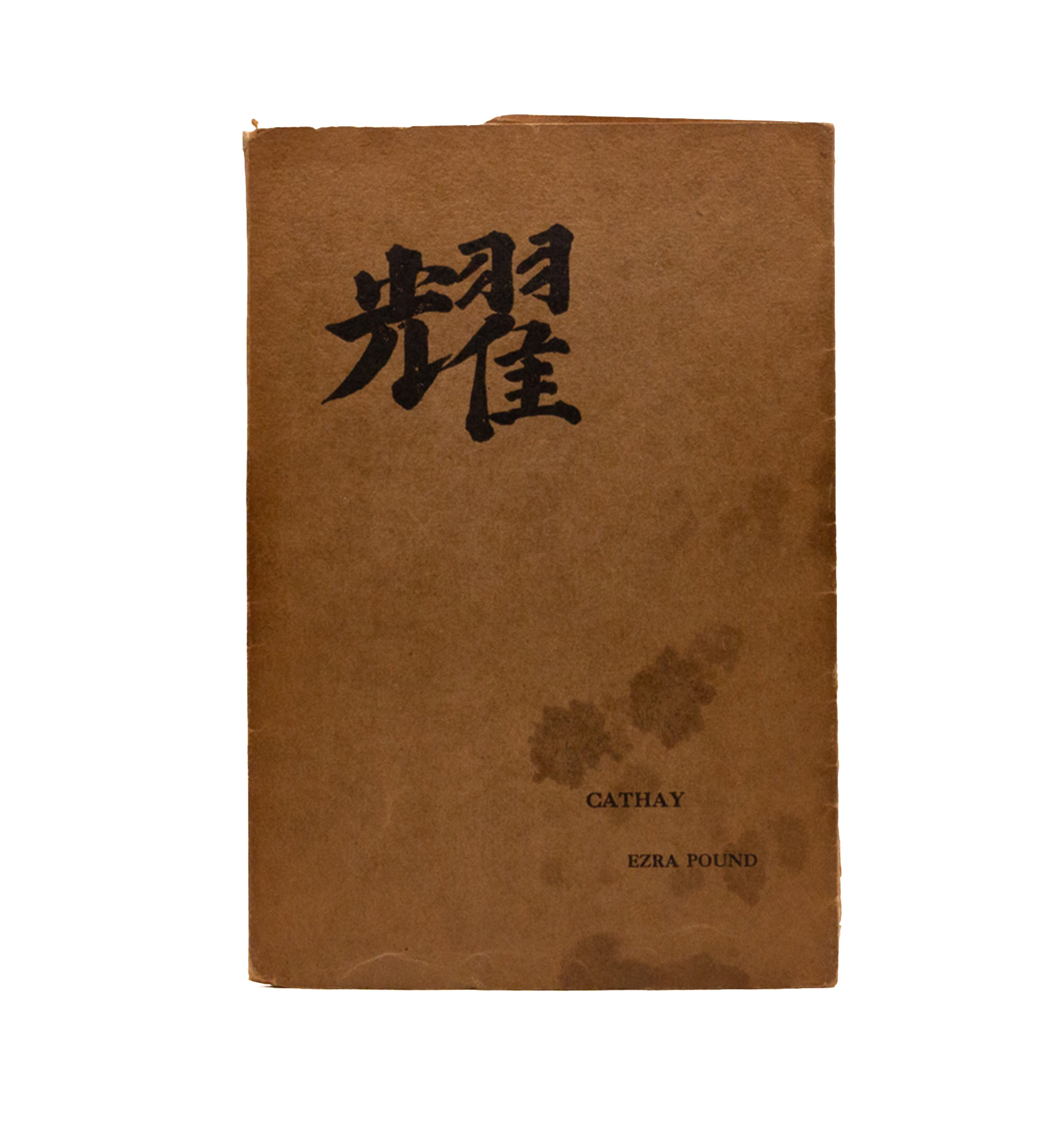
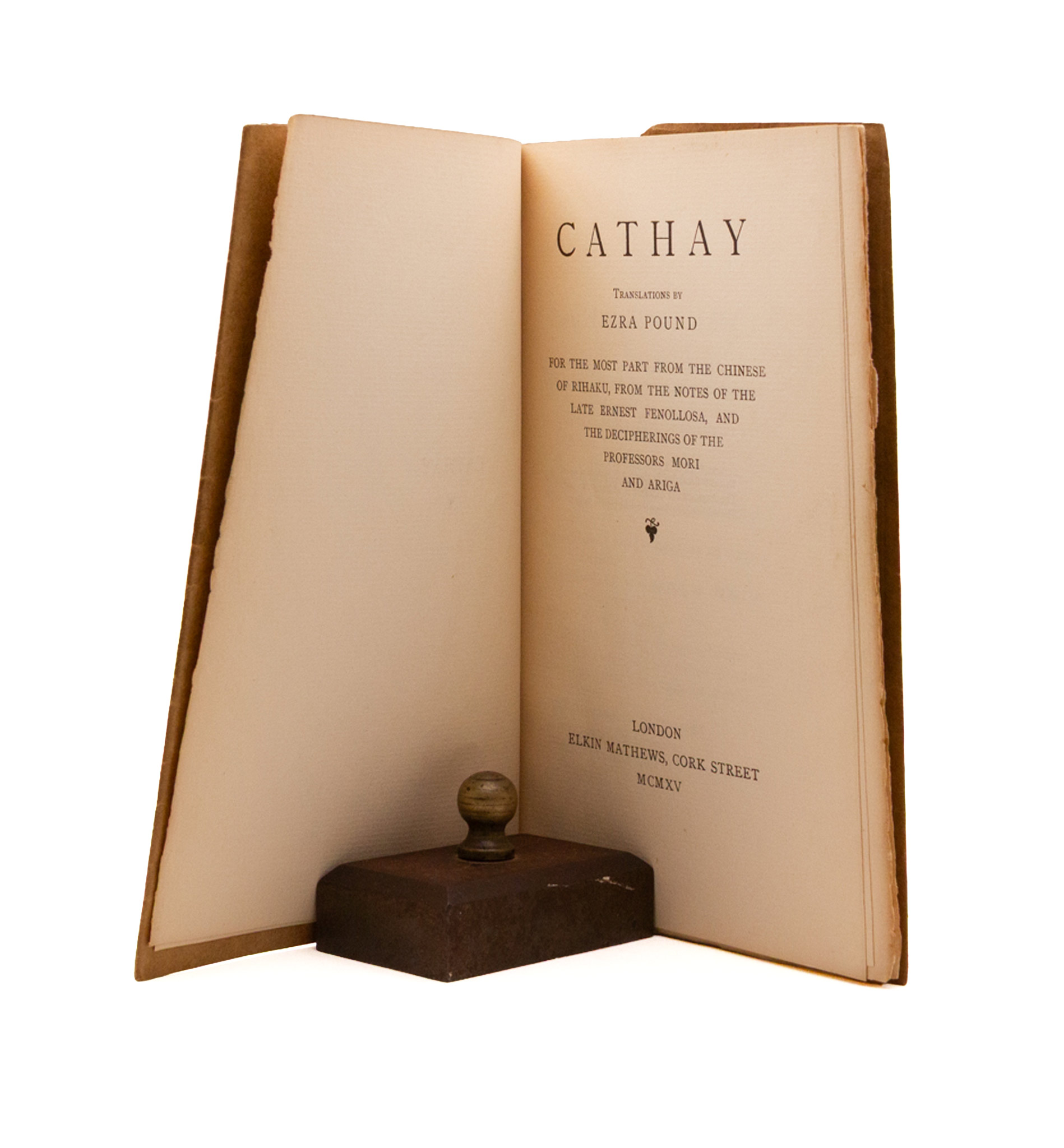
Cathay
Ezra Pound
Published London: Elkin Mathews, 1915
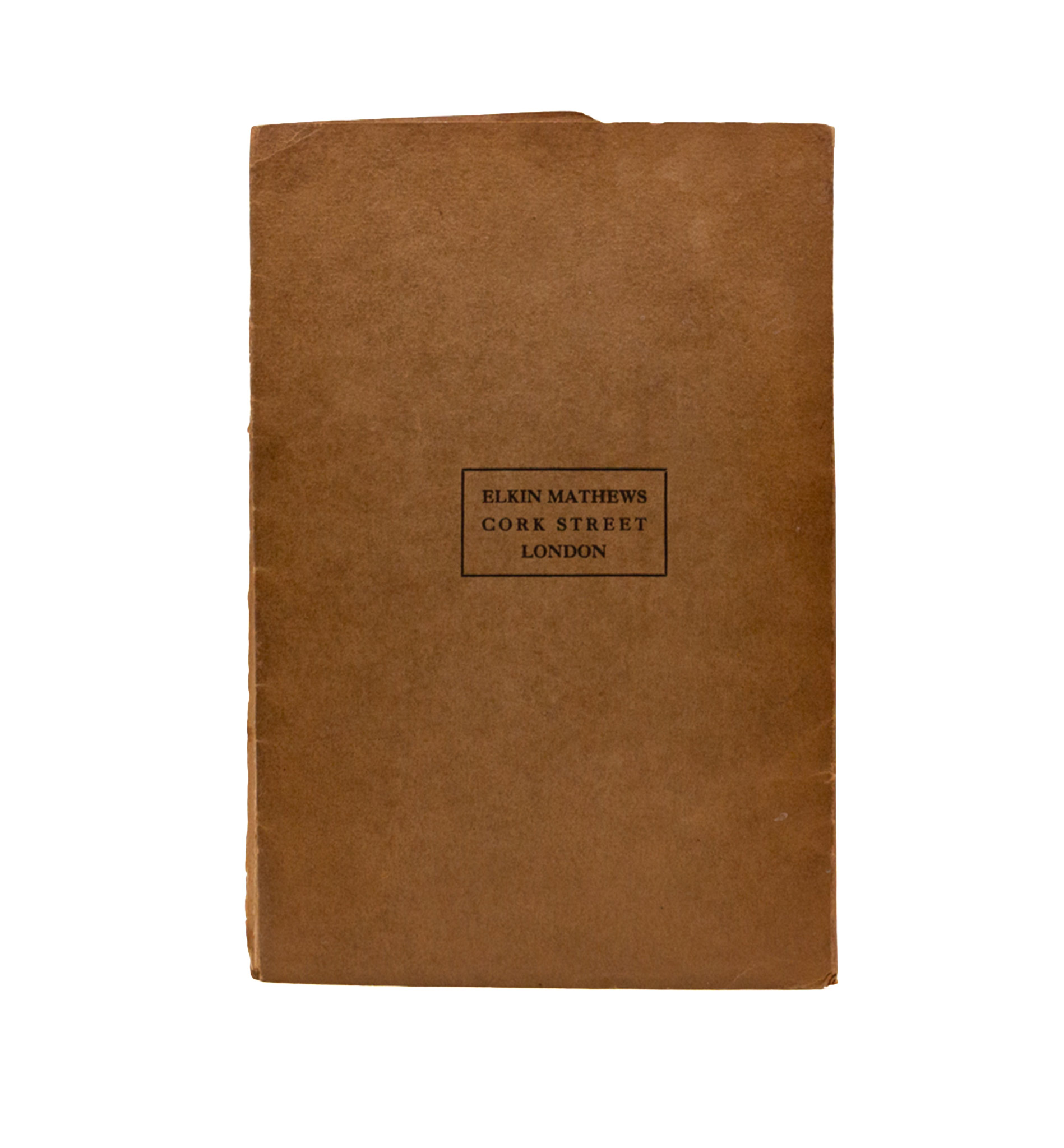
31pp.; 19.3 x 13.2 cm. Heavy tan paper wrappers printed in black, folded over end-papers.
Containing some of Pound’s most beautiful poems, translations by Ernest Fenollosa from the Chinese of Li Bai, reworked by Pound. One of 1000 copies. Wraps very lightly age-worn with darkneing along the spine and an unfortunate few dark stains to the front cover (petals on a wet, black bough); inside the best copy one could hope for, without a spot of fox as is common for this book. Gallup A9.
tap to cycle
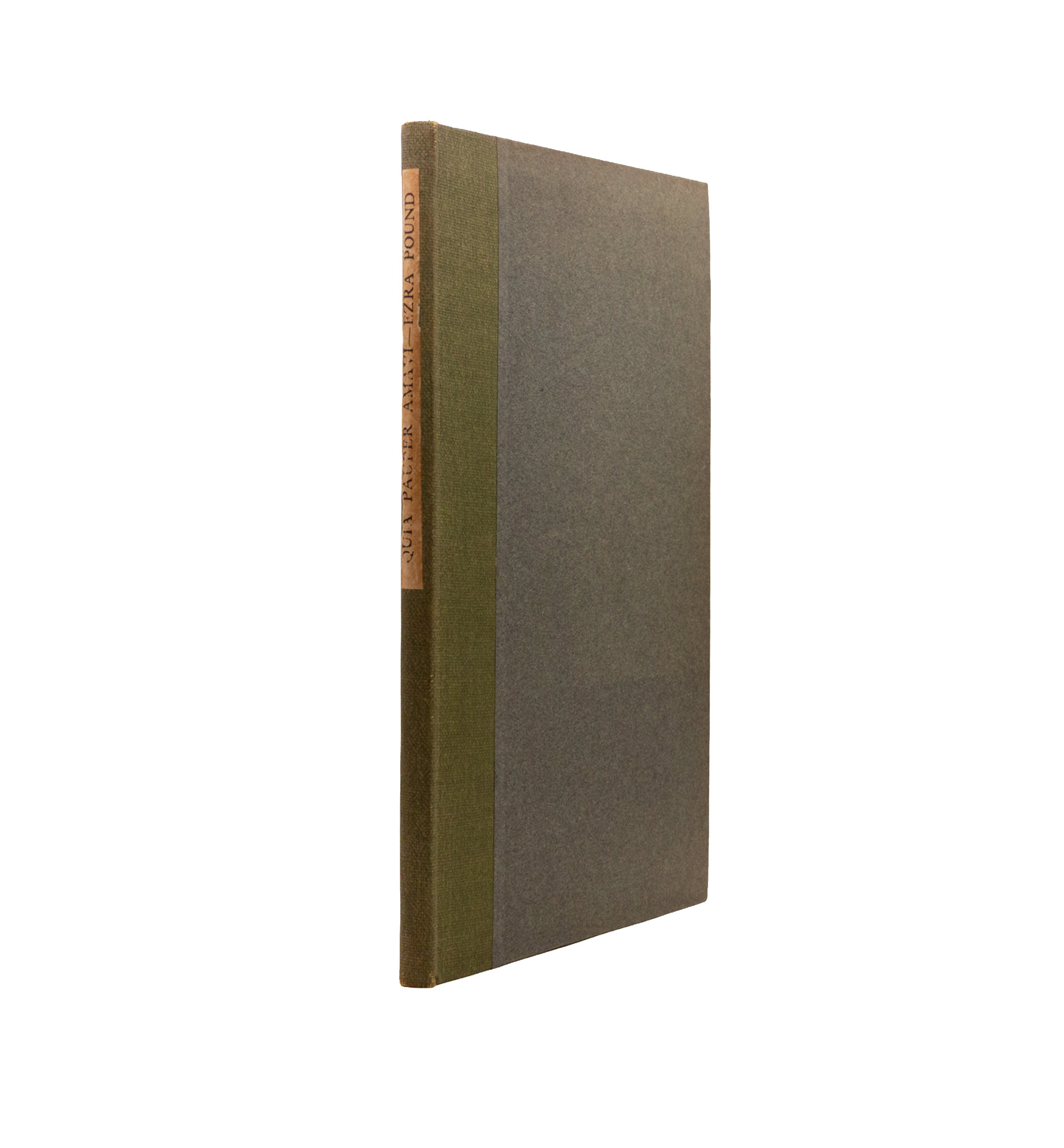
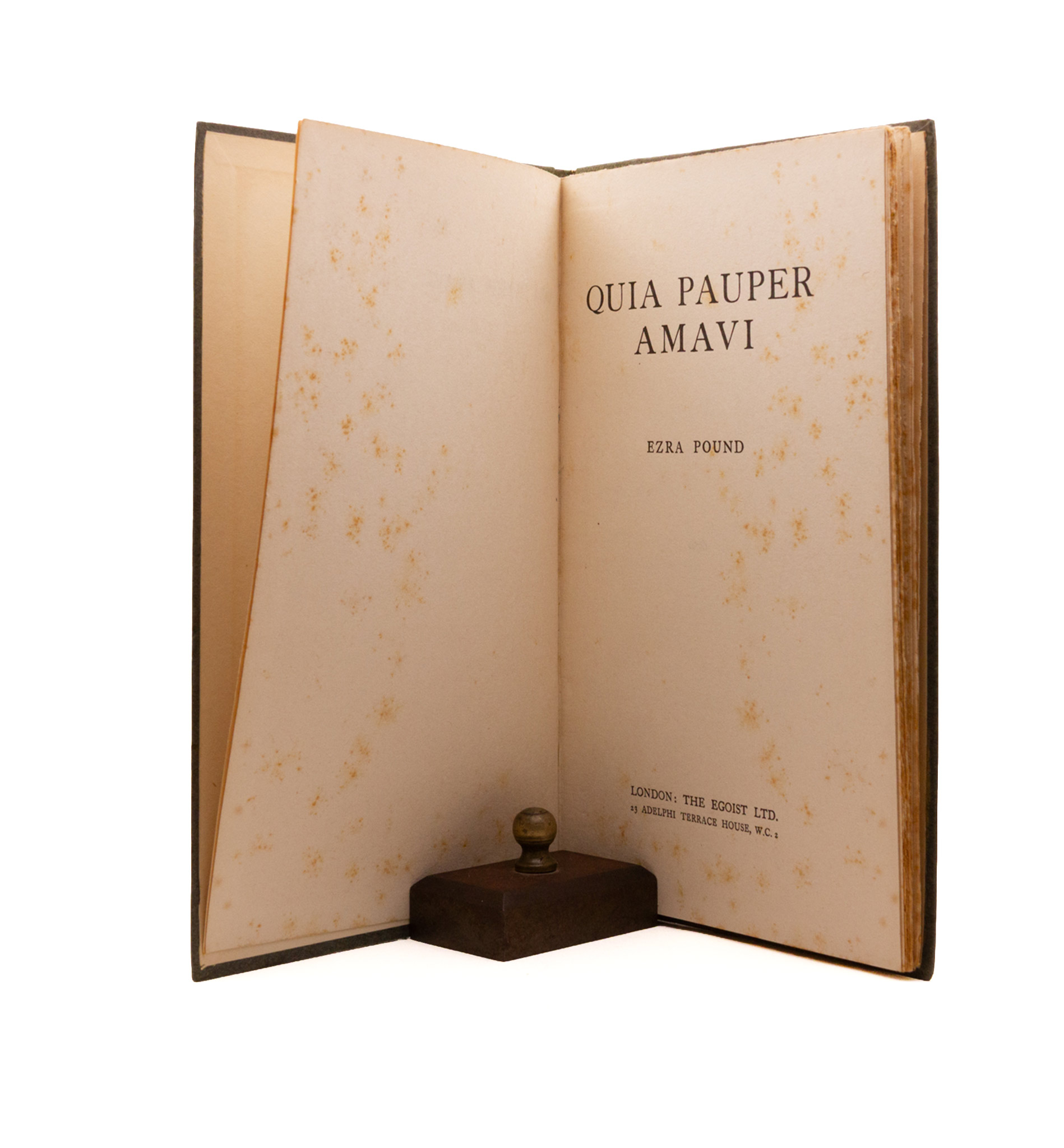
Quia Pauper Amavi
Ezra Pound
Published London: The Egoist Ltd., 1919
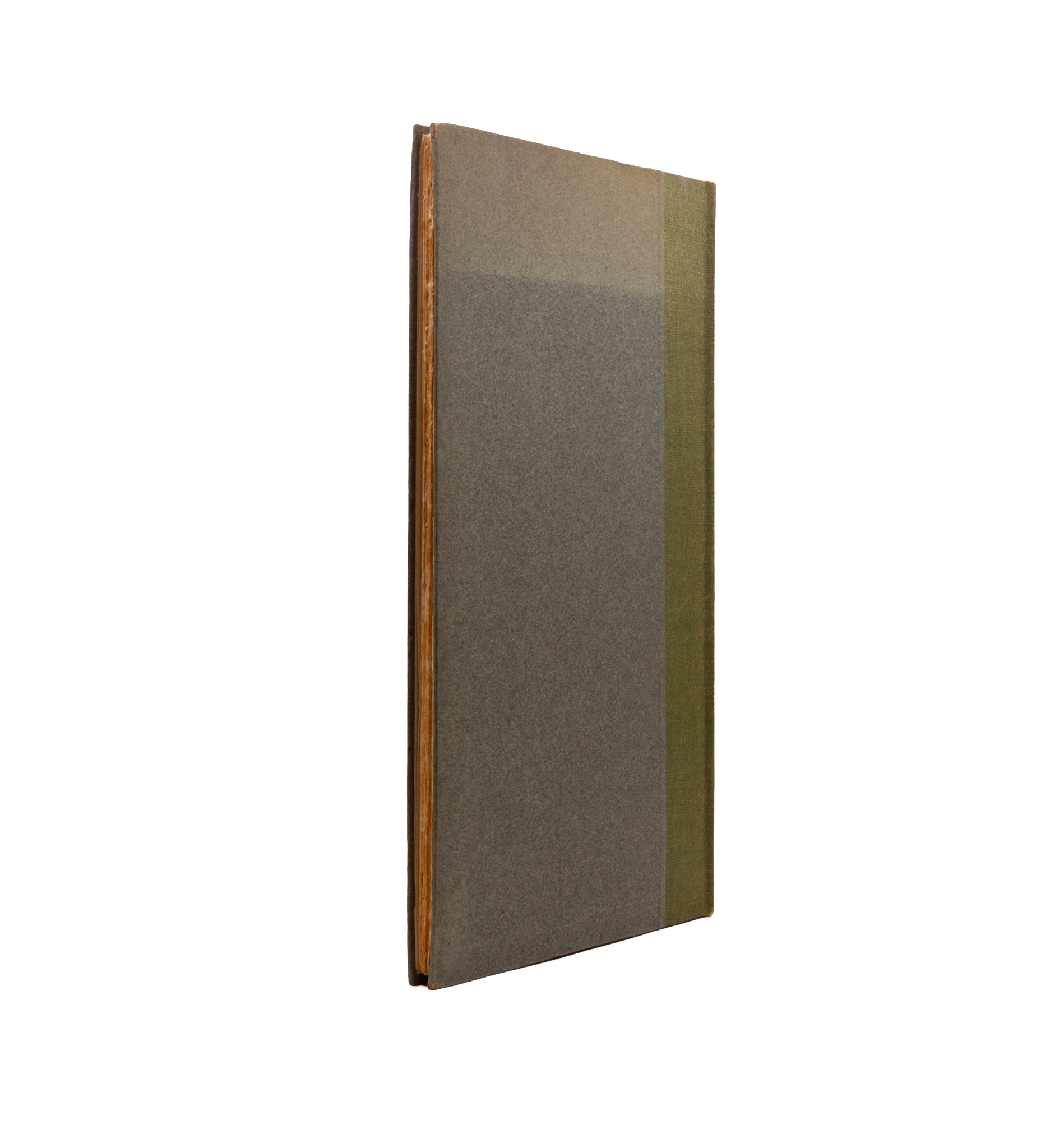
51pp.; 25.4 x 15.9 cm. Olive-green paper boards back in green cloth. Paper label printed in black up spine.
QPA, one of 500 copies printed by The De La More Press, London, and published by The Egoist. Contains a number of poems by Pound, “Langue d’Oc”, “Moeurs contemporaines” and “Three Cantos” (the Urcantos). With the misprint “Wherefore” instead of “Wherefrom” on p.34 uncorrected. Externally near fine, just a touch of shelf-wear at top and tail of spine, the label a little rubbed. Internally foxed throughout, but nice nonetheless. Gallup A17a.
tap to cycle
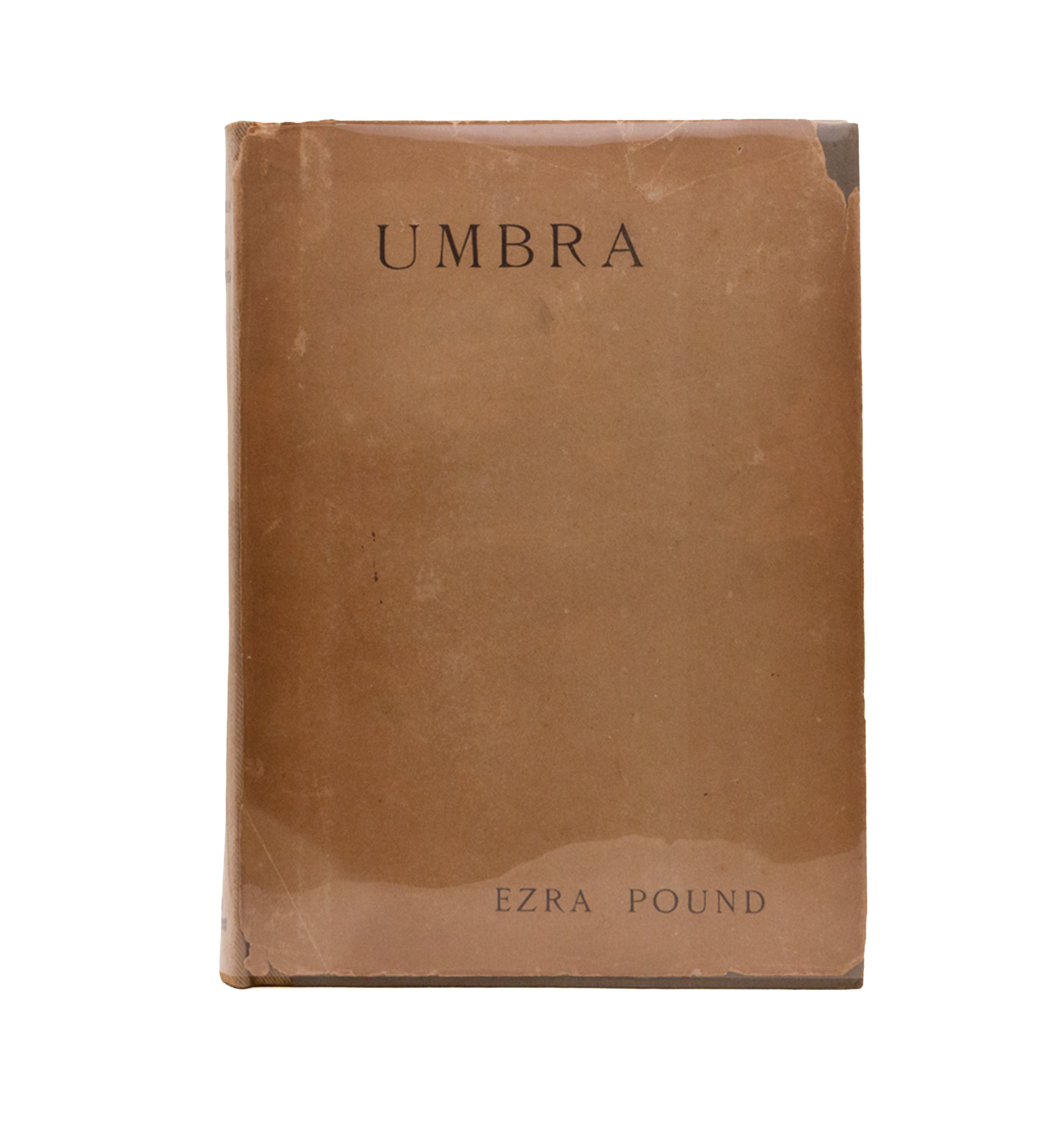
Umbra
Ezra Pound
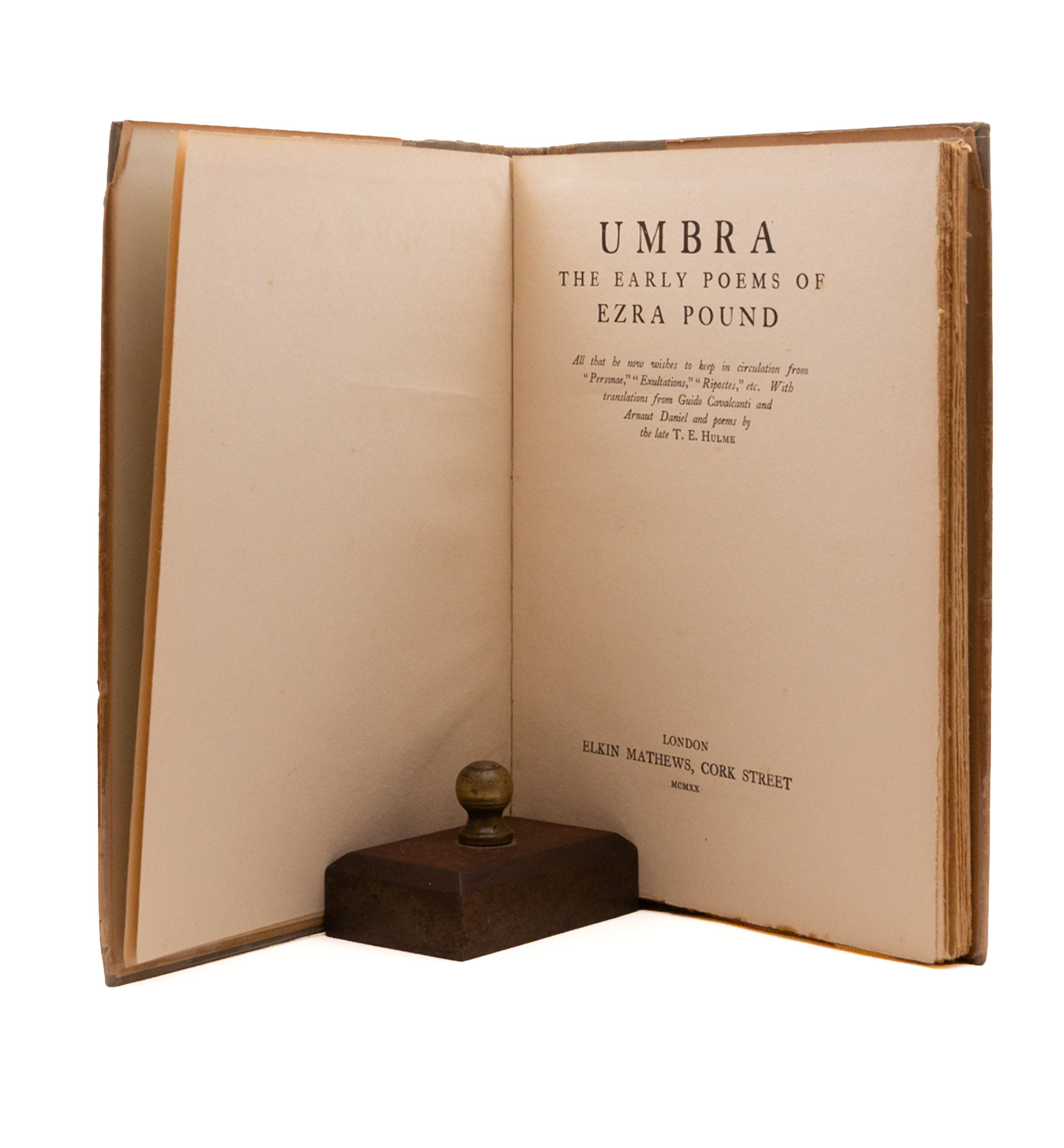
Published London: Elkin Mathews, 1920
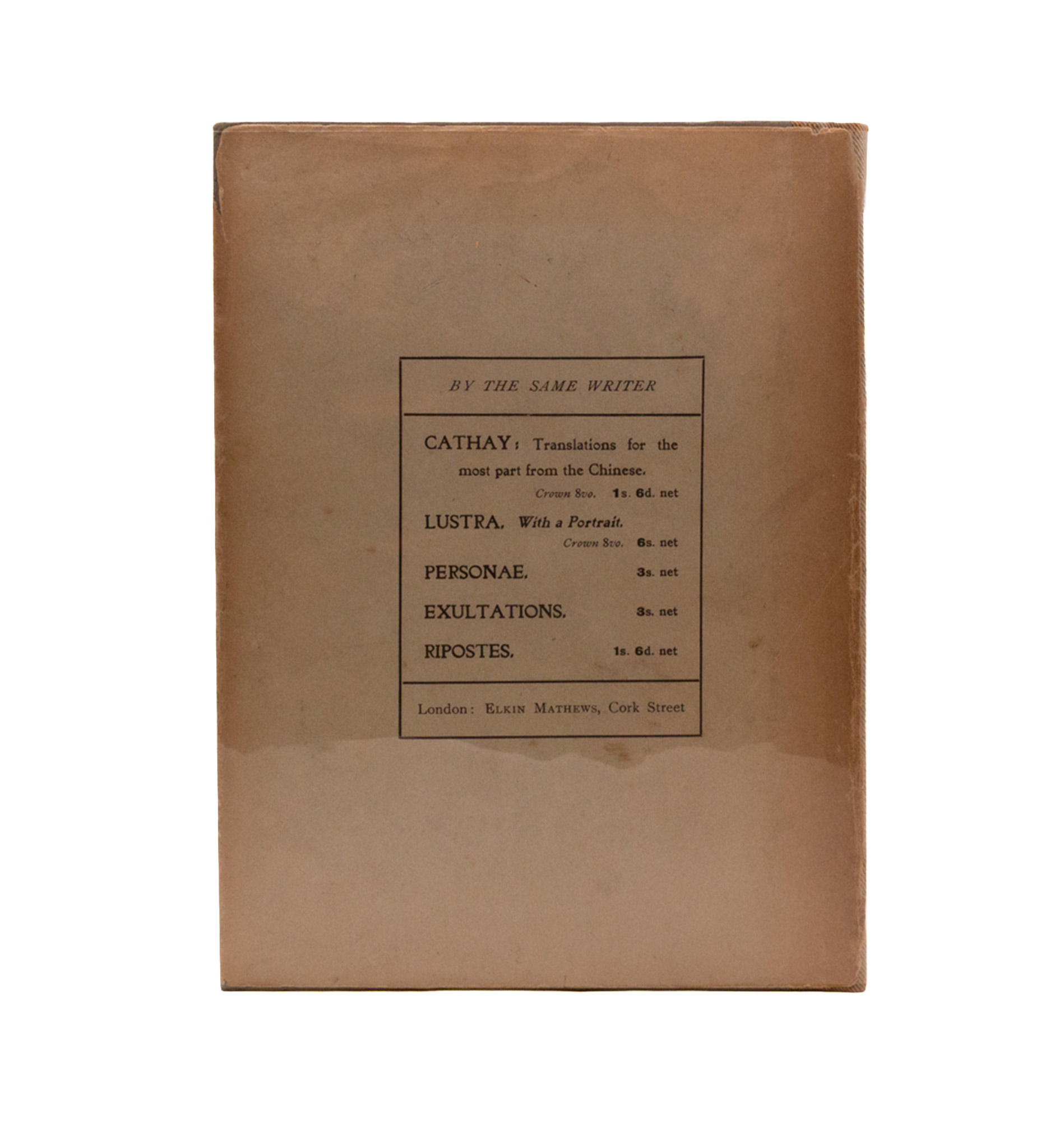
128pp.; 19.7 x 14.3 cm. Grey paper covered boards backed in canvas lettered in blue to front and spine. Grey-blue dust-jacket printed in black.
First edition, one of 1000 copies for trade. With the scarce and beautiful dust-jacket, covers only, without spine; spine-title remaining and laid-in; small chips, tears and a little loss to the front-cover; back-cover complete with good colour radially fading; flaps complete with even better colour showing the original duck-egg blue. Some browning to end-papers. A small piece of Japanese newspaper laid in on pp.10-11, marked in pen, “24.2.21 / E. Pound,” with offsetting. Gallup A20.
tap to cycle
Profile
Ezra Pound, editor
Published Milan: [Giovanni Scheiwiller], 1932
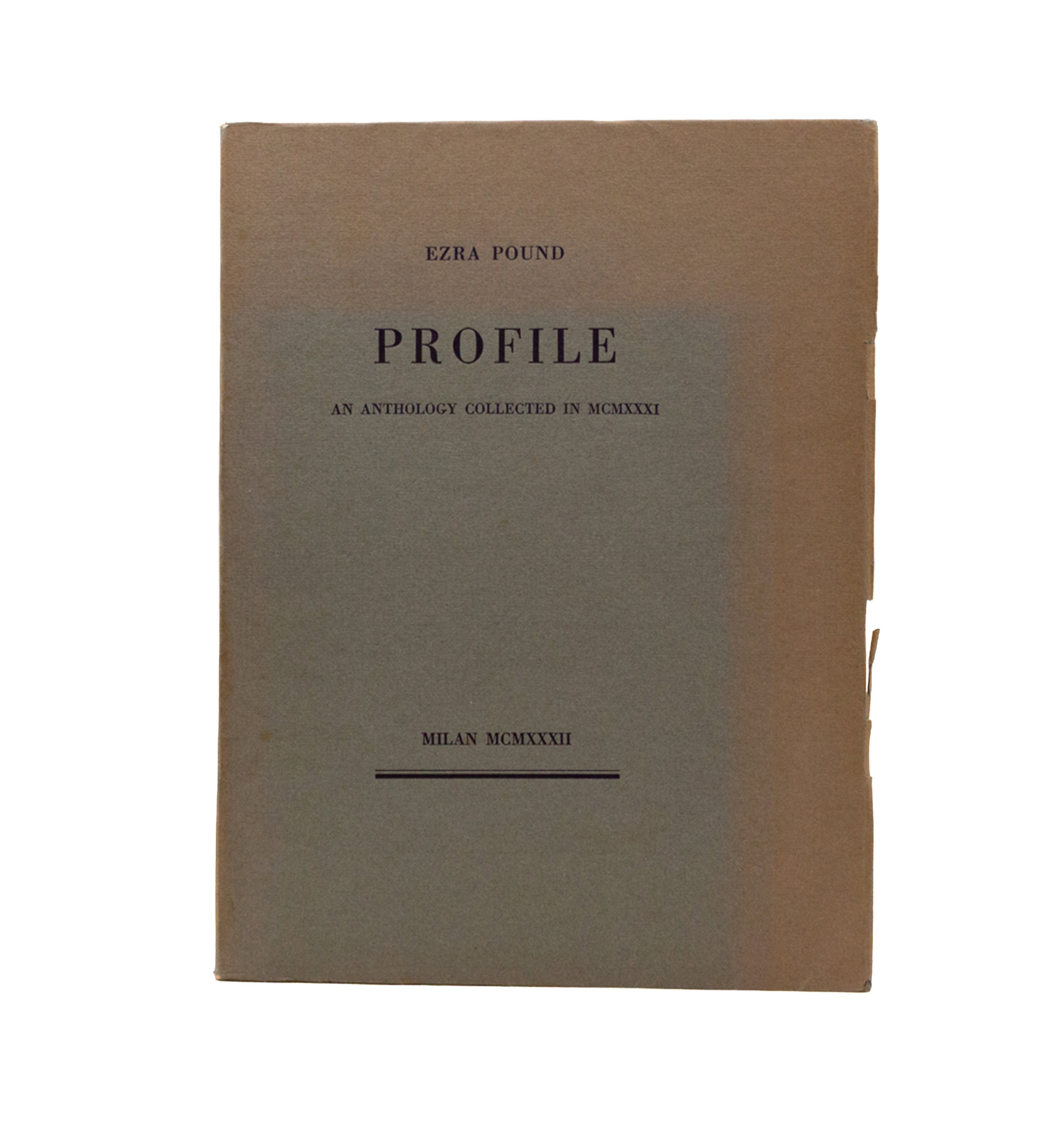
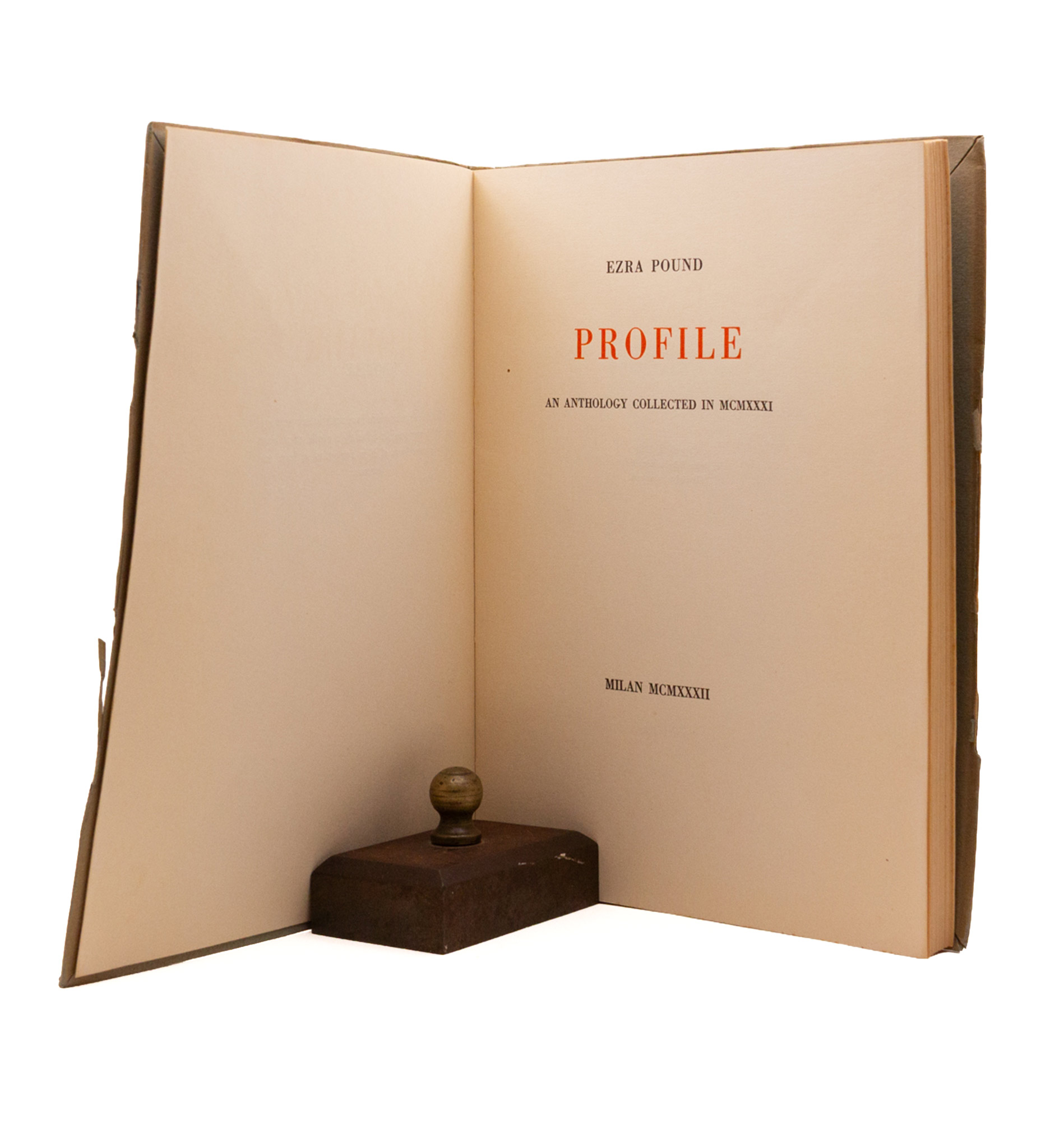
142pp.; 20.7 x 15.8 cm. Green paper wrappers printed in black.
“A collection of poems which have stuck in my memory and which may possibly define their epoch, or at least rectify current ideas of it in respect to at least one contour.”
Collected in 1931 and published in 1932, the third of EP’s six poetry anthologies (editorial of Exile aside). Number 29 of 250 copies printed privately by John [Giovanni] Scheiwiller. With poems by a slew of great names, James Joyce, William Carlos Williams, H. D., Yeats, Eliot, Marianne Moore, Mina Loy, e. e. cummings, Ernest Hemingway, Robert McAlmon, Ralph Cheever Dunning, Louis Zukofsky, … it goes on. Presented chronologically with Pound’s interspersed commentary to guide the reader. Fine inside; the covers somewhat faded with a little chipping to the oversized fore; spine without any creasing. Gallup B28.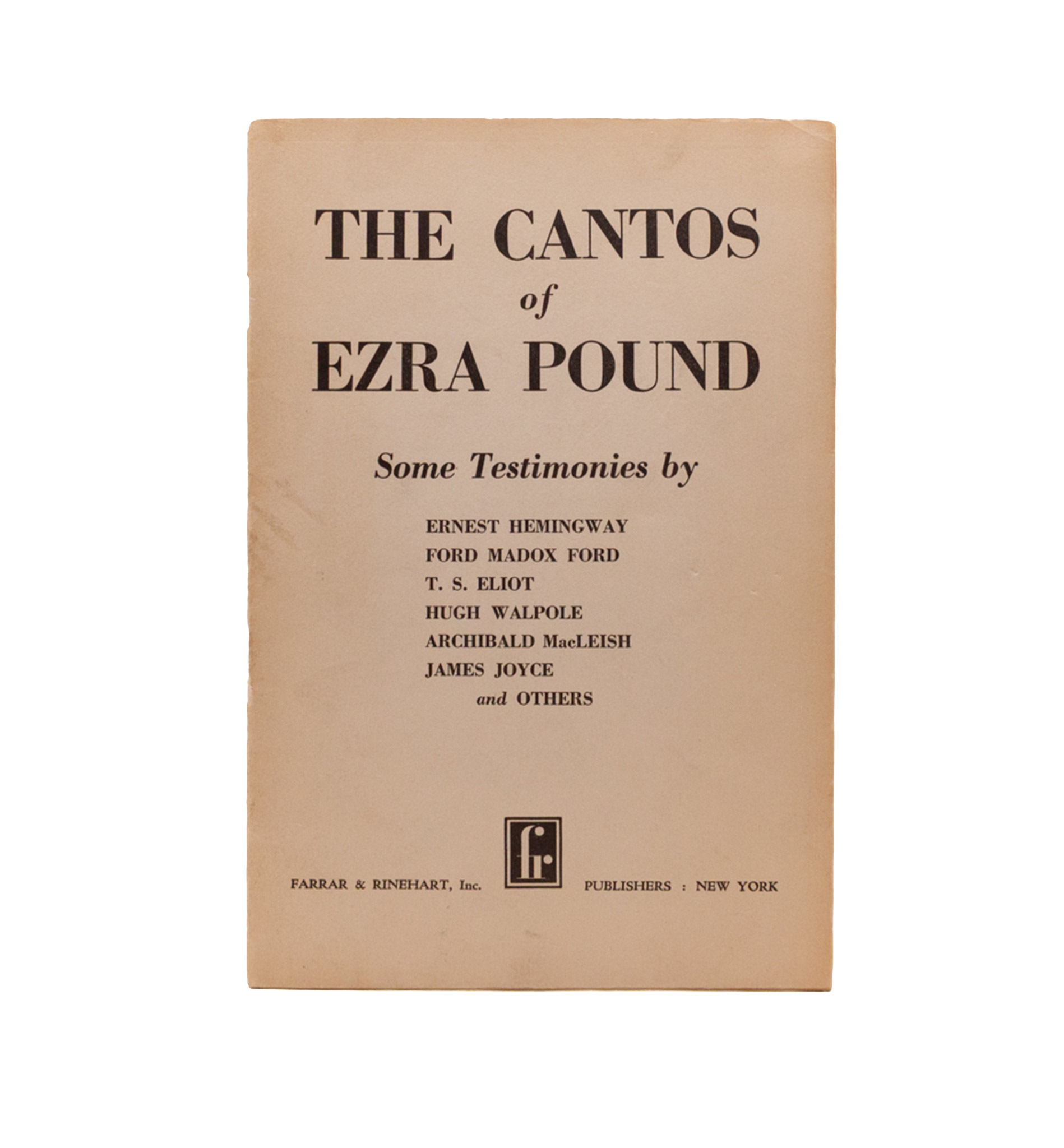
tap to cycle
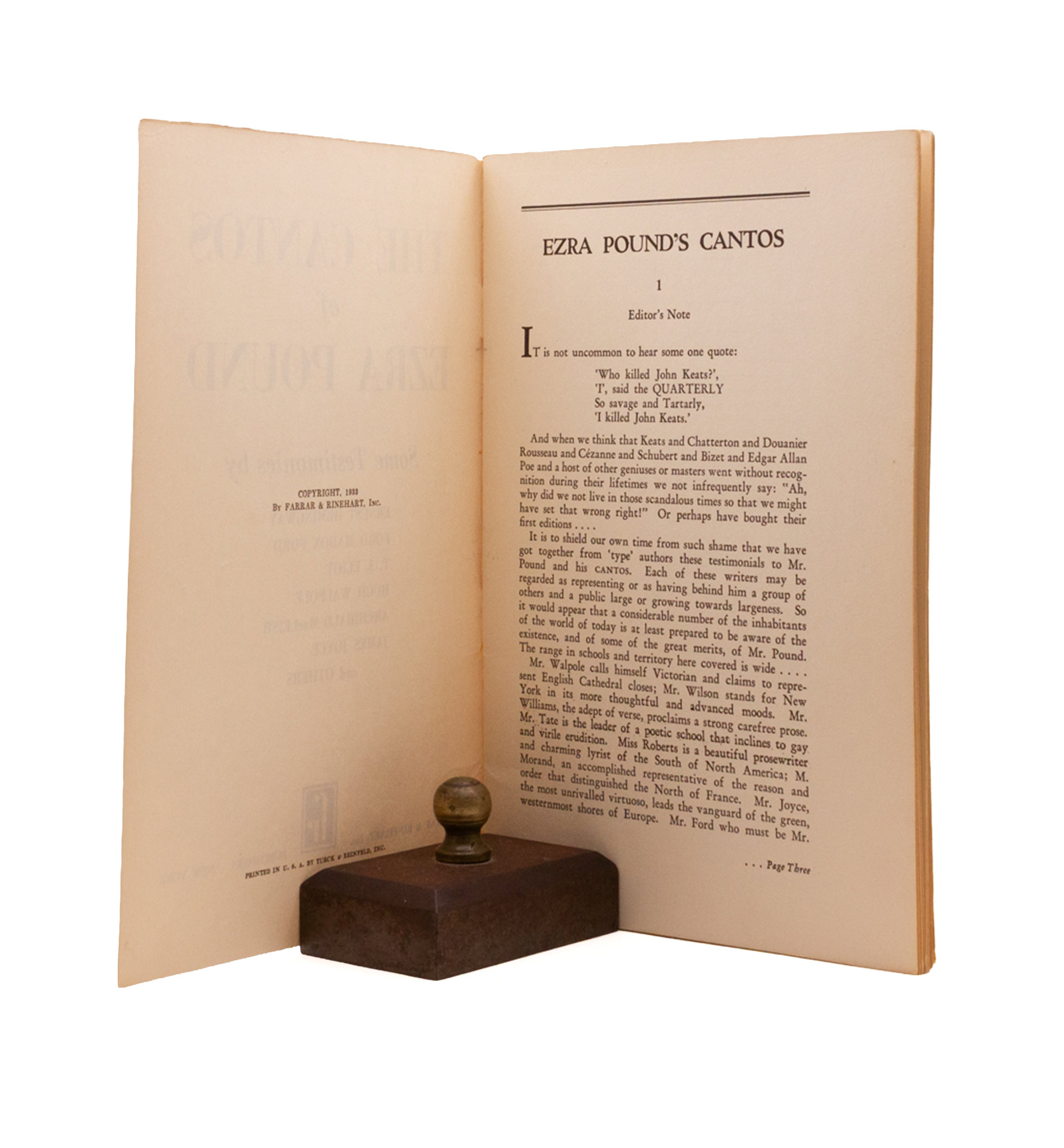
The Cantos of Ezra Pound, Some Testimonies
[Ford Madox Ford, curator]
D. C. [?], editor
Ernest Hemingway, T. S. Eliot, James Joyce, H. D., William Carlos Williams etc.
Published New York: Farrar & Rinehart, 1933
22pp.; 19.7 x 13.3 cm. White paper wrappers printed in black; wire-stitched.
A leaflet curated by F. M. Ford and at his instigation in a letter to the publishers to accompany the first American edition of Pound’s Draft of XXX Cantos, distributed gratis. Contains tributes to EP from a brilliant selection of writers, being: Hugh Walpole; Edmund Wilson; William Carlos Williams; Allen Tate; Elizabeth Madox Roberts; Francesco Monotti; Archibald MacLeish; Paul Morand; James Joyce; Ernest Hemingway; Ford Madox Ford; T. S. Eliot; H. D.; John Peale Bishop; Basil Bunting. Opening with an “Editor’s Note” signed D. C. who is probably someone at F&R, but may be Desmond Chute. A near fine copy; scarce, let alone in this condition: a little fading along the spine and top edge, a couple light marks to the covers, and very gently handled. Detailed under Gallup A31c.
tap to cycle
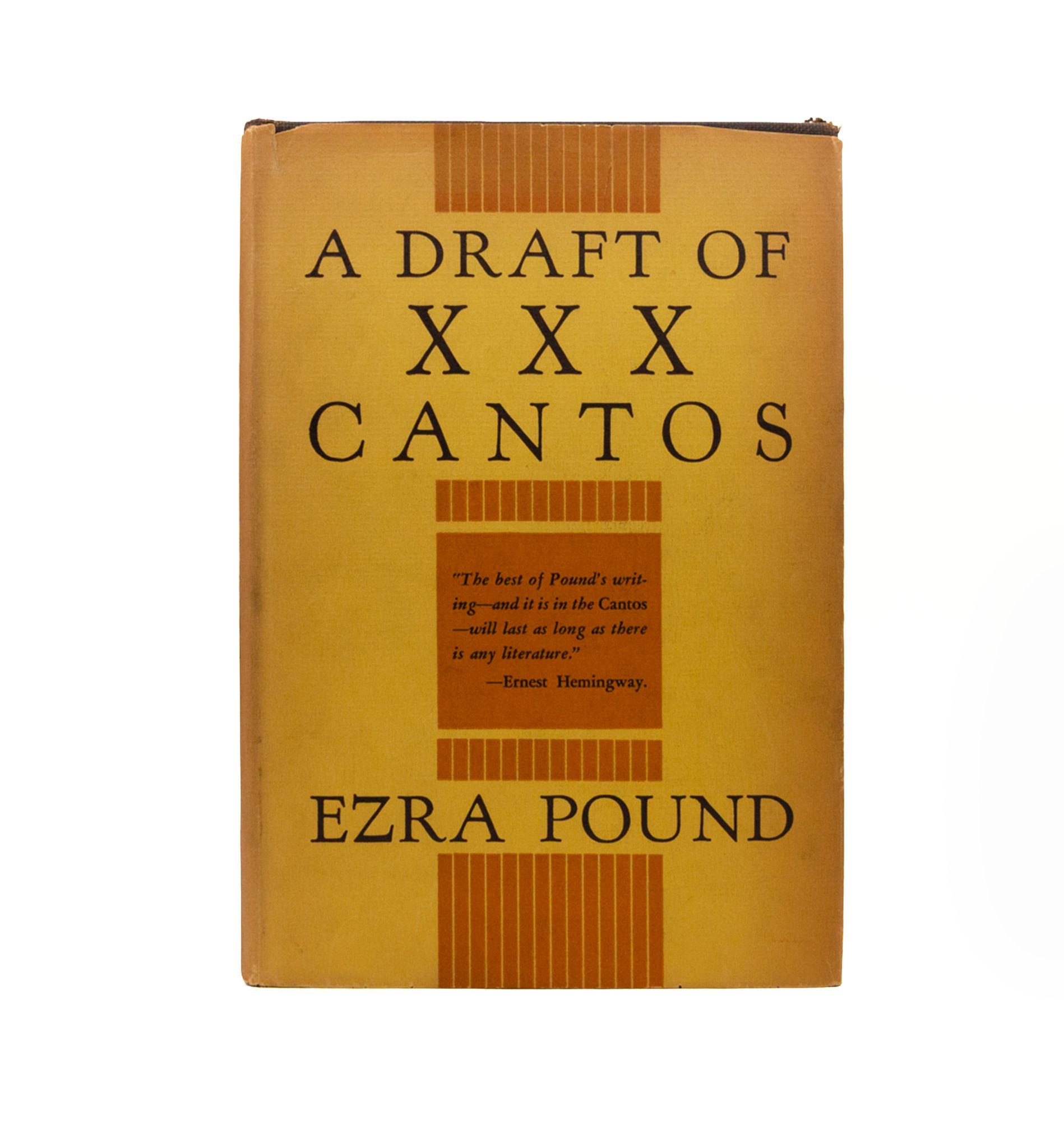
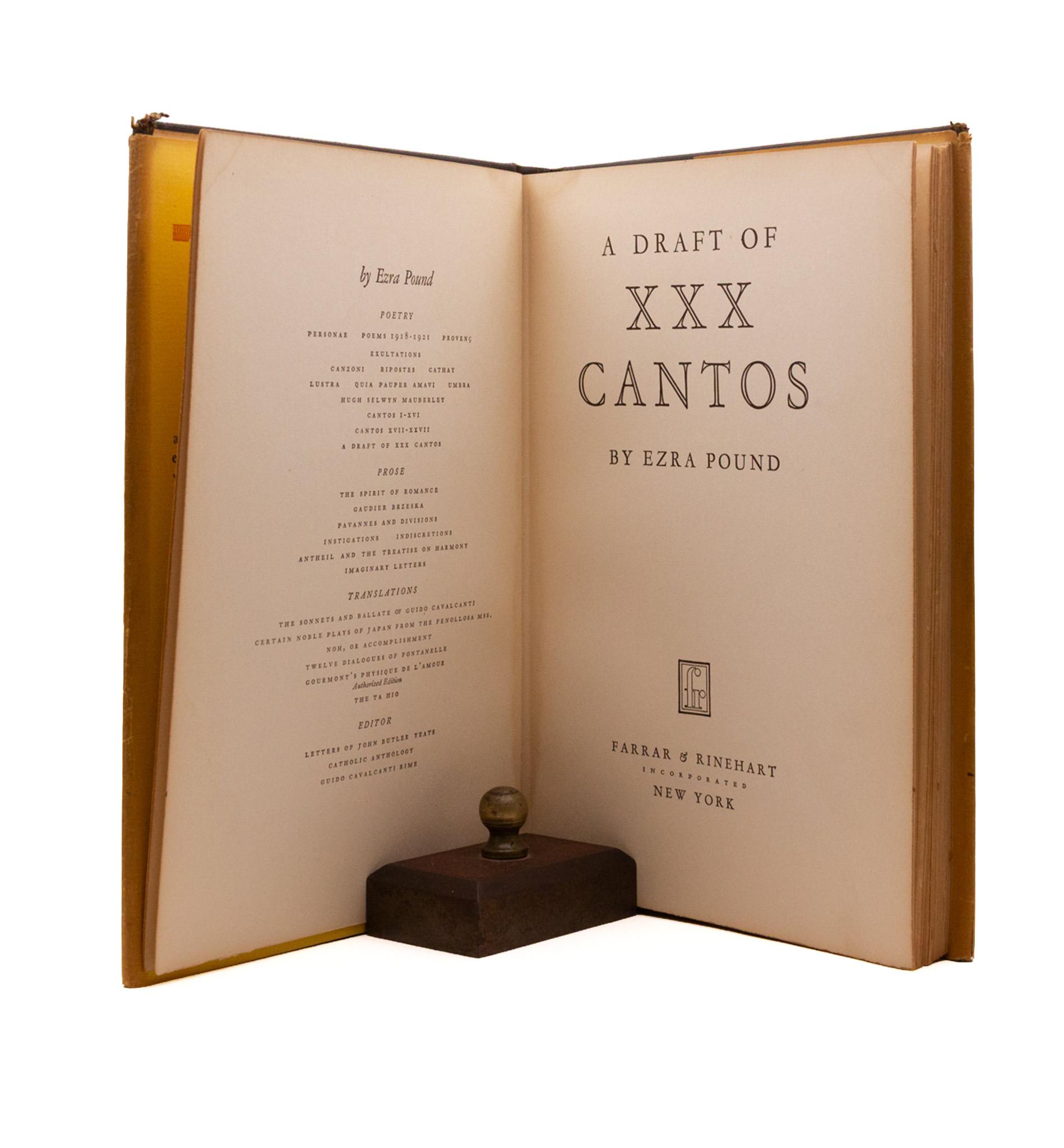
A Draft of XXX Cantos
Ezra Pound
Published New York: Farrar & Rinehart, Incorporated, [1933]
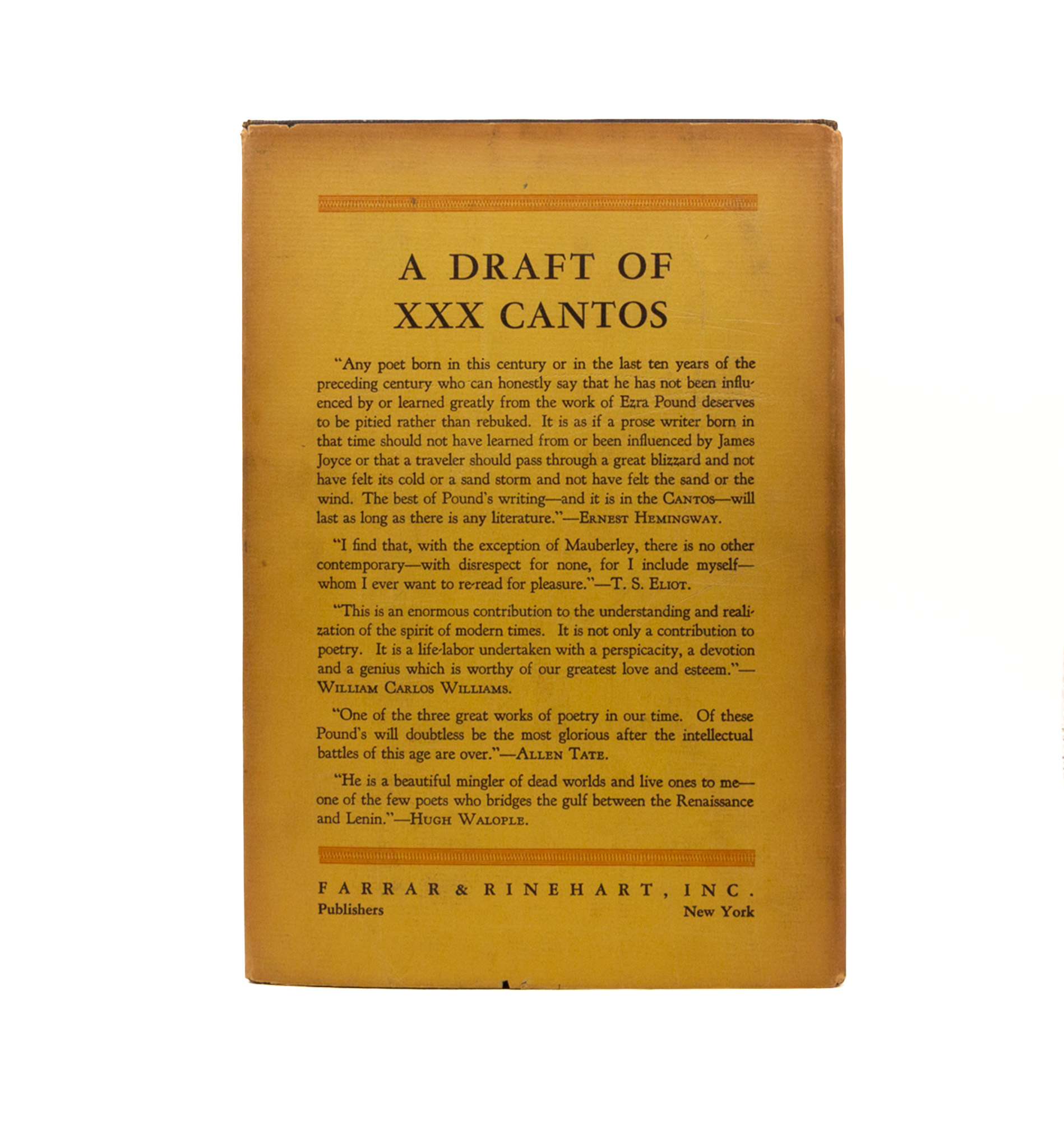
149pp.; 22.7 x 15.8 cm. Black cloth boards lettered in silver down spine. Yellow dust-jacket printed in brown and black.
First American edition, and the first appearance after Nancy Cunard’s Hours Press edition. First impression, with a cancel leaf for pp. 61-62 omitting the ‘i’ in ‘shit’ (Gallup only located 3 unexpurgated copies). A very nice copy, printed on much better stock than the English edition; clean throughout; a neat gift inscription dated 1934 to ffep. Some light marking to the cloth. Dust-jacket price-clipped, spine sunned and some scratching to the rear. Gallup A31c.

tap to cycle
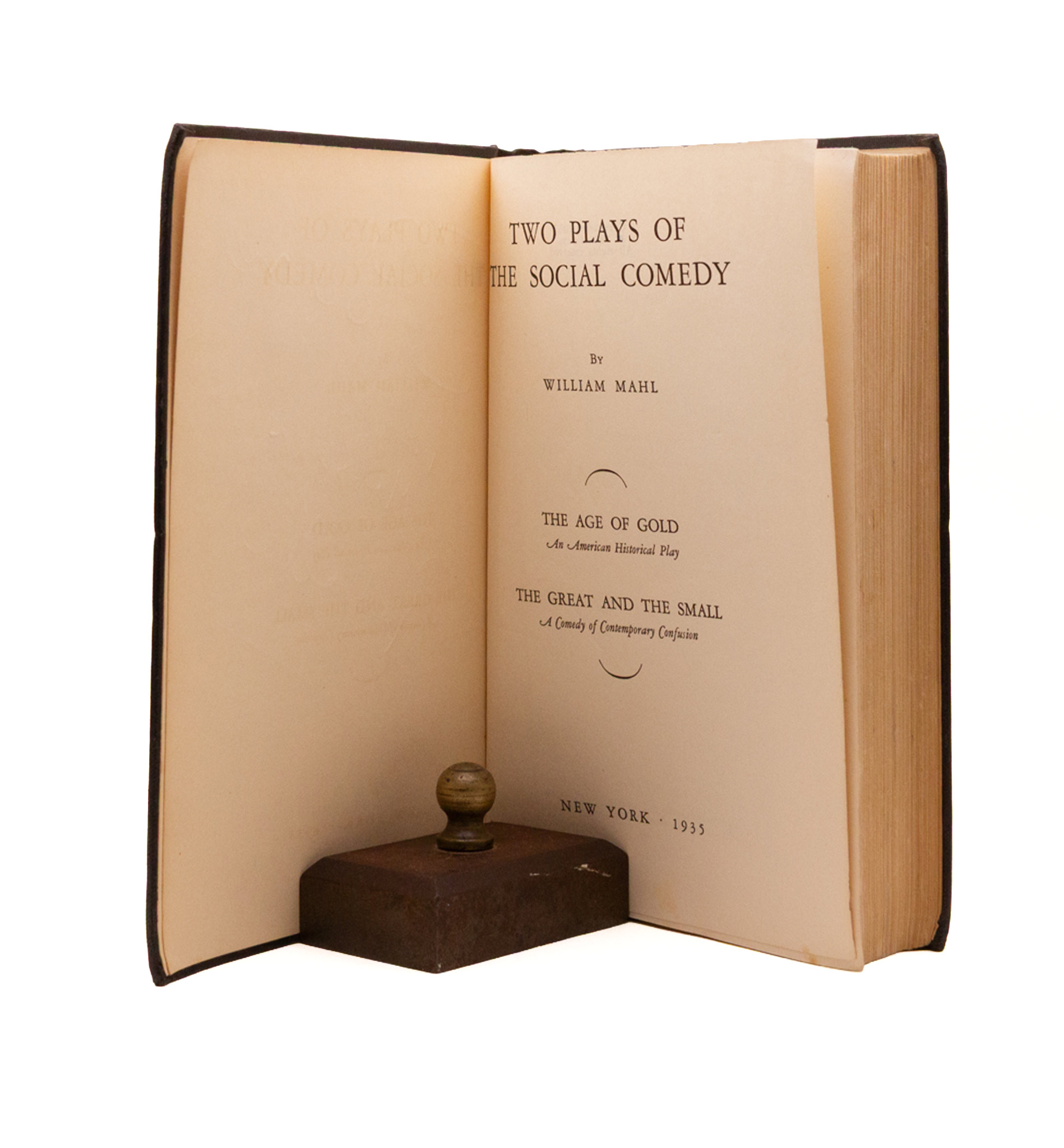
Two Plays of the Social Comedy; Ezra Pound’s copy
William Mahl
Published New York: William Mahl, 1935
392pp.; 19.2 x 13.5 cm. Black cloth boards stamped in red to front and on spine.
“This is a play about those ancient American years when the Republican party was both Radical and Revolutionary—just after it had completely destroyed the invested interests and the property rights of the landed Southern society.”
— Mahl, Foreword to “The Golden Bough”
It has also been mentioned to me that the trial scene has not sufficient dramatic value. I am sorry, for the scene is taken practically intact from the court records. I beg the reader to forgive the lack of good theatre and to accept the actuality.
EP, revelling in what Izzo called Mahl’s “documentary,” is one of the very few to have recognised Mahl, recommending his work in Introduzione alla Natura Economica degli S.U.A. (Venice, 1944, Gallup A53a), translated into English by John Drummond and published as Peter Russell’s Money Pamphlet, No. 1 (London, 1950, Gallup A53b).“Novelists and playwrites, once in a while, give on a clearer idea than professors. One can learn more from Ernest Poole’s THE HARBOUR about fast sailing-ships; and from William Mahl’s TWO PLAYS OF THE SOCIAL COMEDY about the attempt of monopolizing the gold in 1869, than he is likely to learn from historiographers.”
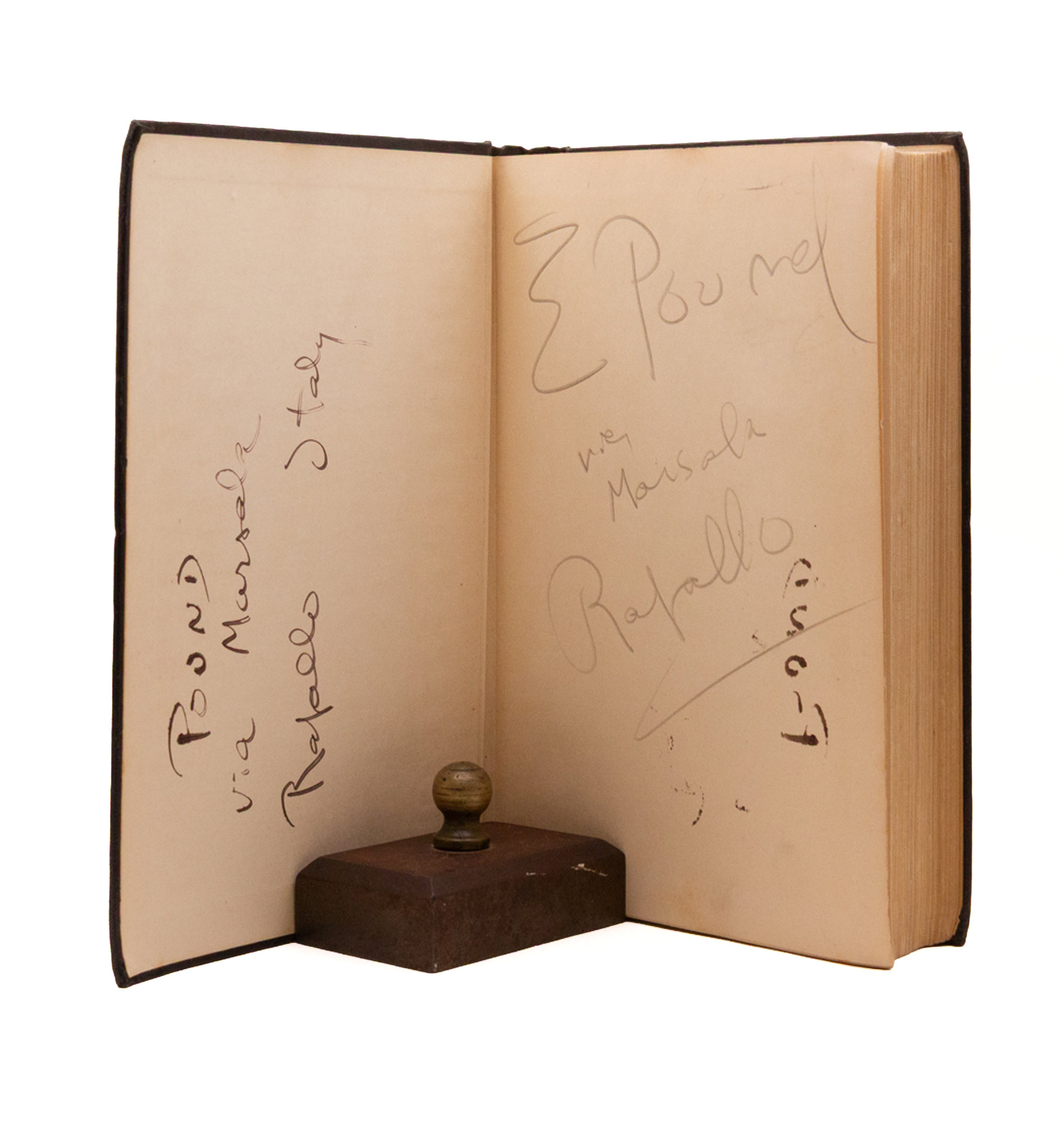
A scarce book in its own right, published privately in New York, 1935, and seemingly Mahl’s the second and last publication following Madame, His Mother; a play in three acts on Letizia Buonaparte, Napoleon’s mother, printed by the same Vail-Ballou Press of Binghamton, N.Y. and published privately in 1931. Ezra Pound’s copy, with his ownership inscription and via Marsala address (1925-1944) twice, once to fpd with fountain pen, a little offsetting, and again in pencil to ffep, the impression visible verso. No further inscriptions. Top corners bumped; some very light age to the cloth. Spine loosened in reading.Very unusual to find a book from Pound’s own library on the market. Provenance as yet unknown, including how Pound obtained the book. Possible that Izzo used this same copy.
tap to cycle
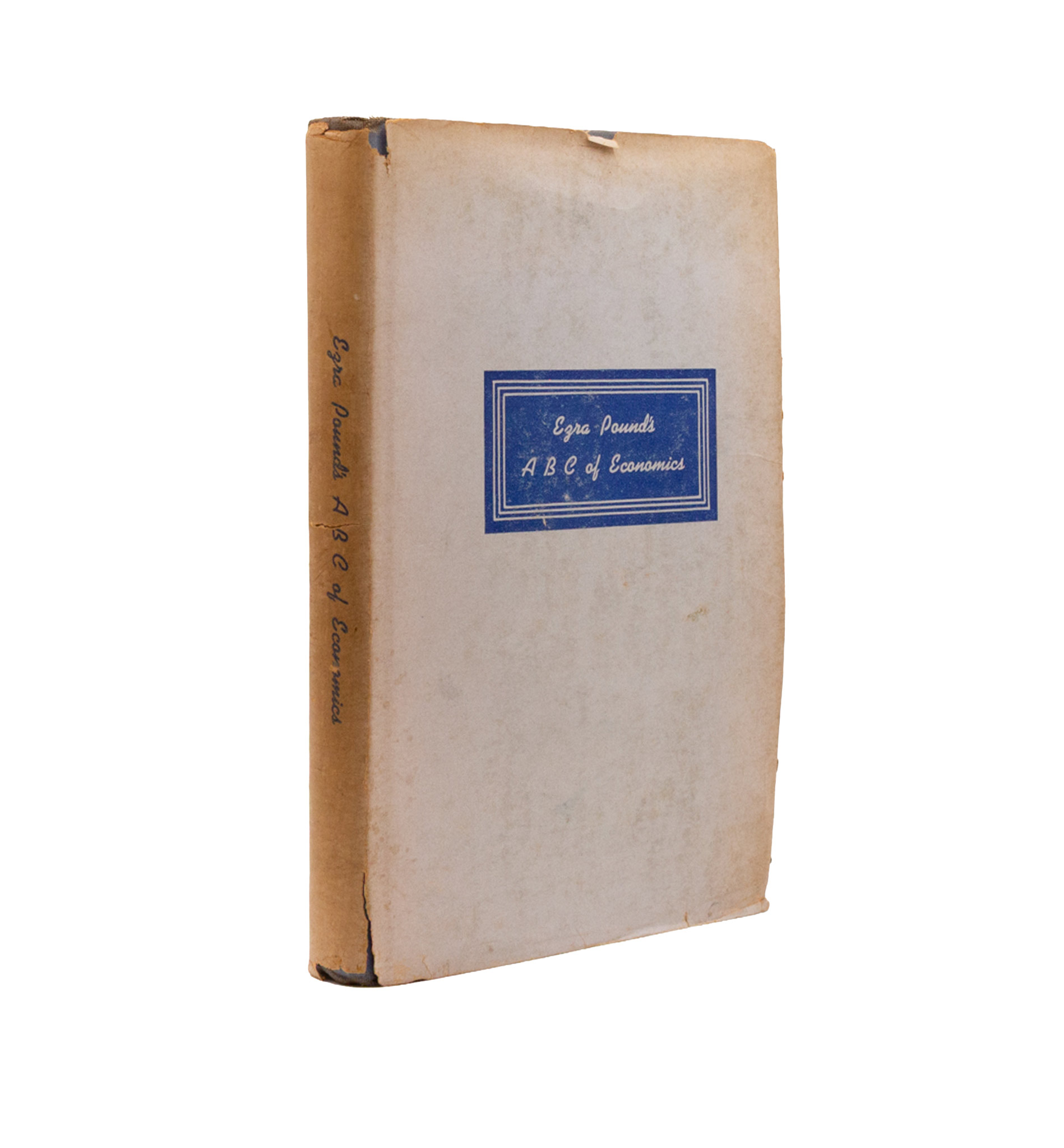
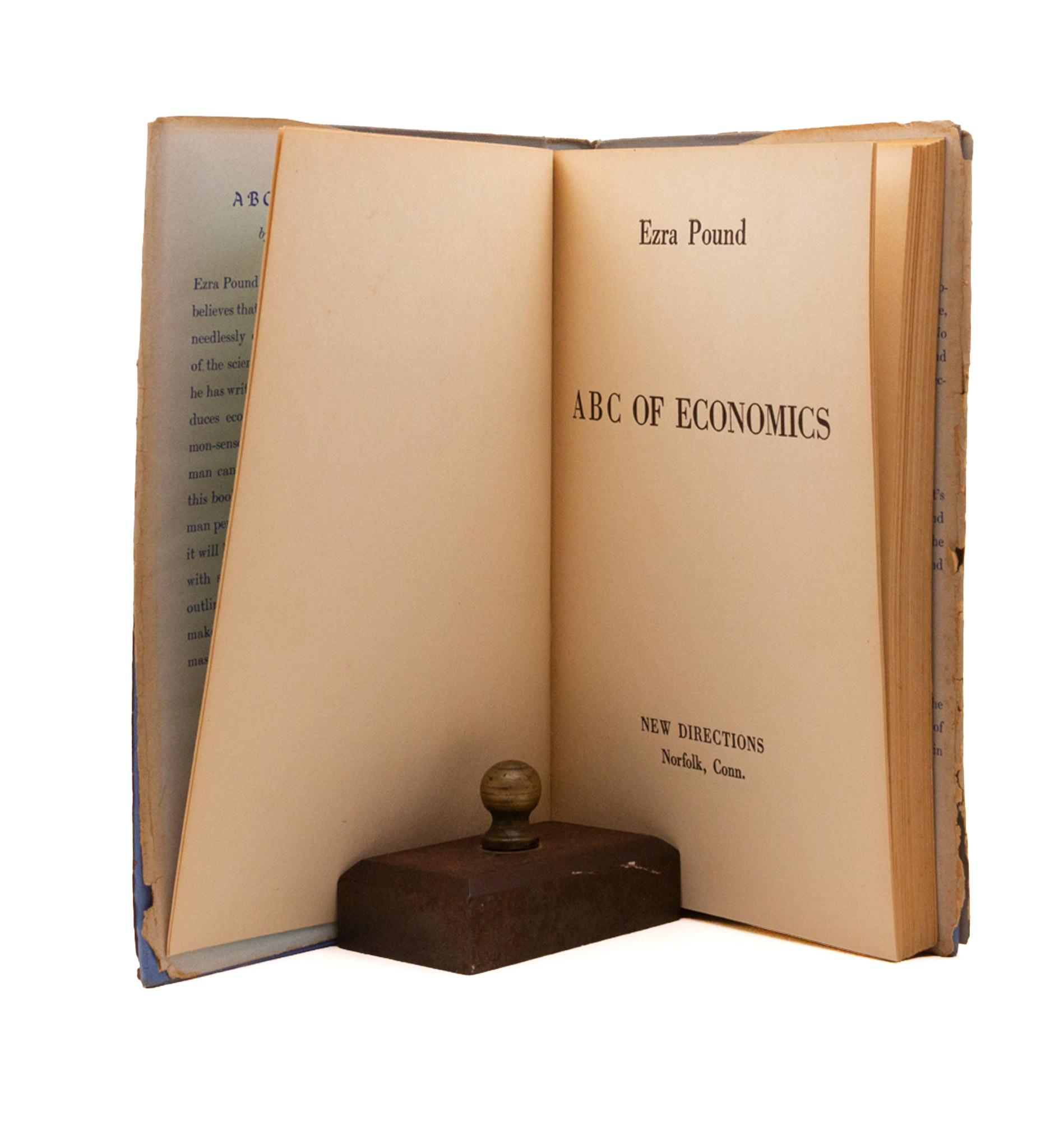
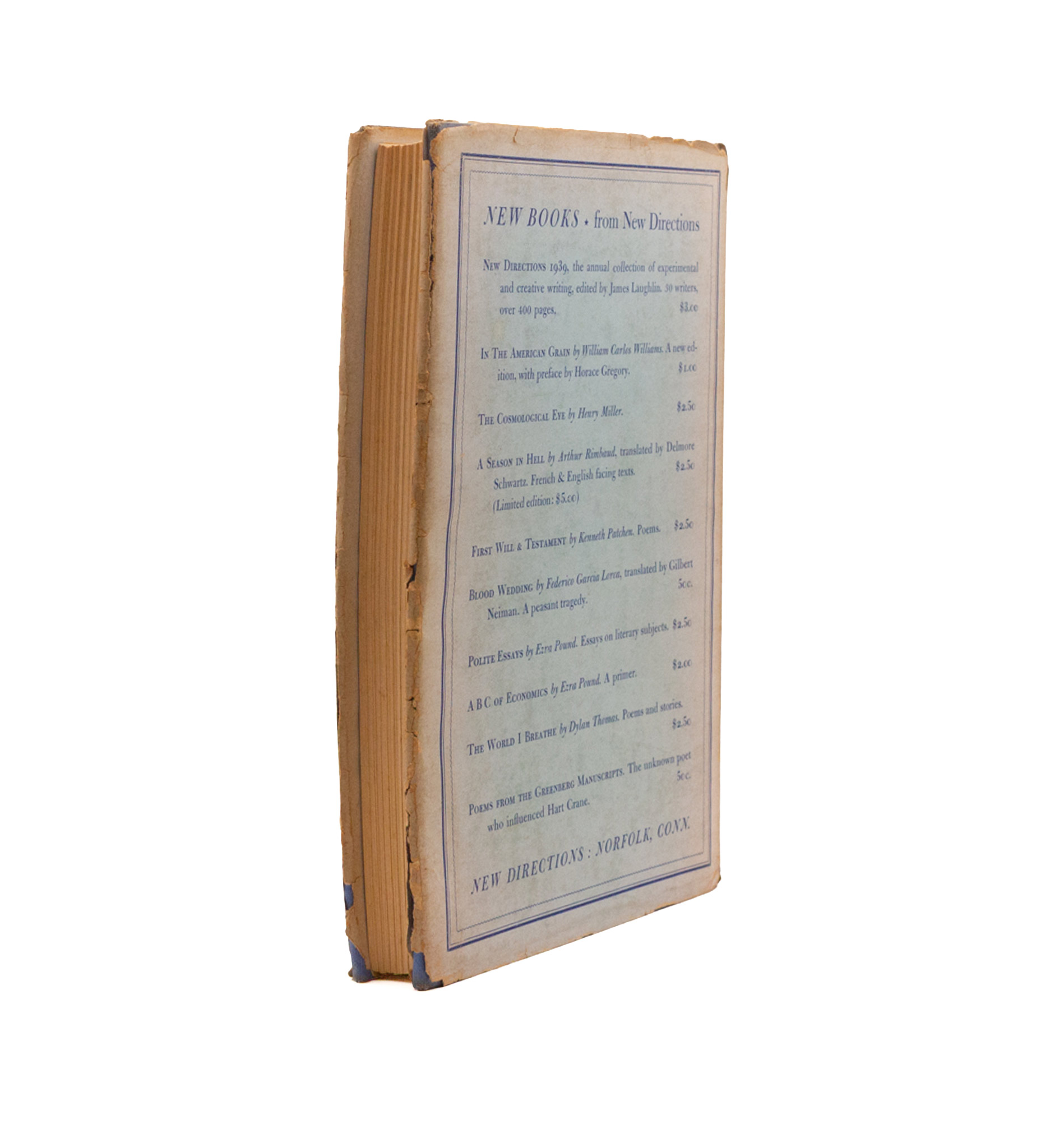
ABC of Economics
Ezra Pound
Published Norfolk, Conneticut: New Directions, [1940]
128pp.; 19 x 13 cm. Blue cloth boards with paper label printed in black down spine. Eggshell blue dust-jacket printed in dark blue.
First edition, American issue of EP’s ABC of Economics. One of 300 copies, from the original sheets (c. 1000 of which were published by Faber in 1933, a further 720 sets bombed), imported and jacketed by James Laughlin for New Directions with a cancel title-leaf. Boards lightly discoloured along the top edge with soiling in the gutters; label on spine pristine; a general backwards bowing of the book; fpd and ffep browned but leaves otherwise very nice. The jacket is the most remarkable part of this book, a beautiful design rarely surviving in this condition; the front cover faded, the spine browned, the back cover retaining colour and the flaps some true colour; light breaks to the folds and one scar to the spine, but in one piece and entirely unrestored. Gallup A34b.

tap to cycle
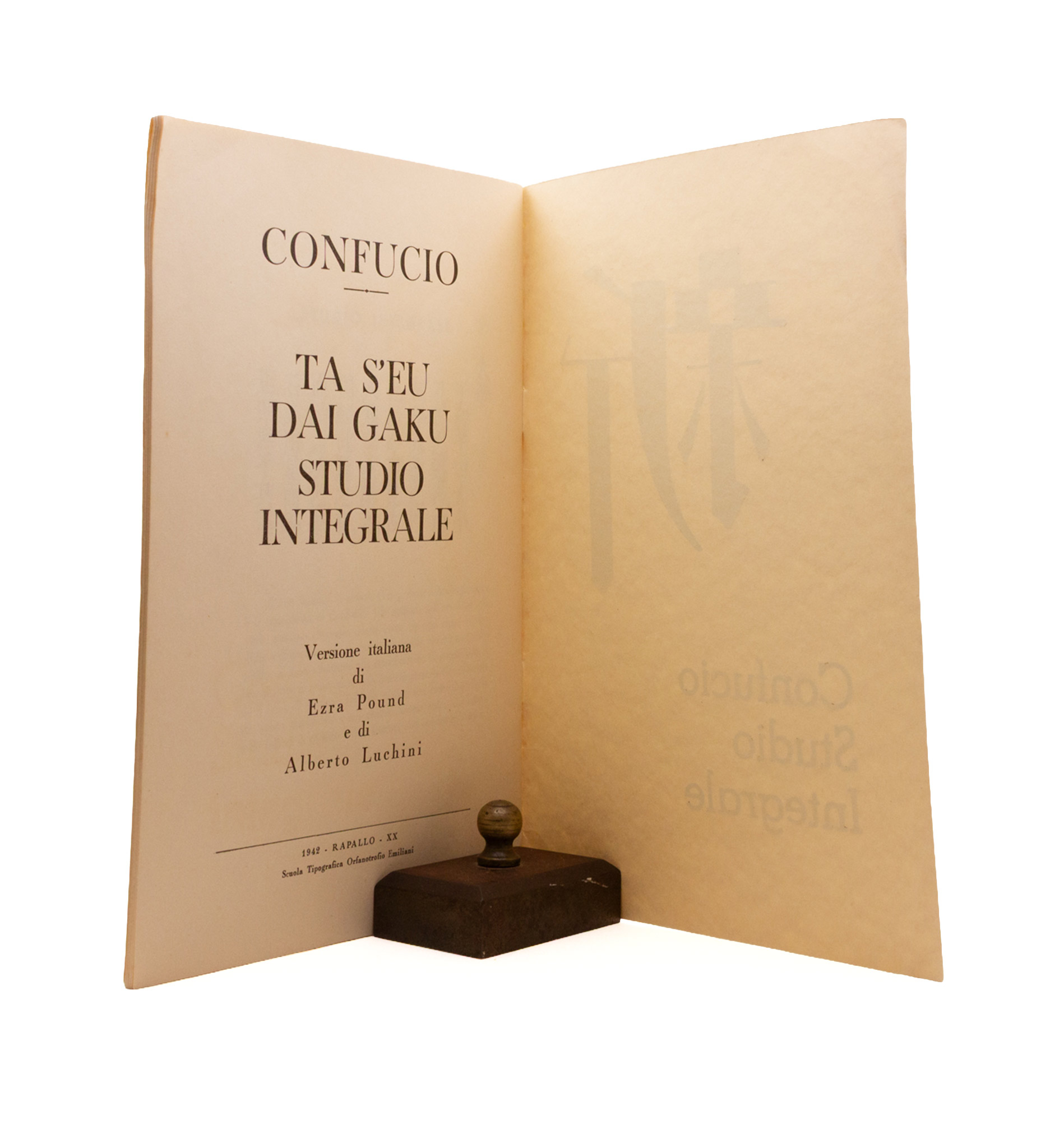
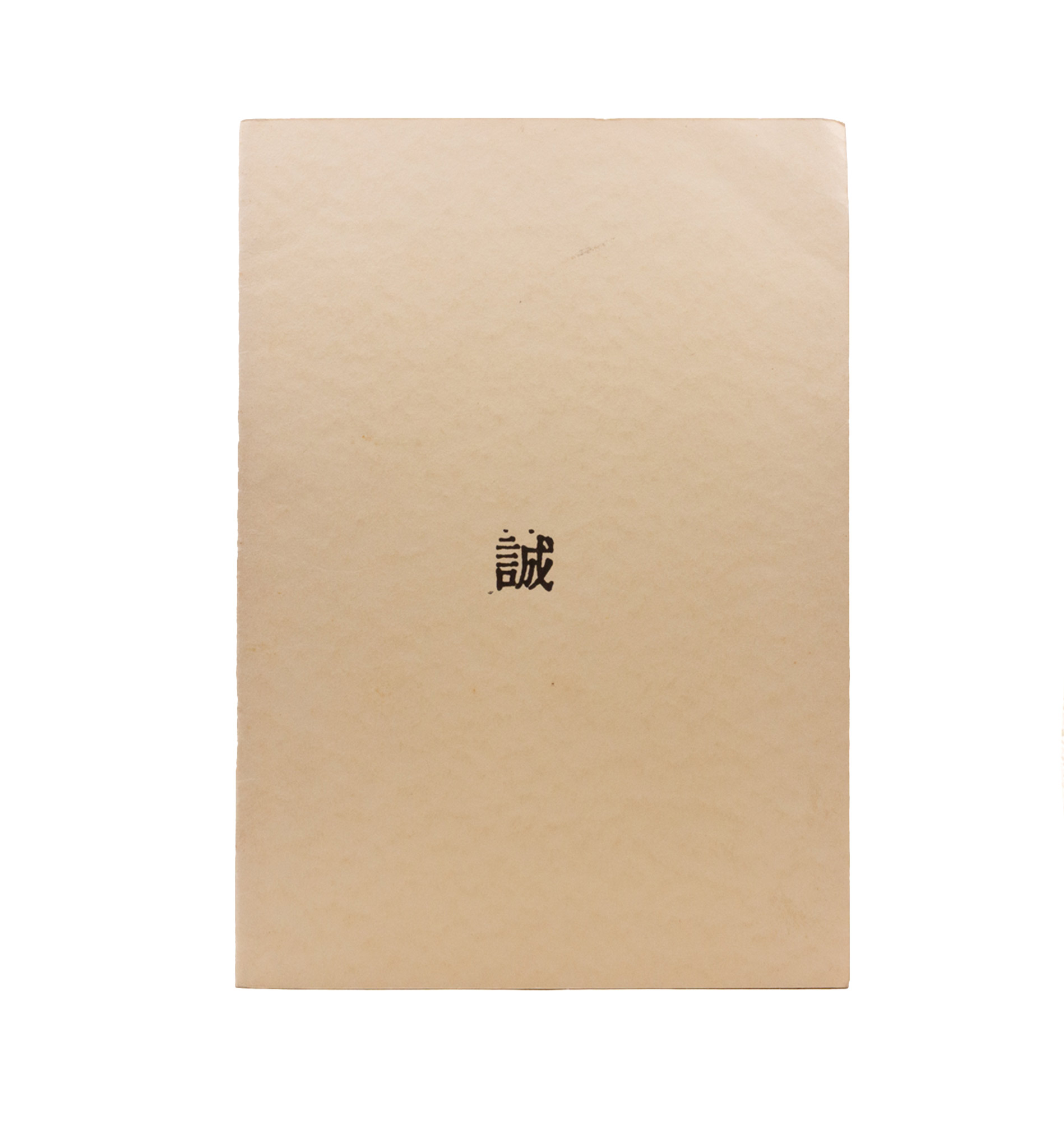
Confucio. Ta S’eu. Dai Gaku. Studio Integrale
Ezra Pound, Alberto Luchini
Published Rapallo: Scuola Tipografica Orfanotrofio Emiliani, 1942
32pp.; 24.3 x 17.2 cm. Heavy cream paper wrappers printed in black; stapled.
Pound’s first Italian rendering of the Confucian Ta S’eu, the first of the Four Shu. Pound translated the text into English following the French of Guillaume Pauthier, publishing the “wrongly spelled” Ta Hio in 1927 (Gallup A28). This translation, made into Pound’s Italian and then “put into real Italian” by Alberto Luchini, showcases Pound’s advances in the study of Confucius and Chinese, and is rendered together with the original Chinese text, also bound from ‘back to front’ in the Chinese manner. For Pound’s understanding of Confucius and ideogram at this date, see “Ta Hio” in Meridiano di Roma, VI. 46 (1941, Gallup C1617).
Predated by a periodical appearance of Chapter I as “Studio Integrale,” with Chinese, in the Meridiano di Roma, VI. 43 (1941, Gallup C1616). Published again without the Chinese as Testamento di Confucio (Venice, 1944, Gallup A54). Later translated from the Italian to English in Confucius. The Unwobbling Pivot & The Great Digest (New York, 1951 and London, 1952, Gallup B53).
Three states of this book exist, the first a cheap paper and cheap wrapper edition, the second a deluxe edition with watermarked paper and heavier cream wrappers, and the third Gallup suspects a mistake, being cheap paper with the heavier, deluxe wrappers. This copy is second state, with the watermarked paper and heavier wrappers. A very good copy, some foxing to the wraps, the top corner leafed with a small nick to the fore-edge of p.29. Gallup B46.
tap to cycle
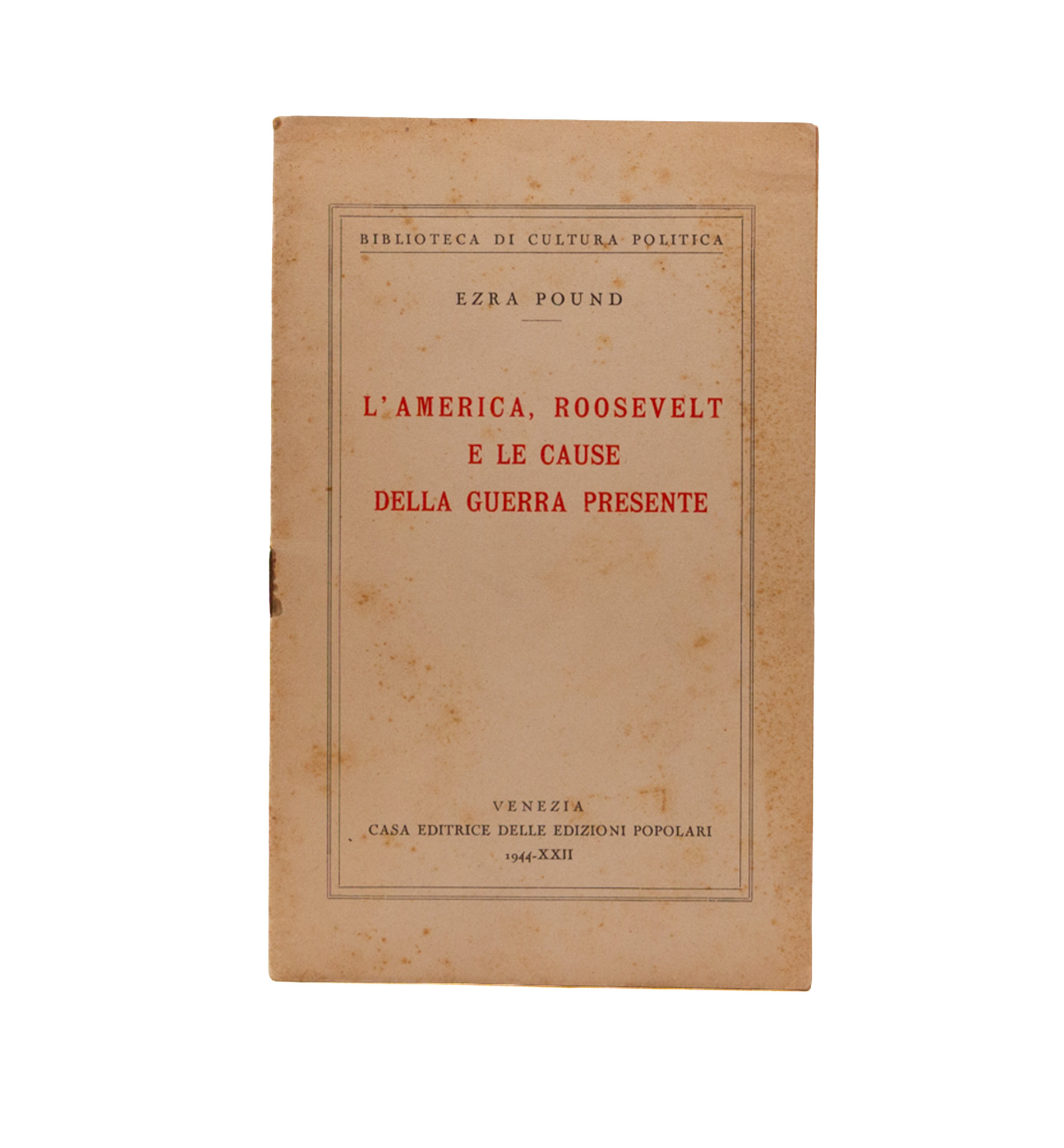
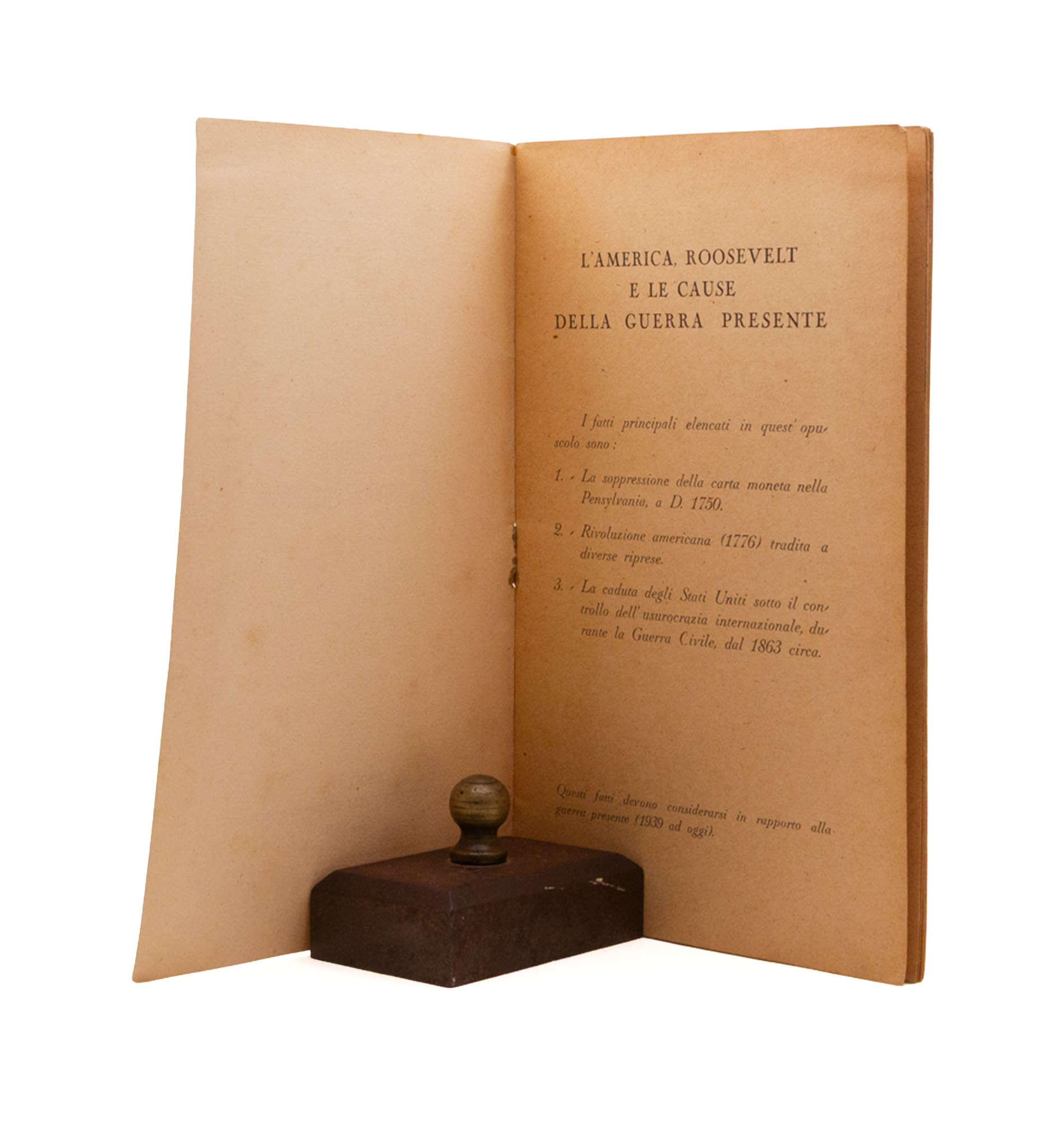
L’America, Roosevelt, e le Cause della Guerra Presente
Ezra Pound
Published Venice: Casa Editrice delle Edizioni Popolari, 1944
32pp.; 19.4 x 12.2 cm. Stiff paper wraps printed in red and black; stapled.
The first of Ezra Pound’s six publications with Casa Editrice, a publishing house operating under the Republic of Salò’s Ministry of Popular Culture. All published in 1944 and 1945 at the height of the war effort in Italy, these pieces served as propaganda, Poundian propaganda though with pro-war, pro-Axis, and anti-Usurocratic intersections with the RSI, in Italian to be read by the Italian people. L’America… is a history of usurious and anti-usurious acts in America and the occasional relation therein to Britain, and asserts that “The first serious attempt against [the usurers], after Lincoln’s, began with the Fascist Revolution, to be reaffirmed by the formation of the Rome-Berlin Axis.”
First edition, in the original Italian, later translated into English by John Drummond and published by Peter Russell as the sixth Money Pamphlet (London, 1951, Gallup A51b). Published in March 1944 (unrecorded by Gallup) under the auspices of Fernando Mezzamosa, Minister of Popular Culture. A scarce title, given the context in which it was published and the cheap, wartime stock used. Pound had in fact written to Mezzamosa earlier in the year requesting resources to start a journal, Volontà Repubblicana (cf. “Money is, in the first place, an instrument of the will.”) in Rapallo, but was rejected “due to the absolute necessity of reducing the use of paper to the minimum.” That Pound had suggested to Mezzamosa that the paper would not be an “organ of the state” may have had some bearing.
This booklet is the first in Editrice’s “Biblioteca di Cultura Politica” series, which Pound had some hand in editing, providing at least Arthur Kitson’s La Storia di un reato. In April 1944, James (Giacomo) Strachey Barnes, an English Italophile ex-pat and fascist, and a good friend of Pound’s at the time, received a request from Mezzamosa to contribute, and provided Giustizia Sociale: attraverso la riforma moneteria, a similar booklet filled with Poundian ideas, e.g. Gessellism, which Barnes and Pound had discussed over the previous year; though Barnes later revealed, in drafting a plea to Churchill for Pound’s pardon, that he did not understand Pound’s views.
A particularly good copy, no less for the poor quality of the production; covers clean, straight, uncreased and unbroken with bright ink. Internally fine, without a chip. Has seen some damp (Venetian?) in its time, with a little foxing and leaking from the staple, but this almost exclusively to the front cover, the remainder unaffected. Small label pasted inside the backcover, possibly of later bookseller’s inventory. Gallup records various corrections made in pencil or with slips typed by Pound and pasted over lines; this copy has neither and is as, or very nearly, off the press. Gallup A51a.
tap to cycle
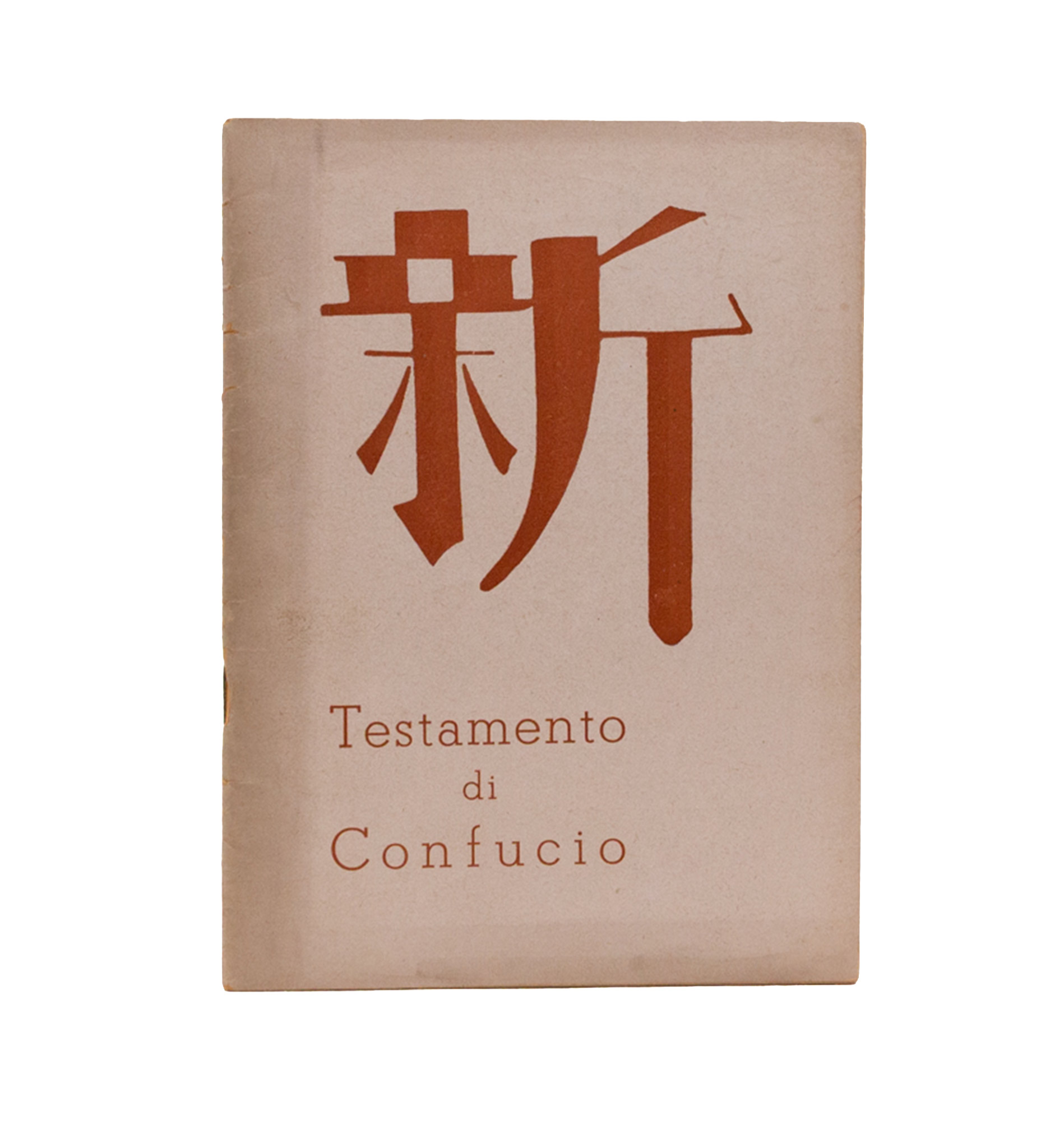
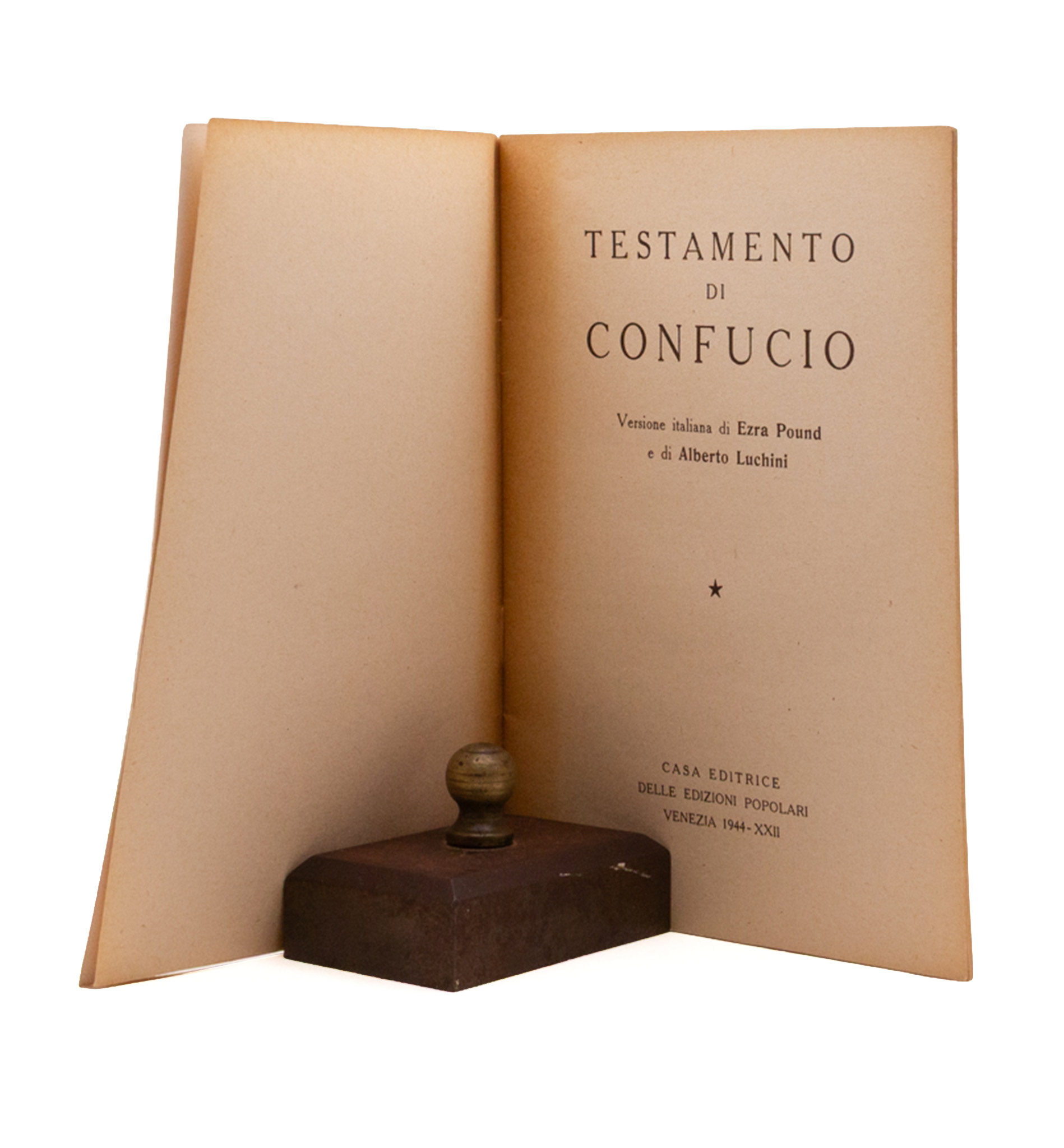
Testamento di Confucio
Ezra Pound, Alberto Luchini
Published Venice: Casa Editrice delle Edizioni Popolari, 1944
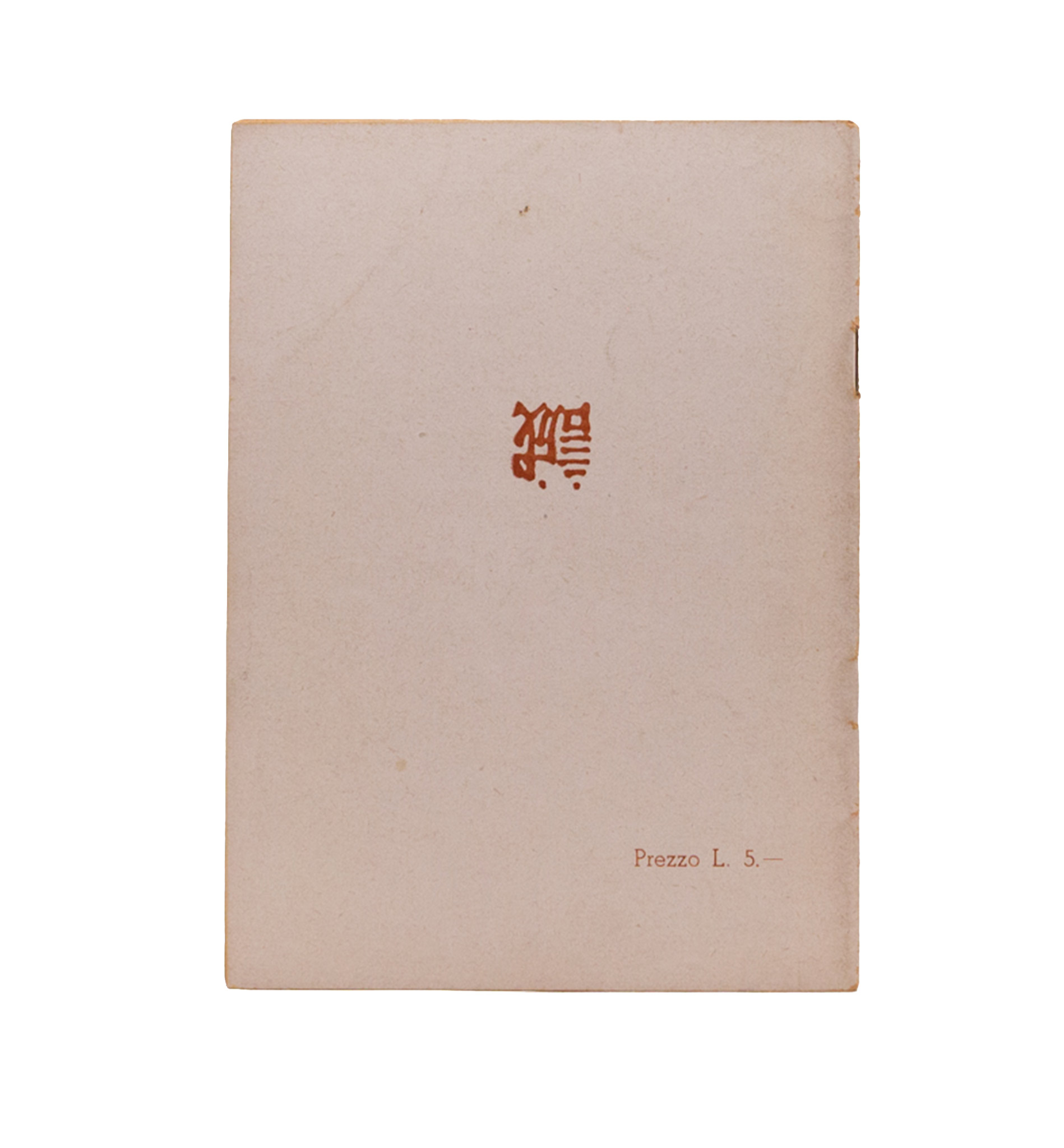
37pp.; 16.5 x 12.1 cm. Stiff white paper wrappers printed in reddish brown; wire-stitched.
The Great Digest, the first of the Four Shu, originally translated by Pound from the French of Pauthier and published as the Ta Hio in 1927. Later retranslated using the Chinese into Italian (with the help of Alberto Luchini), retitled Confucio. Ta S’eu. Dai Gaku. Studio Integrale and printed with the original Chinese in 1942. Described as the ‘first separate edition,’ the Testamento di Confucio is the Ta S’eu, Italian text only, though a few beautiful woodblocked ideograms are interspersed.
The third of Pound’s Casa Editrice booklets, and the rarest of the three that weren’t destroyed either by publisher or by Ally, i.e. L’America…; Introduzione alla Natura Economica della S.U.A.; and the Testamento. The other three of Pound’s Editrice publications, Orientamenti, Jefferson e Mussolini and L’Asse che non vacilla were all destroyed after the Liberation in April 1945, as the Allies reached Venice, each being seen as pro-Axis propaganda. Orientamenti and Jefferson e Mussolini are likely the rarest editions in all Pound’s oeuvre, with only a handful having left the publishing house before their runs were destroyed. L’Asse che non vacilla, a translation of the Chung Yung, the second of the Four Shu, was offered for sale between February and April 1945, but was, as Gallup says, “condemned, unread,” the title translating towards The Axis Don’t Waver.
Between the covers, Confucius remains an “ethical system,” but Pound’s Confucius at this date is one which he weaponised.
“Confucius is the material which should be taken into the trenches.”
— EP to Pietro Ubaldi, 2 Nov 44.
I offer my Confucian studies as an act of war. I offer these studies as a radical cure for subversive thought, which remains subversive from the times of Seun and Mi, and is not the exclusive property of Middle Eastern usurers.
I offer Confucius’s way of thinking and the ideogram as a remedy for all the poison of the Cross, for all the tendency toward the abstract, toward the rounding off of corners (ref. O. Buglia Gianfigli), all the “sluts” of the XIX century—a century in which thought was nothing other than a continuous game of equivocation, an indefinite and ambiguous middle term.
A remarkable copy. Very slight cracking to the thin layer of coloured material that covers the wrappers around the spine. The front cover darkened along the spine, less to the bottom edge, and less to the top edge. Internally fine, a little darkened along the inner edge. A beautiful production with its woodblocks, and of the right size to slip into a soldier’s pocket; this a peaceful copy. Gallup A54.
tap to cycle
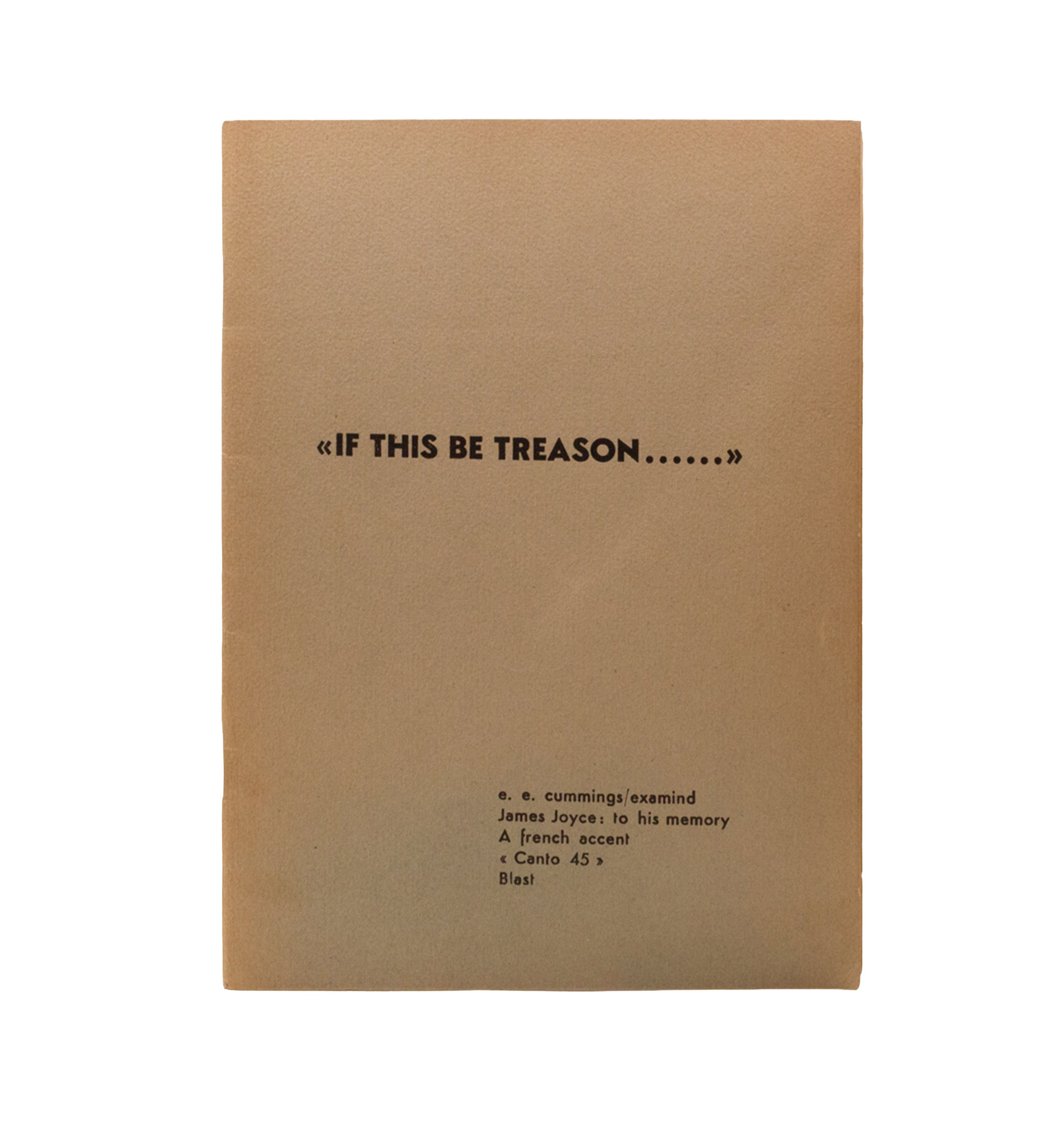
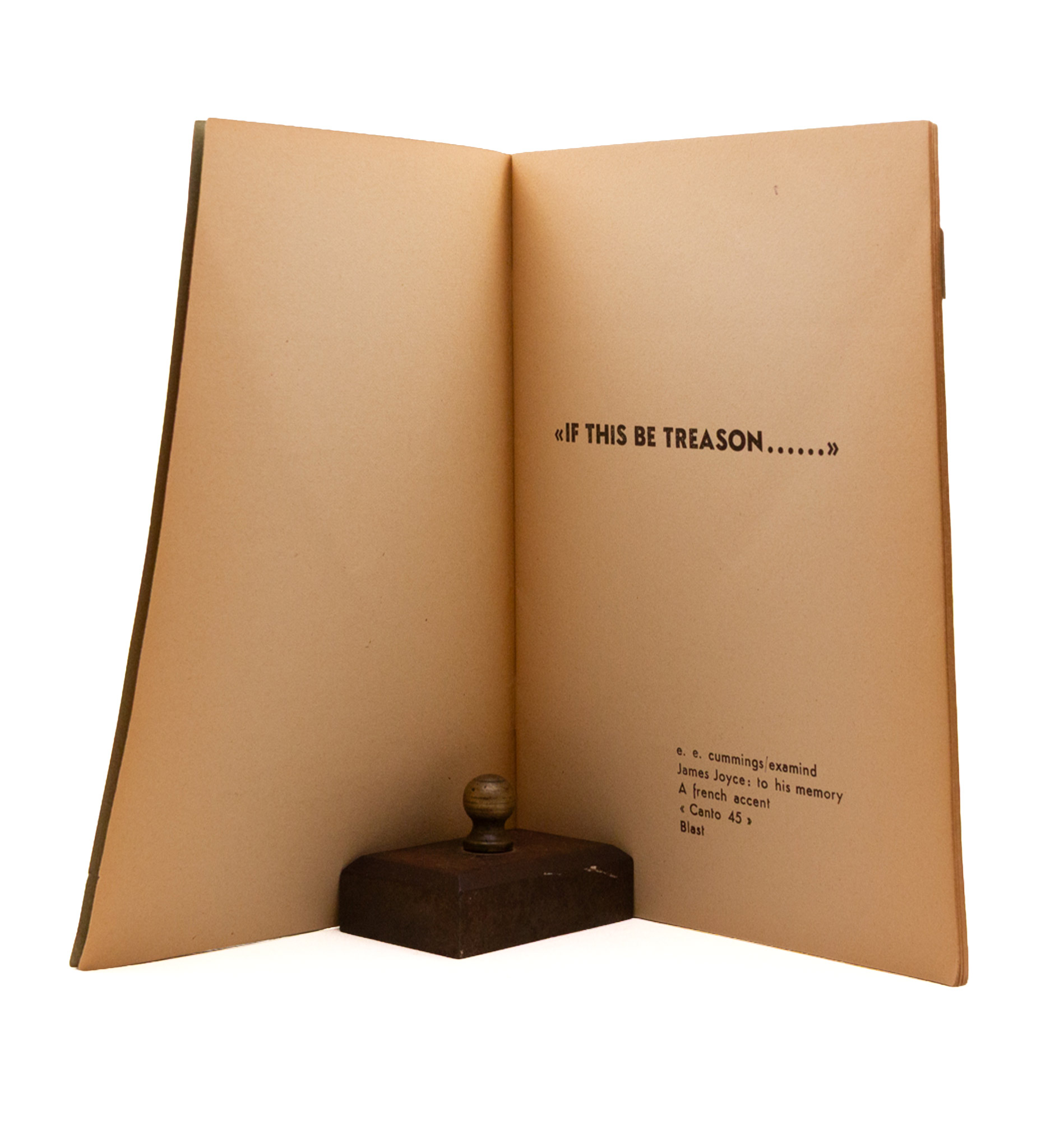
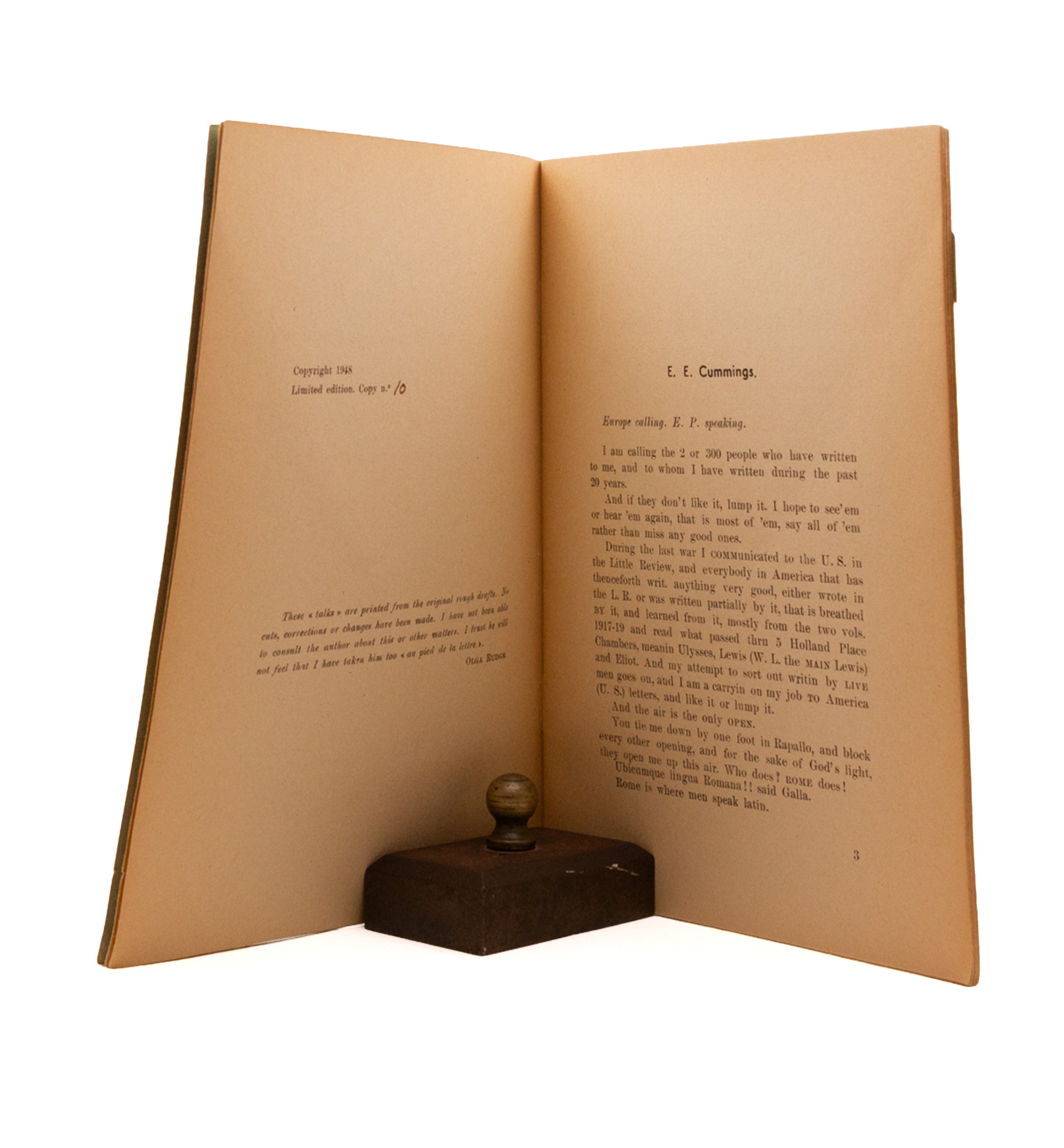
« if this be treason… »
Ezra Pound
Olga Rudge, editor
Published Siena: [Olga Rudge], 1948
33pp.; 21.3 x 15.7 cm. Heavy green paper wraps printed in black; stapled.
“If this be treason, make the most of it.”
So closed Patrick Henry his speech amid cries of “Treason!” to the House of Burgesses, Virginia, 1765. Henry stood against the Stamp Act, a tax imposed on the American British colonies by the Parliament of Great Britain, which would, as Pound quotes John Adams in Canto 66, “drain cash out of the country | and is, further, UNconstitutional.” A dangerous reference by Rudge to the same man who claimed, “Give me liberty, or give me death,” this selection of Pound’s radio broadcasts, the first to be printed, and taken directly from manuscript, do not so well proclaim Pound’s innocence as to proclaim his rightness.Rudge had not seen Pound for three years and would not for another ten. When considering the care taken over Pound’s political material at this date, even the threats William Levy received from Dorothy Pound’s solicitors in 1966 for publishing two radio speeches in IT, one has to stress the independence of Rudge in this publication.
Privately printed for the editor in Siena by Tip[ografica]. Nuova, January 1948. One of, Gallup suspects, around 300 numbered copies, most left unnumbered, this one rather special being No. 10. Provenance on request. Front cover and spine faded, rear cover and versos with better retention. Gallup A59.
tap to cycle
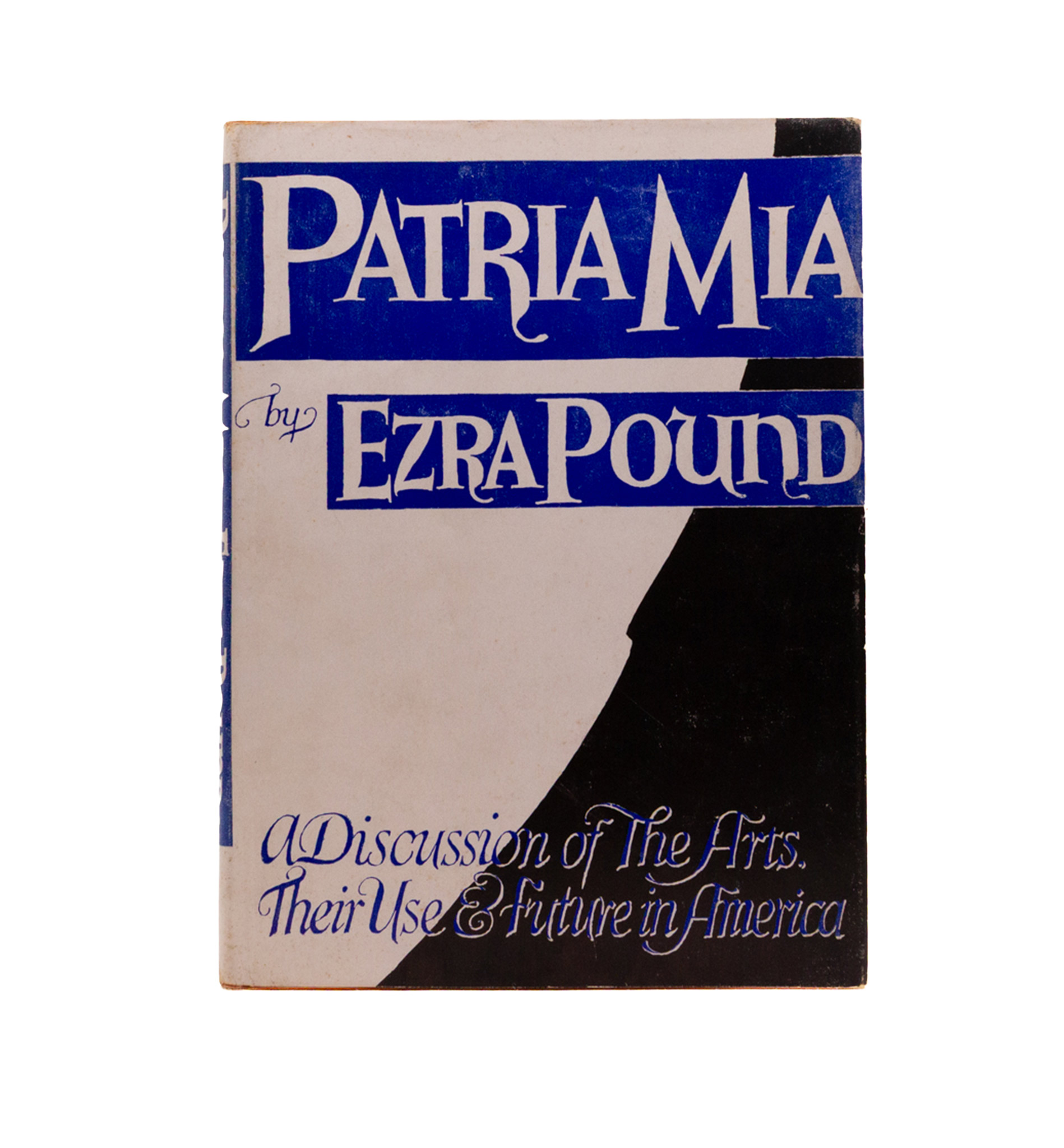
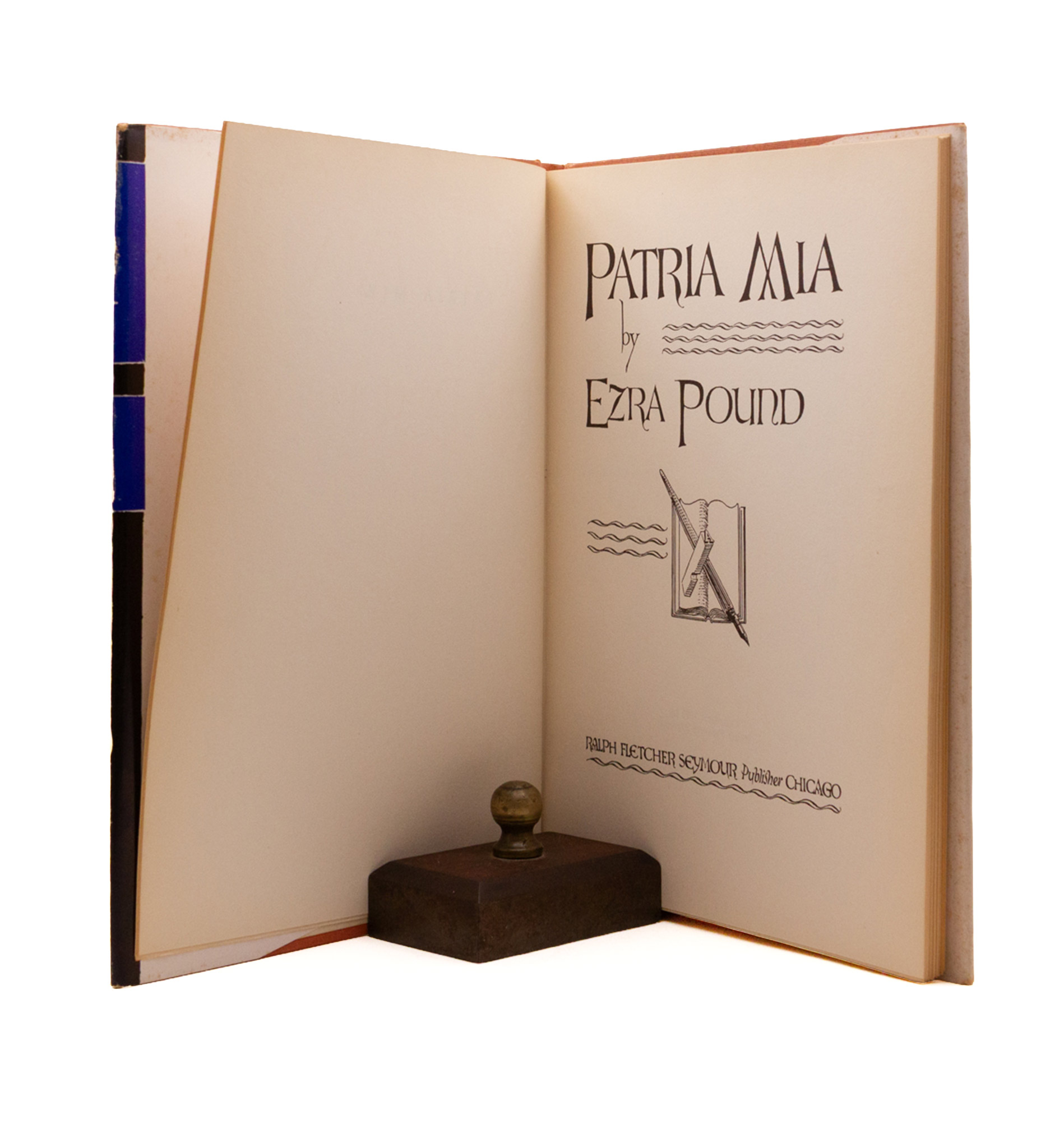
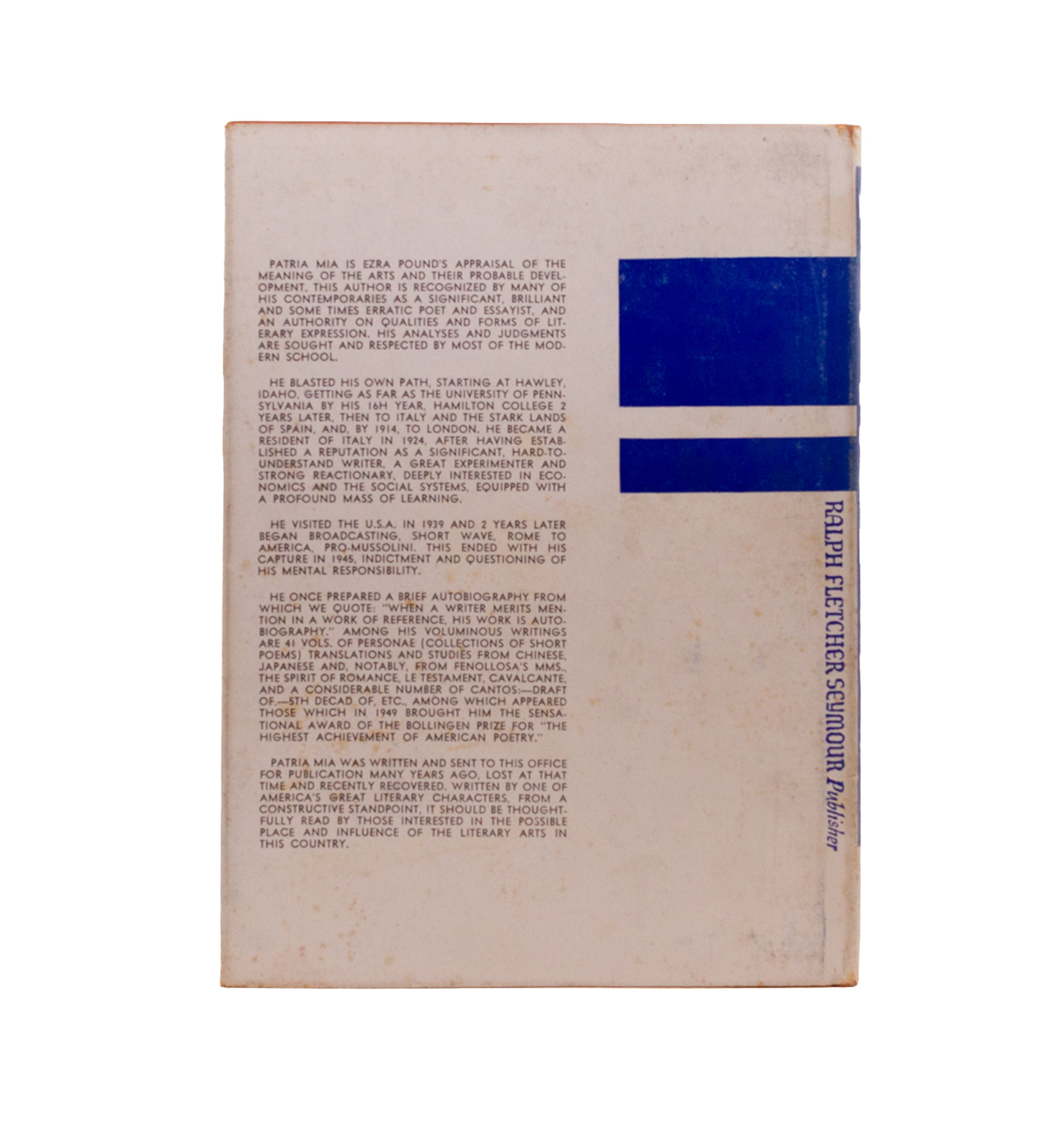
Patria Mia
Ezra Pound
Published Chicago: Ralph Fletcher Seymour, 1950
97pp.; 21.5 x 16 cm. Red-brown cloth boards printed in brown both covers and down spine. White dust-jacket printed in blue and black.
First edition, a revision of the original serialised publication in A. R. Orage’s The New Age (11 issues, 1912). Pound had sent the revised manuscript to Seymour, Daughaday and Company (sometime publishers of Harriet Monroe’s Poetry) in 1913 but the publishing house dissolved and the manuscript was lost for four decades. Book is very near fine; jacket has some light rubbing, one short tear, and a little foxing. Gallup A63.

tap to cycle
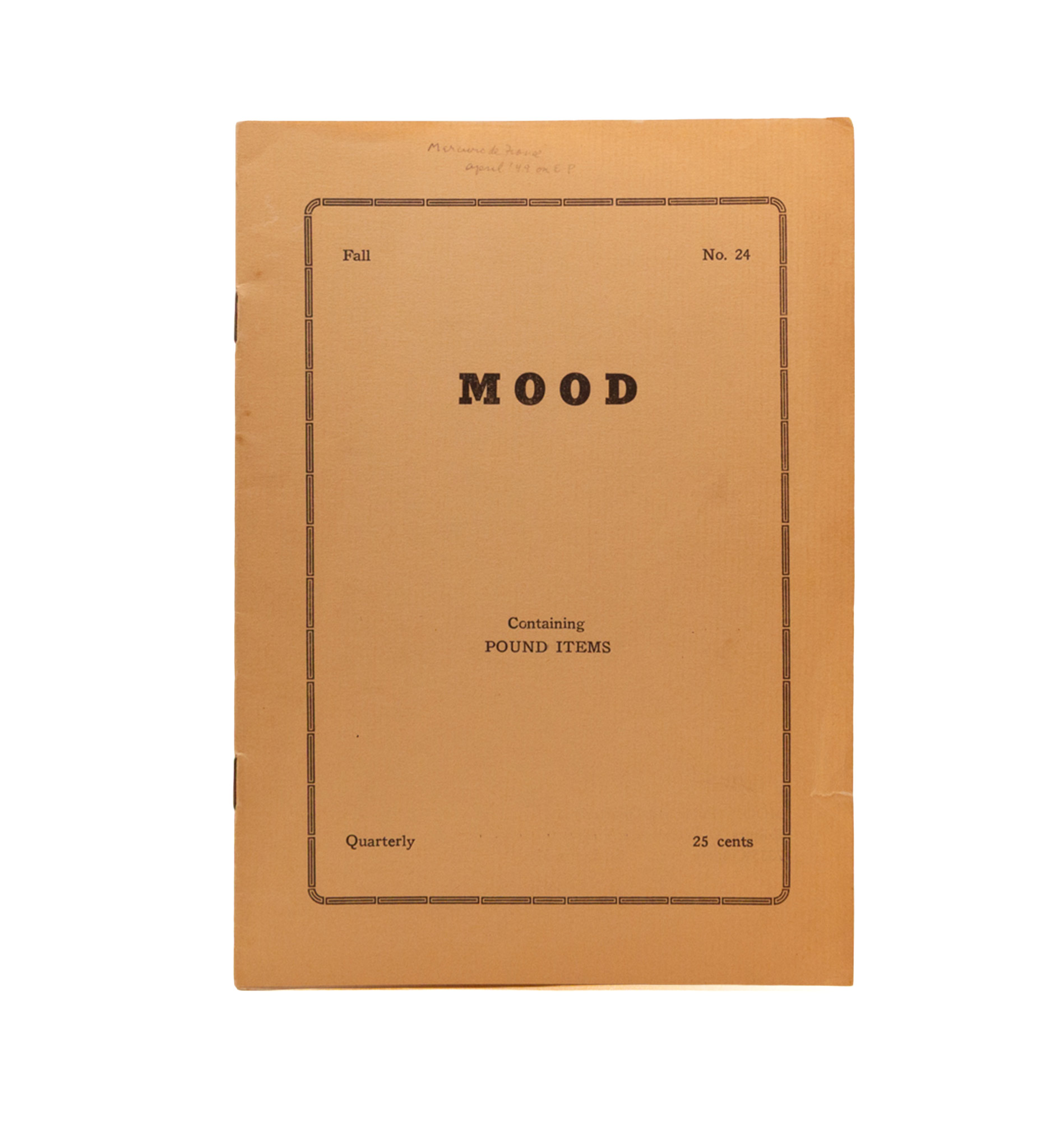
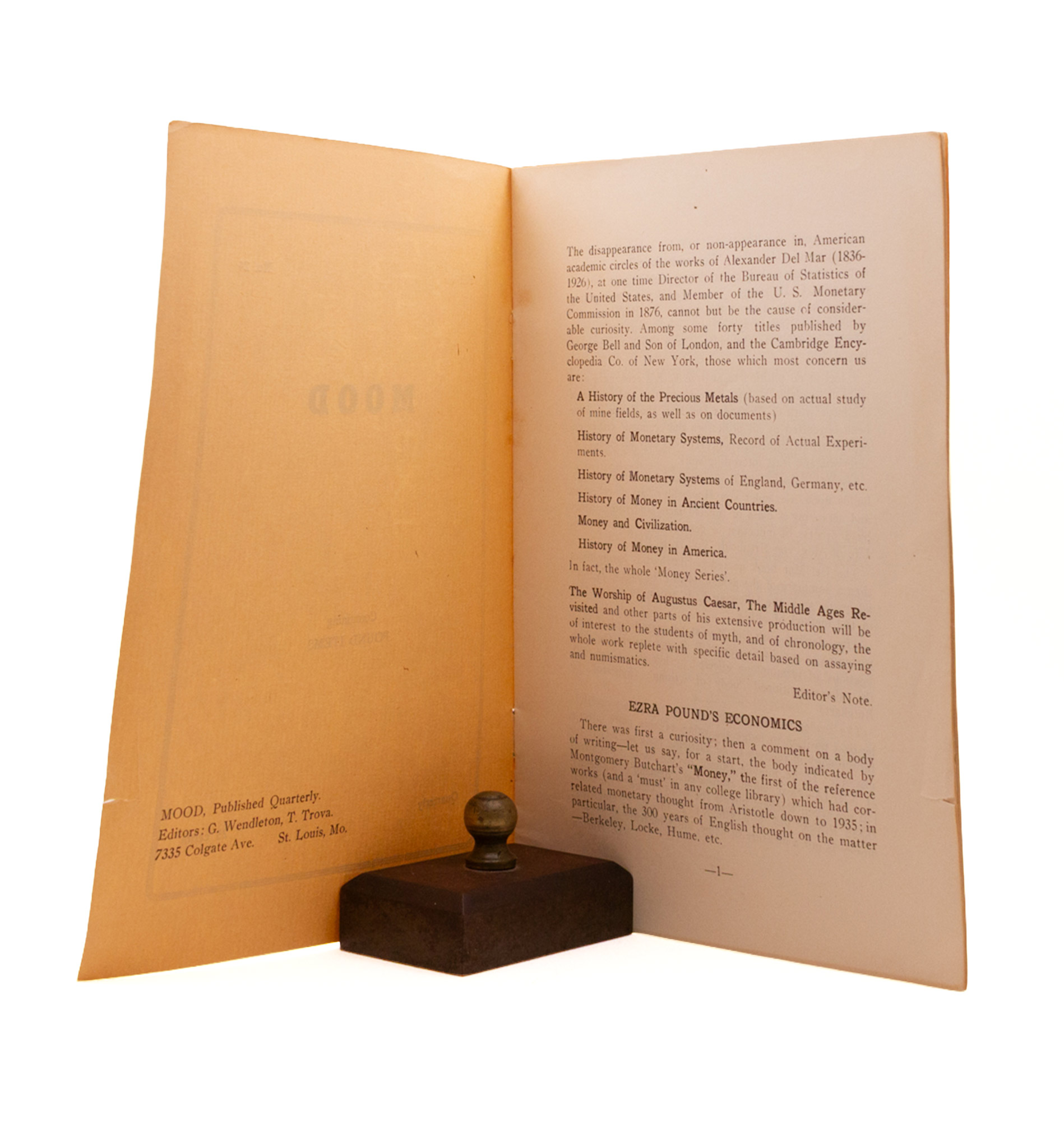
Mood, No. 24: Containing Pound Items
G. Wendleton, T. [Ernest] Trova, editors
Ezra Pound, contributor
Published St. Louis, Missouri: Mood, 1950
16pp.; 21.2 x 15.1 cm. Pale orange paper wrappers printed in black; stapled.
Mood, No. 24 (Fall 1950), one of two issues of Ernest Trova’s literary magazine The Mood dedicated to EP; the other being No. 23: Ezra Pound (May 1950). Possibly the final issue of Mood, not much information on the magazine exists and issues are incredibly scarce, being locally produced for cheap and of small run. This issue in particular marks something of a misstep in the care taken over Pound’s post-war publications in America. With Laughlin and Eliot’s (and Dorothy Pound’s careful) suppression of EP’s political material, the few journal pieces to appear between 1945 and 1949 are both one-off and literary. While in England, 1950 saw the release of Peter Russell’s Money Pamphlets, reproducing Pound’s incendiary wartime (and thus somewhat historic) material, the attitude towards publishing in America was quite different. In 1950 publication of Four Pages also began, “edited” by Dallam Simpson, shadow-edited by EP, and which at Dorothy Pound’s request was strictly not to use either her or EP’s names. The same is true for the later reviews (Strike, Edge, Voice; 1955-1957), in which EP’s contributions are either unsigned, pseudonymous, or literary. Mood, No. 24, and the preceding No. 23 (in which Gallup only accounts for the Introductory Text-Book; Gallup C1724) are most unusual in their blasé use of Pound’s name (see the cover of No. 23 here). No. 24 even more so for its inclusion of inflammatory material. One piece in particular which does not appear to be reprinted elsewhere until collected in Contributions to Periodicals (which butchers the format, suggesting the piece is from Nine), “A Draft Bill of Rights Adapted for the Needs of Great Britain,” is a Gessellite criticism of tax, proclamation for the individual’s land rights, and suggestion for elections to be held among trade representatives, which asks Americans to consider the same. The reason why Trova so liberally used Pound’s name is unknown—all relevant BRBL material remains offline—but is undoubtedly unusual for its bannering EP’s name and views in America at this time.
Trova (1927-2009), at the time a young man as Simpson or Stock, later gained a reputation as an American sculptor, his series Falling Man received international acclaim for sometime and was displayed publicly around St. Louis. No study conducted (or found) on his relationship with EP. No information available on G. Wendleton, nor why Trova gave his initial as “T.”
Light pencil to the front cover reading “Mercure de France, April ’49 on EP,” referring to an article in the Gazette at the very back of the issue, “Ezra Pound a-t-il trahi?” containing responses by DP and “Shakespear and Parkyn” to accusations of Pound’s fascism by Jacques Vallette in the previous issue; further letters from Rome, and a final word from the editor (?) Camillo Pellizzi, former President of the ex-Institute of Fascist Culture of Rome, stating that EP was never a member of the Fascist Party. See here, p.764.
Short tear to fore-edge, two inches from bottom, front cover and the first six pages. Three spots of fox near the top staple. Gallup C1726.

tap to cycle
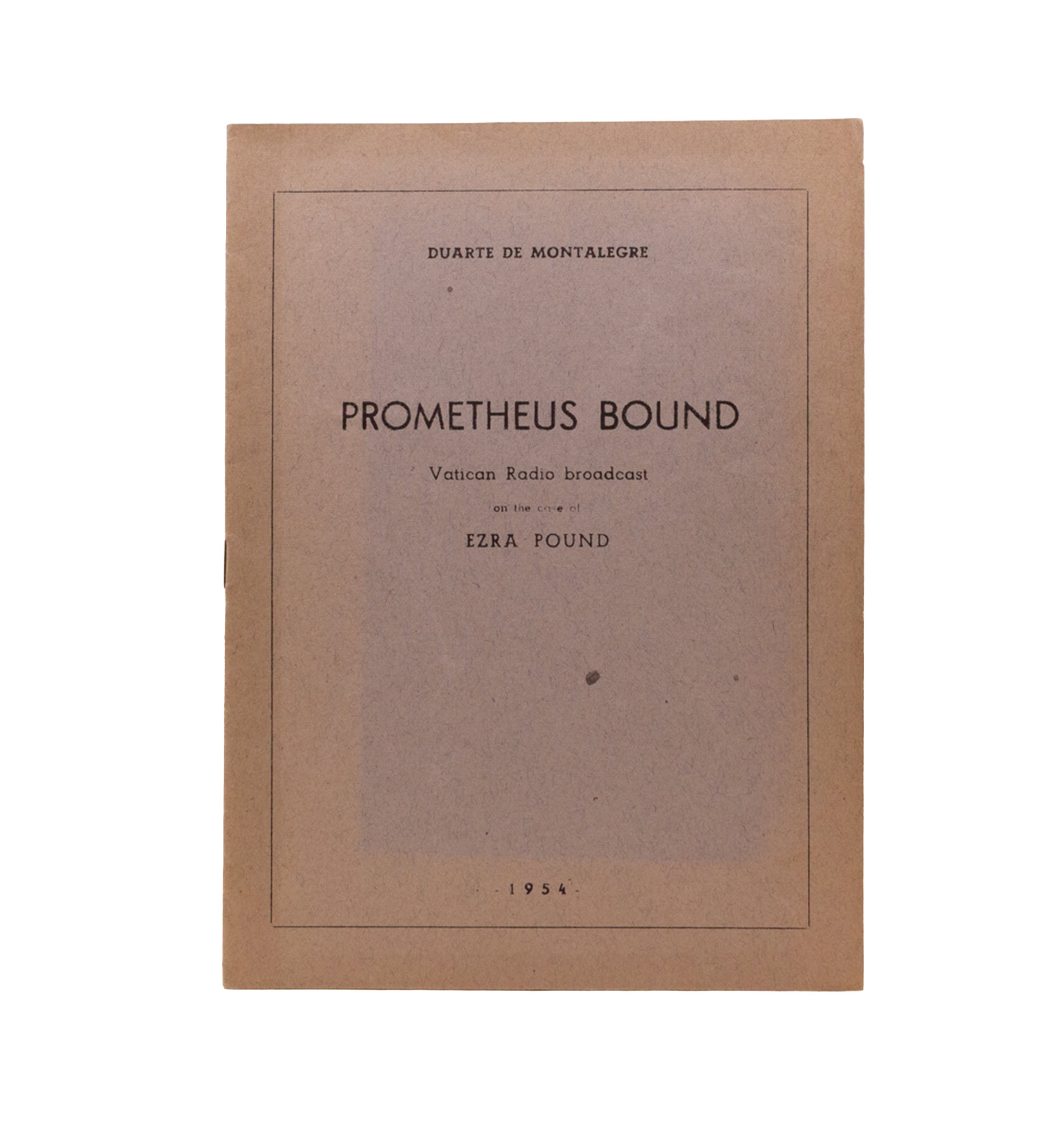
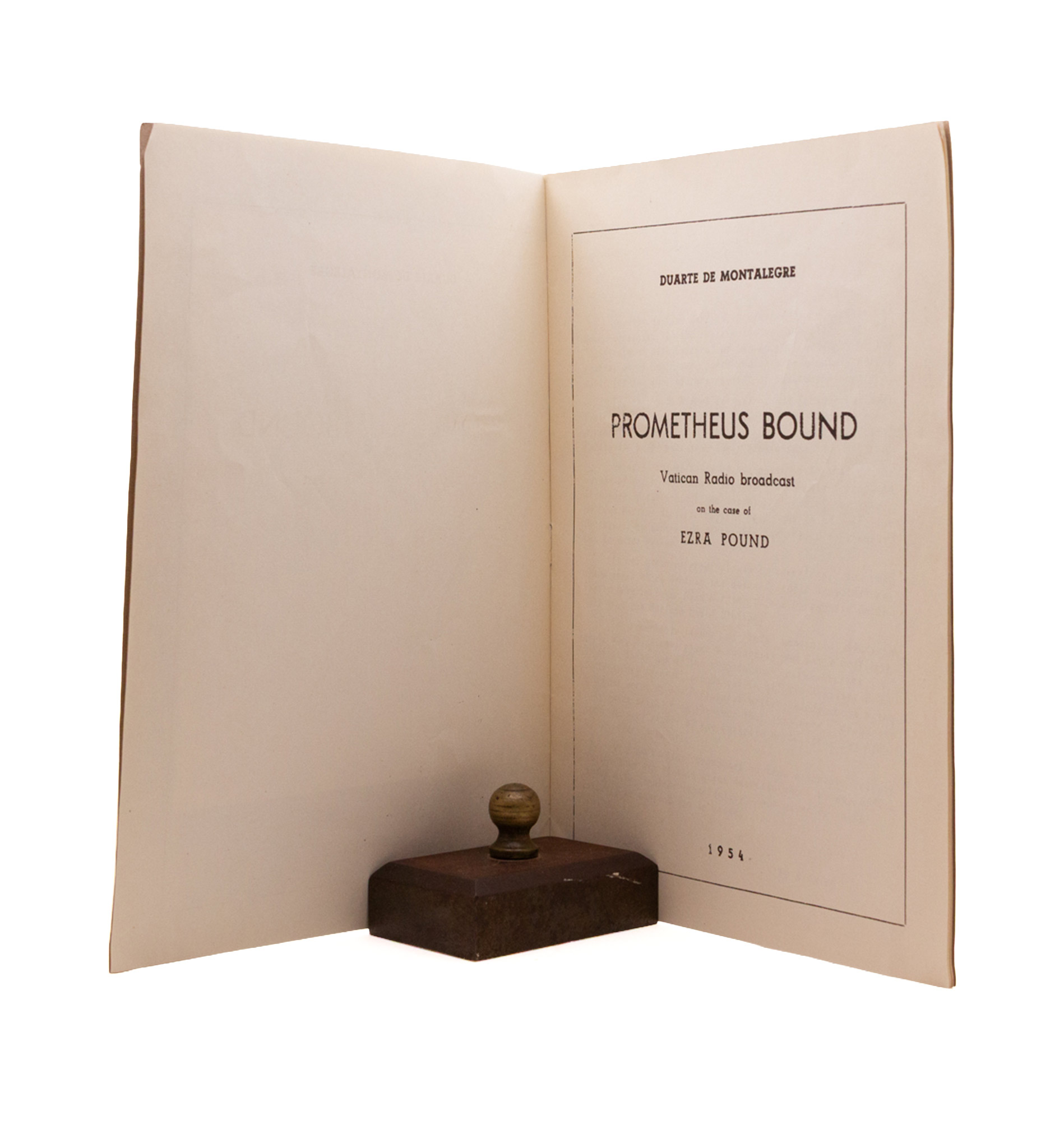
Prometheus Bound: Vatican Radio Broadcast on the case of Ezra Pound
Duarte de Montalegre [José Vittorio de Pina Martins]
Leo Magnino, foreword
Olivia Rossetti Agresti, translator
Published Vatican City: Vatican Radio, 1954
12pp.; 21.4 x 15.8 cm. Grey paper wrappers printed in black on front; stapled.
English translation by O. R. Agresti of Duarte de Montalegre (pseud. José Vittorio de Pina Martins; beautiful surname)’s speech aired March 1954 on Vatican Radio arguing against the chaining of “the greatest poet of the United States and one of the greatest poets of the world” to a rock: St. Lizs. Sole edition. Well handled with some crinkling to the pages; fading to wraps and one spot to front cover.

tap to cycle
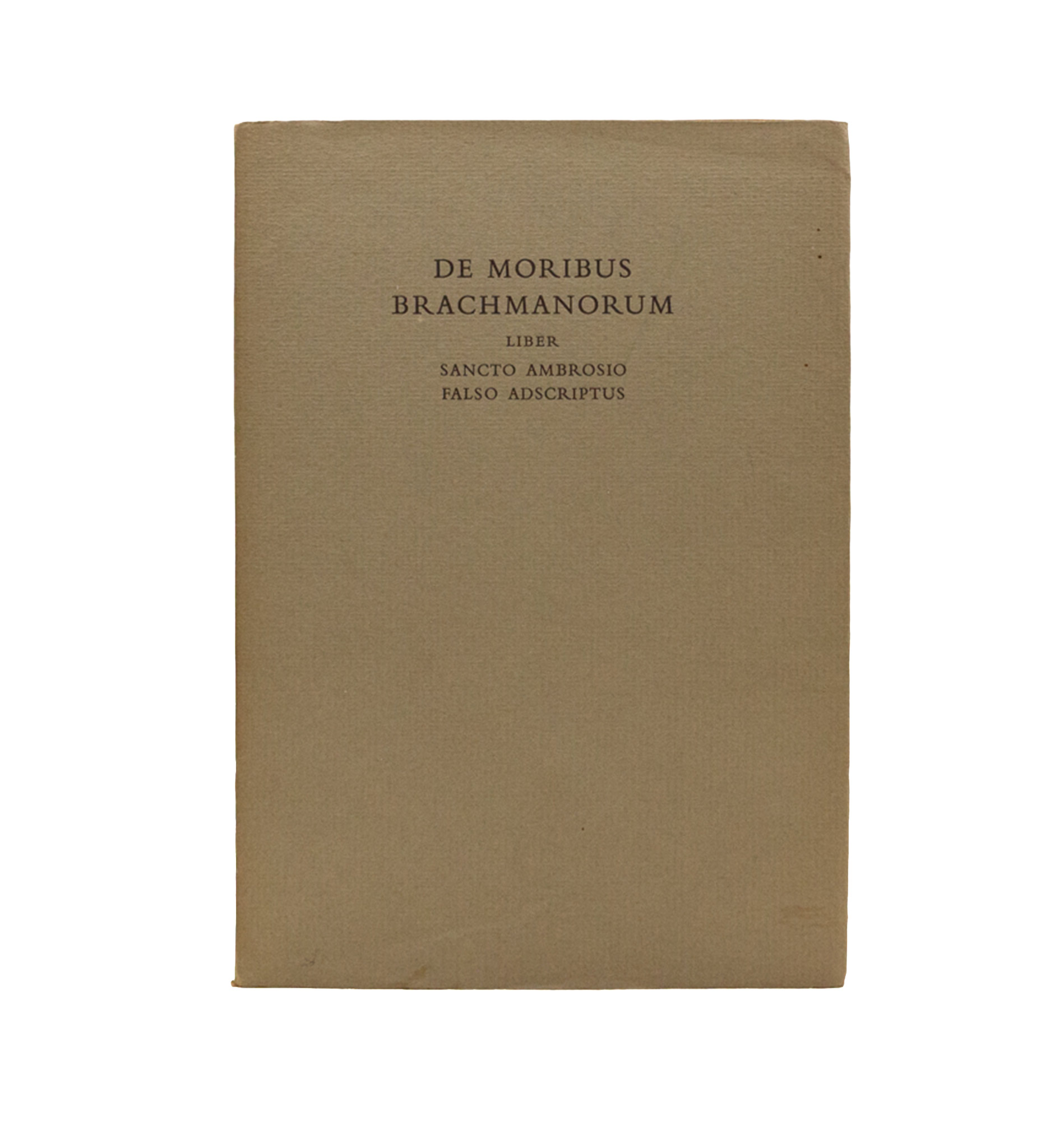
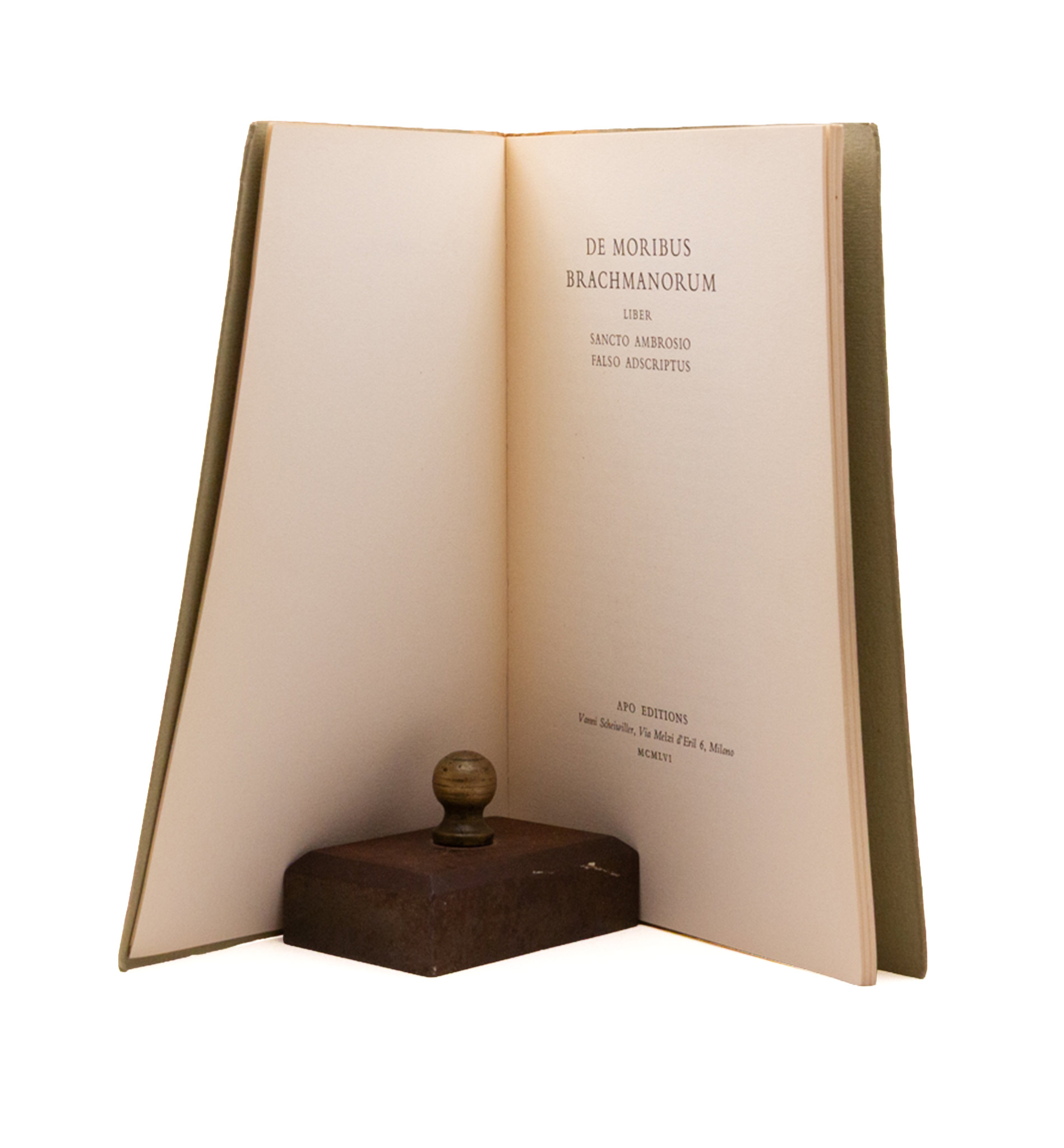
De Moribus Brachmanorum
Sancto Ambrosio, Falso Adscriptus
[Ezra Pound, editor]
Published Milan: Apo Editions, 1956
32pp.; 18.1 x 12.8 cm. Plain stiff white paper wraps. Green dust-jacket printed in black, attached at spine.
Falsely attributed to Saint Ambrose, understood to be in fact a Latin translation of a Greek work by Palladius of Galatia (c. 363-425 AD), De Moribus Brachmanorum, “On the Customs of the Brahmans,” the intelligenzia of Hindu society. Anonymously edited by EP during his internment at St. Elizabeths, the text probably appealing for its account of civic order. Deserves comment for Latin in the 1950’s. Printed by Vanni Scheiwiller and published under Apo Editions, i.e. “A Po[und] Editions,” i.e., in Italian, a series to be edited “by Pound.” The first and last Apo, though the name is used again in Noel Stock’s Edge and possibly elsewhere; an idiosyncrasy of the 1950’s. No. 195 of 500 copies. Tiny pencil ownership inscription to rfep reading something like “- bs/ Tunl / March 1973.” Lightly aged but very good. Gallup B58.
tap to cycle
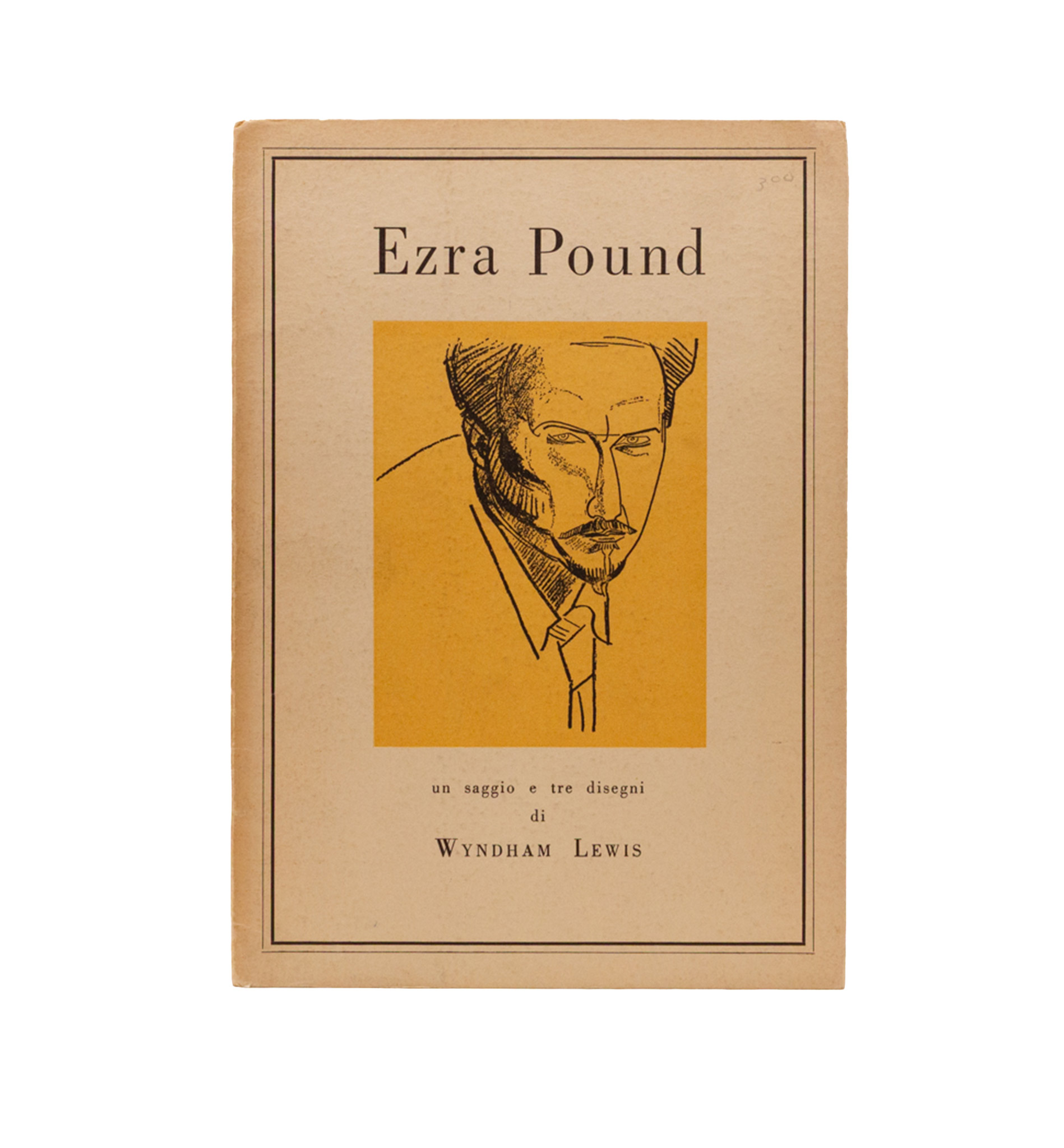
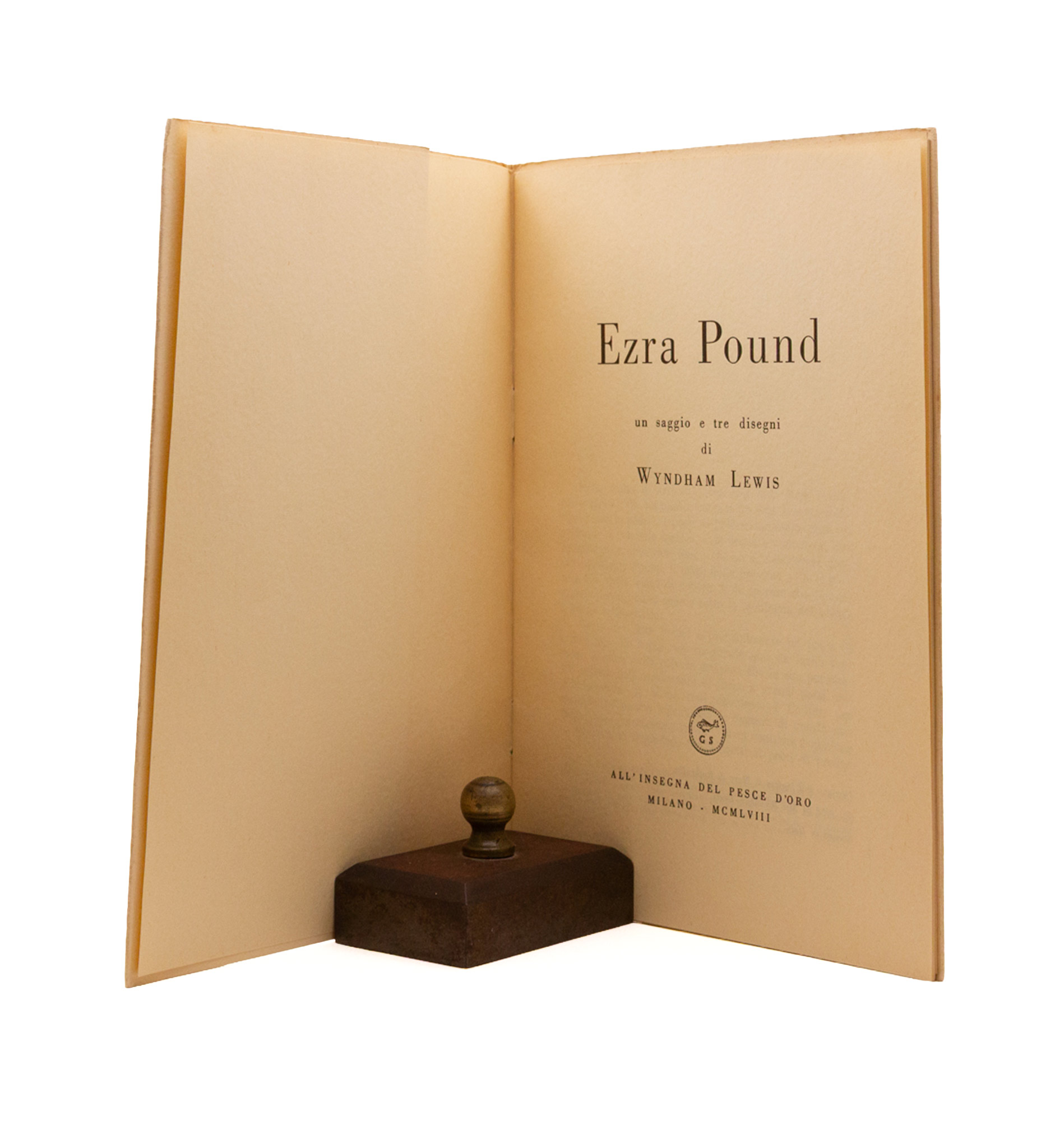
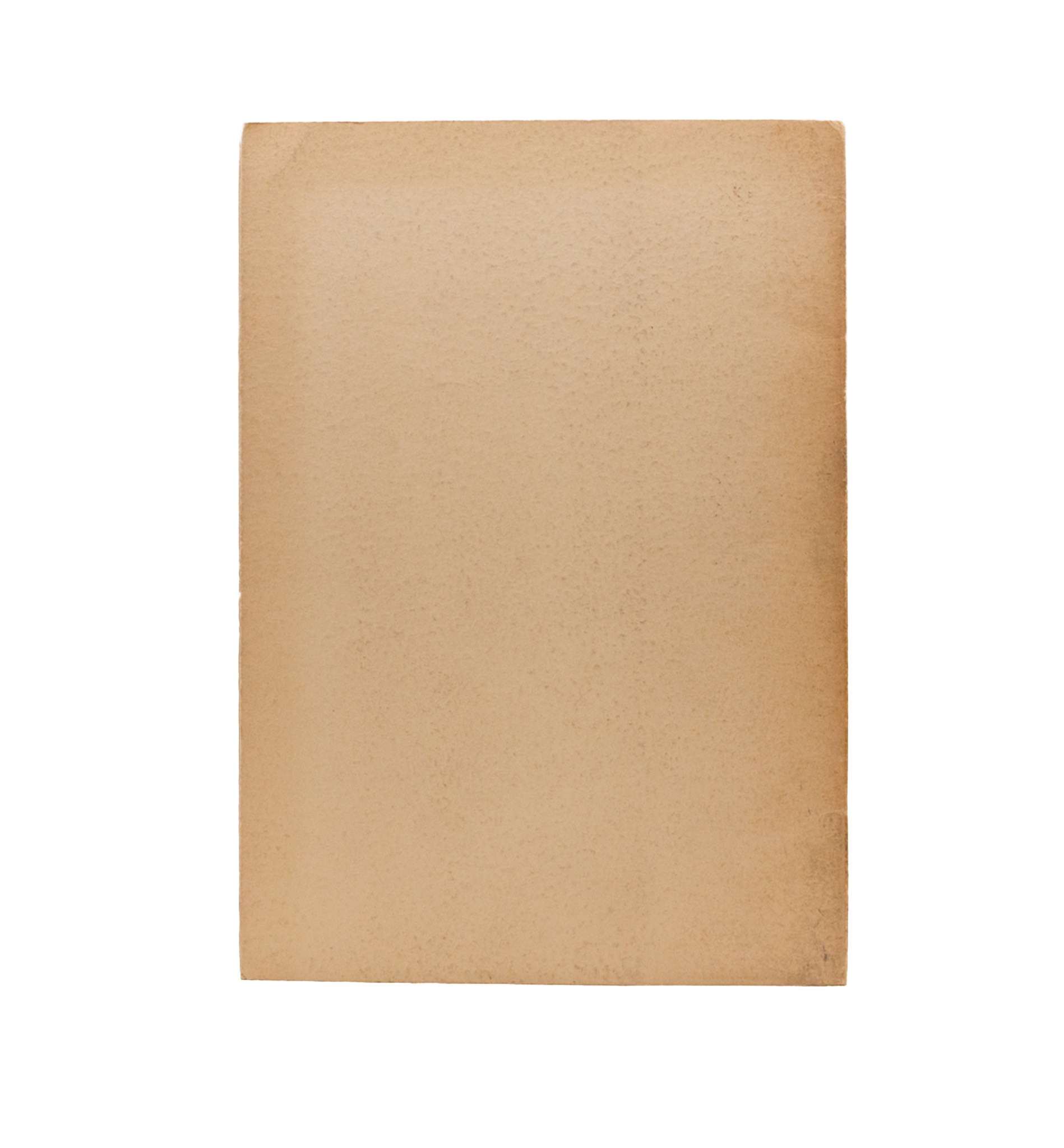
Ezra Pound, un saggio e tre disegni
Wyndham Lewis
Mary de Rachewiltz, translator
Published Milan: All’Insegna del Pesce d’Oro, 1958
20pp.; 20.5 x 14.6 cm. Stiff paper wraps printed in yellow and black.
An essay by WL on EP, together with three drawings of EP by WL. First published in Peter Russell’s 1950 An Examination of Ezra Pound. No. 217 of 1000 copies. First in the Fascioli del Verri series. Wraps browned at edges. Not in Gallup, being secondary.
tap to cycle
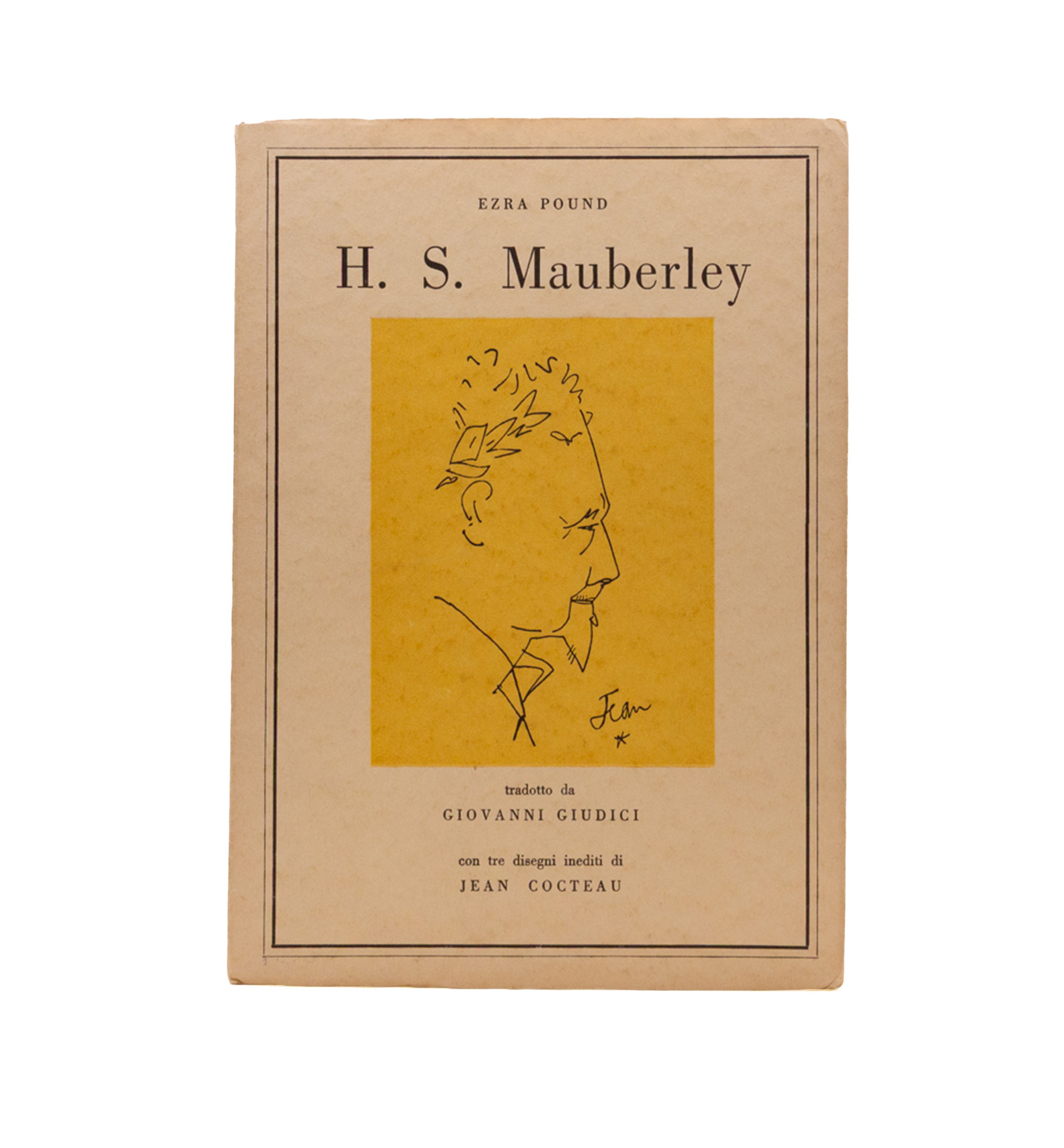
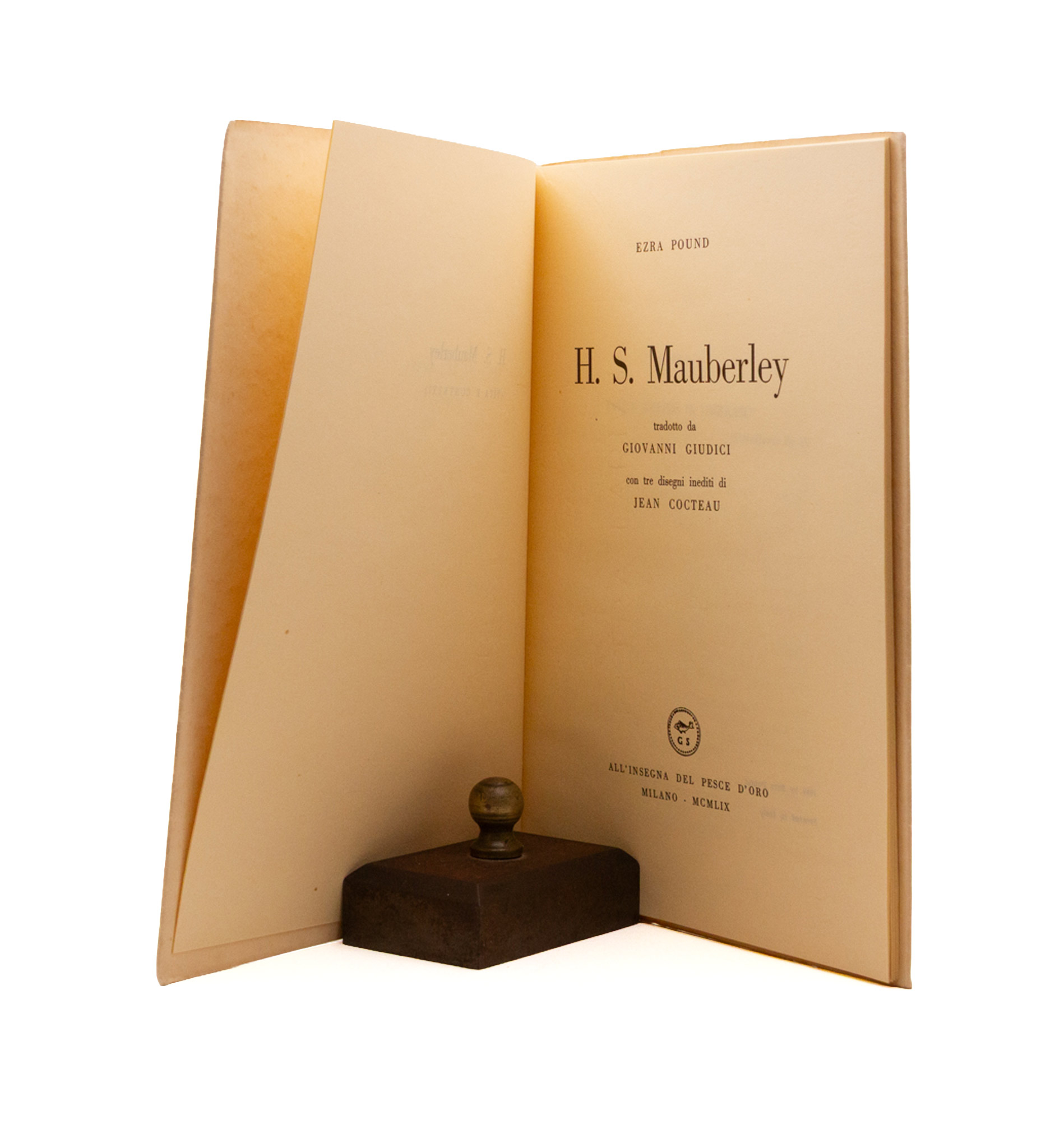
H. S. Mauberley
Ezra Pound
Giovanni Giudici, translator
Jean Cocteau, illustrator
Published Milan: All’Insegna del Pesce d’Oro, 1959
60pp.; 20.5 x 14.6 cm. Stiff paper wraps printed in black and stamped in yellow.
First Italian translation of H.S.M., printed vis-à-vis the English. With three previously unpublished drawings of Pound by Jean Cocteau. No. 492 of 1000 copies. Fourth in the Fascioli del Verri series. A near fine copy. Gallup D75.
tap to cycle
Vagabond; Special Poetry Edition No. 4
J. Bennett Jr., editor
Charles Bukowski, Archibald Henderson, contributors
Published Munich: Vagabond, 1967
24pp.; 20 x 15.1 cm. White paper wrappers printed in black; wire-stitched.
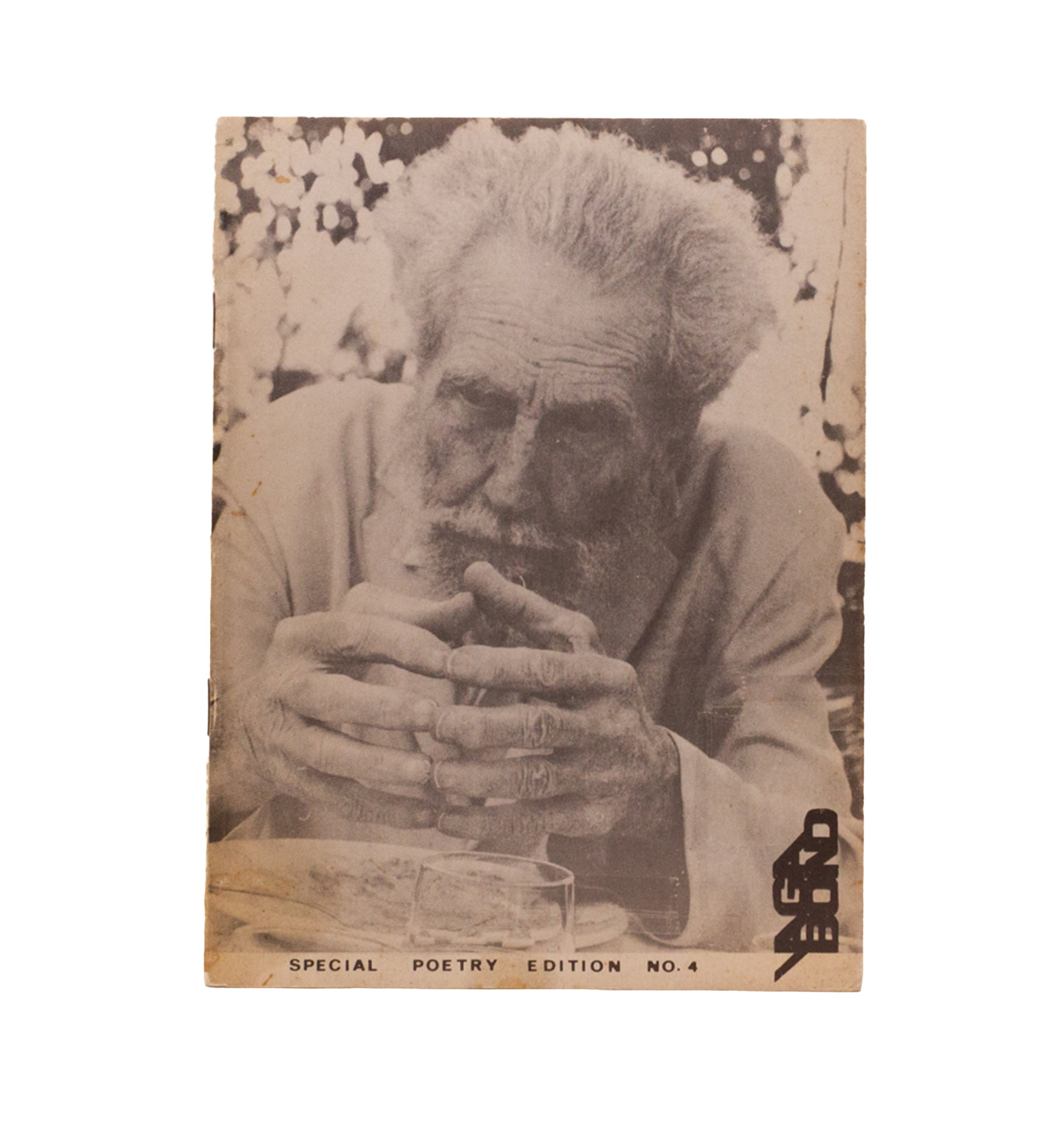
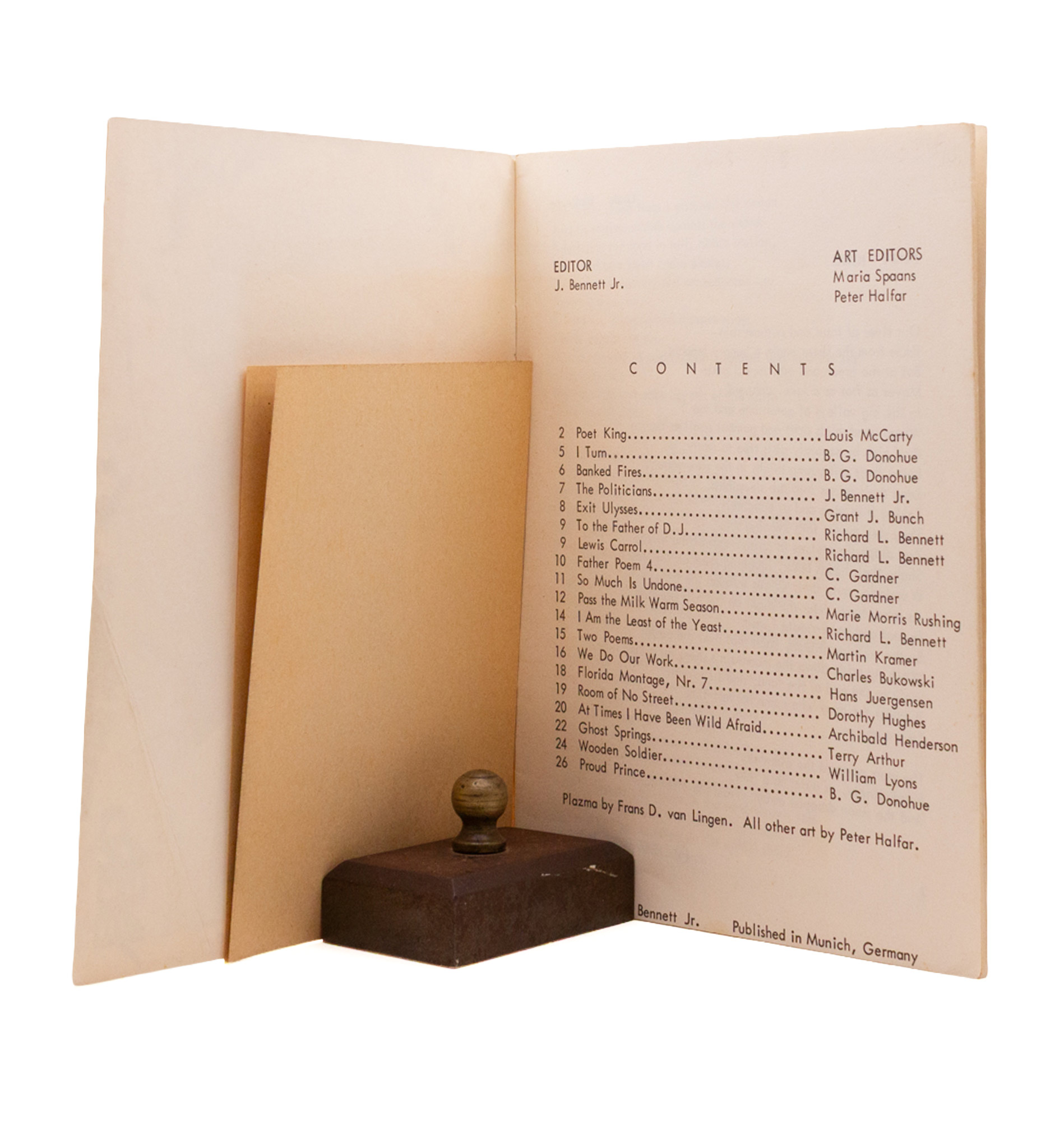
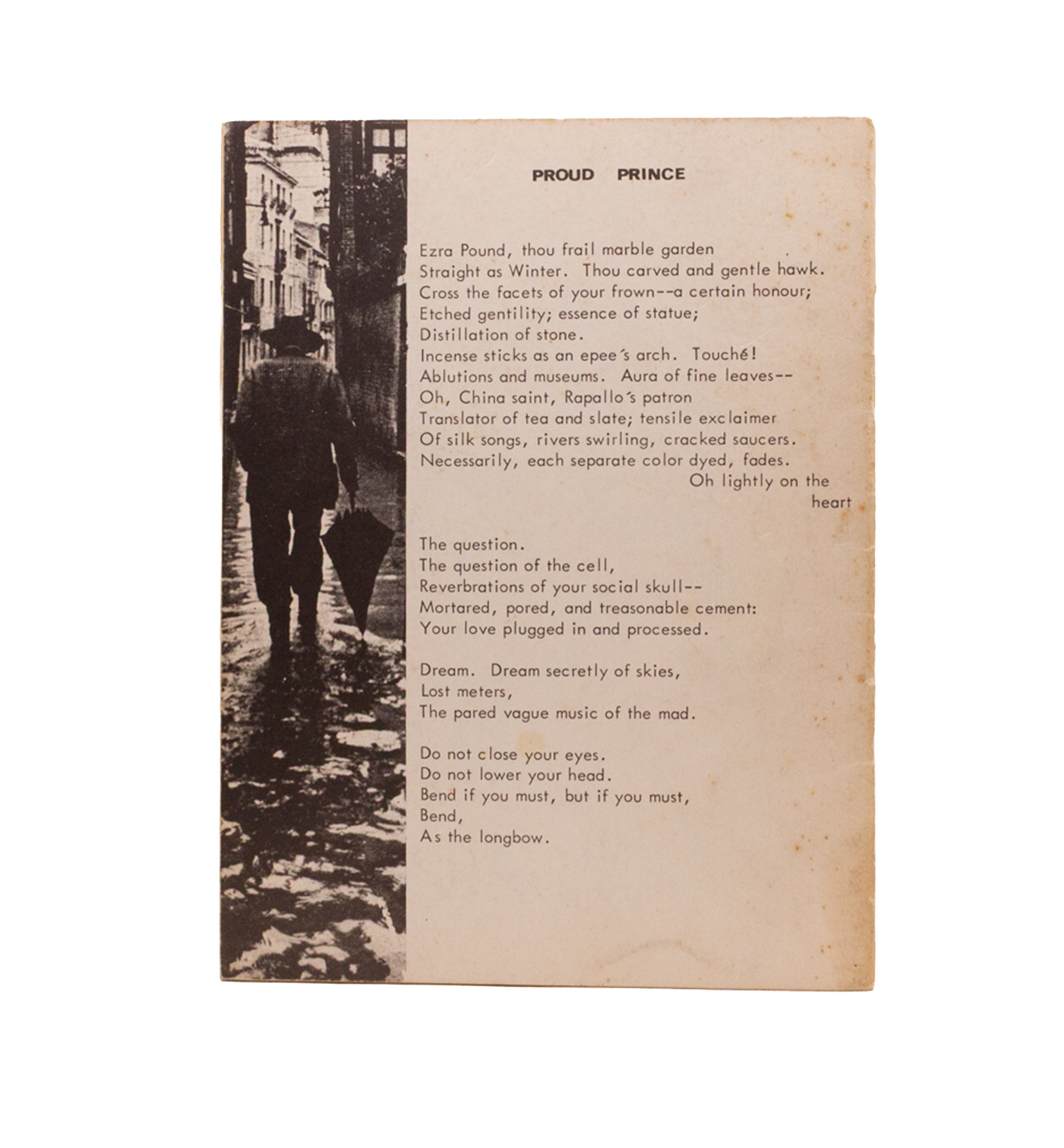
Vol. 1 No. 4 of John Bennett’s Vagabond, a poetry periodical printed on a 1917 A.B. Dick mimeograph machine found by Glenn Miller. Published from Munich for the first 8 (?) issues, and then moving to California. Bukowski was a friend and regular contributor; the more interesting contribution here is “At Times I Have Been Wild Afraid” by the same Archie Henderson as Gallup’s bibliographic heir. This copy illustrated with two late photos of EP to both covers, and a poem on p.26 (i.e. the rear cover), “Proud Prince” by B. G. Donohue written for EP. Wraps aged, foxed, with water-mark showing on the inside wraps but not affecting the text-block. With a subscription notice mocking the Statue of Liberty laid-in, single fold but fine.

tap to cycle
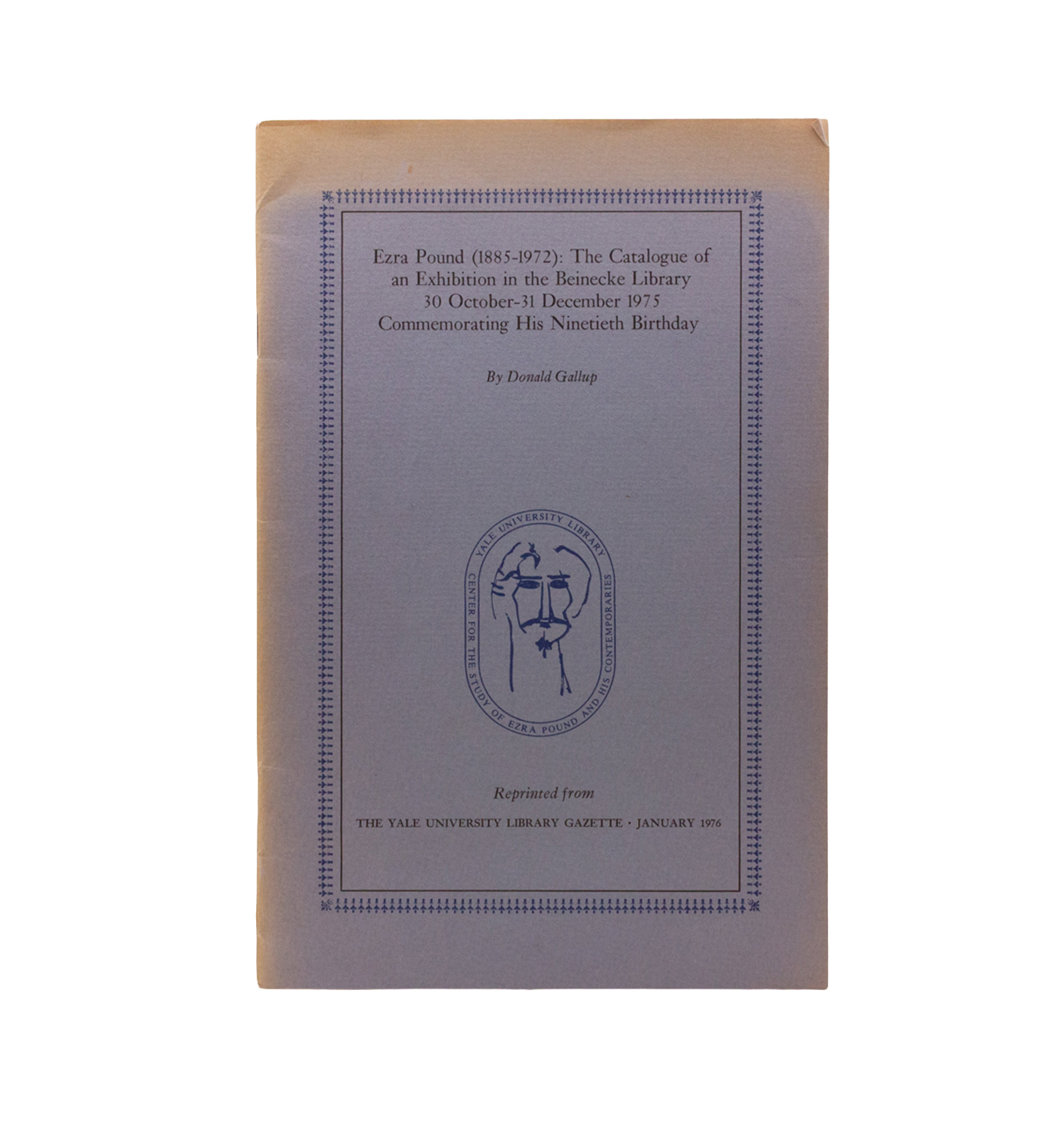
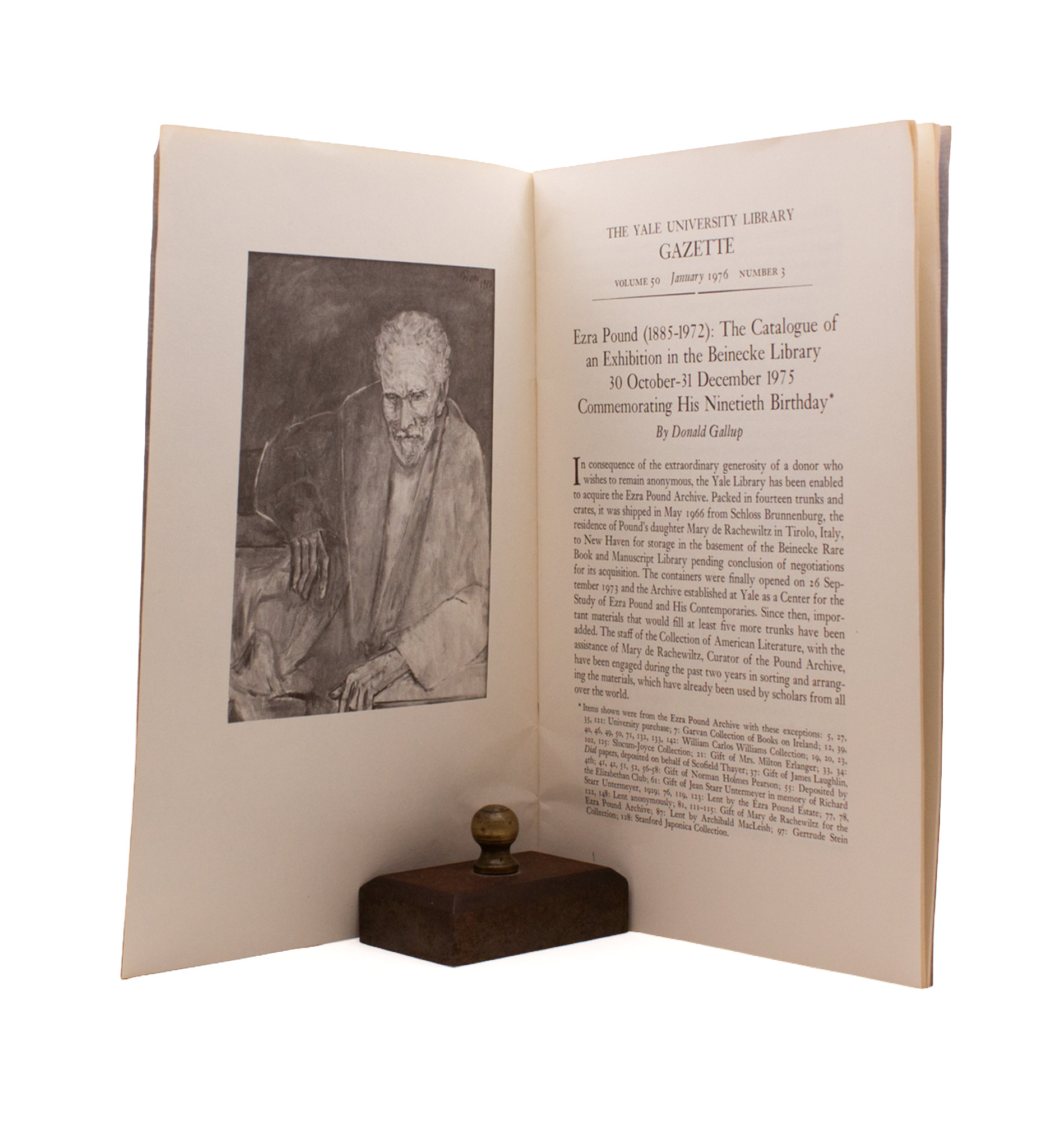
Ezra Pound: The Catalogue of an Exhibition in the Beinecke Library
Donald Gallup
Published The Yale University Library Gazette, 1976
16ll.; 23.4 x 15.4 cm. Blue paper wraps printed in dark blue and black; wire-stitched.
Catalogue to an exhibition of Poundiana to showcase Yale’s acquisition of Pound’s literary archive from Mary de Rachewiltz. For an account of the acquisition, best refer to Donald Gallup’s Pigeons on the Granite (1988). Exhibits include a large amount of manuscript and typescript drafts as well as letters. A little creasing around spine; fading to spine and top edge.

tap to cycle
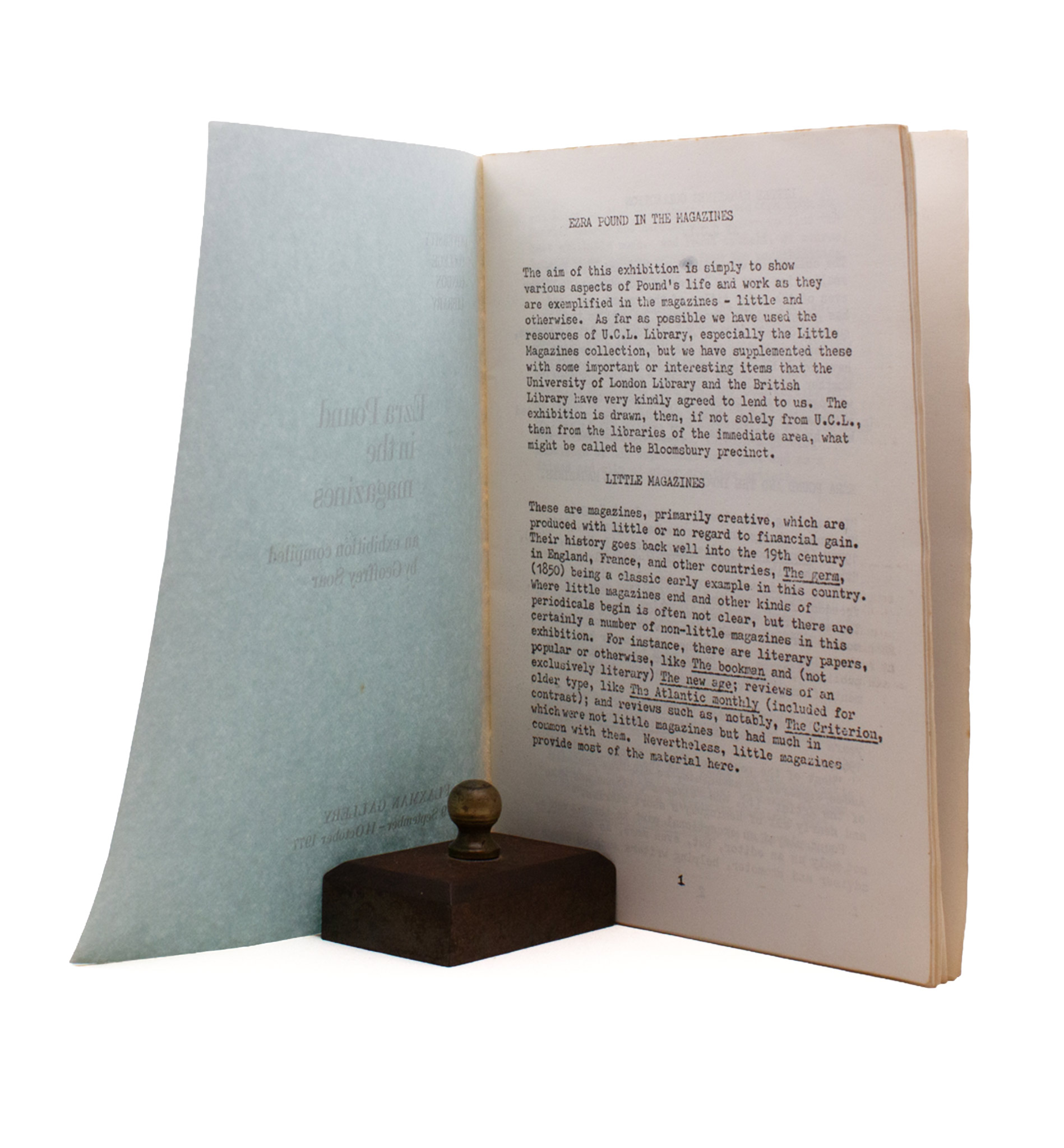
Ezra Pound in the magazines
Geoffrey Soar, curator
Published Flaxman Gallery, 1977
40pp.; 21 x 15 cm. Pale blue paper wraps printed in black; wire-stitched.
A beautiful, simple mimeographed leaflet, the catalogue to an exhibition on Pound’s publications in the little mags, something totally crucial to EP’s work & modern literature on the whole. From the collections of primarily the UCL Library, and the University of London Library, and the British Library. Light age to the wraps and fading to spine.
tap to cycle
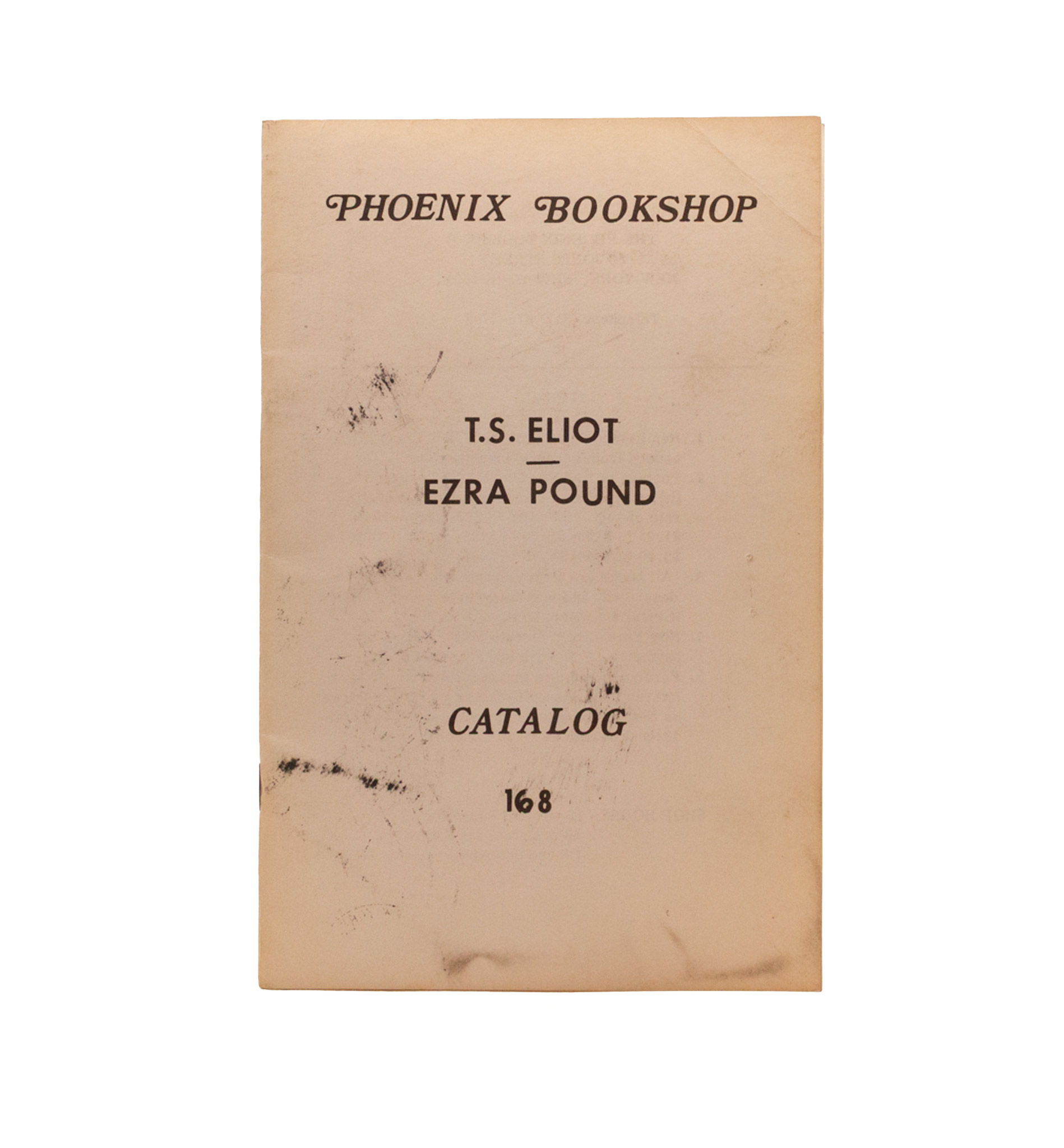
Phoenix Bookshop Catalog 168: T. S. Eliot / Ezra Pound
[Robert A. Wilson]
Published New York: Phoenix Bookshop, [1981]
24pp.; 21.2 x 13.8 cm. Stiff white paper wrappers printed in black; wire-stitched.
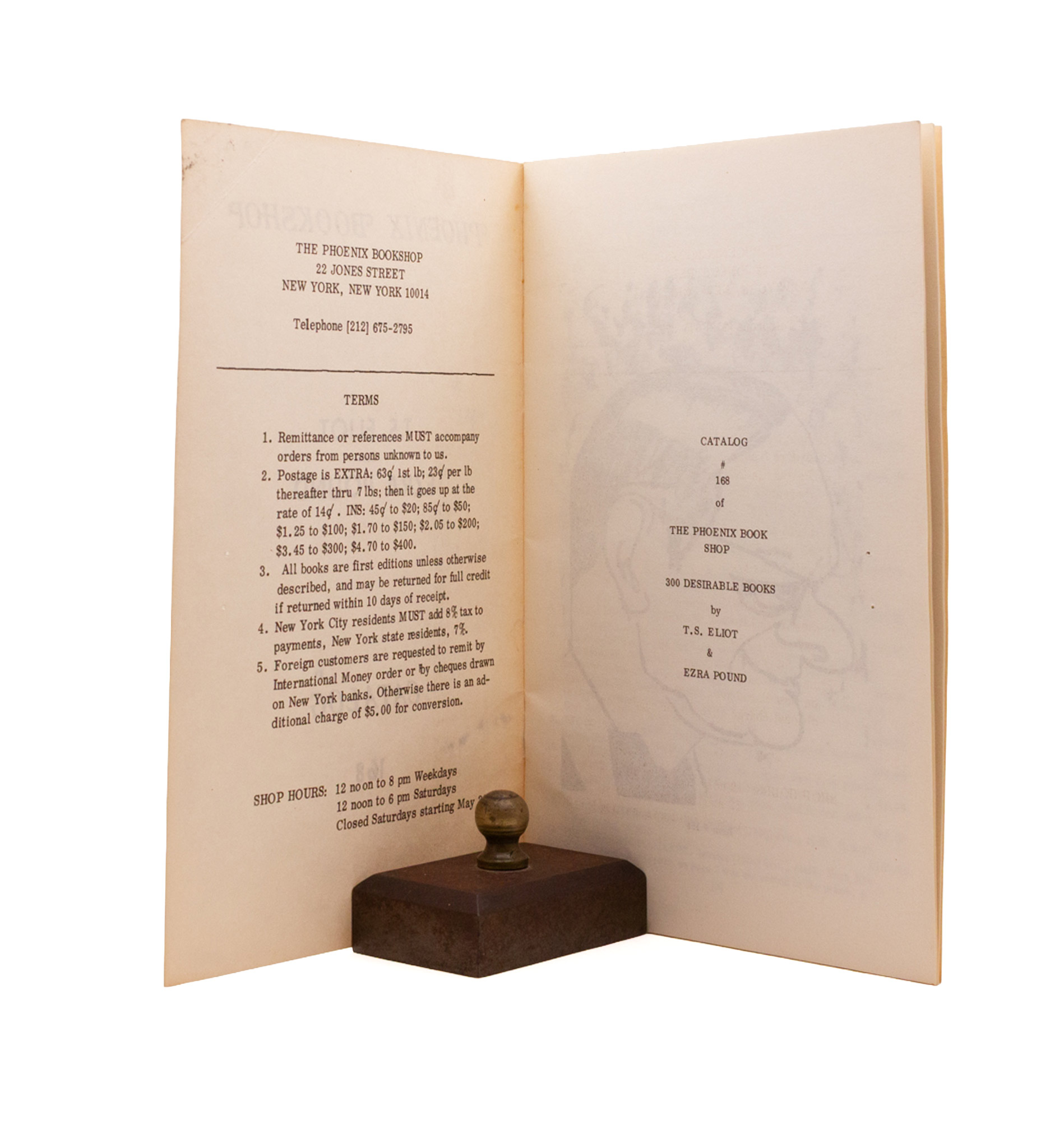
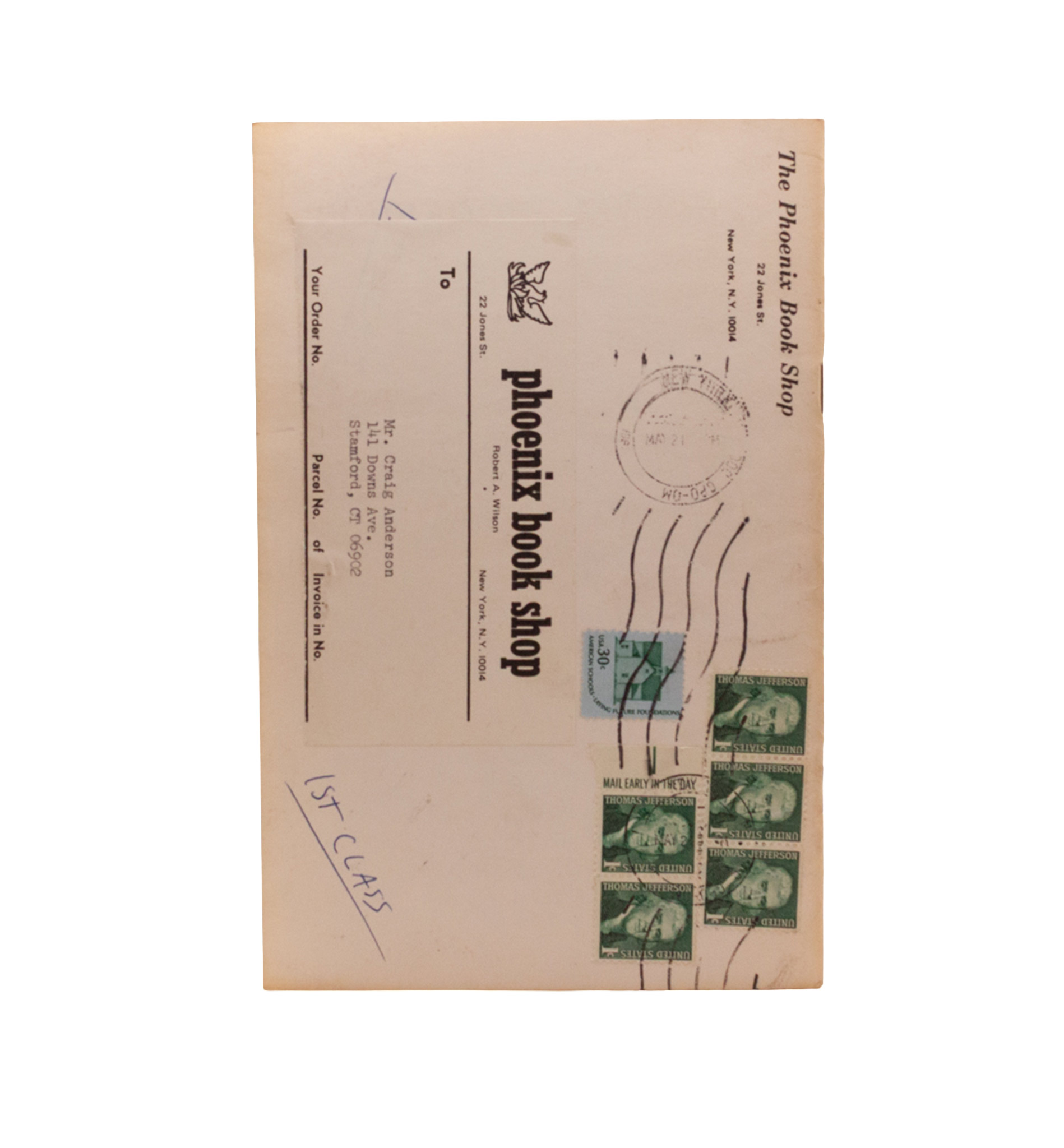
Catalogue 168 from Robert Wilson’s Phoenix Bookshop in Greenwich Village, a destination for writers including Allen Ginsberg, Diane di Prima, and Patti Smith. Dedicated to the works of Eliot and Pound, each listing with Gallup’s index. Highlights include a second impression of Quinzane for this Yule (1908) advertised for $10,000 and a 1 7/8 ips tape recording, privately made, of Pound reading at the Spoleto Festival in 1967 for $5. This copy mailed to L. Craig Anderson; the postage stamp on the back faintly reveals the date as 1981. Ink smudge to front cover in the same form as that on the rear, suggesting the post office’s stamping and stacking. Light crease to top corner. Remnants of staple near fore-edge running from front cover thru to rear, presumably etiquette in posting. Scarce, and very cool.

tap to cycle
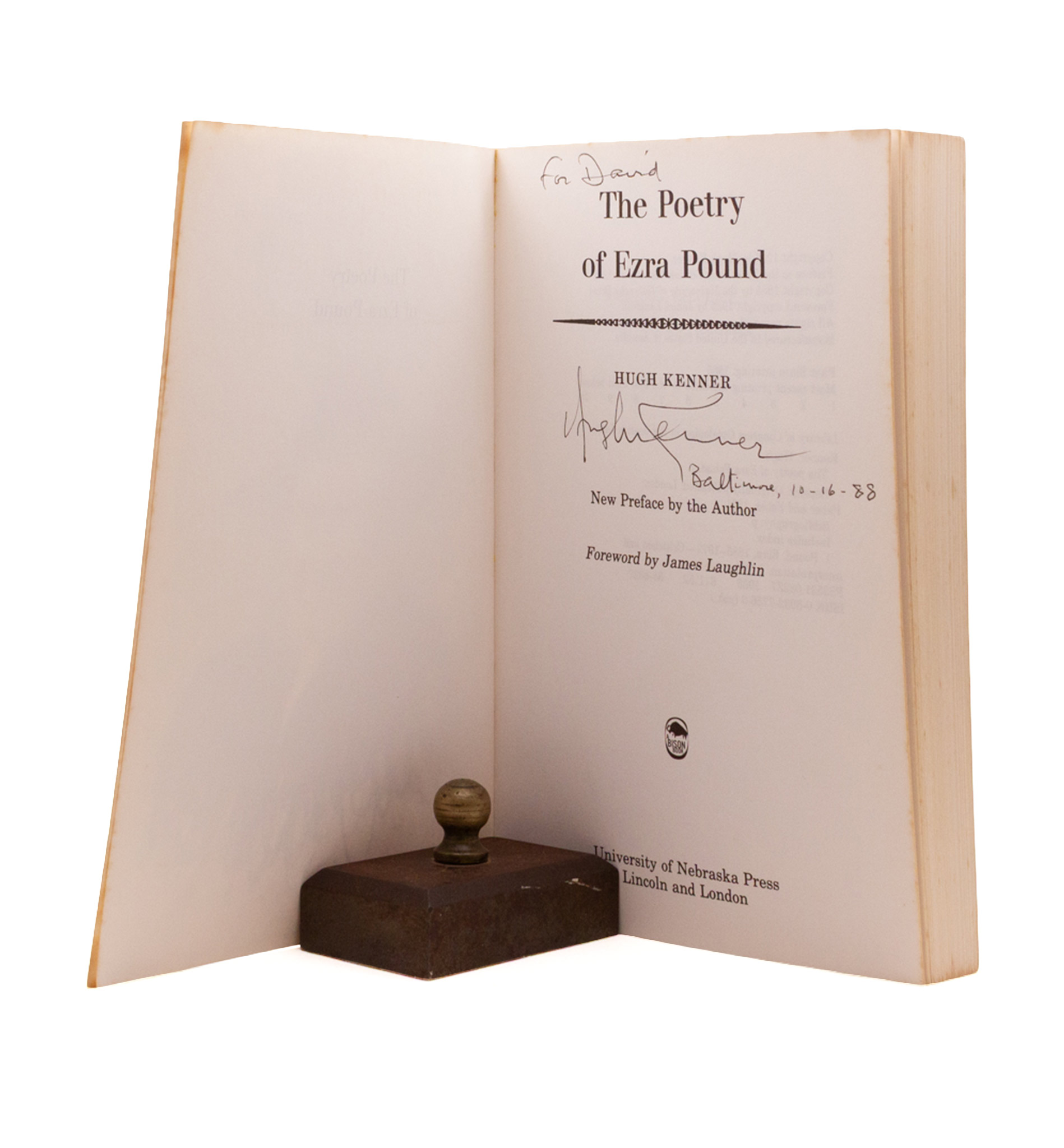
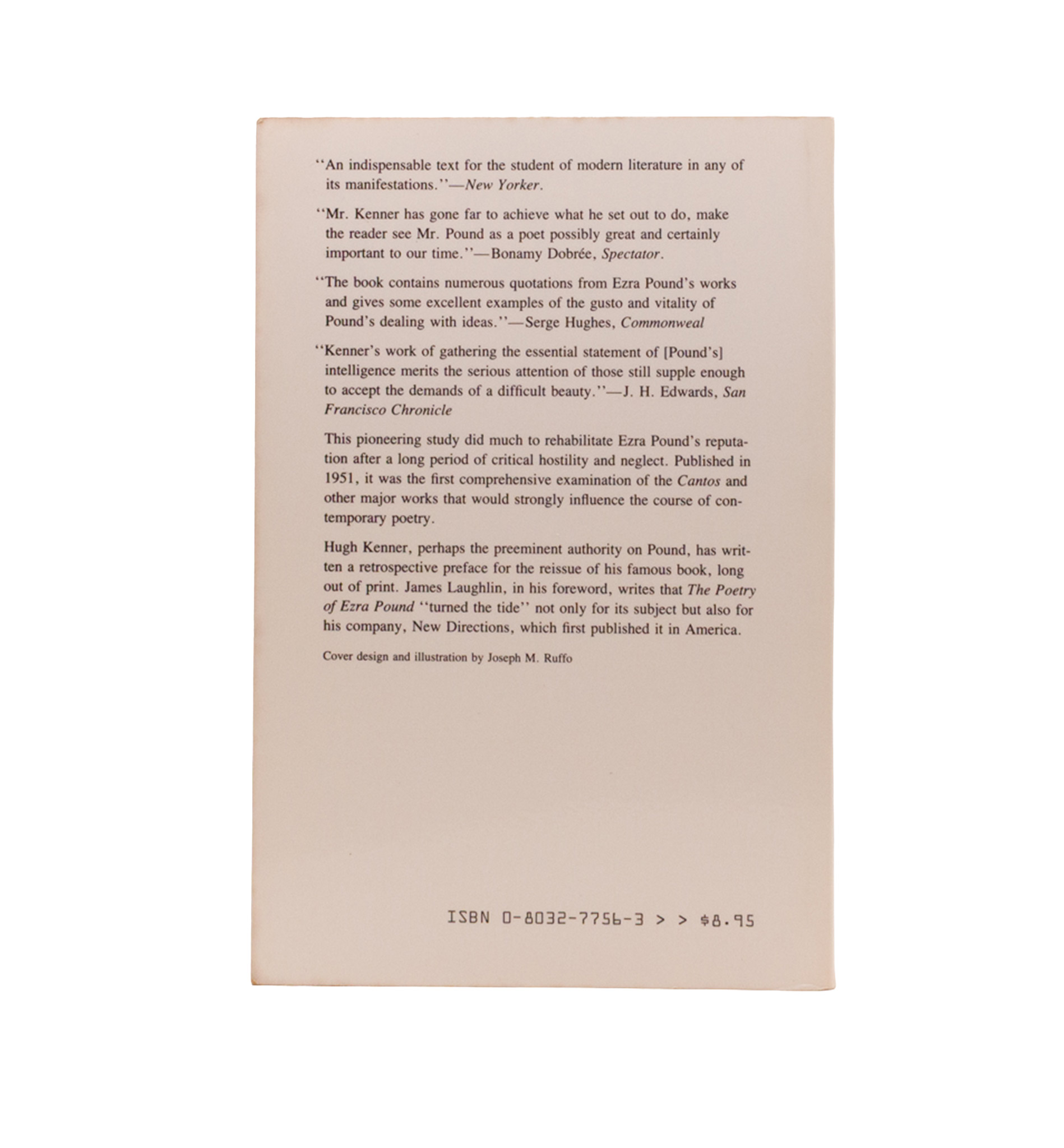
The Poetry of Ezra Pound
Hugh Kenner
James Laughlin, foreword
Published Lincoln and London: Bison Books, University of Nebraska Press, 1985
342pp.; 20.2 x 13.6 cm. Stiff white printed paper wraps.
An important issue of Kenner’s first book on Pound, published by New Direction in 1951, here republished by Bison Books with a foreword, “Some Irreverent Literary History,” by James Laughlin and a new preface, “Retrospect: 1985,” in which Kenner recounts his first meeting Pound, his learning Pound’s poetry, and the relevance this book has kept or lost since its writing. This copy inscribed for David Moody by Kenner on the title page, dated “Baltimore 10-16-88.” Near fine, spotting on the top edge. Too late for Gallup, but otherwise B52.

tap to cycle
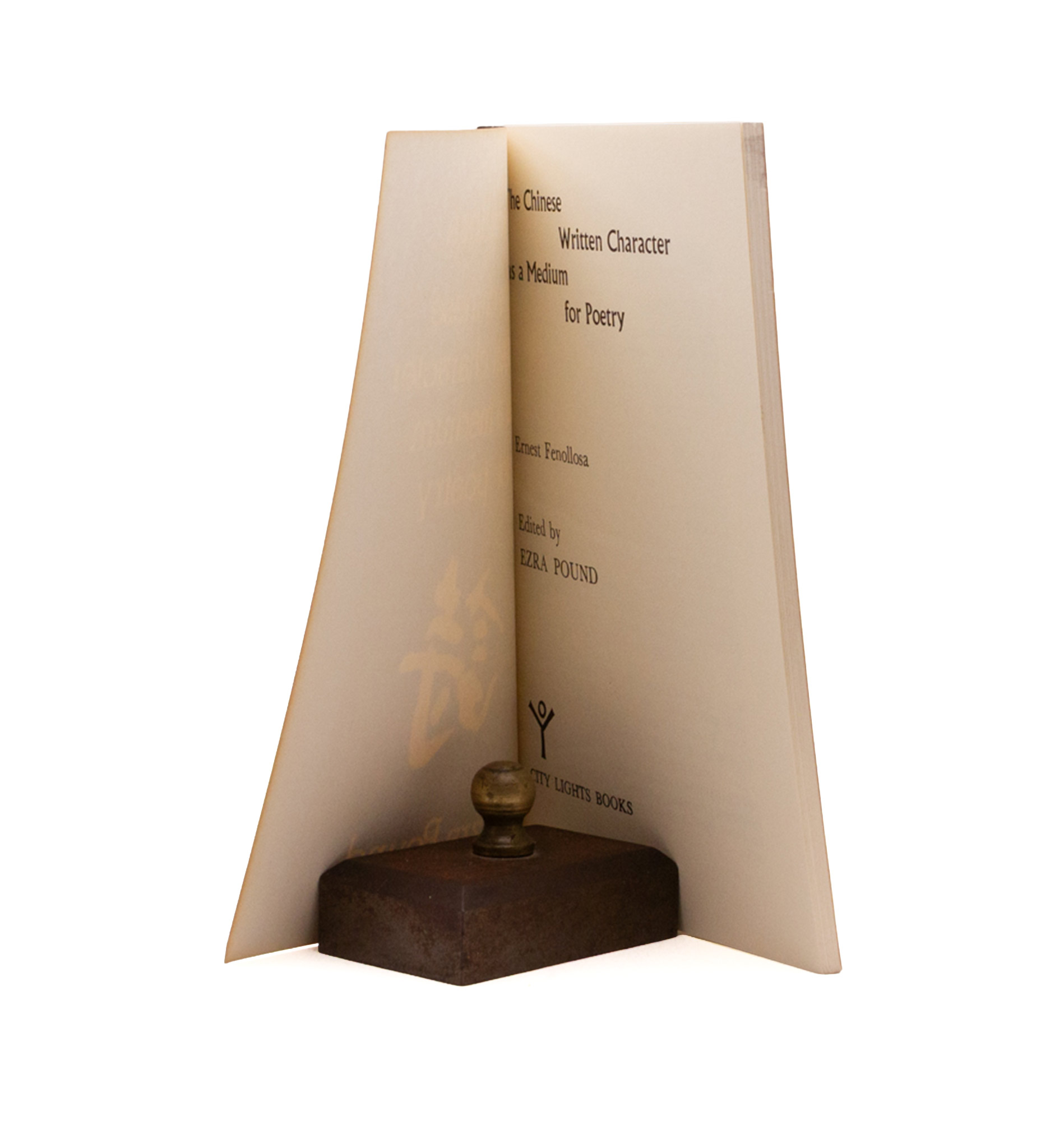
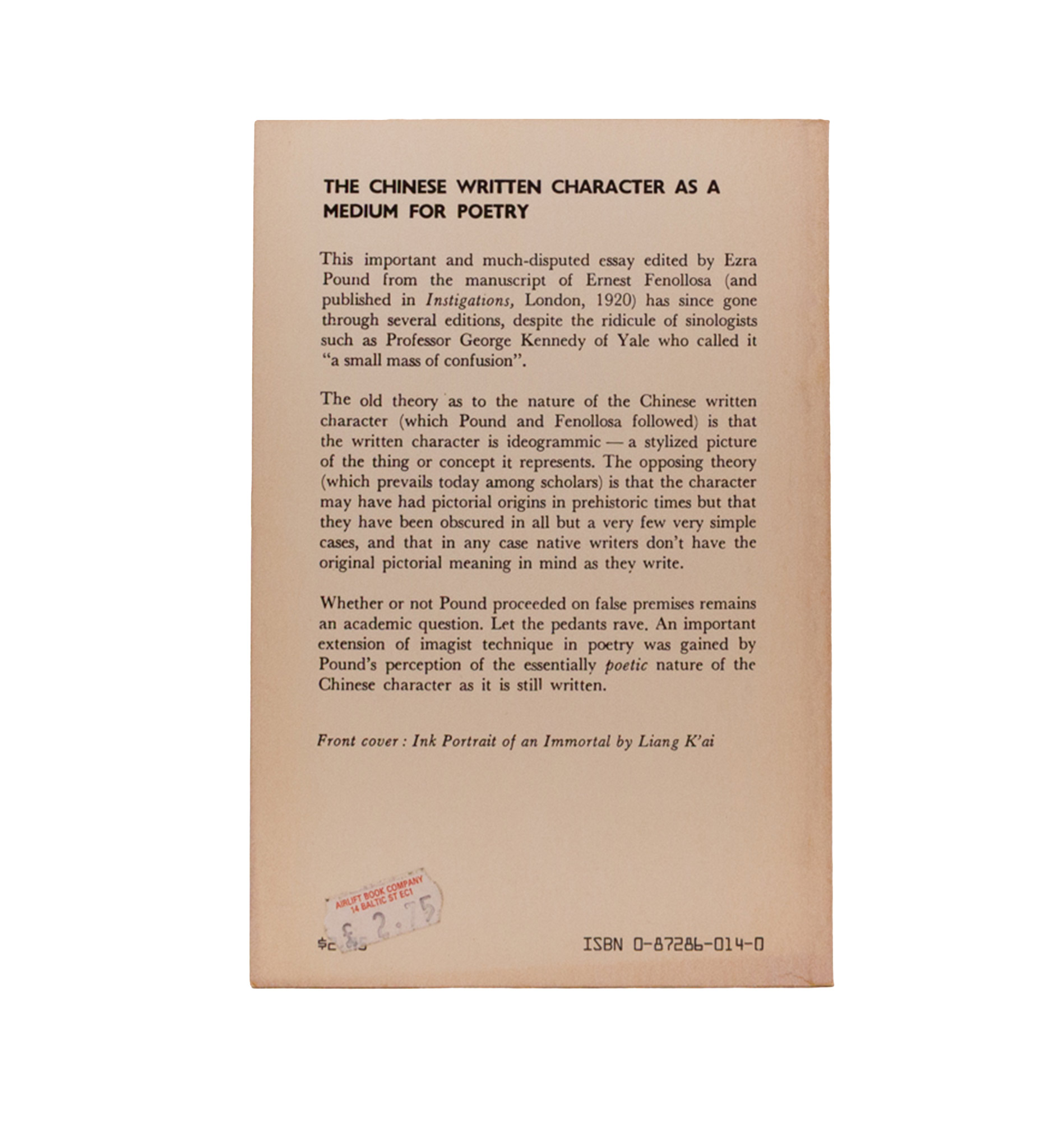
The Chinese Written Character as a Medium for Poetry
Ernest Fenollosa, Ezra Pound
Published San Francisco: City Lights Books, 1983
45pp. + adverts; 18.4 x 12.3 cm. Stiff white paper wrappers printed in black and yellow.
Ninth printing (June 1983) of the City Lights edition of this classic Pound-Fenollosa treatise. A near fine copy, slim format ideal for the commuter. Somewhat detailed under Gallup B36.
tap to cycle
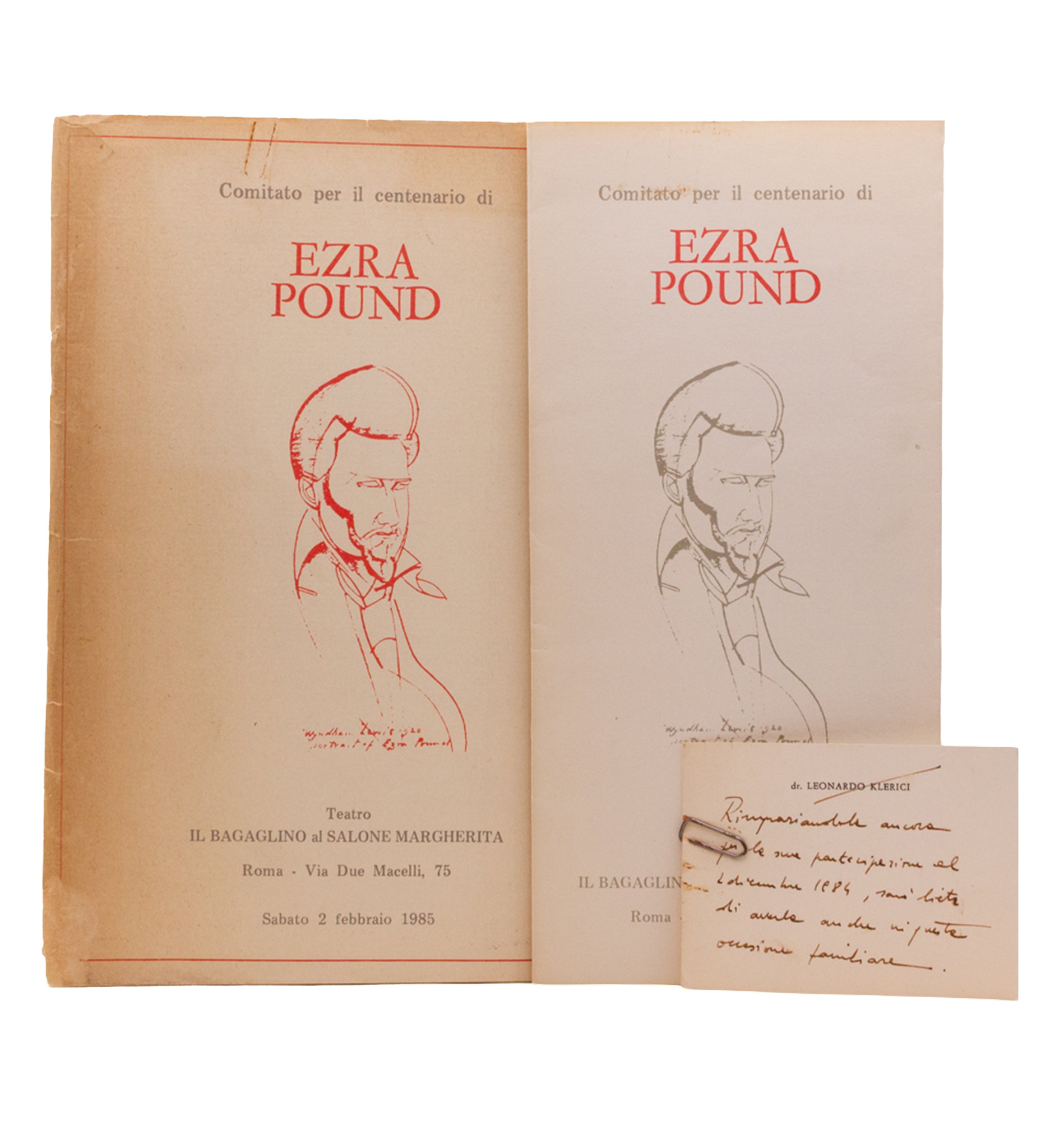
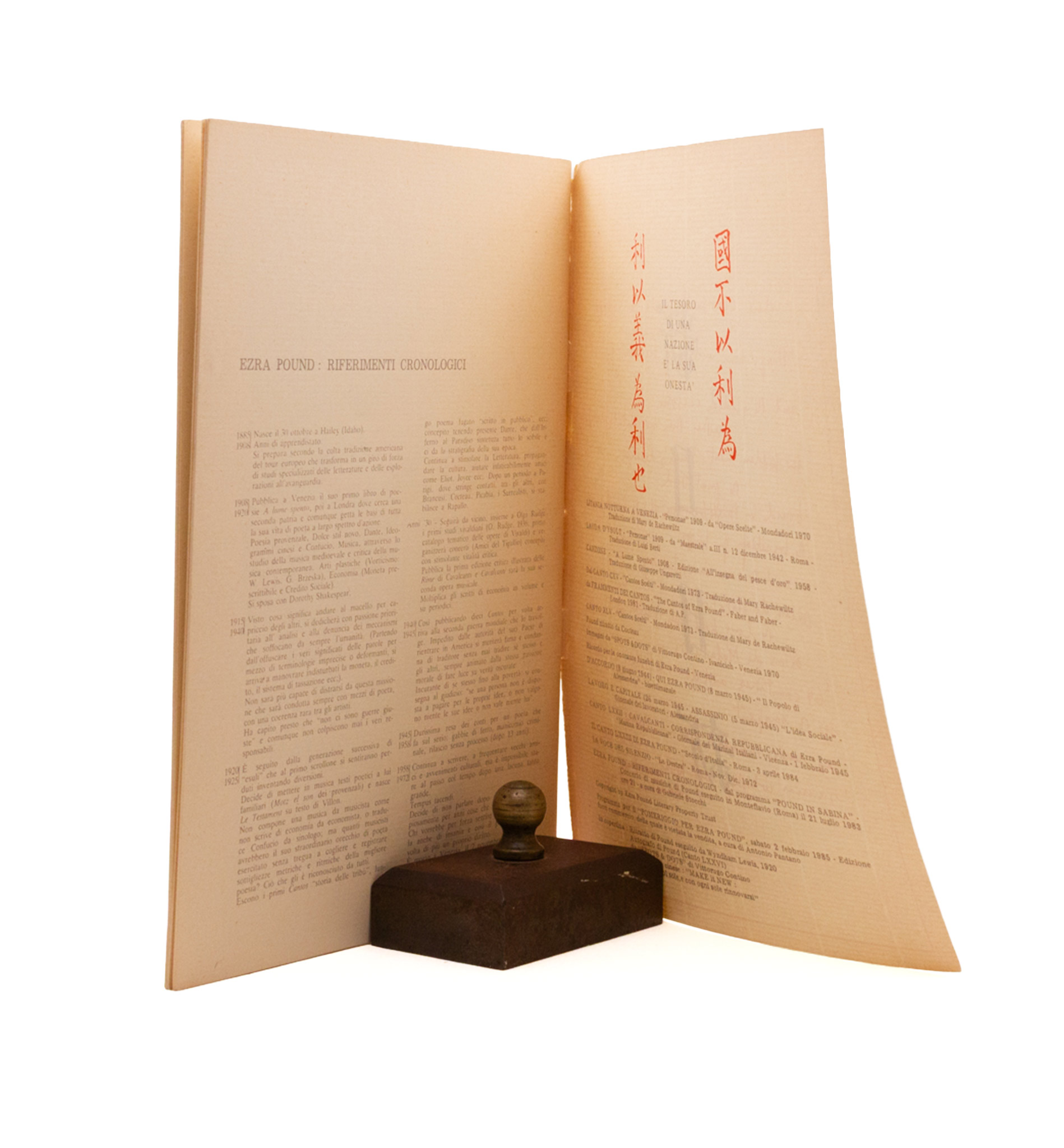
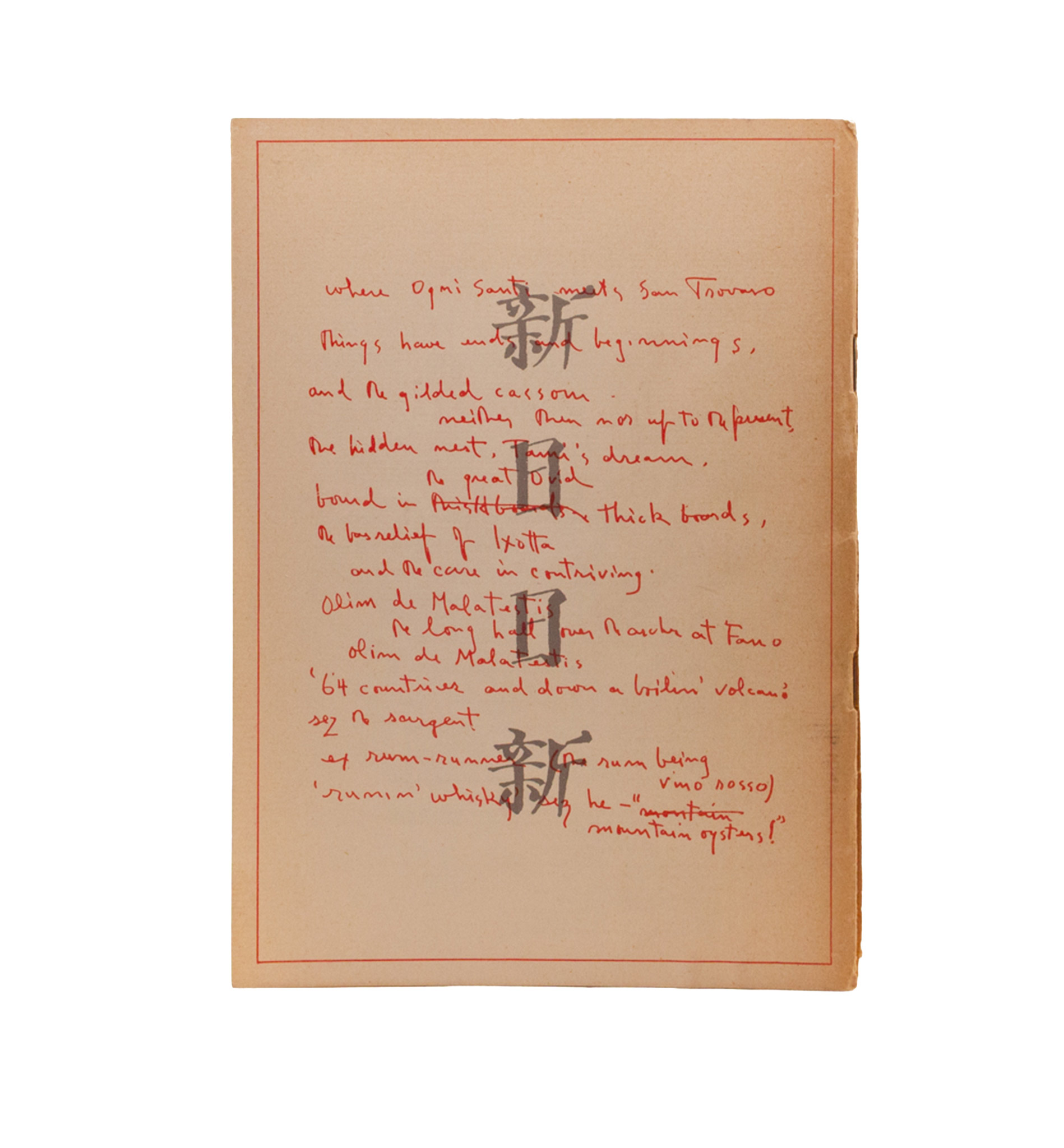
Pomeriggio per Ezra Pound; a collection of ephemera
Comitato per il Centenario di Ezra Pound; Francisco Grisi, Antonio Pantano
Published Rome: Comitato per il Centenario di Ezra Pound, 1985
14ll.; 21 x 15.1 cm. Tan paper wraps printed in grey and red; wire-stitched.
21.1 x 39.5 cm. Single heavy white paper leaf printed in grey and black; leporello.
An invite and booklet accompanying a Pound conference held on Saturday, 2 February 1985 in the Salone Margherita theatre, Rome where Olga Rudge held a presentation, talk and slides, on Pound’s last years, and a flute quintet performed music by Pound, Mozart, Schubert and Maderna, followed by talks and poetry recitals. The brilliant booklet reproduces a number of poems in Italian (with translations from MdR, Luigi Berti, Giuseppe Ungaretti), scans of a selection of Pound’s articles in the Italian newspapers of 1943-1945, and essays from Francesco Grisi and Claudio Quarantotto.
Also included is a large newspaper cutting from La Stampa, 20 April 1985 of an article about EP and Dorothy Shakespeare entitled “Caro Ezra Pound, mia figlia non può sposarla [Dear Ezra Pound, my daughter cannot marry you].” Also two photocopies (one enhanced) of an article by Antonio Pantano in an unknown paper dated 1984 titled “Olga Rudge: cinquant’anni con Ezra Pound,” discussing among other things the Venice residence. And small calling card of Leonardo Klerici originally attached by paperclip to the booklet, with thanks for attendance in hand.
Light toning all round. Booklet’s wraps hanging on by the top staple. Generally very good.

tap to cycle
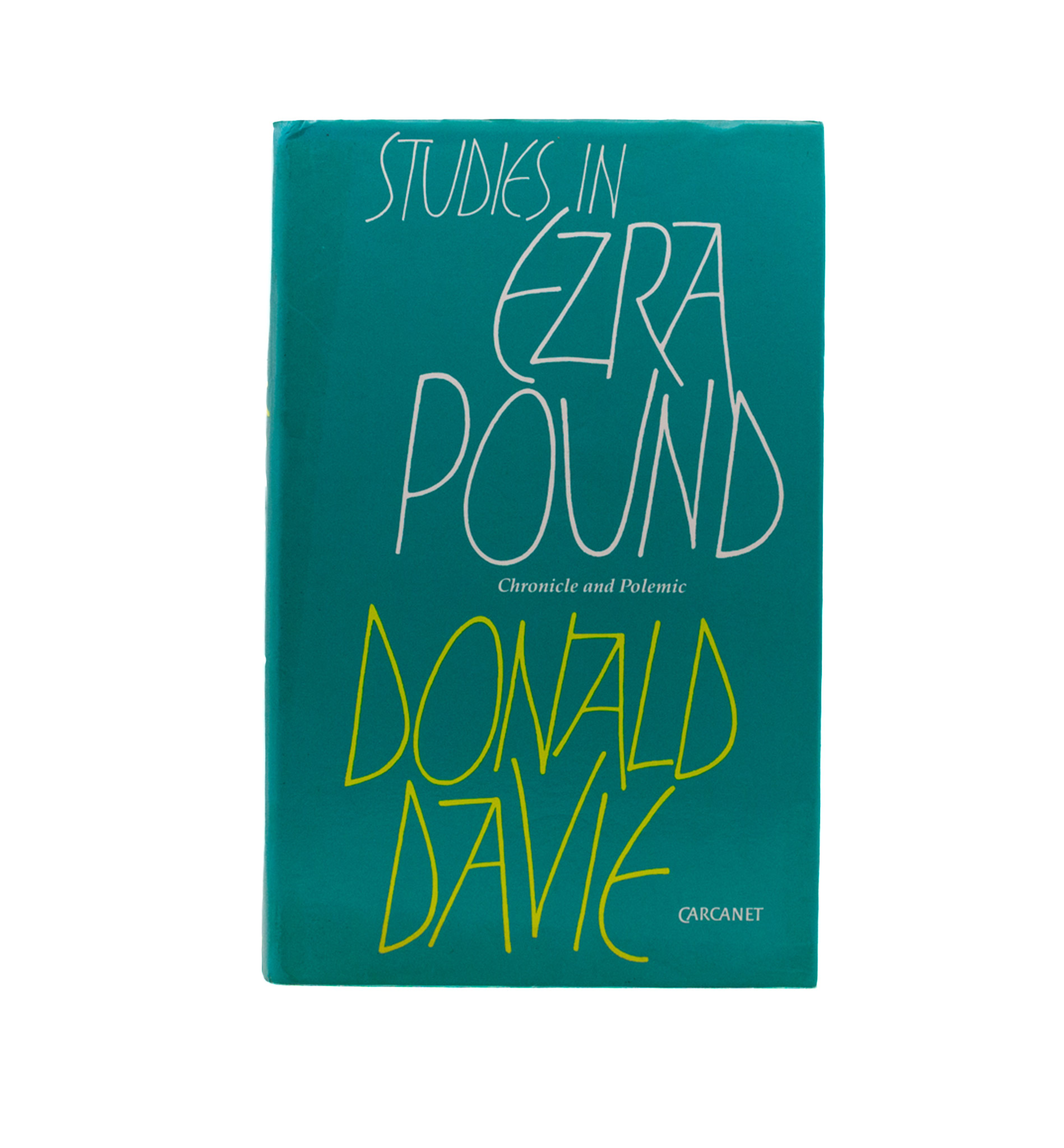
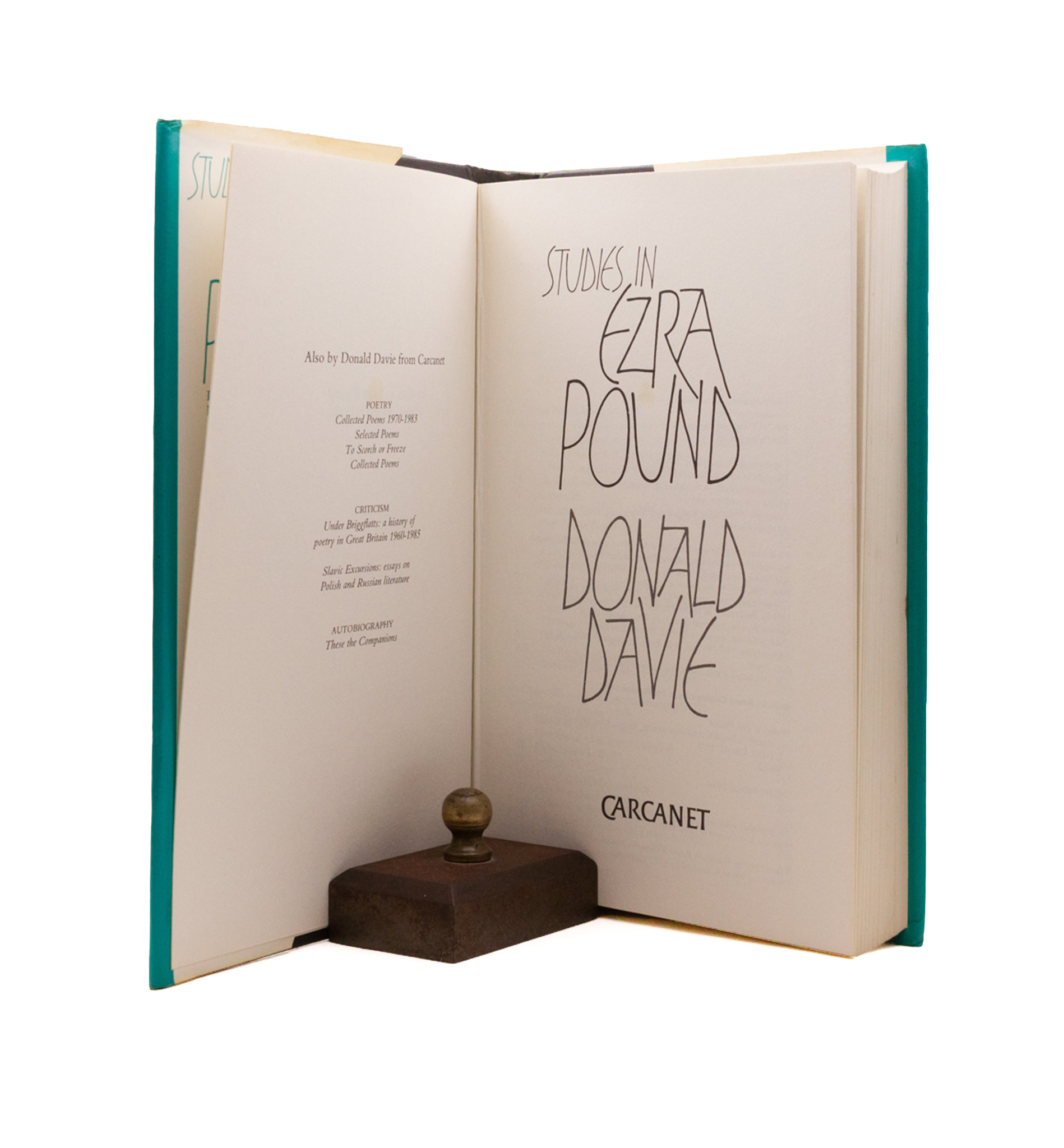
Studies in Ezra Pound
Donald Davie
Published Manchester: Carcanet, 1991
388pp.; 22.2 x 14.3 cm. Black cloth boards stamped in gold down spine. White dust-jacket printed in green, yellow and white.
A selection of Davie’s essays on Pound over the years, including 12 parts from the 1964 Poet as Sculptor. A very good copy, with some fool’s annotation on p.27 (mine), dust-jacket a little scratched (in fact someone (not me) has lightly scratched ‘ezra pound’ into the rear).

tap to cycle
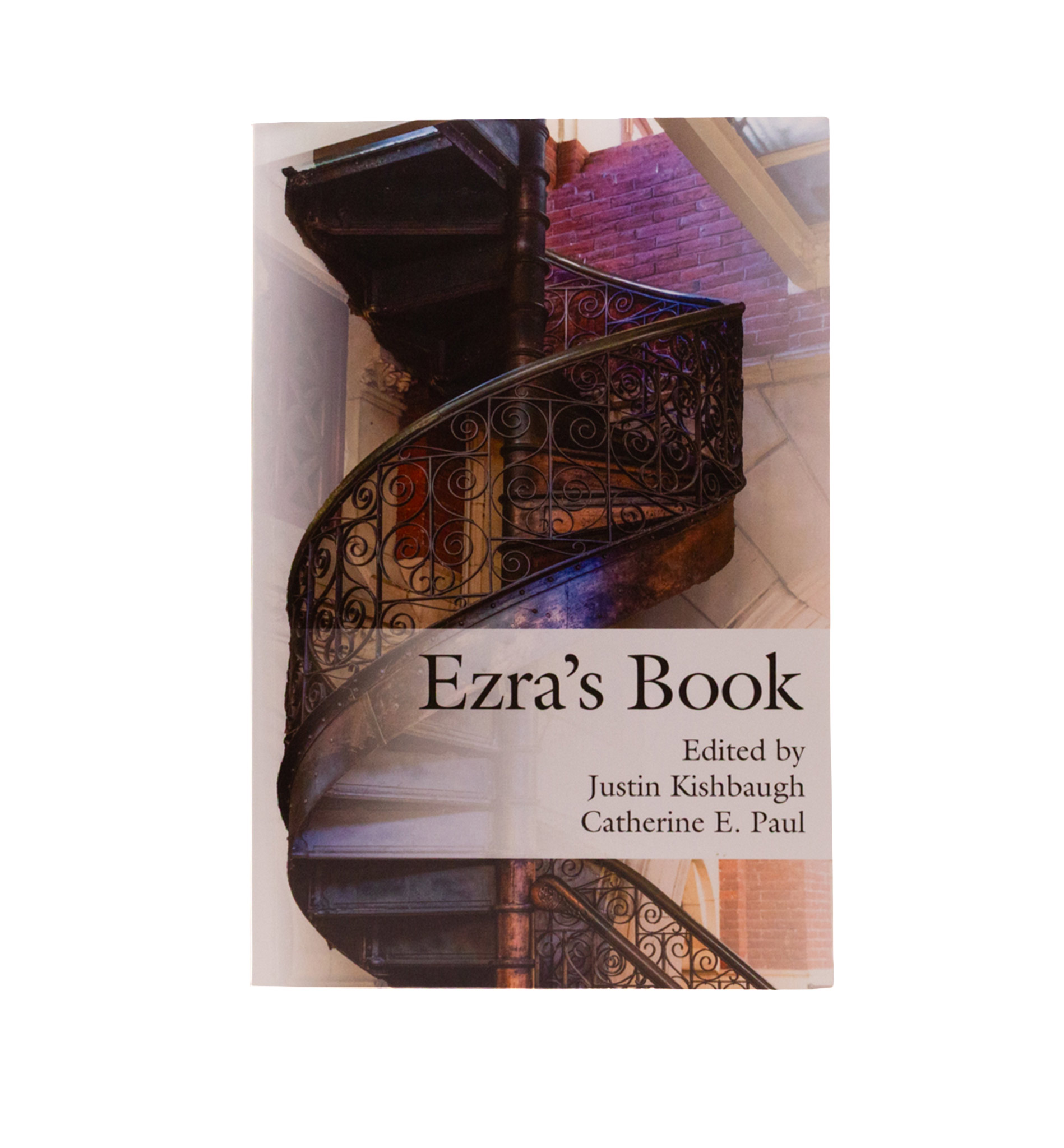
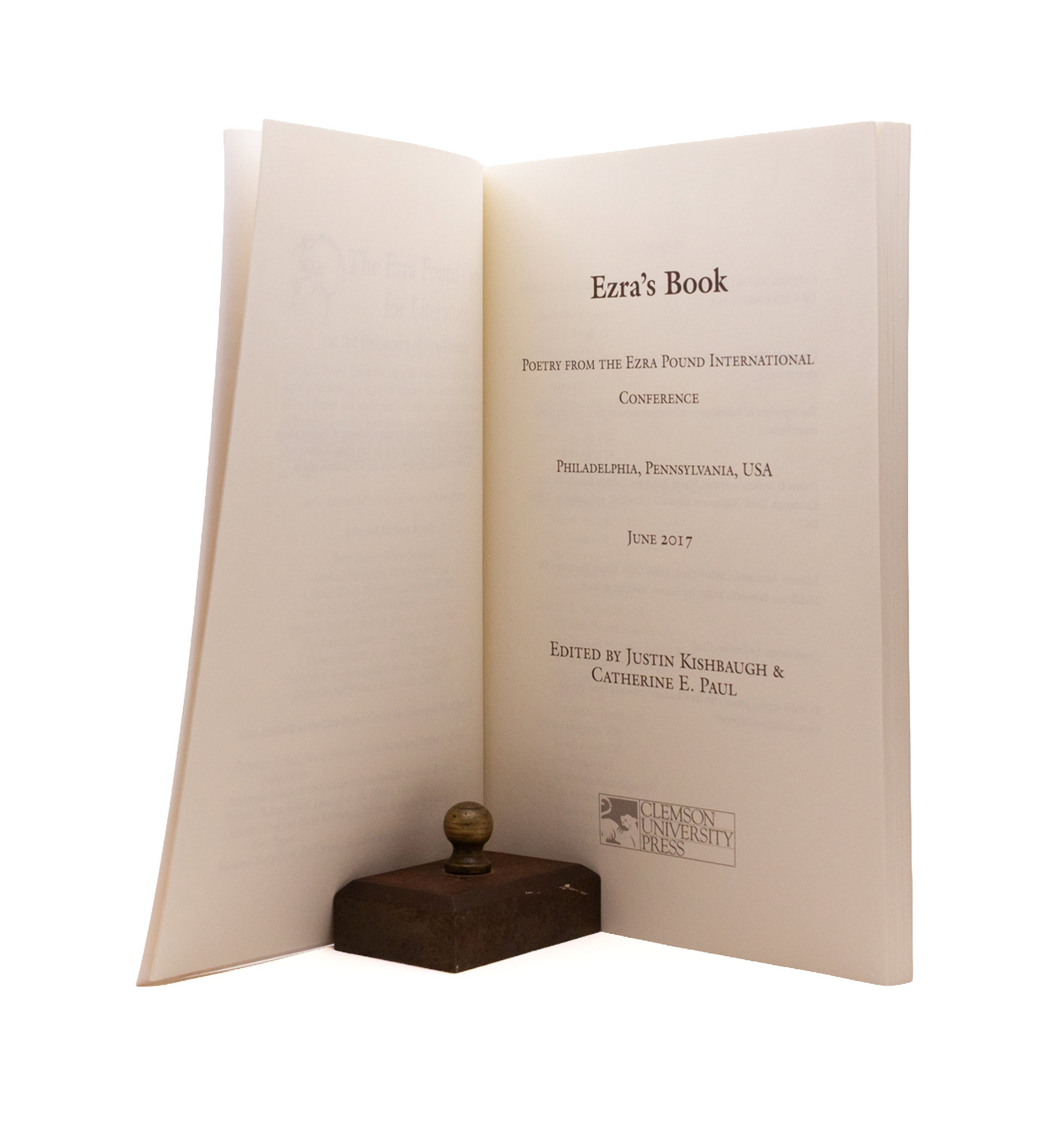
Ezra’s Book
Justin Kishbaugh, Catherine E. Paul, editors
Published South Carolina: Clemson University Press, 2019
115pp.; 22.7 x 15.8 cm. Printed paper wrappers.
From the library of A. David Moody
Poetry from the [27th] Ezra Pound International Conference, Philadelphia, Pennsylvania, USA; June 2017 (see here) and part of John Gery’s Ezra Pound Center for Literature Book Series at the University of New Orleans. Near fine.

tap to cycle
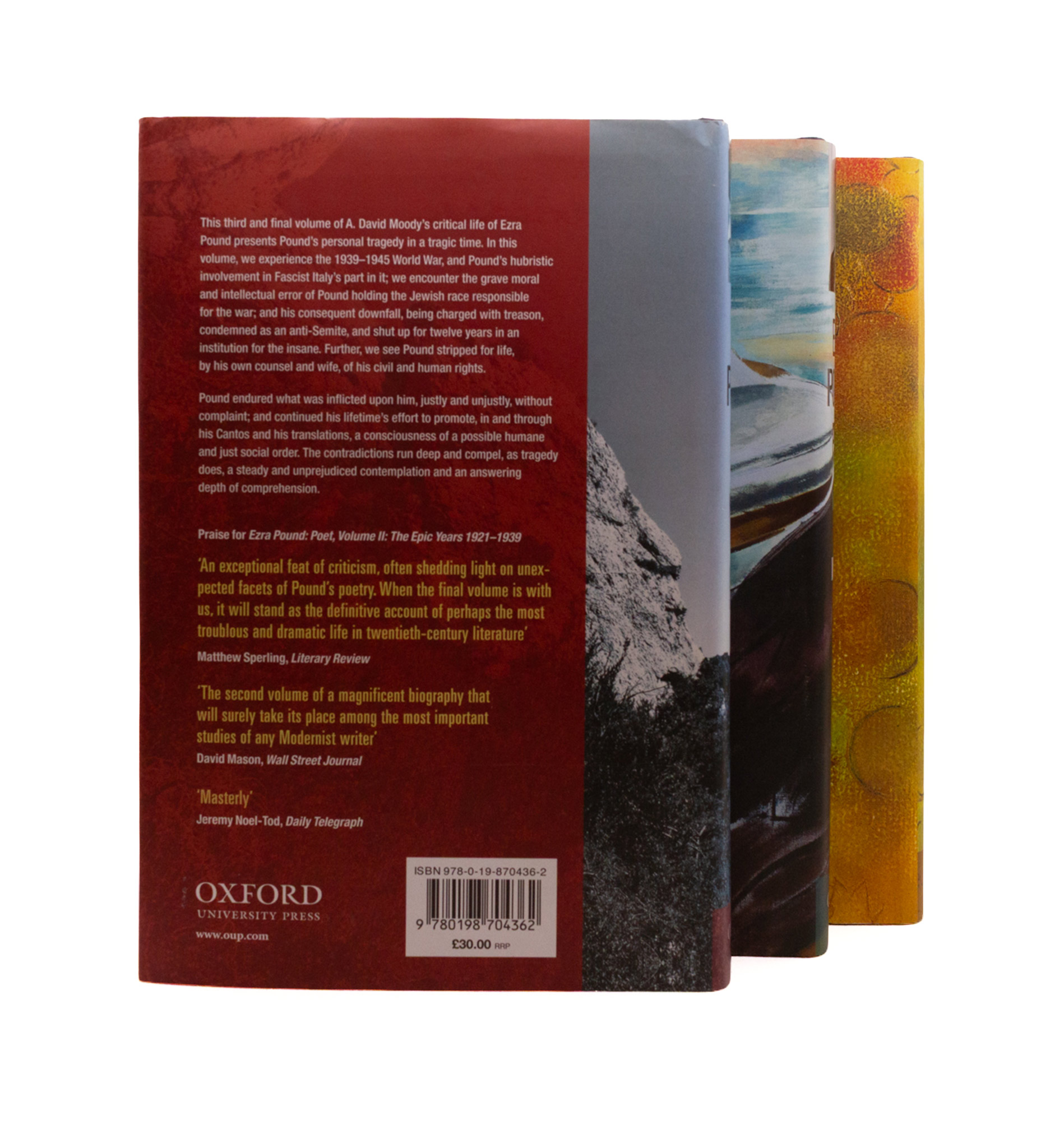
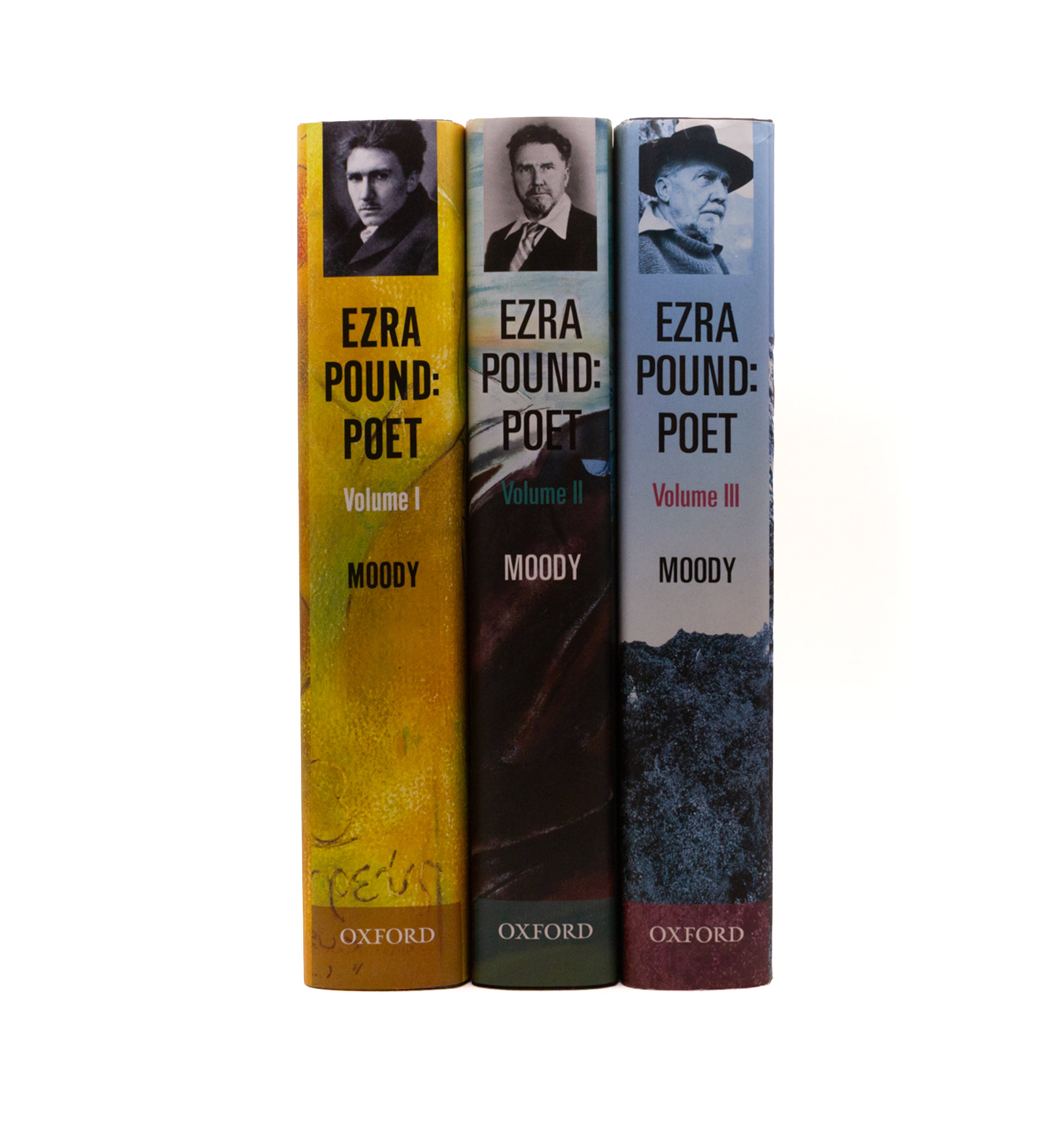
Ezra Pound: Poet; a complete set
David Moody
Published Oxford University Press, 2007-2015
507pp.; 24.1 x 16 cm. Black paper covered boards lettered in gold on spine. White dust-jacket printed in greens, browns and black, with Sheri Martinelli’s self-portrait as Zagreus.
421pp.; 24.1 x 16 cm. Black paper covered boards lettered in gold on spine. White dust-jacket printed in blues and black, with Wyndham Lewis’s portrait of Pound.
654pp.; 24.1 x 16.2 cm. Black paper coveredboards lettered in gold on spine. White dust-jacket printed in red and black.
From the library of A. David Moody
A complete set of the standard Pound biography by Professor A. David Moody at the University of York, published with Oxford. All first, hardcover editions; fine or near fine, Vol. 3 with a little bumping at the top of the spine on jacket.