de Beaumont Rares
debeaumontrares@gmail.com
Periodicals, II
Little mags, modern, and the odd broadside.
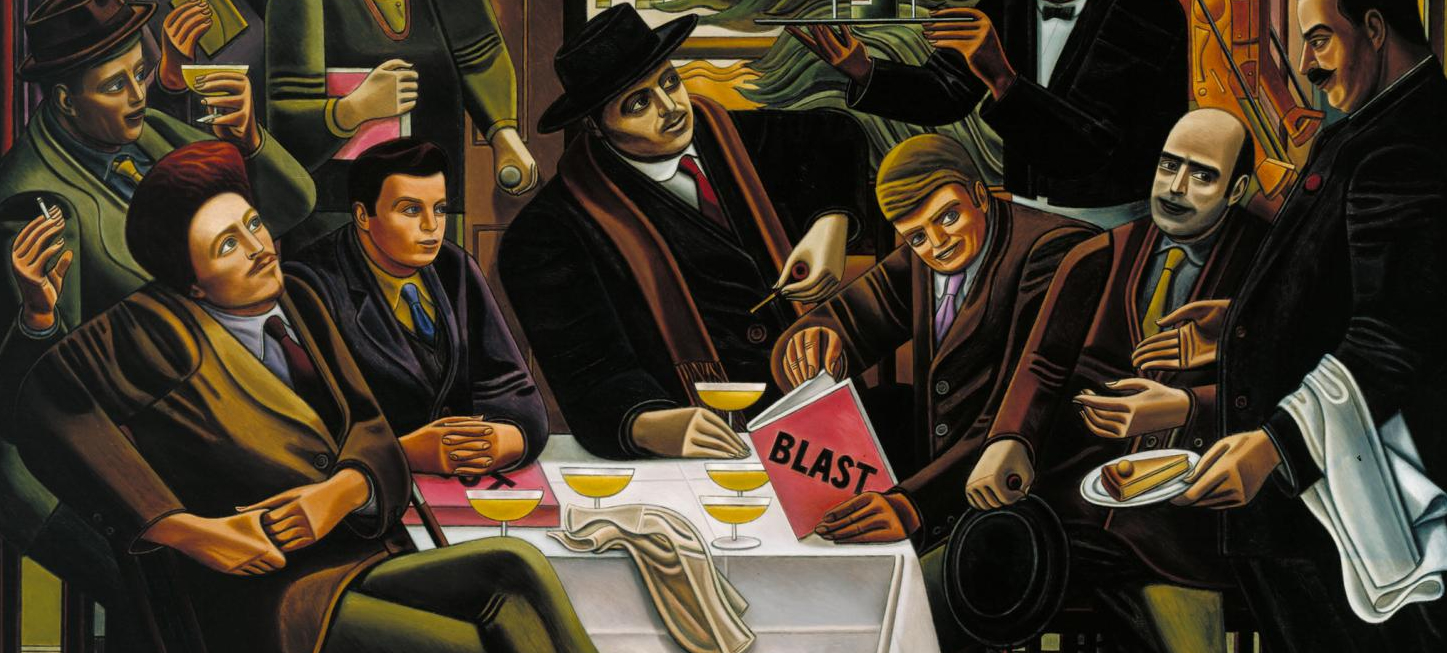
Cover, The Vorticists at the Restaurant de la Tour Eiffel: Spring, 1915 by William Roberts, R. A.
5 November 26
tap to cycle
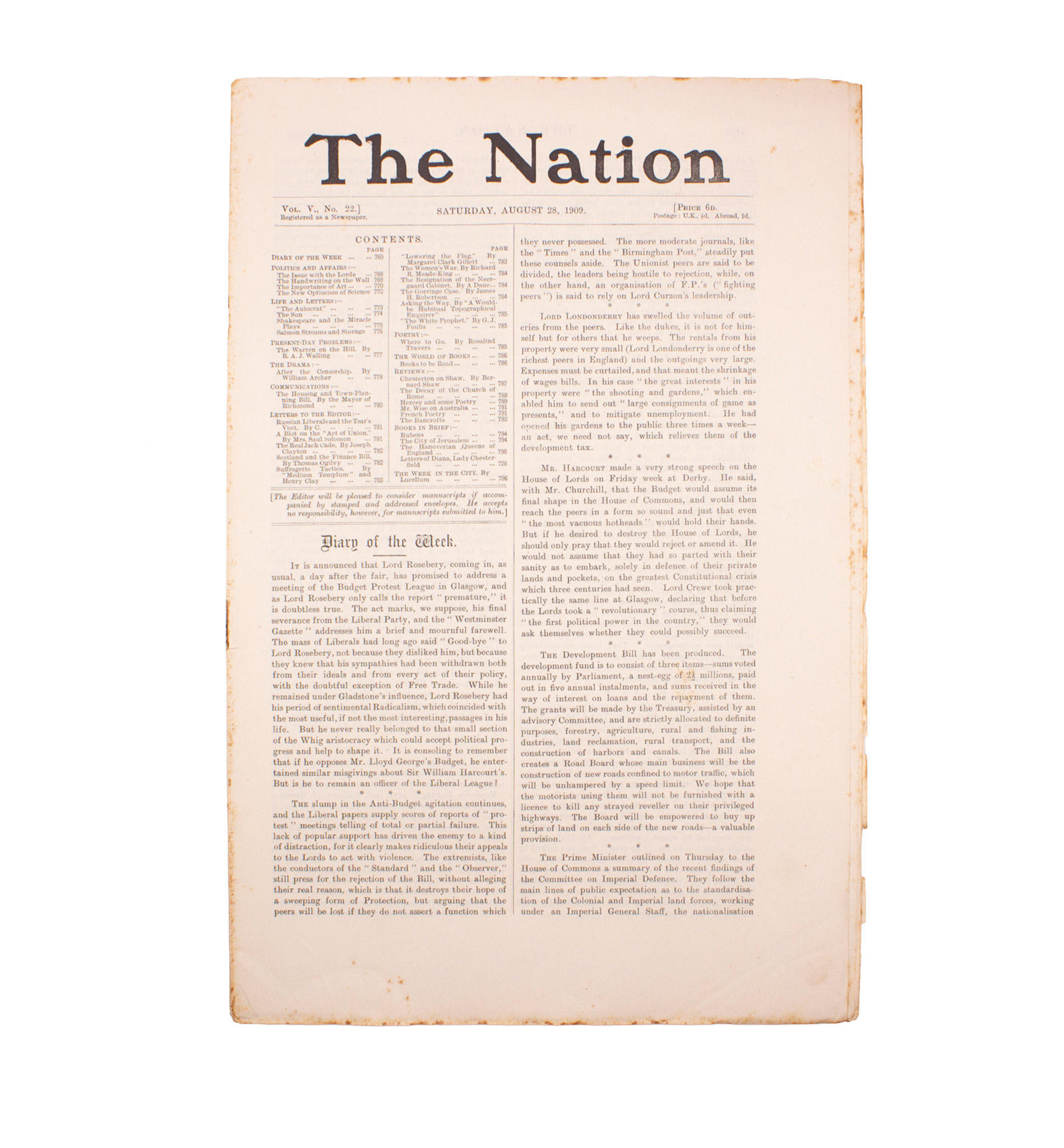
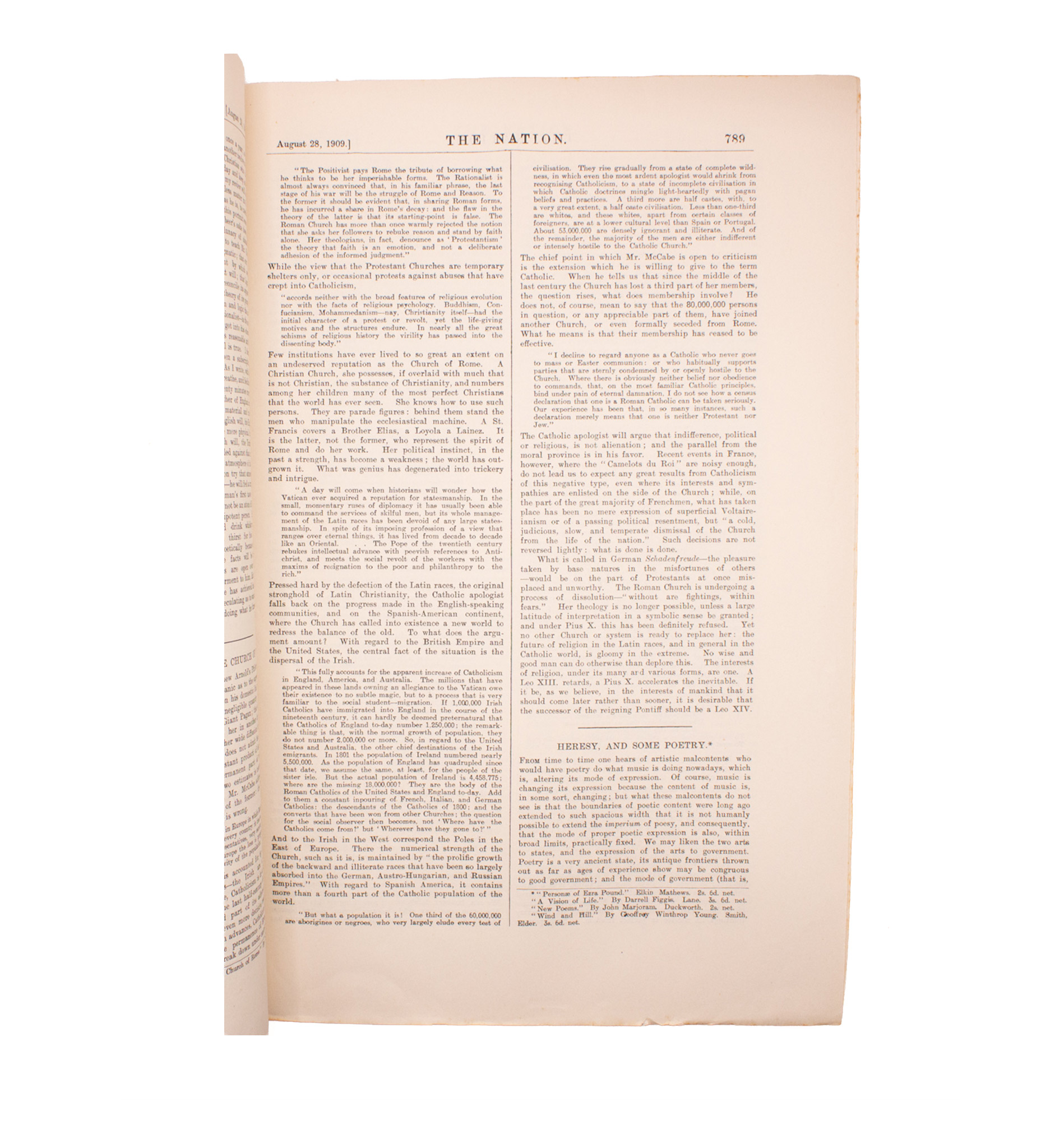
Heresy, and Some Poetry; in The Nation, August 28, 1909
Henry William Massingham, editor
Published London: The Nation Publishing Co., 1909
18ll.; 34.5 x 13 cm. Folded and stapled.
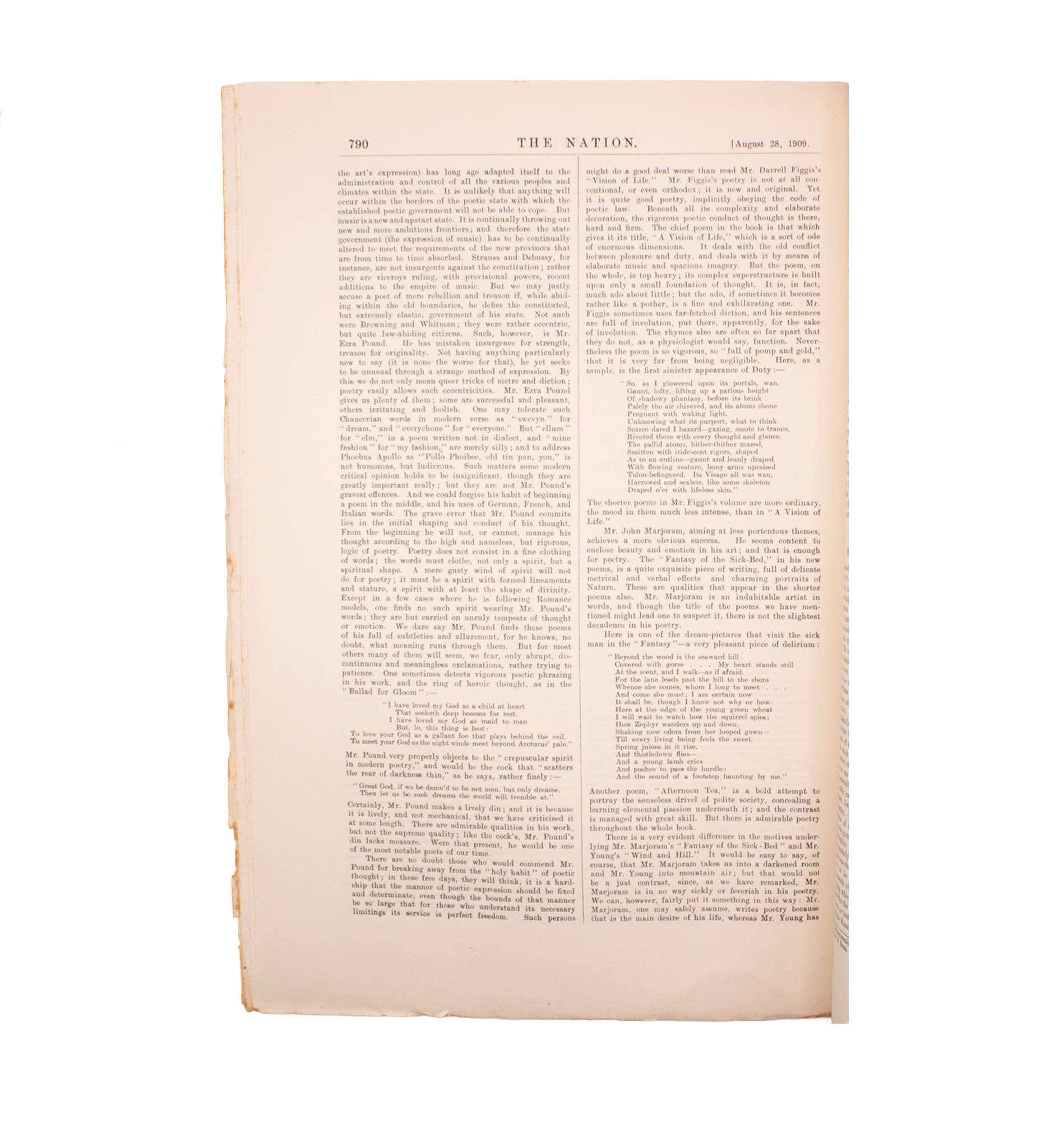
One of few contemporary reviews of EP’s Personae (1909), this offended anonymous reviewer accusing EP, as Pound would put it to Joyce in a letter of Dec. 1916, of being a “traitor to the imperium of Poetry.” Pound sent a copy to his Mother in Sept. 1909 writing,
I send along this delightful onslaught from the Nation. It is pleasant to be abused by one who knows nothing beyond the fact that he is annoyed. The ‘adv’ value is good & the reviewer has caused a good deal of amusement. - at himself -
Described by Betsy Erkkila as ‘weirdly prophetic in equating Pound’s “strange method of expression” with “rebellion and treason” against government and the state.’He has mistaken insurgence for strength, treason for originality.
Clean and straight with just a slight fox to the extremities.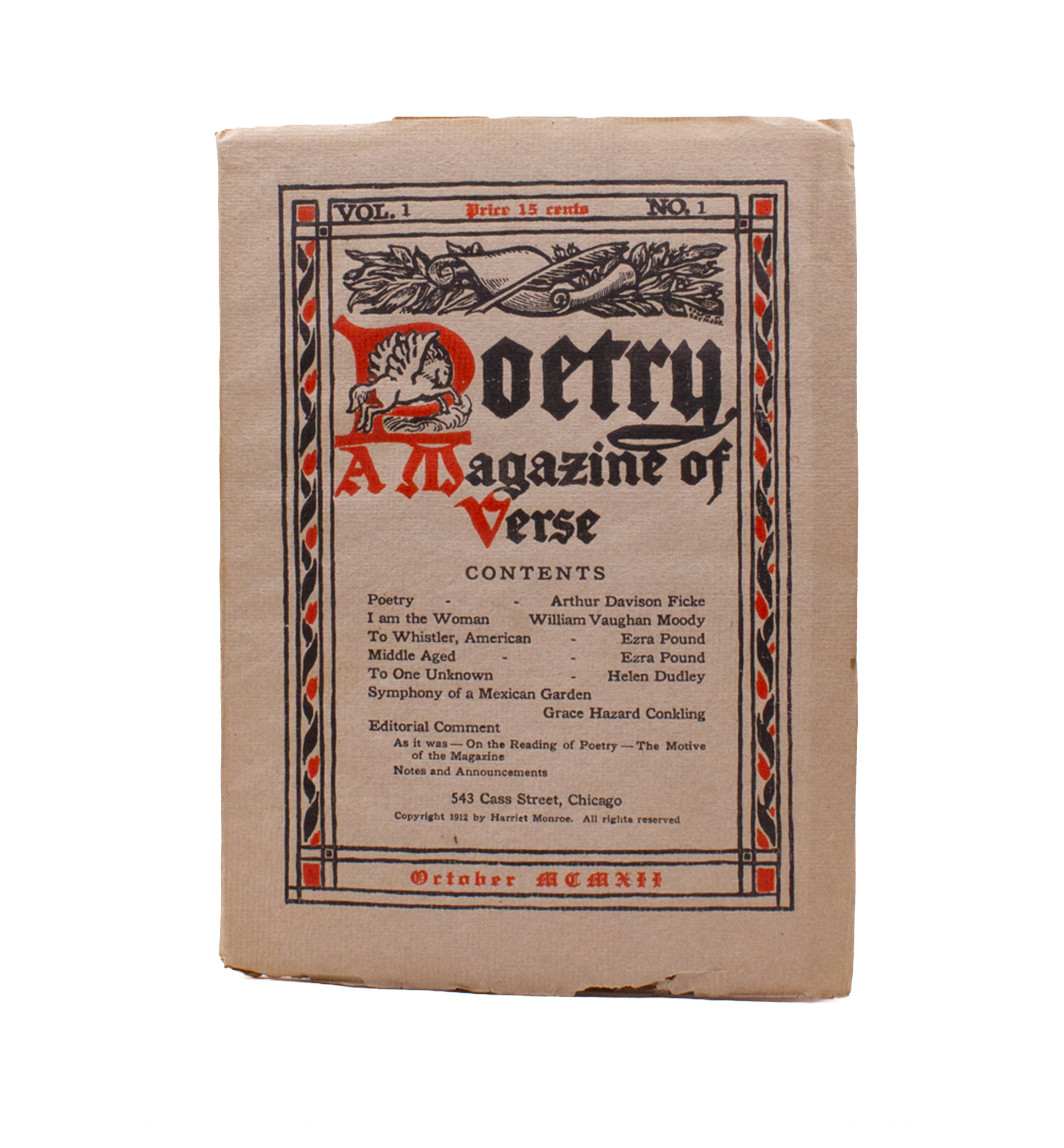
tap to cycle
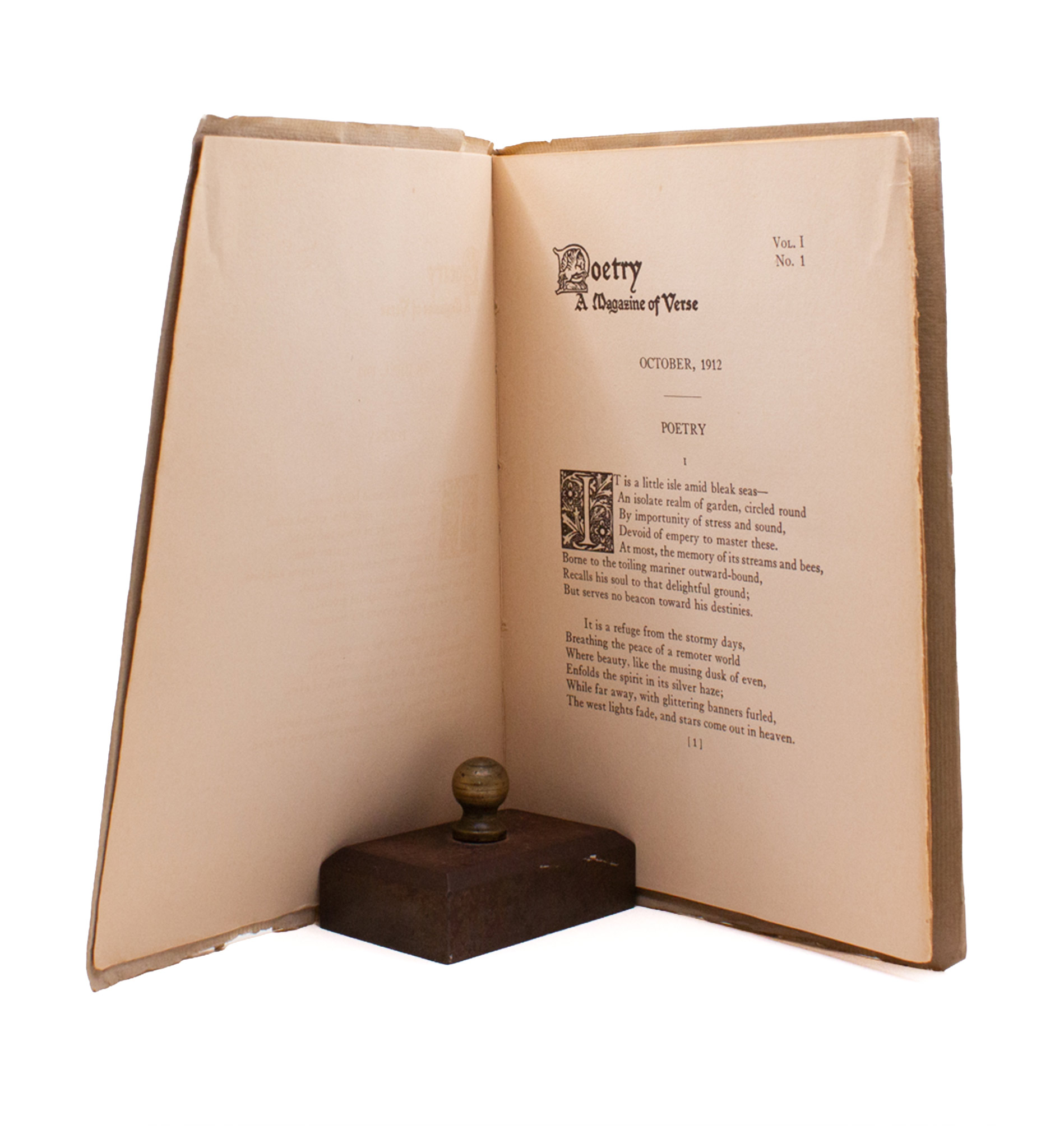
Poetry, A Magazine of Verse, October 1912 (Vol. I, No. 1)
Harriet Monroe, editor
Published Chicago: Harriet Monroe, 1912
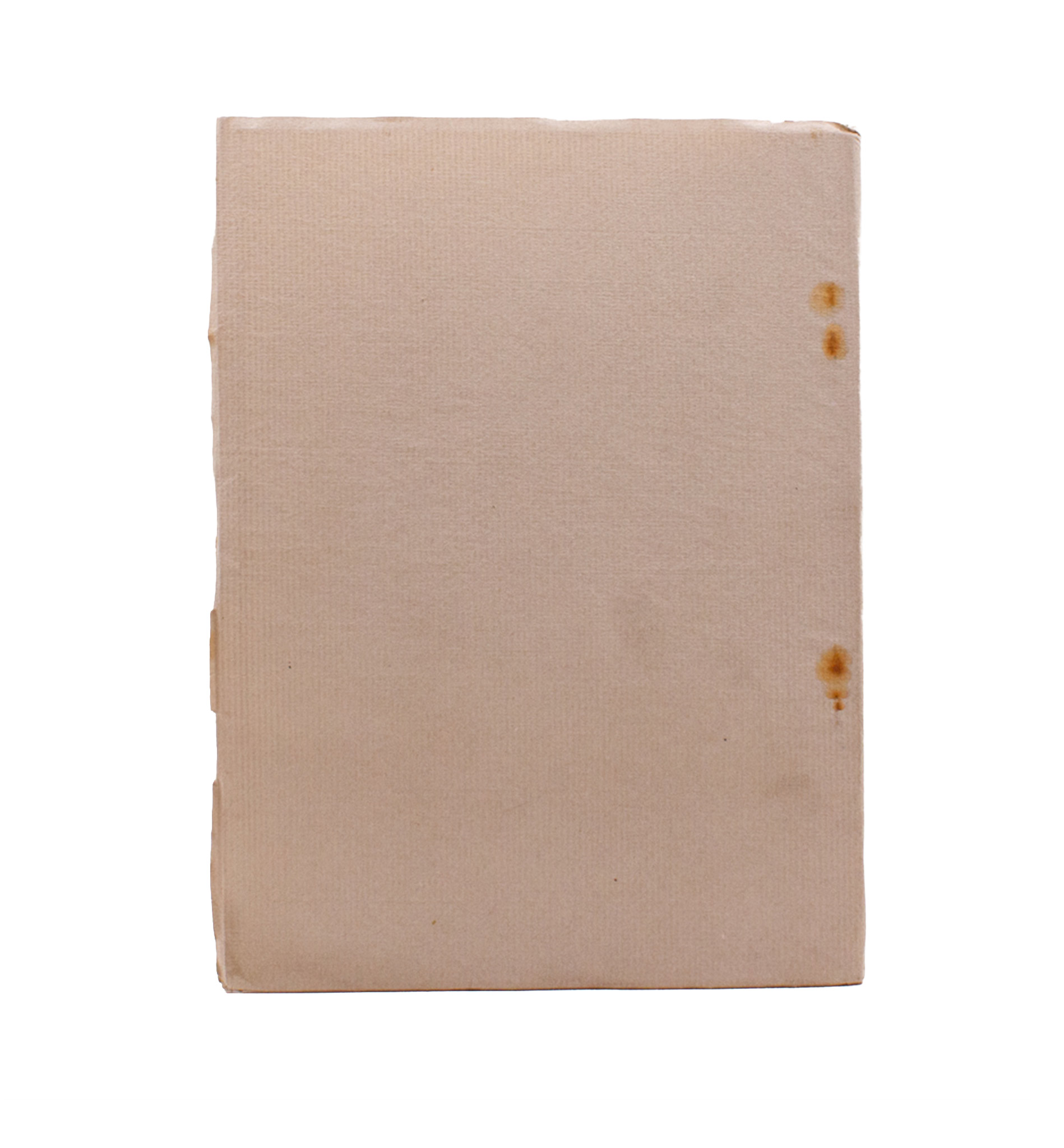
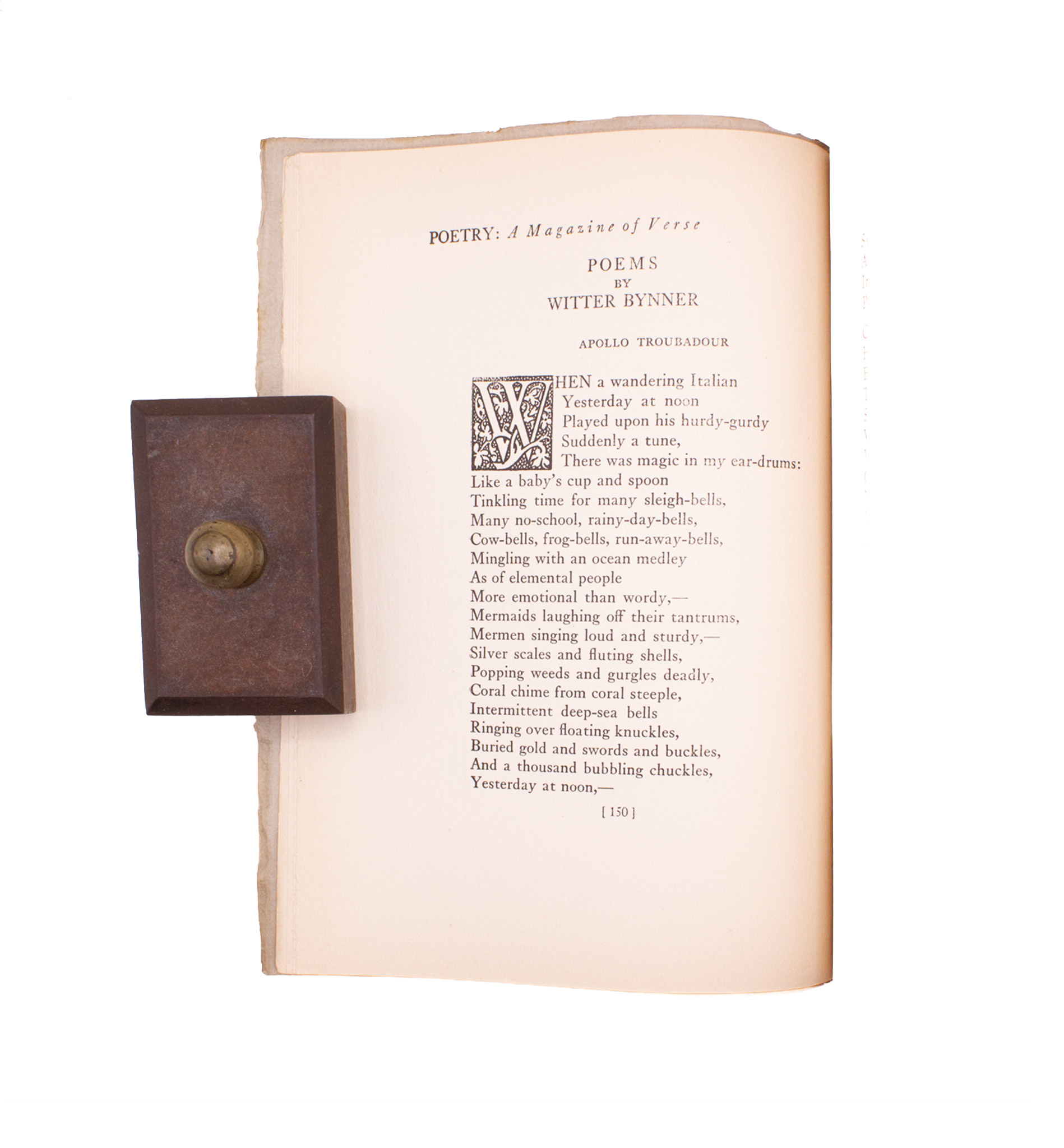
32pp. plus fly; 19 x 14.2 cm. Grey paper wraps printed in red and black.
The inaugural issue of Harriet Monroe’s Chicago magazine, Poetry, A Magazine of Verse, which would go on to house the likes of H. D., T. S. Eliot, W. C. Williams, Marianne Moore, Robert Frost and Wallace Stevens. This first issue also sees two contributions from EP, who was soon to be instated as the magazine’s Foreign Correspondent, providing verse and verse-news from Europe, making this issue Gallup C52 thus. A near fine copy, a little stiff with some wear to the bottom edge of the front cover, and a light stain to the back cover.
tap to cycle
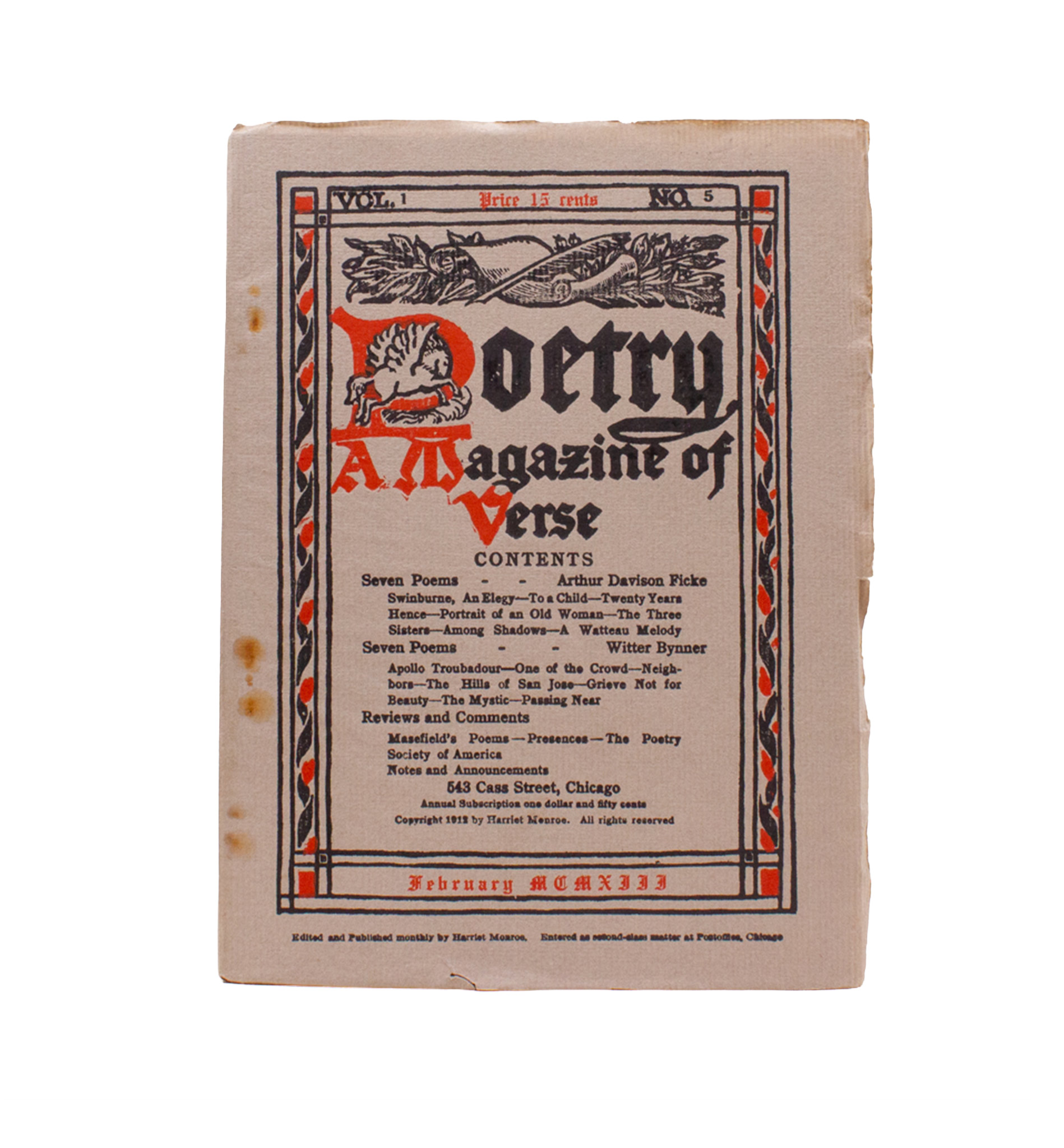
Seven Poems; in Poetry, A Magazine of Verse, February 1913
Harriet Monroe, editor
Witter Bynner, contributor
Published Chicago: Harriet Monroe, 1913
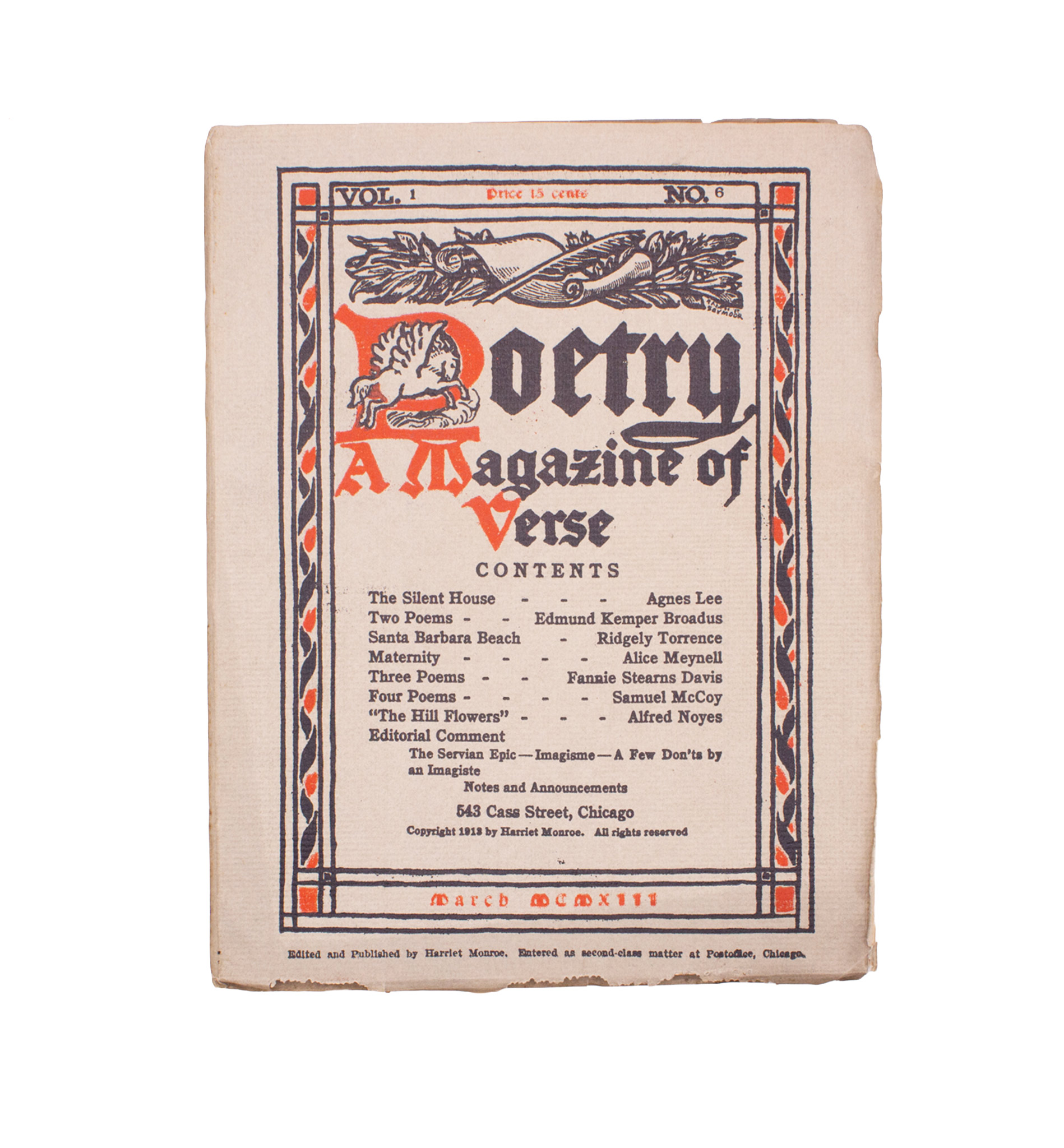
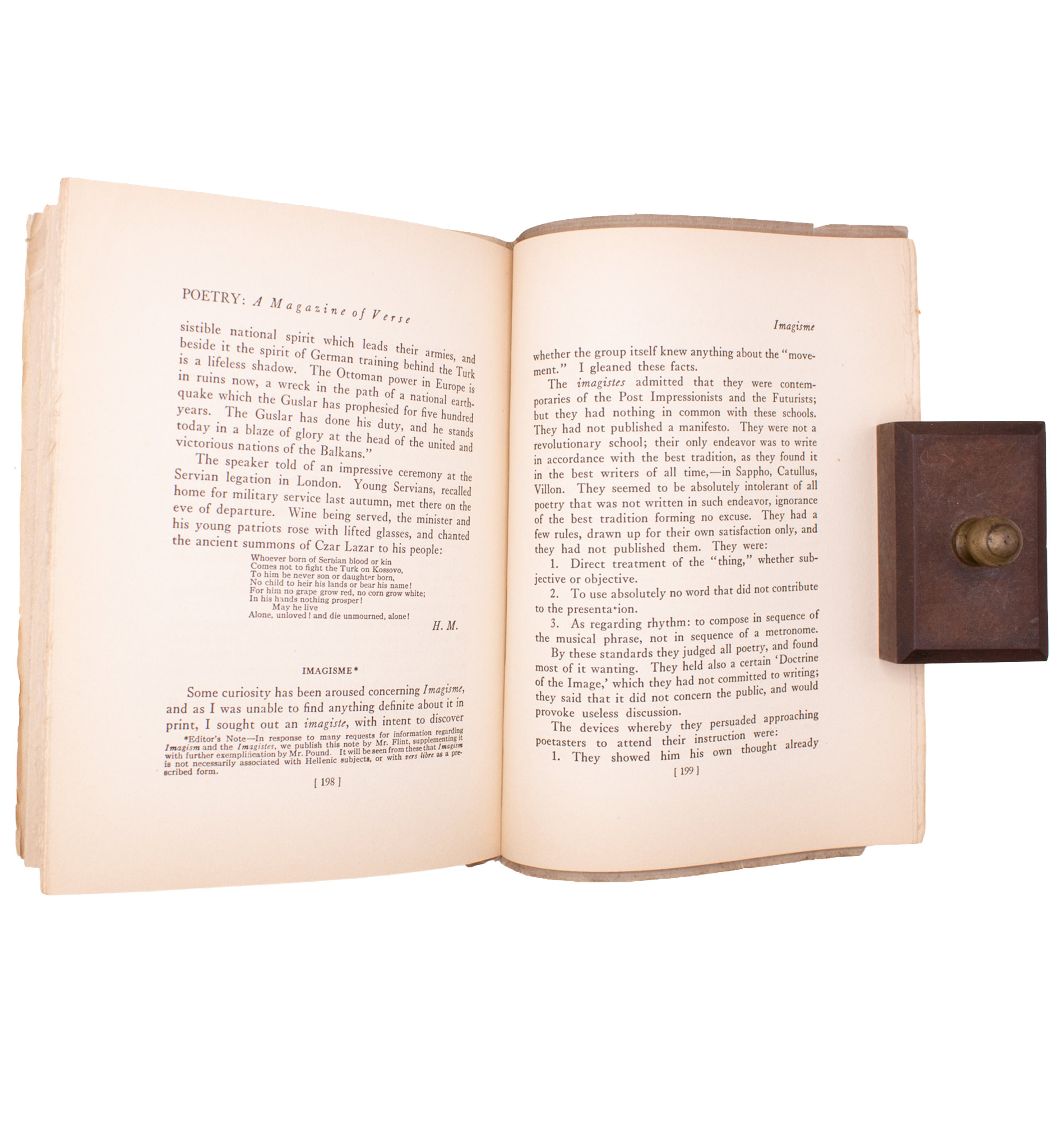
36pp. + ads; 19 x 14.2 cm. Grey paper wraps printed in red and black.
A rare number from the first volume of Harriet Monroe’s Poetry. Containing a large contribution from American poet Witter Bynner, possibly under Pound’s advice; Bynner and Pound were life-long friends after Homer Pound entrusted the future of EP’s poetic career (or travels to Europe in 1908) to Bynner’s discernment as a well-established poet.
Staples rusted through the front and rear covers; a short tear bottom of front cover; and otherwise quite a fine copy. With a reviewatorial contribution from EP making this Gallup C72.
tap to cycle
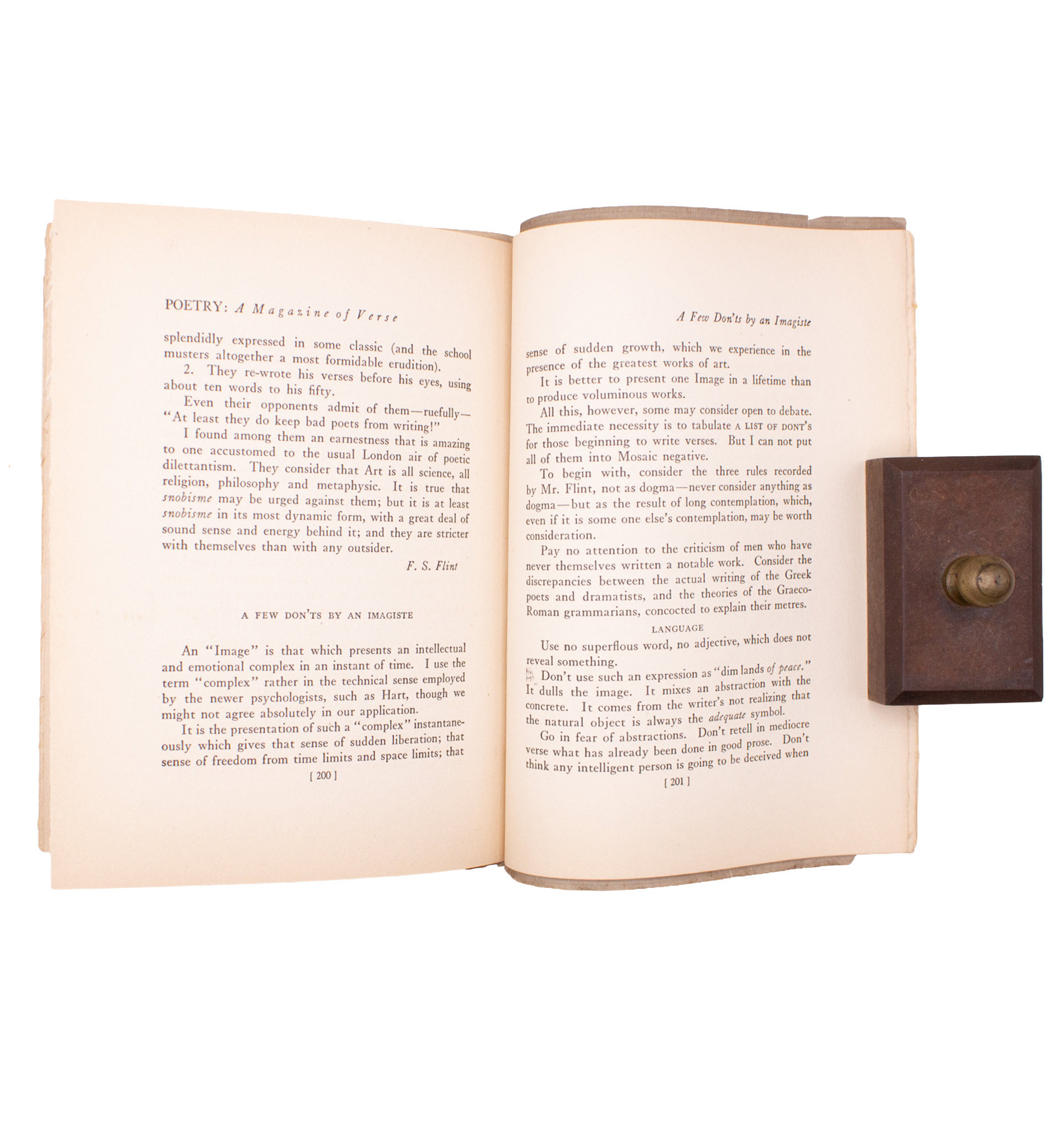
A Few Don’ts by an Imagiste; in Poetry, A Magazine of Verse, March 1913
Harriet Monroe, editor
Ezra Pound, F. S. Flint, contributors
Published Chicago: Harriet Monroe, 1913
36pp. + ads; 18.2 x 14.2 cm. Grey paper wraps printed in red and black.
The first appearance of the tenets of Imagisme (using specifically the French term to discern Pound’s movement from Lowell’s), being both “Imagisme” by F. S. Flint (though composed from Poundian material) in which [EP] lays out the three famous maxims (direct treatment of the thing, no unnecessary ornament, to the metronome) and Pound’s “A Few Don’ts by an Imagiste” which expands on the prior, defining the Image as an “emotional complex in an instant of time” and discussing rhyme, rhythm, and other verse values. Gallup C74.
A couple of spots on the spine, and a little wear to the oversized wraps particularly on the bottom edge of the front cover; a near fine copy.
tap to cycle
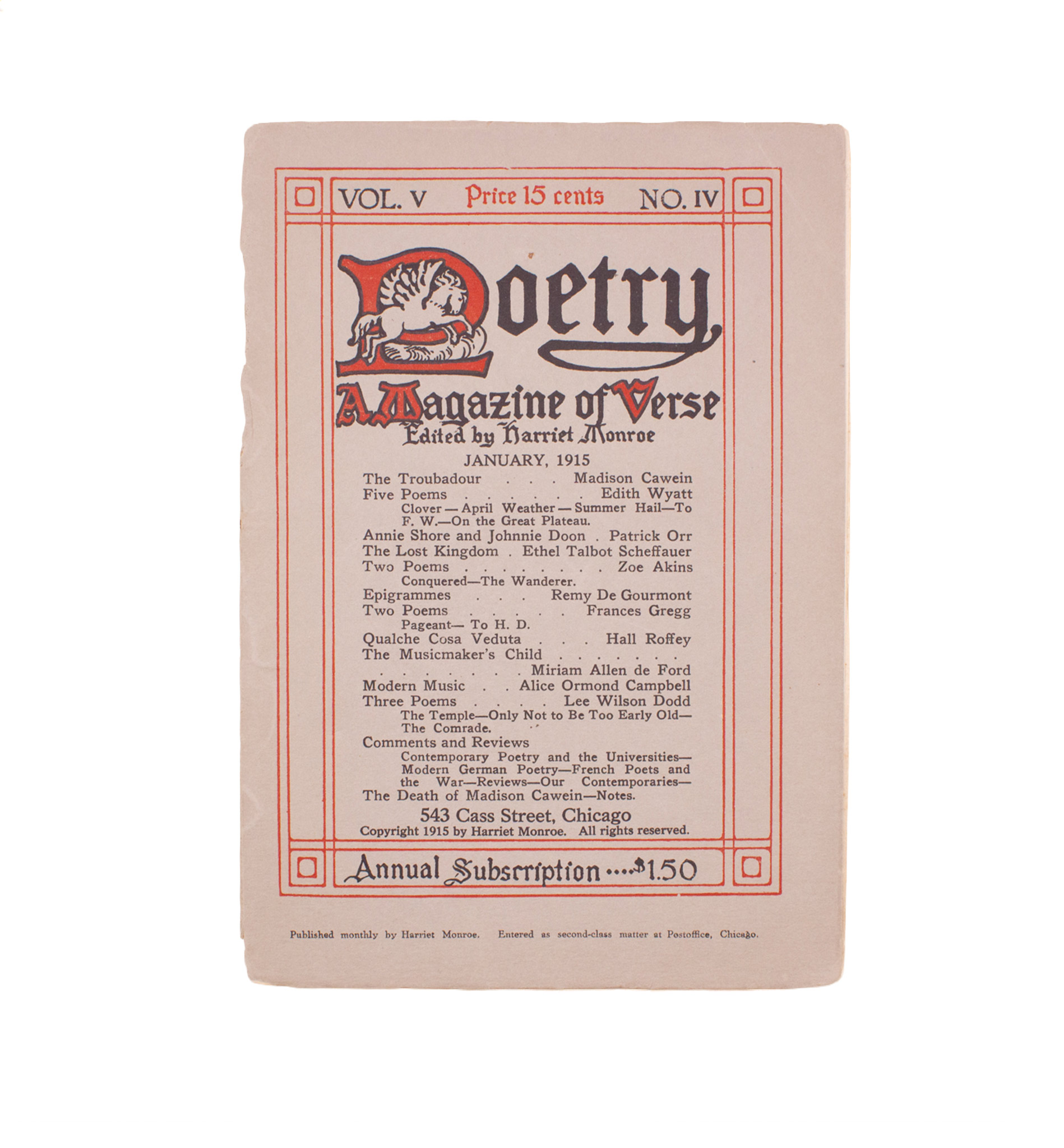
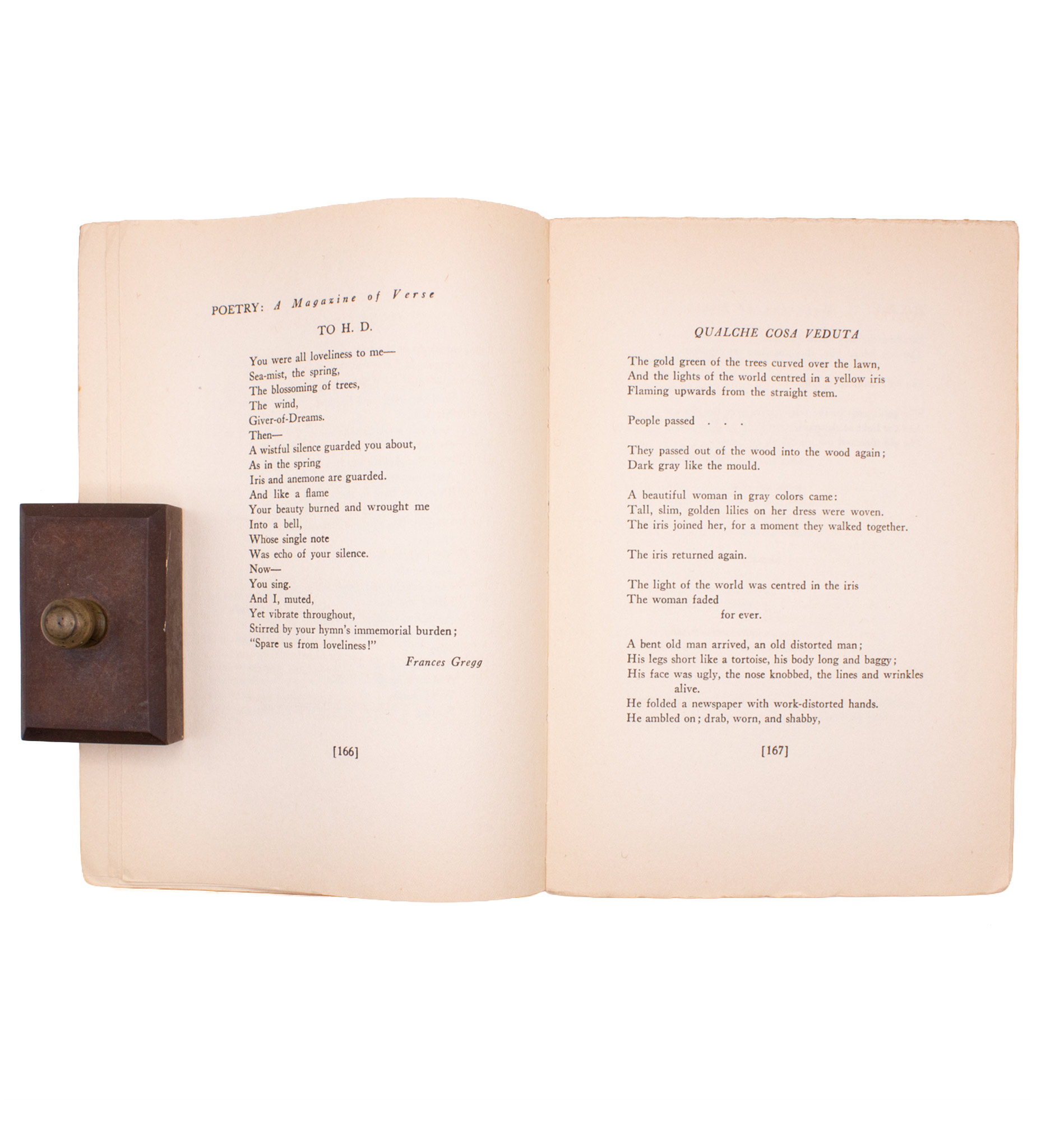
To H. D.; in Poetry, A Magazine of Verse, January 1915
Harriet Monroe, editor
Frances Gregg, contributor
Published Chicago: Harriet Monroe, 1915
50pp. + ads; 20 x 14 cm. Grey paper wrappers printed in red and black.
A special issue of Poetry for its inclusion of one contribution, Frances Gregg’s poem “To H. D.” which publicises the pains of Gregg’s unrequited roundelling love for Doolittle. H.D., EP and F.G. all affected for each other at some point during their upbringings in Pennsylvania, with Gregg being given EP’s handmade Hilda’s Book by Doolittle for safe-keeping, which was buried in a shell blast in Plymouth which killed Gregg and her mother, 1941.
Part of the paper covering the spine lost, but a very nice copy.
tap to cycle
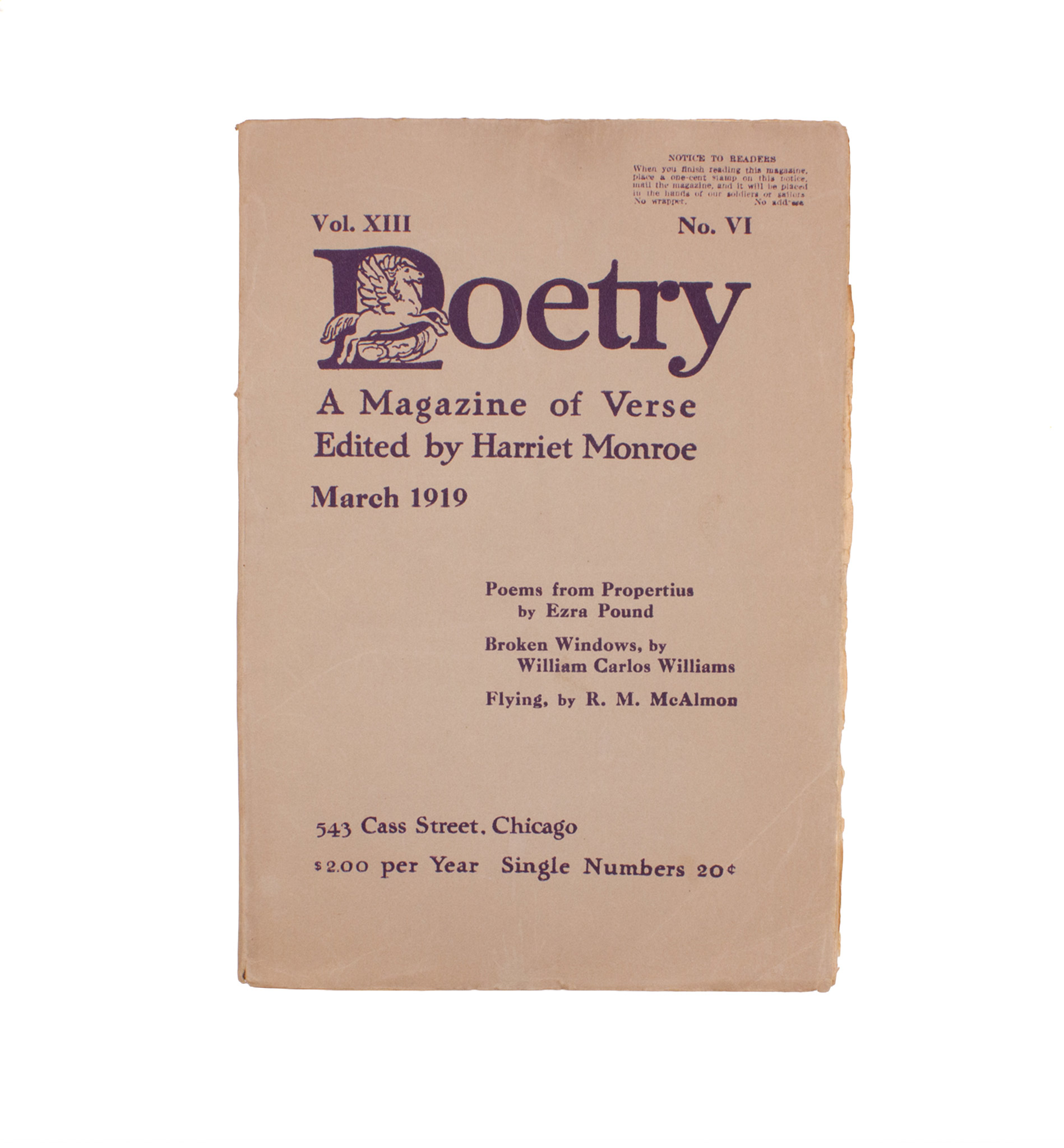
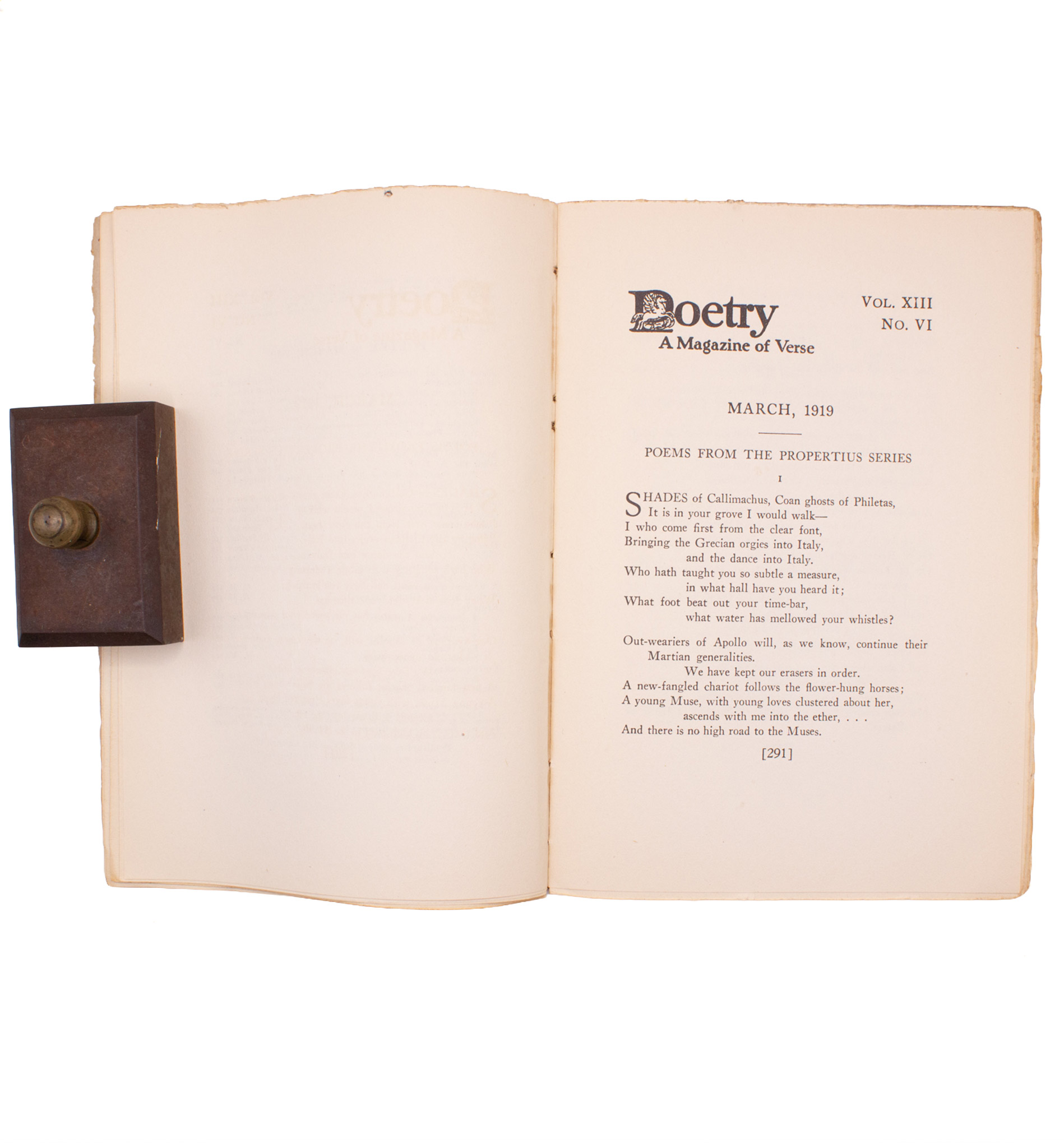
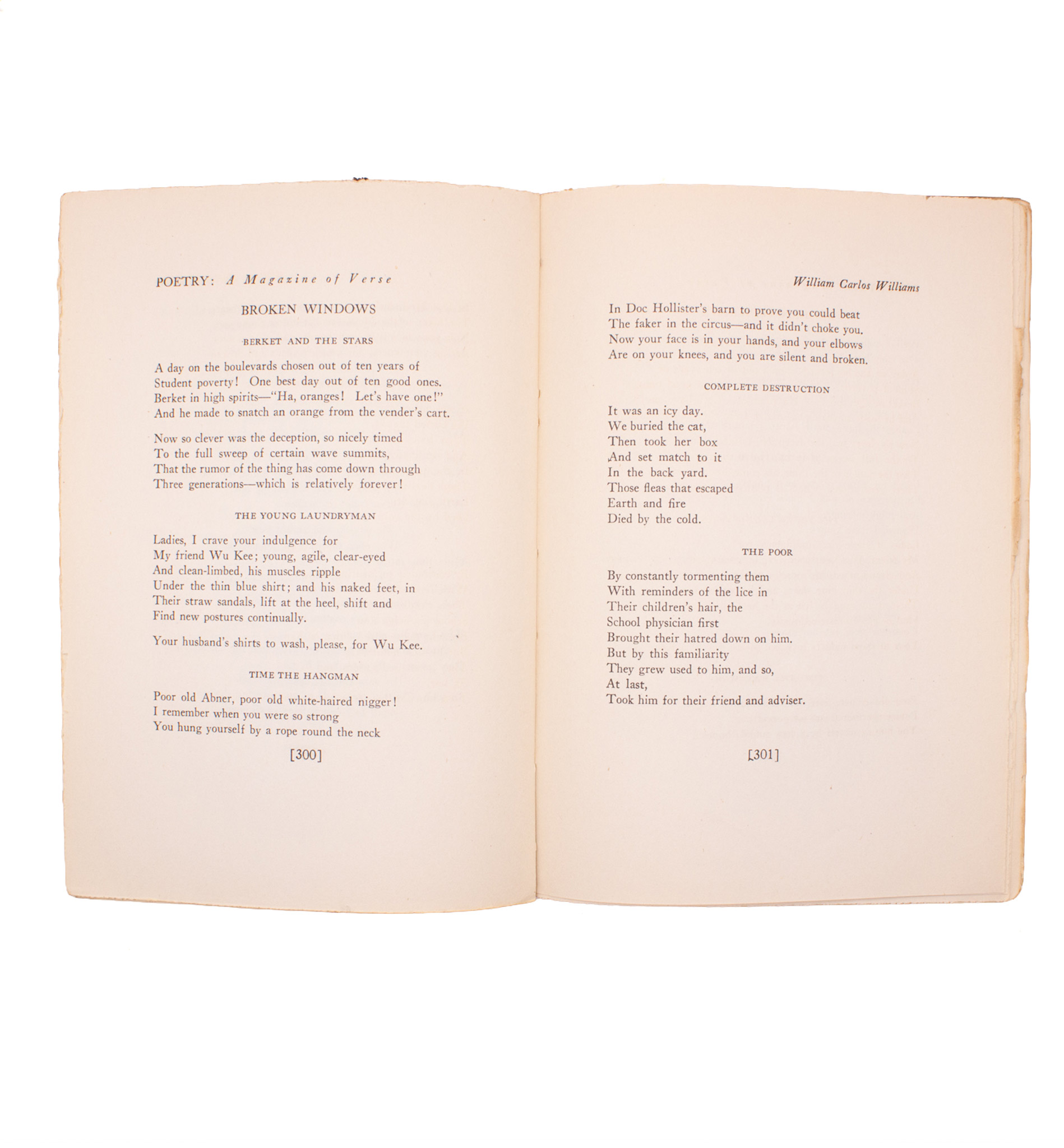
Poetry, A Magazine of Verse, March 1919
Harriet Monroe, editor
Ezra Pound, William Carlos Williams, contributors
Published Chicago: Harriet Monroe, 1919
58pp. + prelims; 20.3 x 14 cm. Grey paper wrappers printed in purple.
The first appearance of parts of “Homage to Sextus Propertius,” published here as “Poems from the Propertius Series.” The poem was first published complete later this year in Quia Pauper Amavi. Also contains “Broken Windows,” eighteen poems by William Carlos Williams, each first appearance. Gallup C449 and Mitchell C34 thus. Wraps lightly handled, with a tiny break to the paper covering spine.
tap to cycle
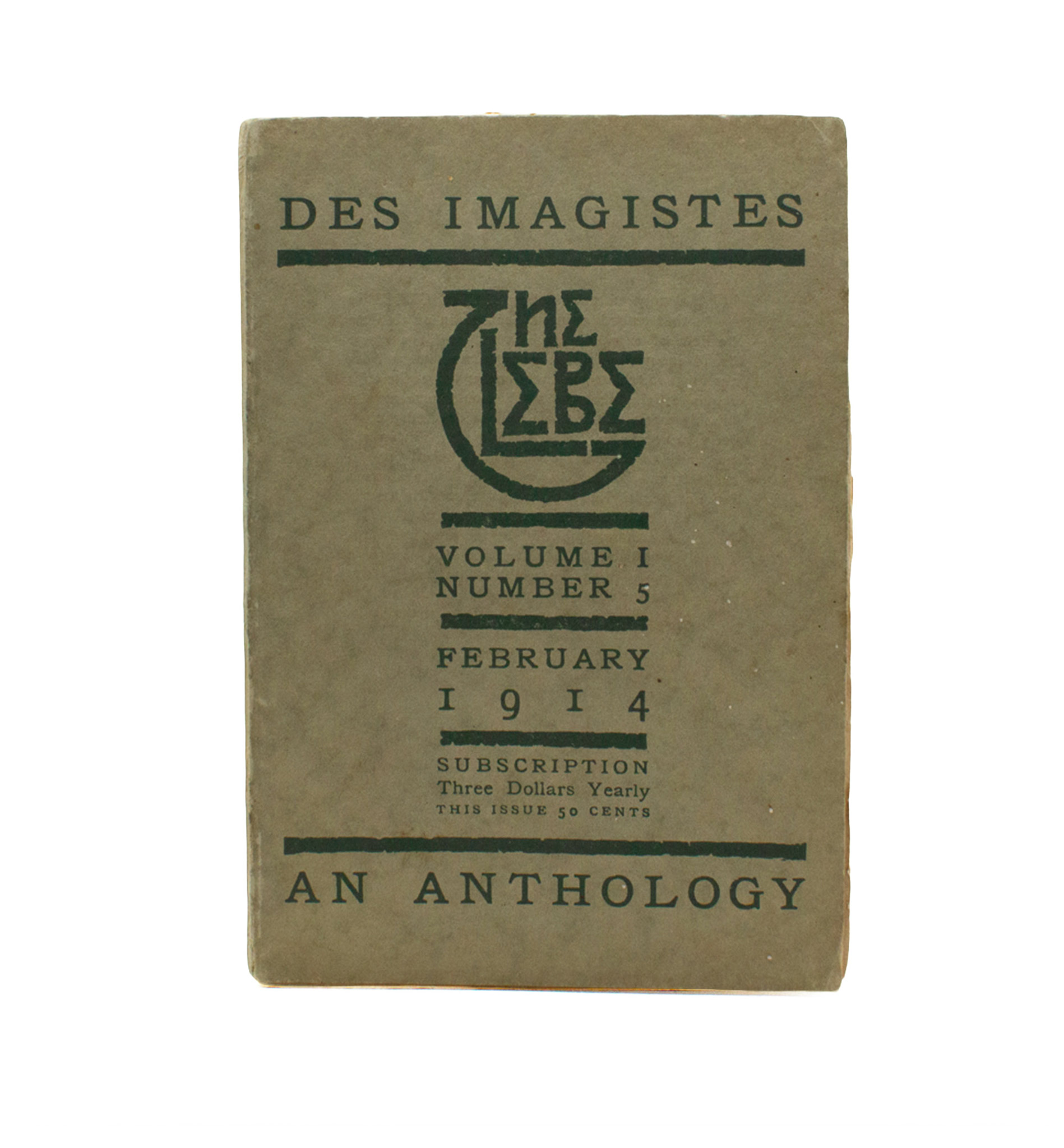
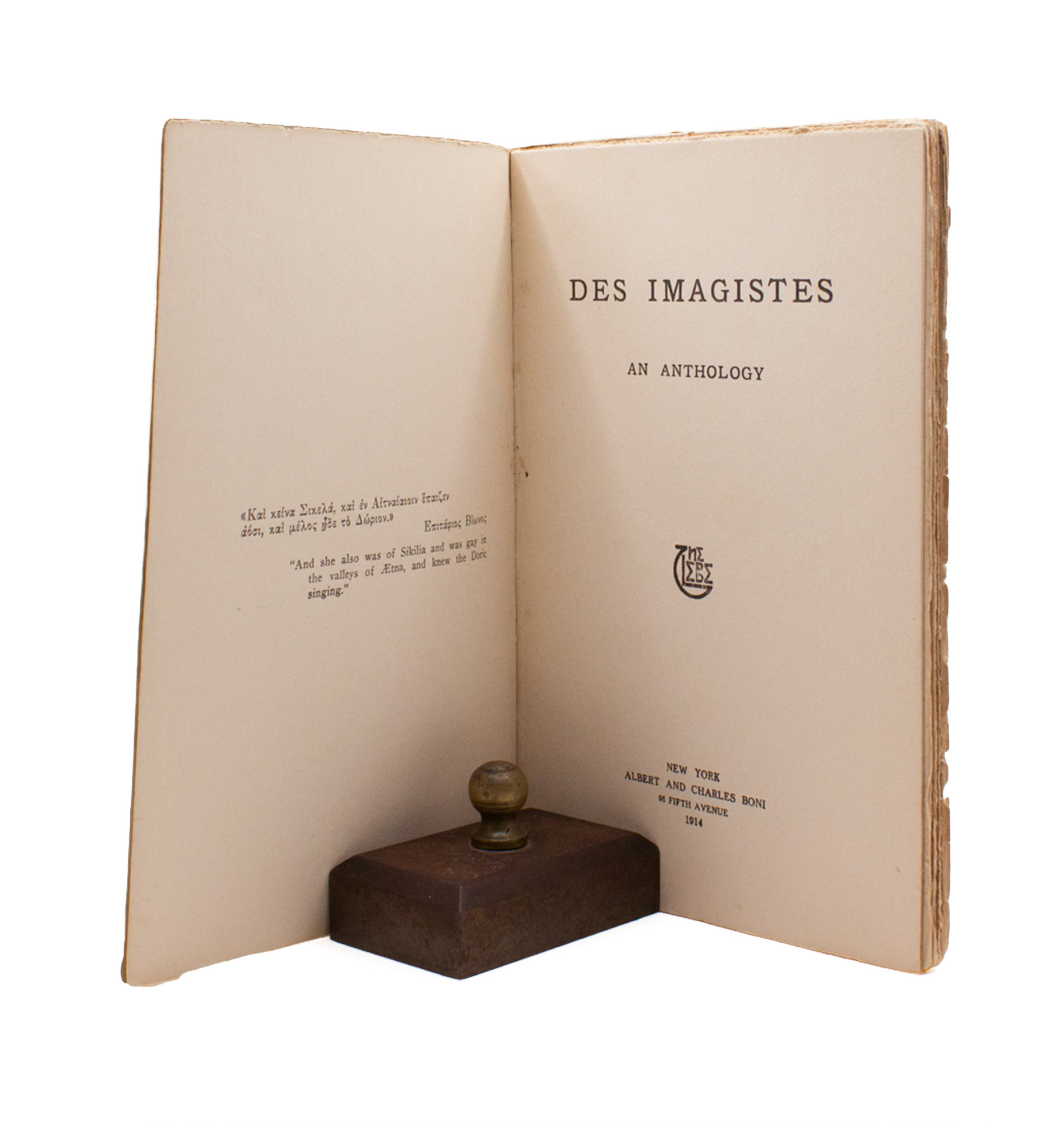
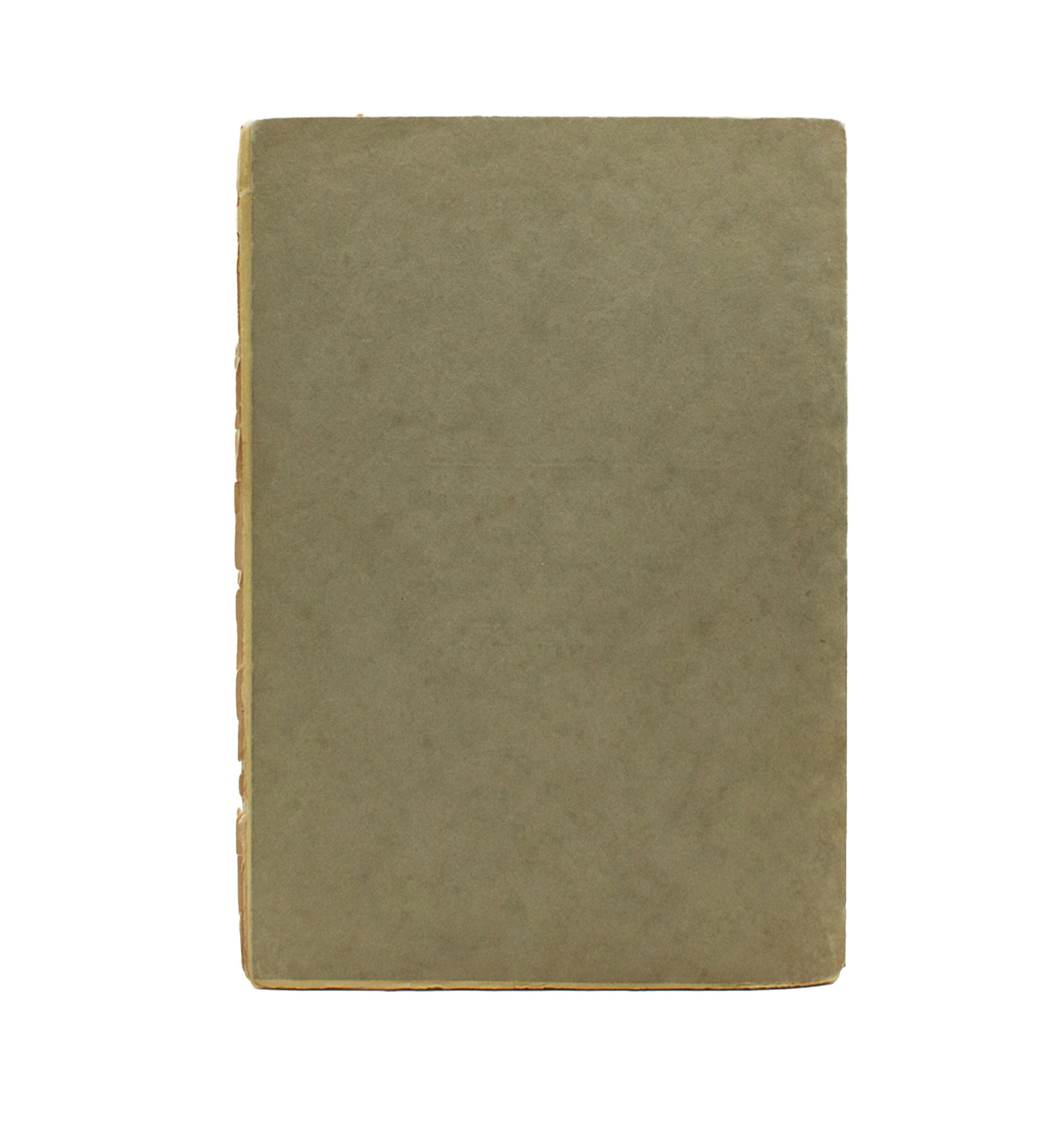
“Des Imagistes”; in The Glebe, Vol. I, No. 5
Ezra Pound, editor
Published New York: Albert and Charles Boni, 1914
64pp.; 19.1 x 13.3 cm. Green paper wrappers printed in dark green.
The first appearance of Ezra Pound’s landmark anthology, possibly the most important publication in the modernisation of English verse. Influenced by Greek and French verse, and following T. E. Hulme’s “School of Images,” Imagisme sought a new clearness in poetry free from Victorian ornament and form, but Des Imagistes: An Anthology, formed not exclusively of Imagistes (Doolittle, Aldington, Flint etc.) but of more than any one clique, became its own socio-literary movement, a proof of new energies in poetry, collected rather than scattered in reviews, and under Pound’s selection provided enough coherence in style to become very widely influential.
Precedes both the book issues. One of two nonprecedential states, the paper either with or without watermark; this copy with the watermark (“D” within a diamond above “Regal Antique”). Without any slip acknowledging copyright to Harriet Monroe’s Poetry, as appeared later. The same leaves that are used here were also used for the clothbound issues, published by Albert and Charles Boni in New York, and the Poetry Bookshop in London, neither having The Glebe’s device on the title-page.
The Glebe was the first of Alfred Kreymborg’s modernist reviews, and was co-edited by Man Ray. The magazine ran for ten issues from September 1913 to November 1914, each issue, including this one (February 1914) published in a run of 300 copies. In fact, the editors intended for “Des Imagistes” to be the first issue of The Glebe, but, as Gallup says, “the plans were changed by Albert and Charles Boni when they took over the financing of the periodical.” See Gallup B7.
Quick flecks of white to front cover, and a short tear to the fore-edge of p. 63. Unfoxed, with no breaking to the backstrip nor any loss; a near fine copy. Gallup C125, Boughn C20, [Wallace C2], Slocum and Cahoon C45.
Contributors: Richard Aldington, H. D. [Hilda Doolittle], F. S. Flint, Skipwith Cannell, Amy Lowell, William Carlos Williams, James Joyce, Ezra Pound, Ford Madox Hueffer, Allen Upward, John Cournos.

tap to cycle
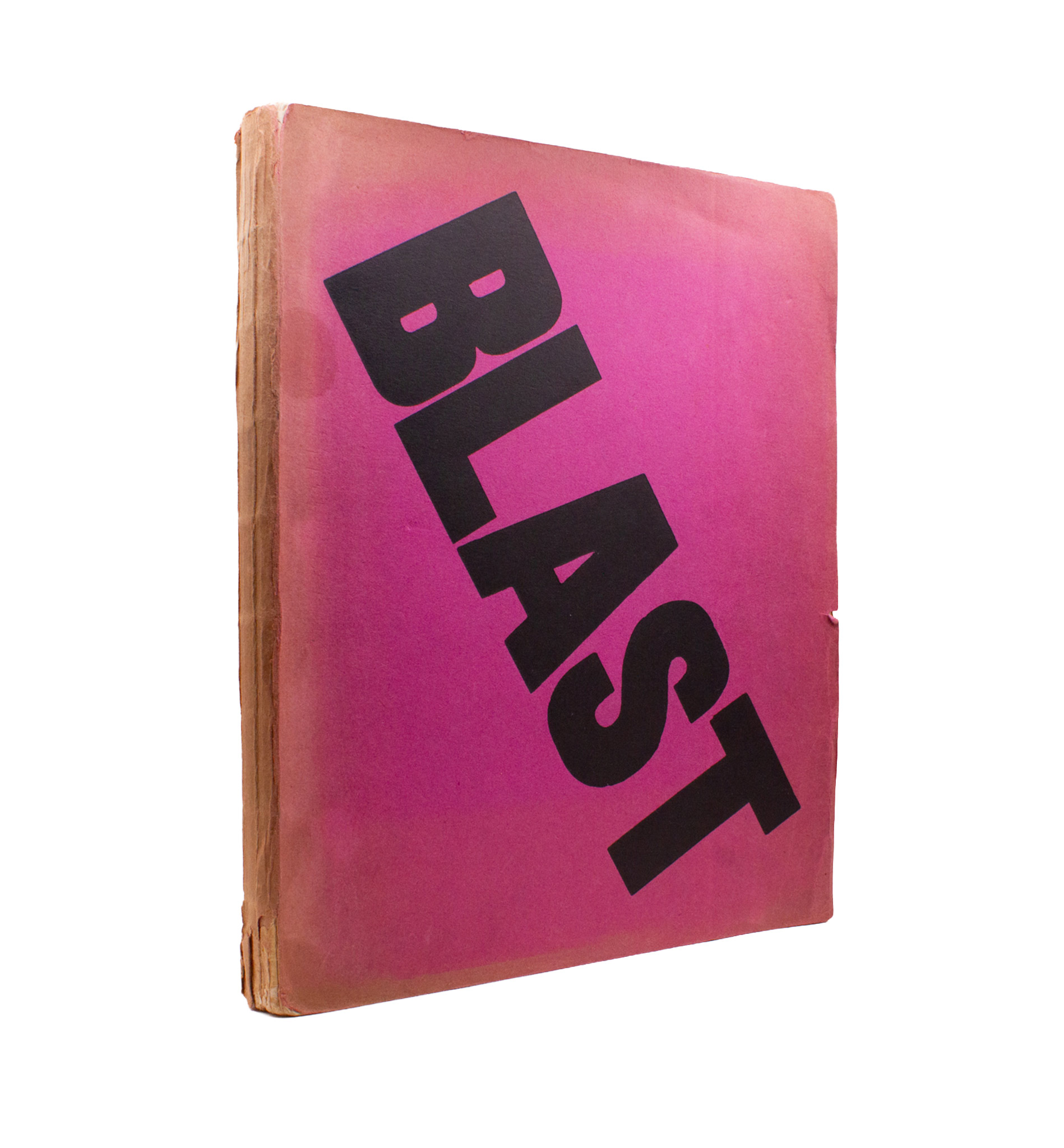
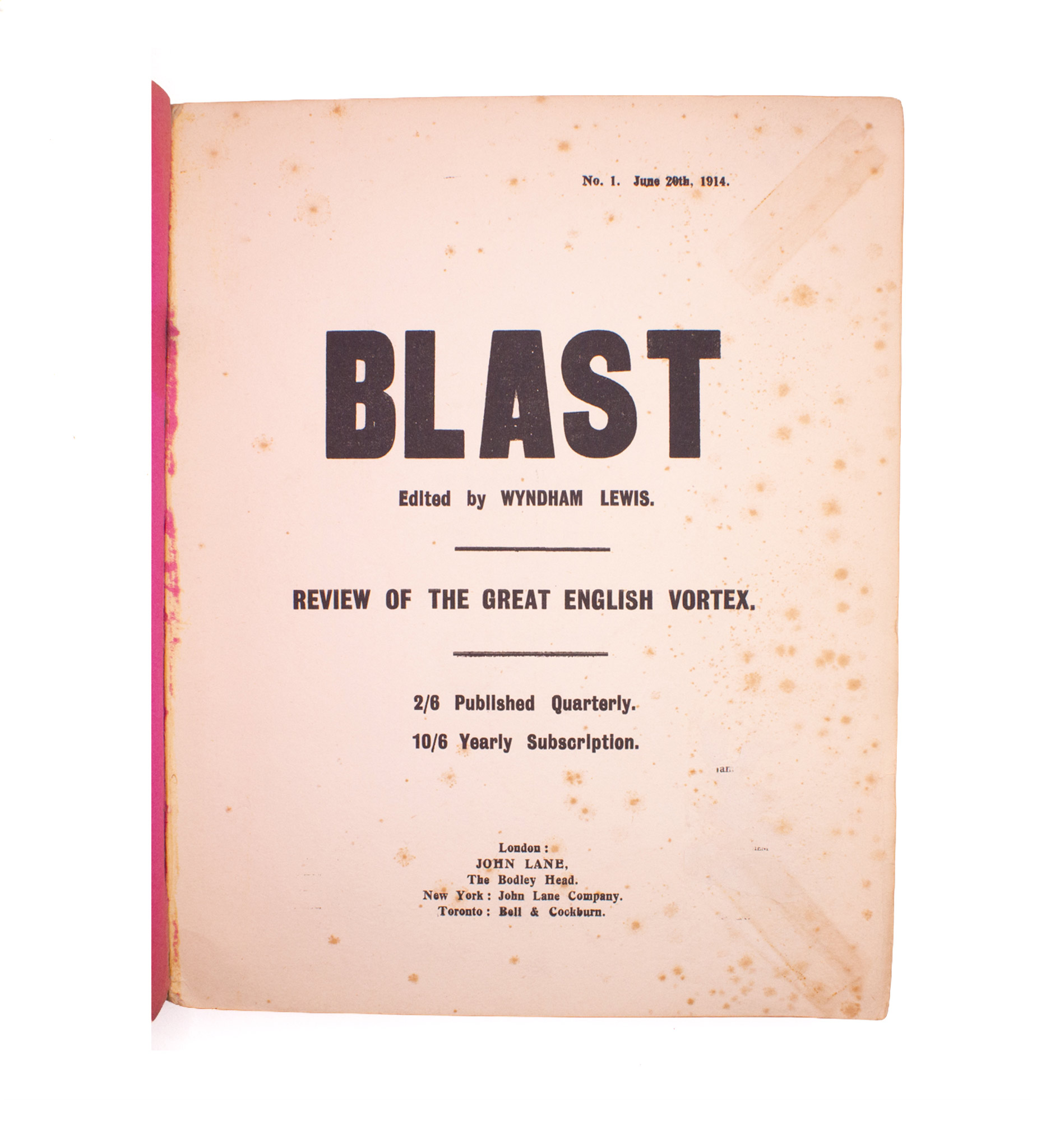
BLAST
Wyndham Lewis, editor
Published London: John Lane, 1914
164pp., 22 plates; 30.5 x 25 cm. Pink sugar paper wraps printed in black.
The first issue of Wyndham Lewis’s Vorticist BLAST, the quintissential modernist mag, and England’s answer to Futurism and Cubism. With poems from Ezra Pound, the polemics of Lewis, the art theories of Henri Gaudier-Brzeska, and the most striking plates from Edward Wadsworth, to name a few of the contributors to this issue.
This copy particularly rare in that its wraps remain attached without repair; only a short loss of the paper over the foot of the spine leaves the front wrap partly revealing. Retaining much of their original colour, with some uneven fading towards the edges, two nicks, and a stain. Internally complete, with all the plates; quires bound out of order by the publishers between pp. 72-89. Marginalia in pencil by an artistic hand c. p. 120. Light, unobtrusive foxing throughout, with those iconic pages of blasting and blessing (London is not a provincial town, etc.) unaffected. Peculiar artefacts of tape (non residual) and text to the title page, probably from the storage or handling of the leaves before binding.
tap to cycle
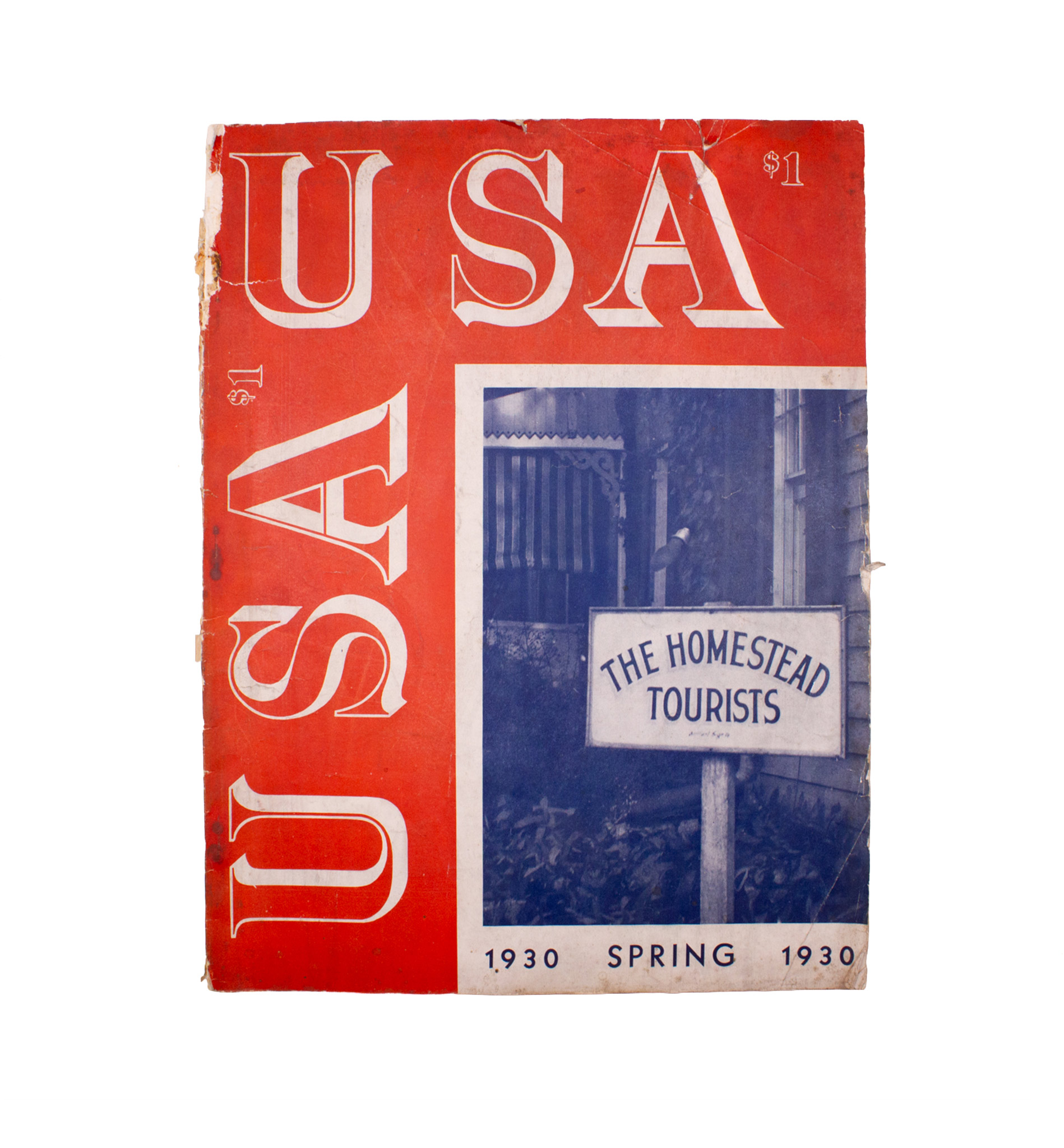
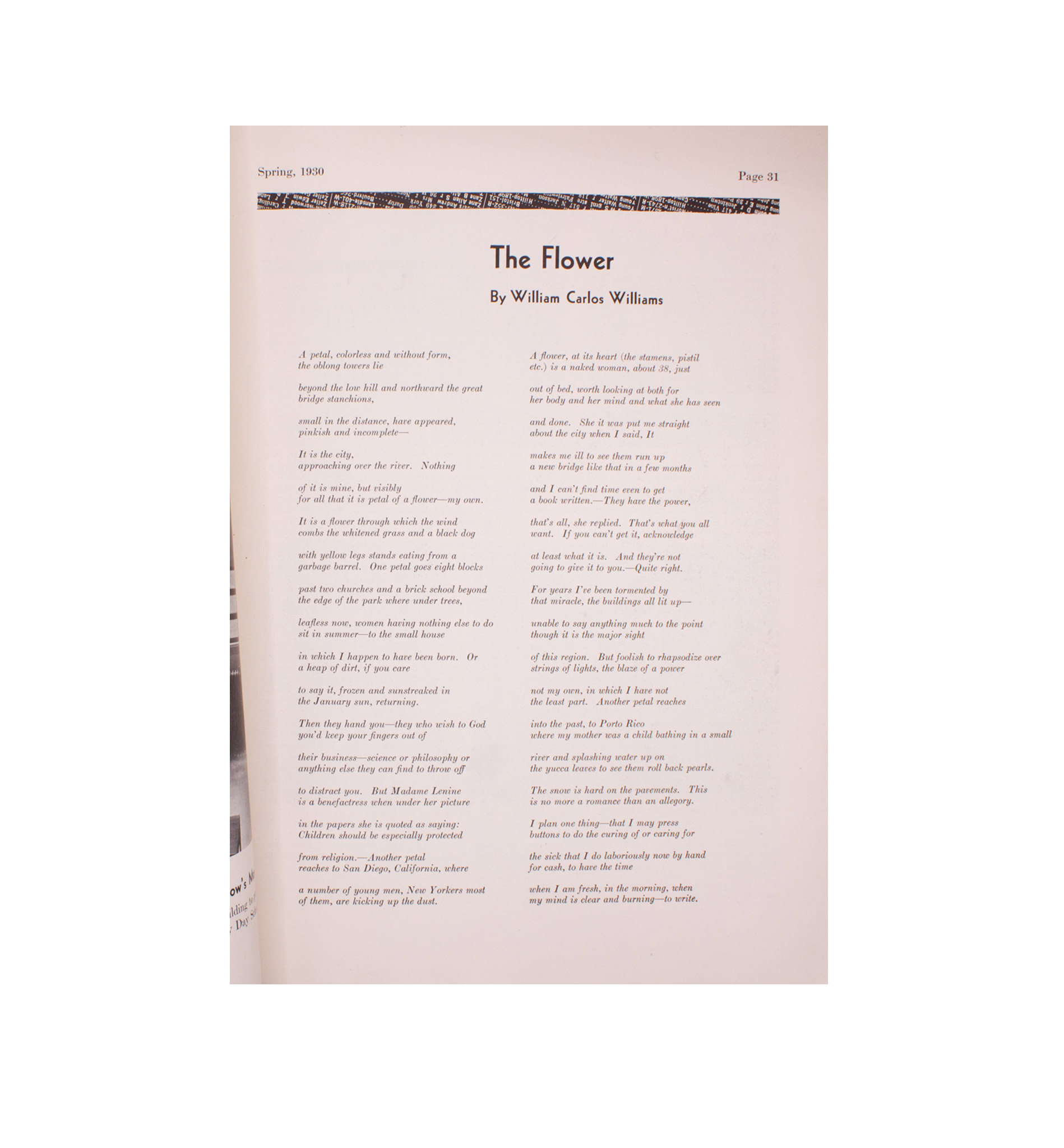
The Flower; in USA, Spring 1930
William Carlos Williams, contributor
Harold Mason, Vaughn Flannery, editors
Published Philadelphia: USA, 1930
54pp.; 30.7 x 23.3 cm. Paper wrappers printed in red and blue.
The first issue of this rare Philadelphian magazine which ran only for three issues total. Dedicated to the arts, particularly architecture, photography, and the machine. In all quite a beautiful magazine, whose “ornaments are fragments of road maps, racing sheets, stock market reports and telephone books.” Contains the first appearance of “The Flower” by William Carlos Williams, and is Wallace C143 thus.
One of 450 copies.The spine broken particularly at the top, the wraps generally grubbied, with creases and short tears near the edges. Internally clean and complete, remaining an important historical document, and quite unusual.
tap to cycle
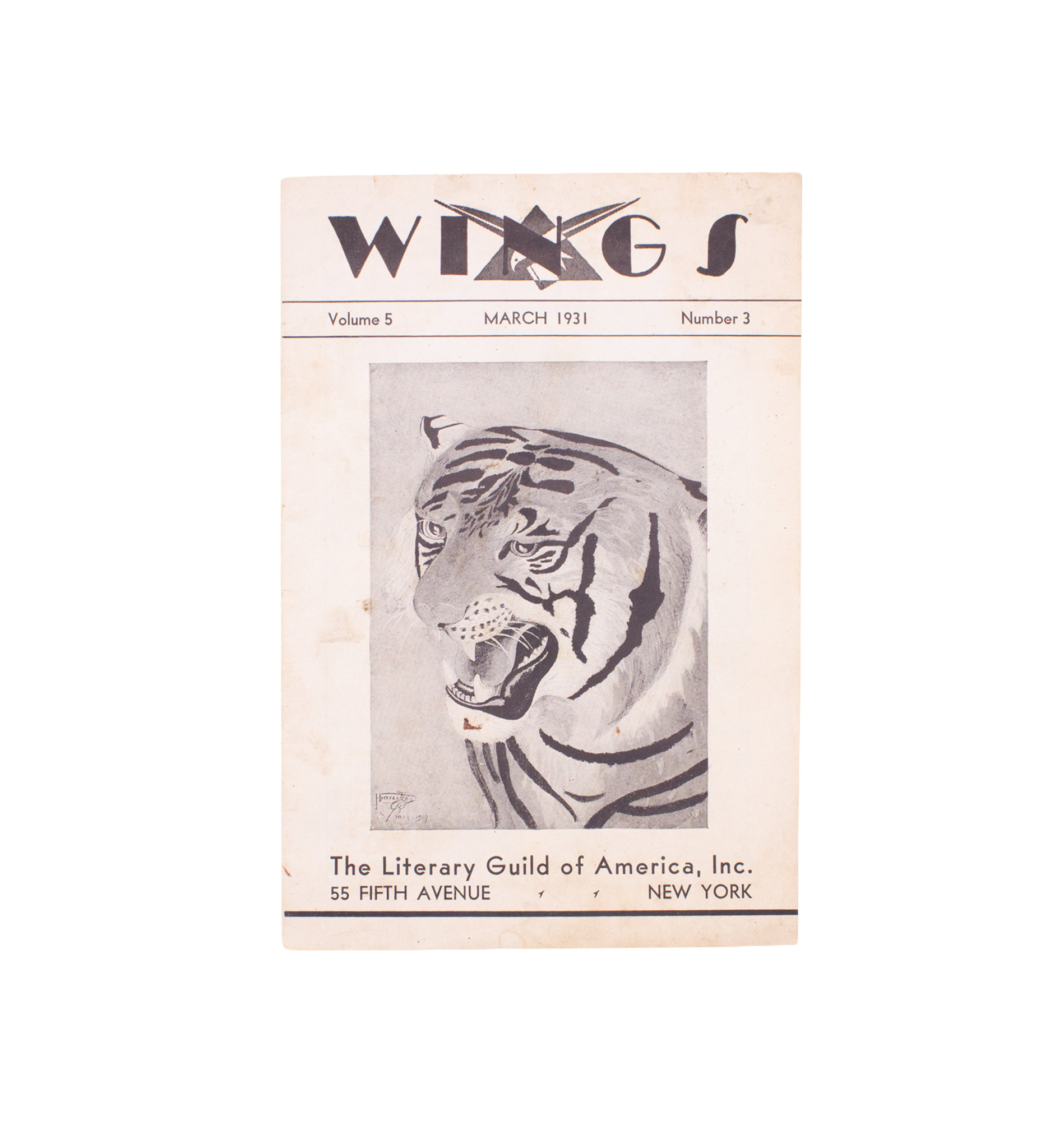
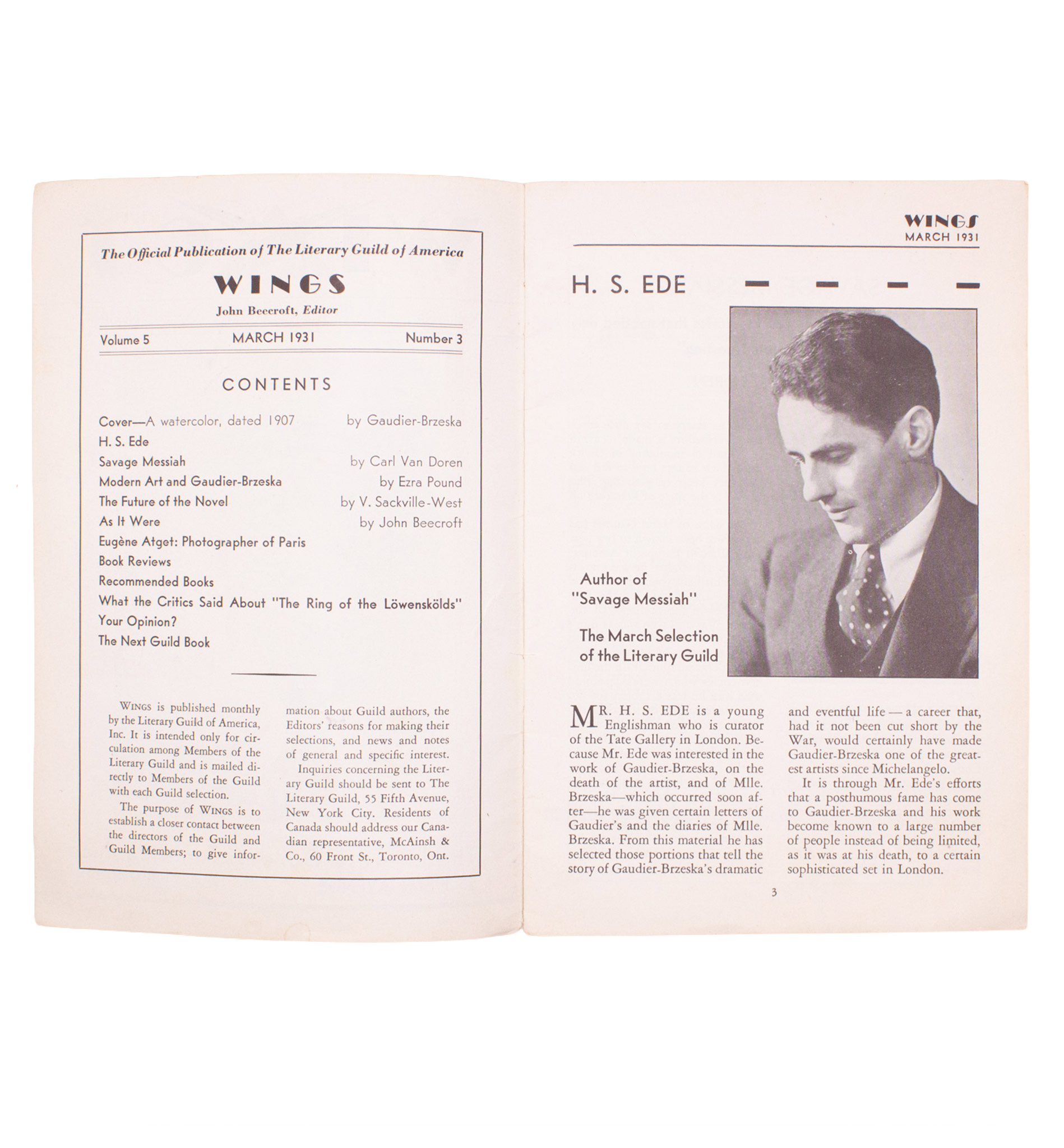
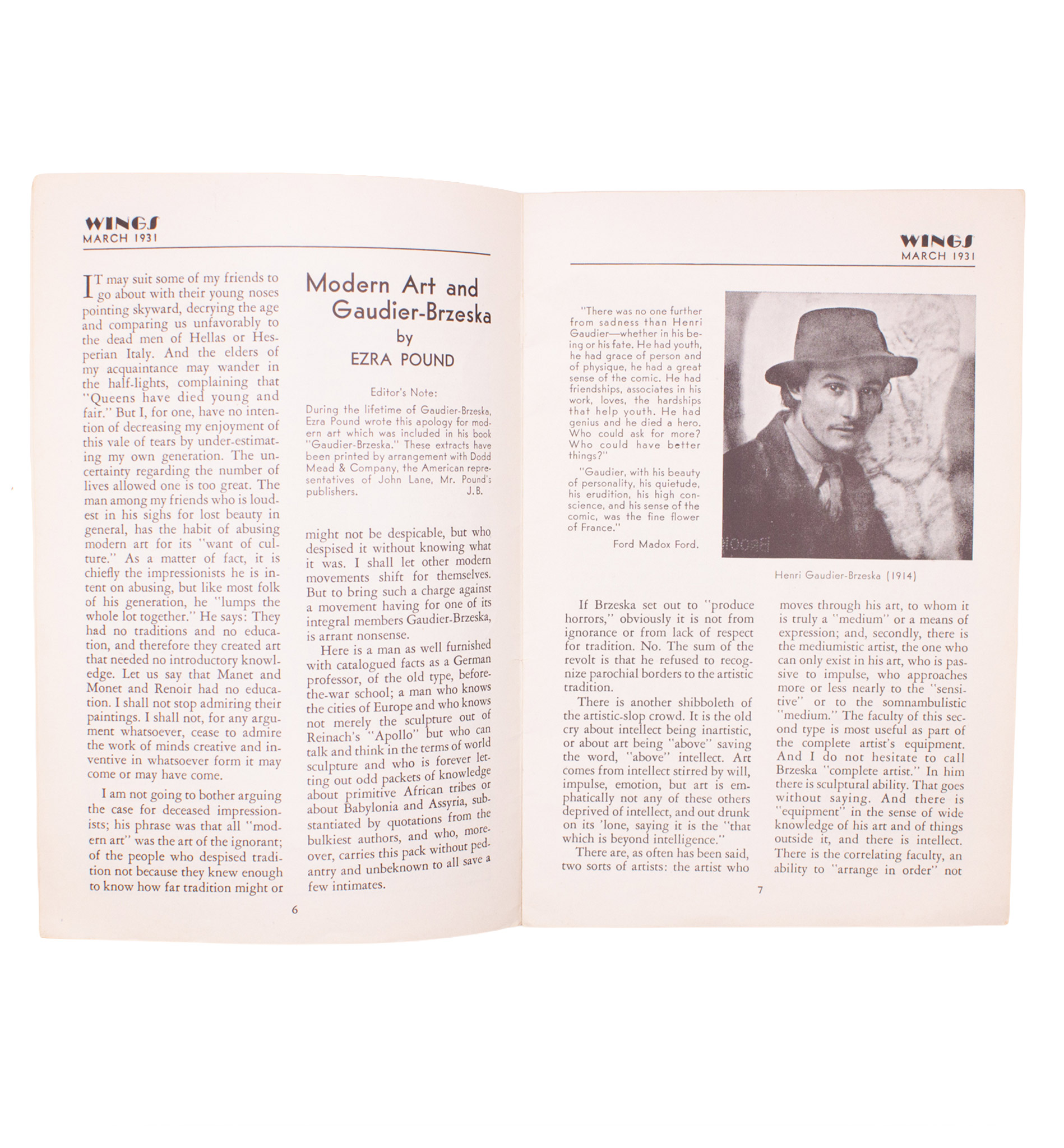
Modern Art and Gaudier-Brzeska; in Wings, March 1931
Ezra Pound, contributor
John Beecroft, editor
Published New York: The Literary Guild of America, 1931
24pp.; 19 x 12.7 cm. Folded and stapled.
The Literary Guild’s monthly review, this one accompanying their publication of H. S. Ede’s Savage Messiah. Contains a brief biography of Ede, a review of Savage Messiah by Carl Van Doren, and “Modern Art and Gaudier-Brzeska” by EP, uncollected by Gallup. A good copy, lightly creased and a little dirtied outside.
tap to cycle
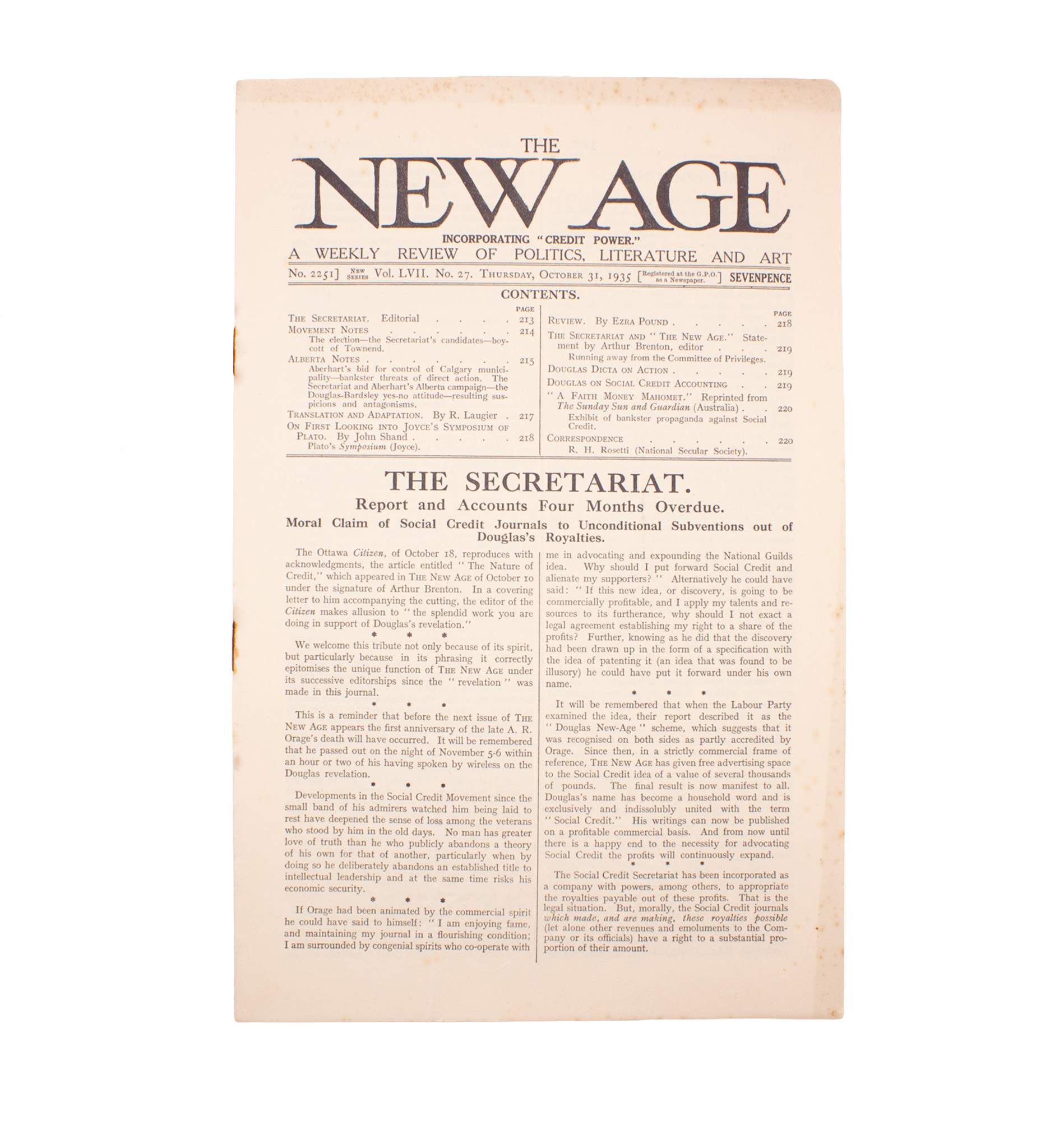
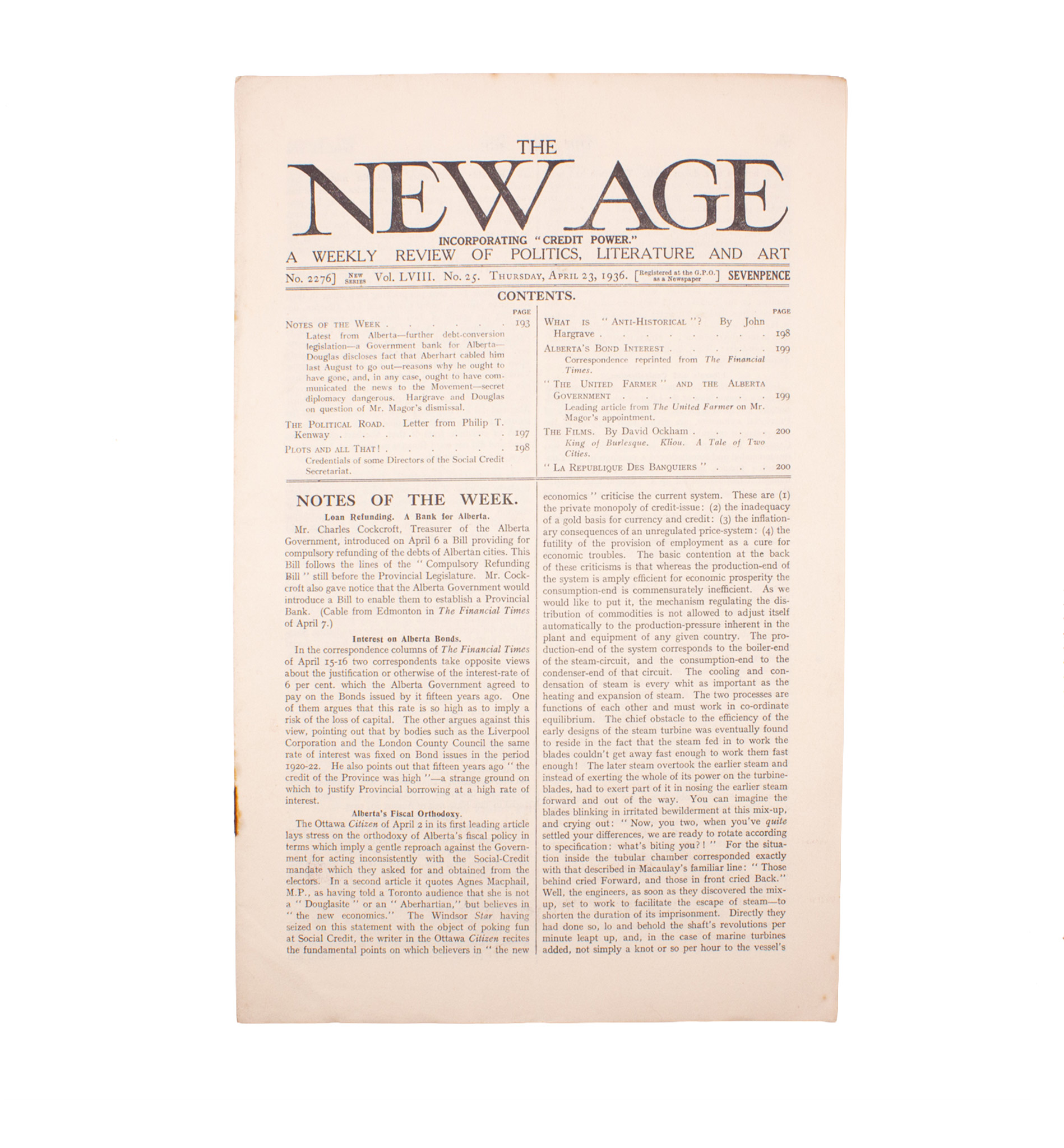
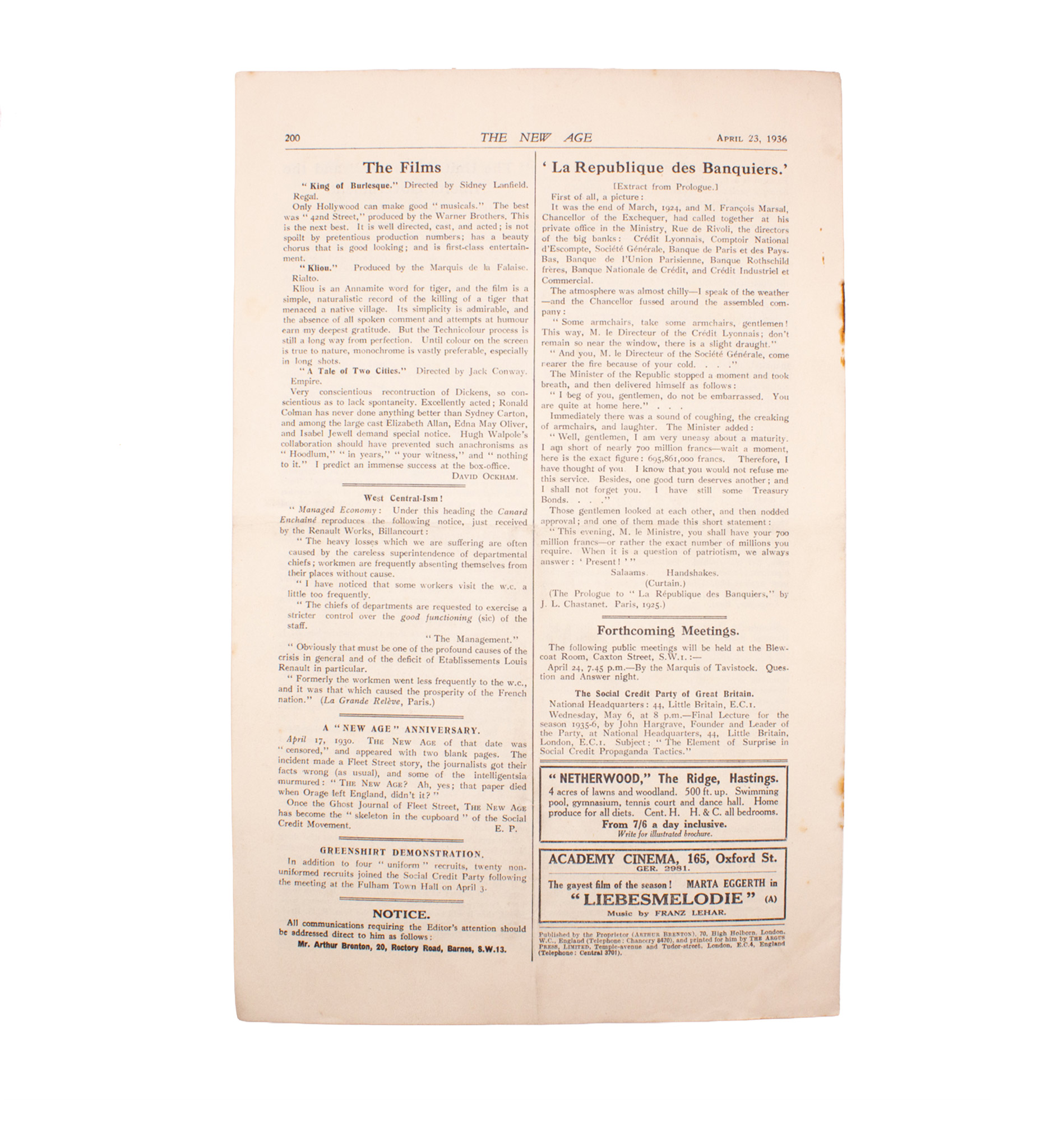
The New Age; Oct. 31, 1935 and Apr. 23, 1936
Ezra Pound, contributor
A. R. Orage, editor
Published London: Arthur Brenton, 1935, 1936
2 issues, each: 8pp.; 32.6 x 21.1. Folded and stapled.
Two issues of The New Age, operating after Orage’s death in 1934, both containing contributions from EP.
The first contains a “Review” by Ezra Pound of No. 380 of the French mag “Vu,” which contains “the first clear exposition of the de facto government of France, which is viler than any de facto government save possibly the English.”
The second issue contains only a note on the back-page by Pound, titled ‘A “New Age” Anniversary,’ describing The New Age as the ‘“skeleton in the cupboard” of the Social Credit Movement.”
Both at least very good condition, a little spotting and discolouration on the top-edge of the first issue, both issues with a little bleed around the staples, but overall beautifully clean and straight.
tap to cycle
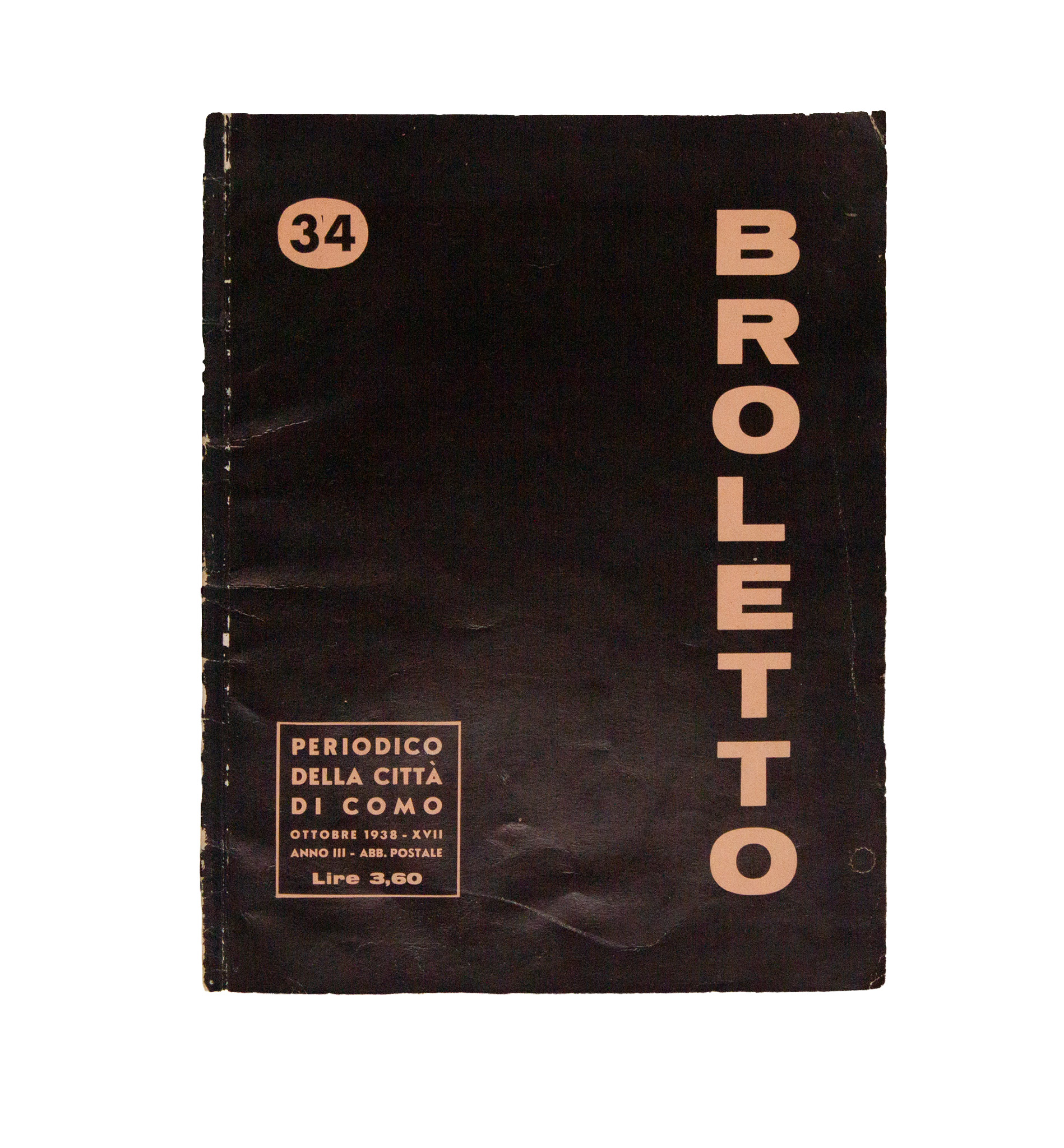
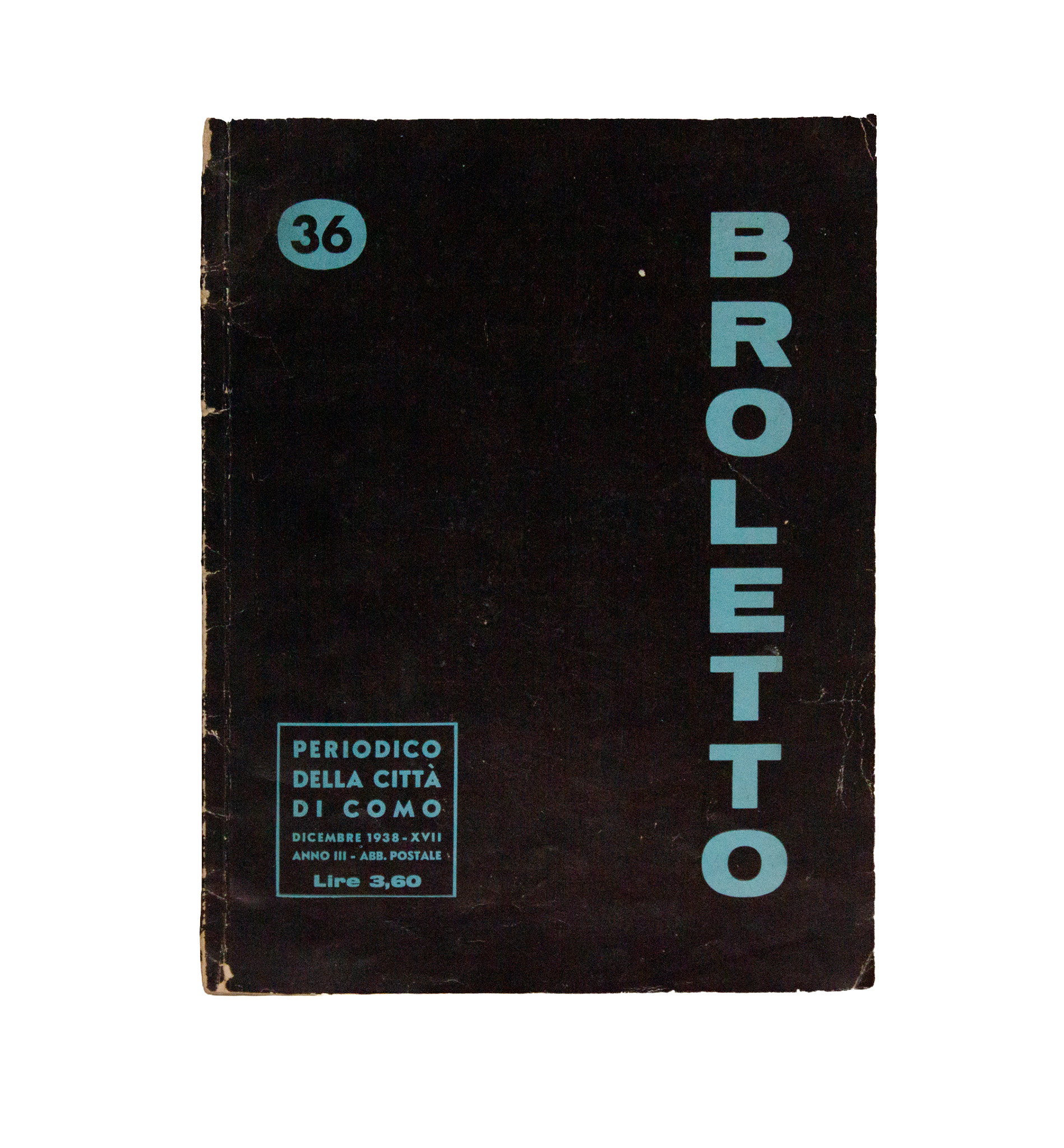
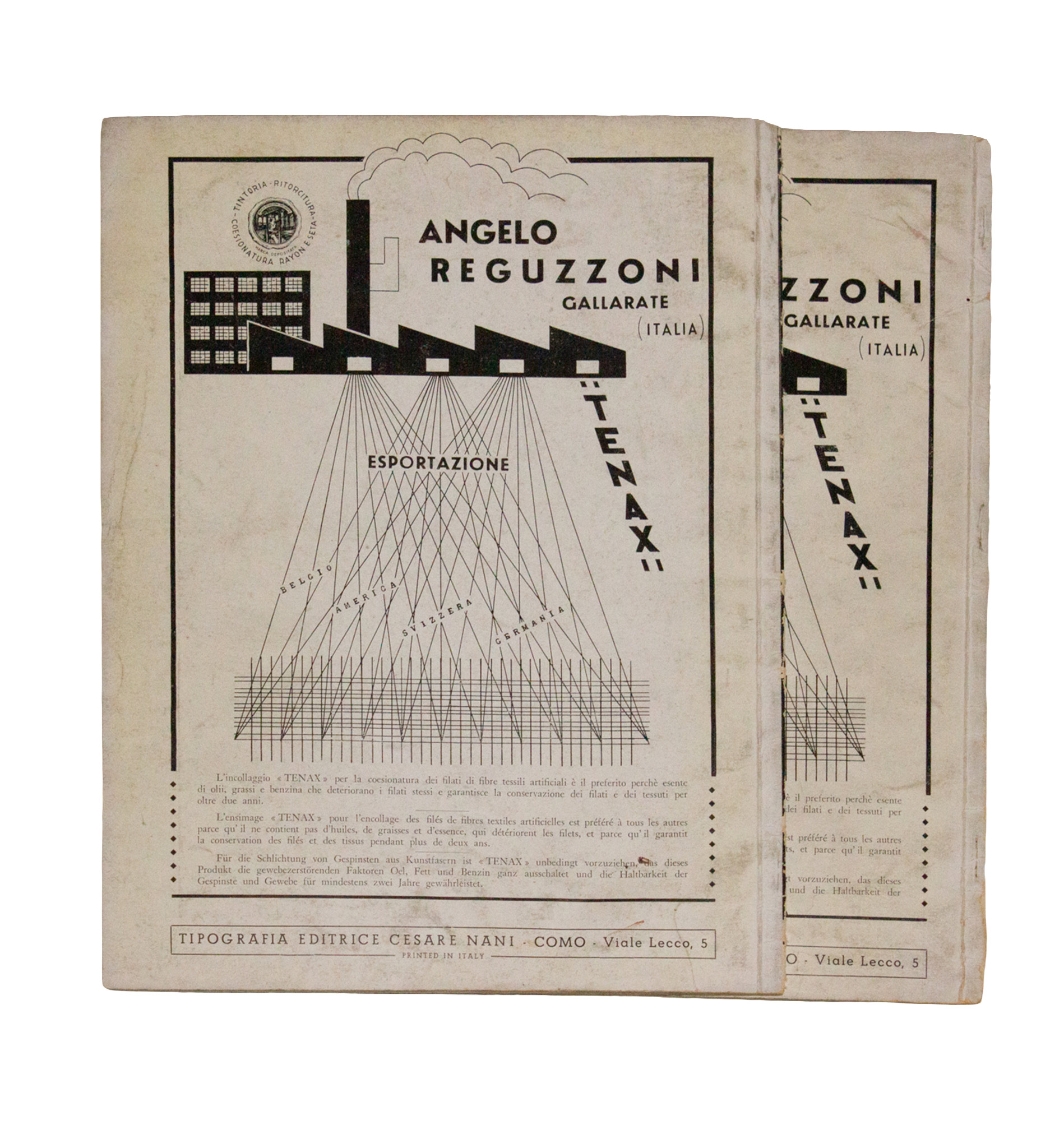
Broletto; 34 (October 1938) and 36 (December 1938)
Ezra Pound, contributor
Carlo Peroni, editor
Published Como: Broletto, 1938
2 issues: 44pp. and 48pp.; 29.2 x 22.7 cm each. Black wrappers printed in pink or blue.
Two issues of Lake Como’s short-lived cultural review, Broletto, containing two of three contributions of EP to the magazine, under his usual “Servizio di Communicazioni.”
The first (34) contains “Binyon: Salutiamo una traduzione pregevolissima della Divina Commedia,” a review and recommendation for Laurence Binyon’s translation of the Divine Commedy; that is, a recommendation for Italians to read the English translation.
The second issue (36) contains “Orientamenti,” EP’s third and final contribution. Described as EP at his clearest by Claudio Sansone, the “ruminative article” is an ideogram on the expiration of Paris as the centre of letters, the concern of poets with economics, the wisdom of survival and the delay of those in cemented seats to see the world’s course. Not collected in Orientamenti (1944, Gallup A55) though possibly the namesake.
Both issues with some wear to wraps, cracking down spine, but very sound and clean internally. Gallup C1477 and C1486.
tap to cycle
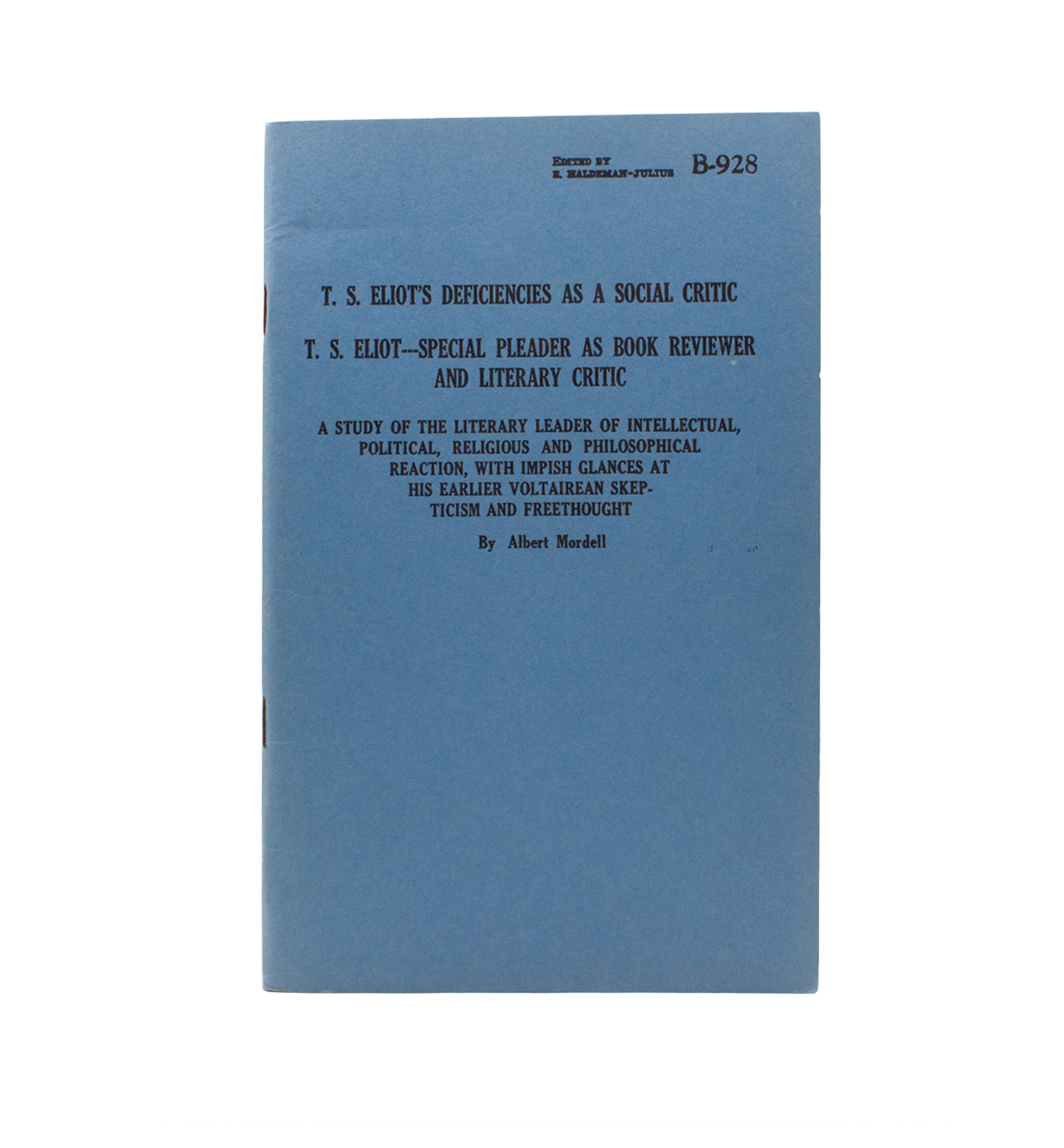
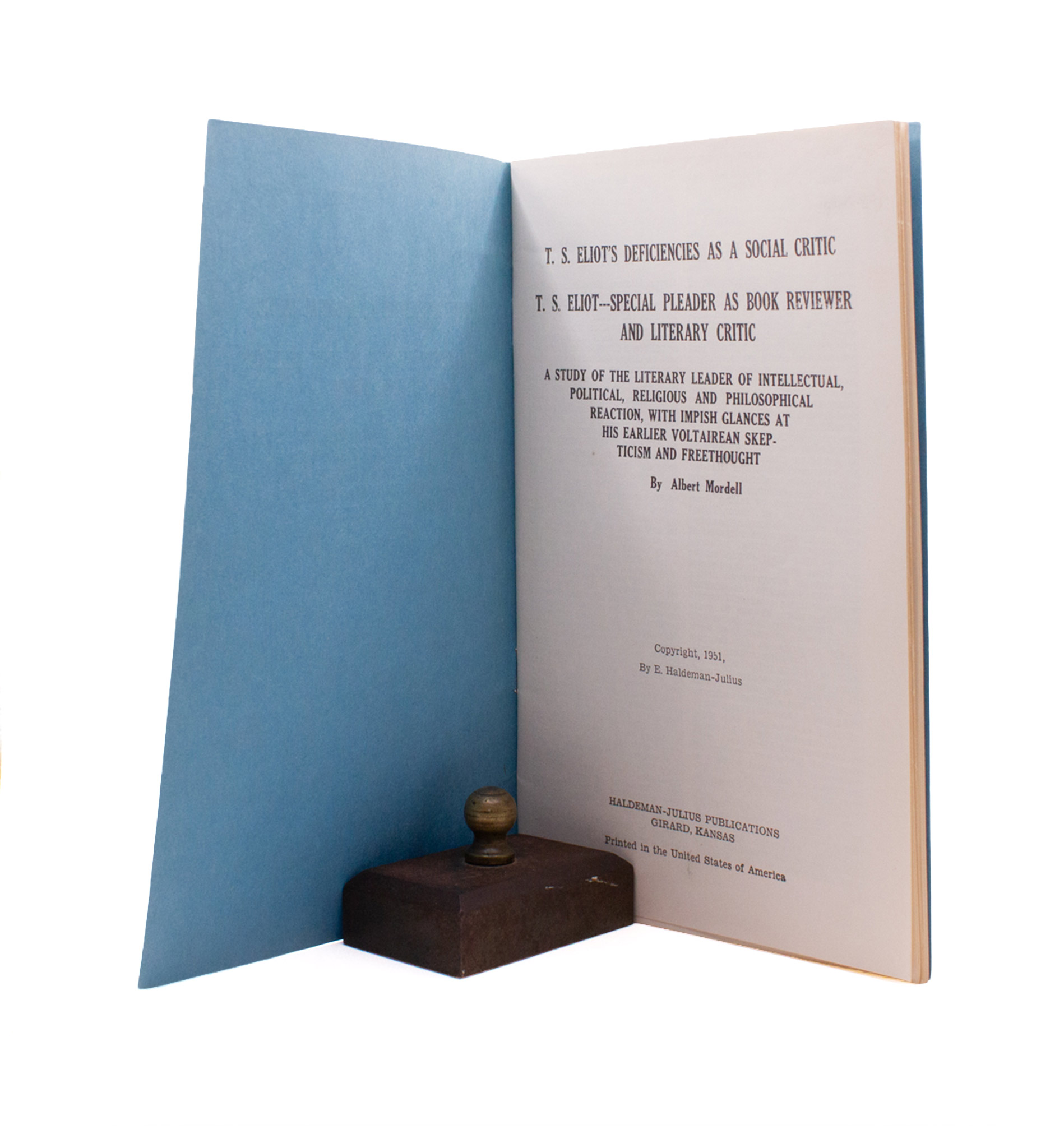
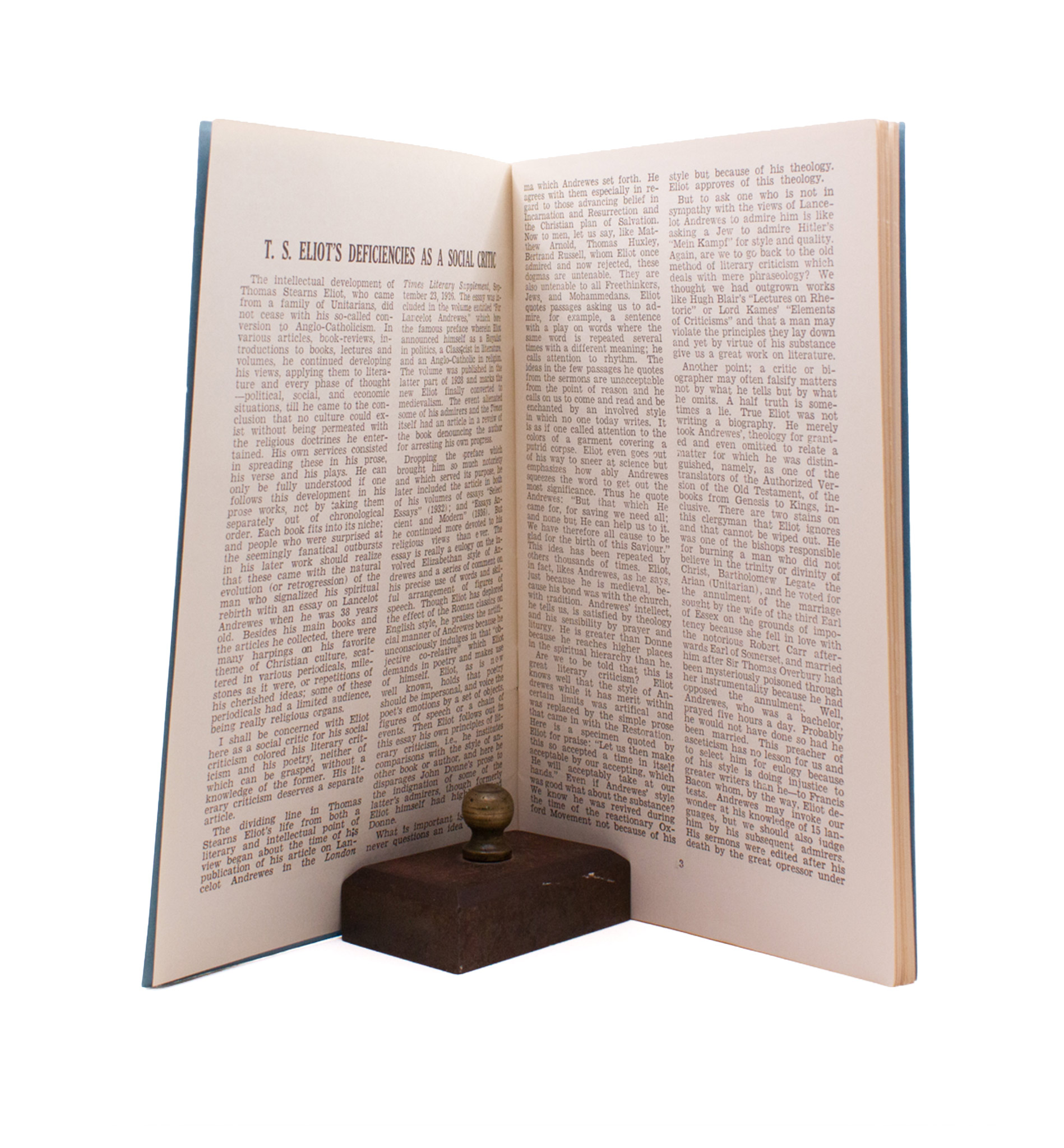
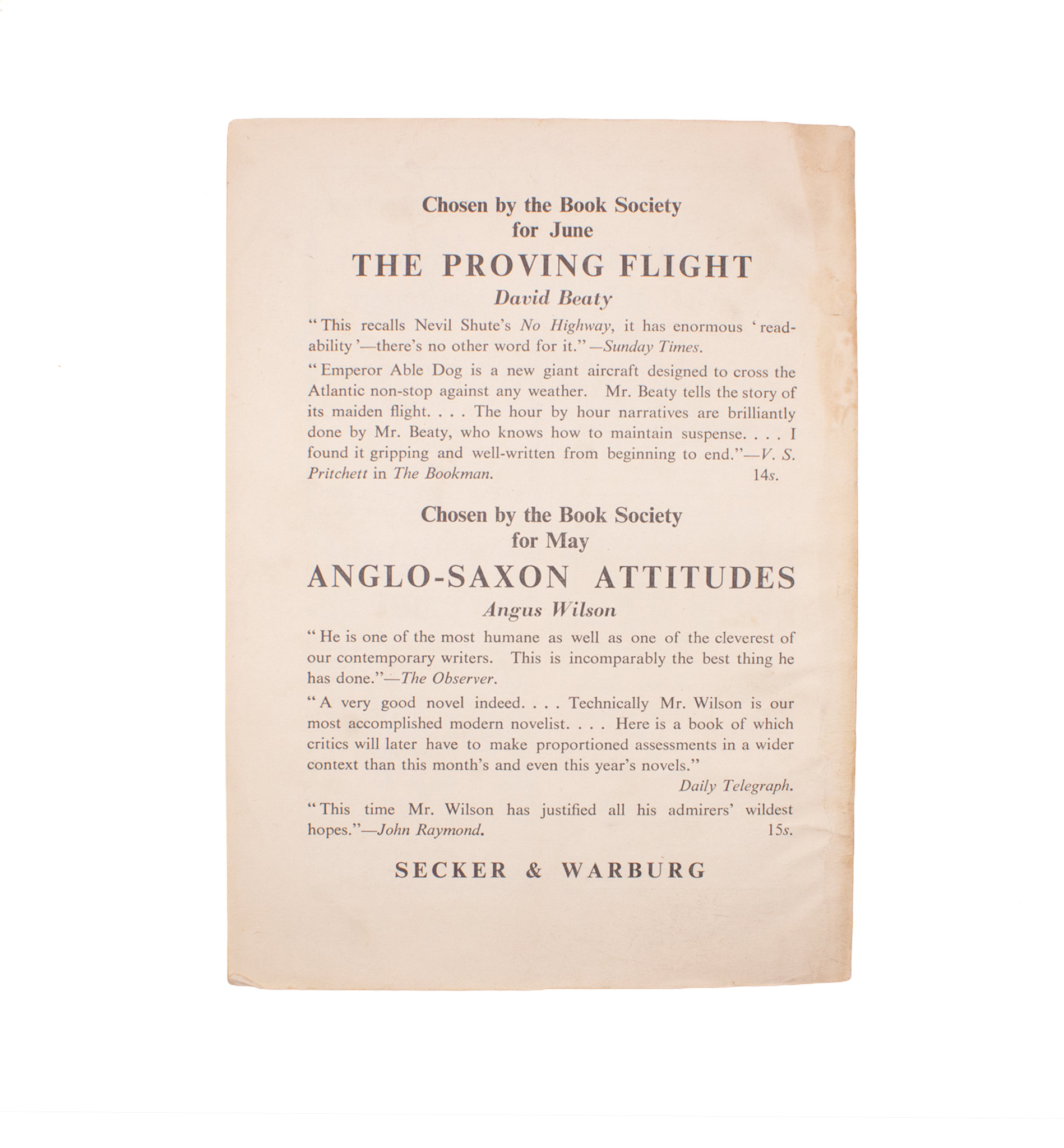
T. S. Eliot’s Deficiencies as a Social Critic
Albert Mordell
Published Kansas: Haldeman-Julius Publications, 1951
56pp.; 21.5 x 13.7 cm. Blue paper wrappers printed in black, wire-stitched.
Two essays criticising TSE’s critical faculties, an eccentric privately printed pamphlet. Fine save for a little landed paint on the back cover.
tap to cycle
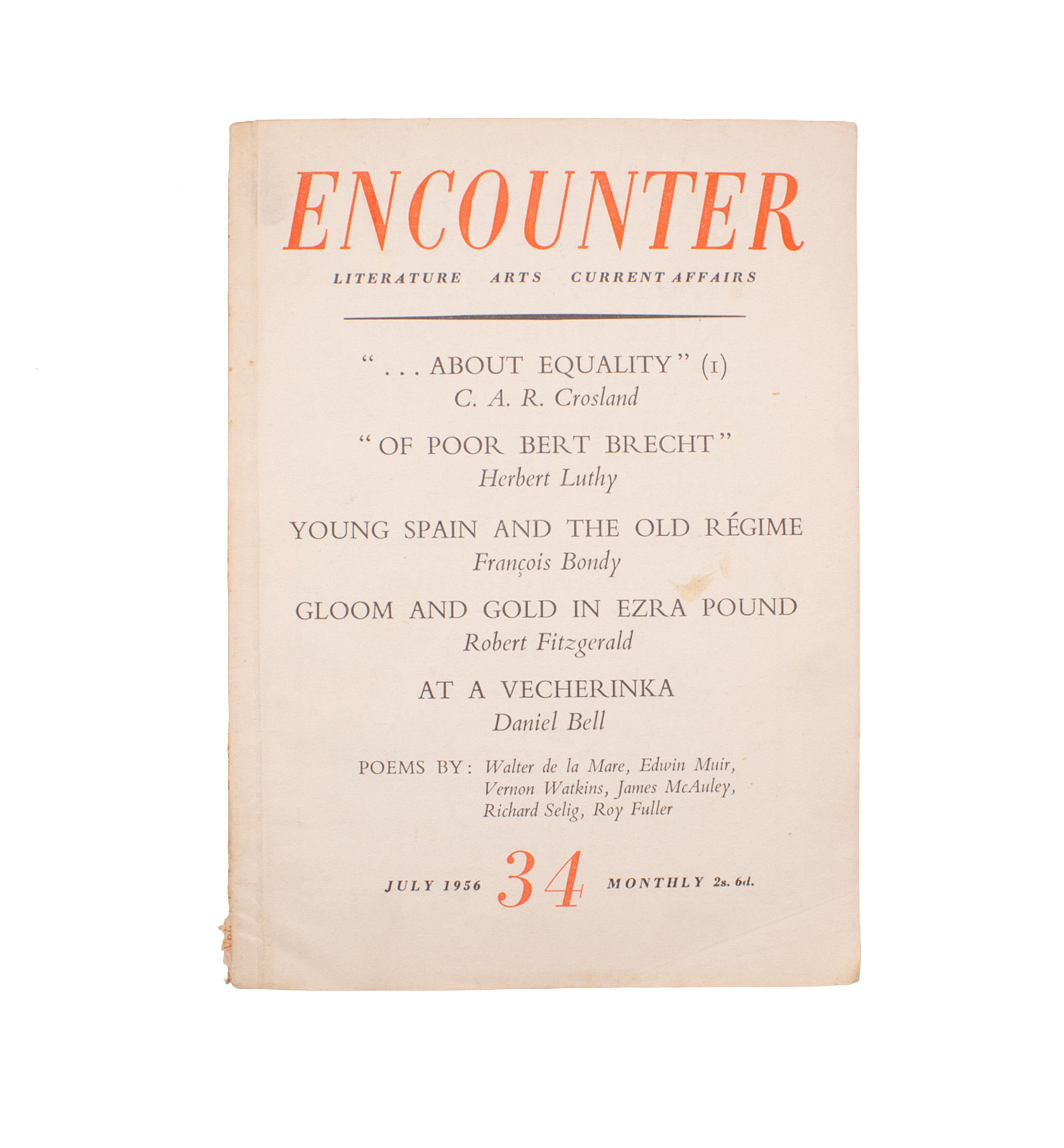
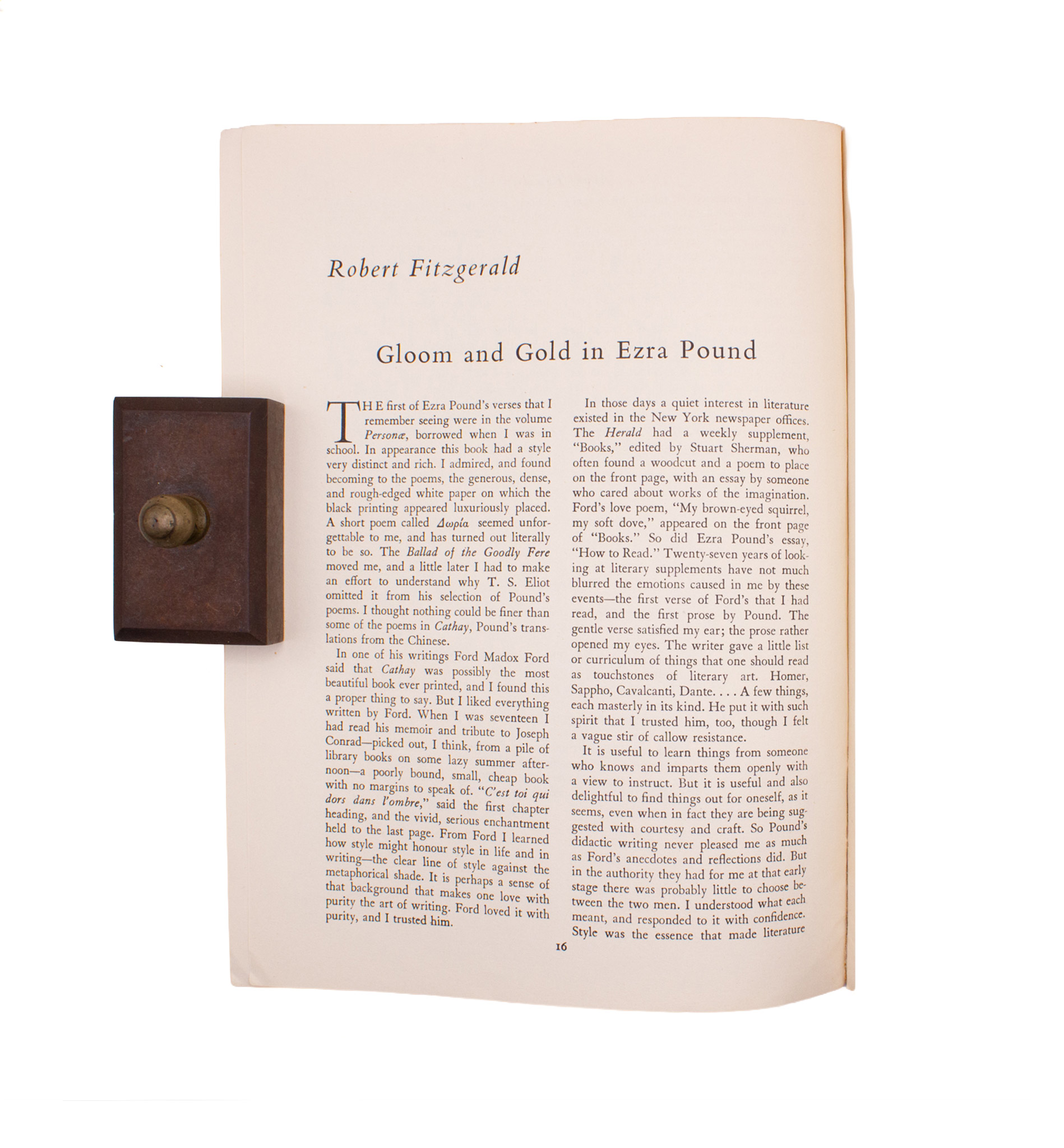
Gloom and Gold in Ezra Pound; in Encounter, July 1956
Stephen Spender, Irving Kristol, editors
Robert Fitzgerald, contributor
Published London: Encounter, 1956
88pp.; 25.3 x 18.5 cm. Cream paper wrappers printed in red and black.
A very pleasant memorial essay from R. Fitzgerald; not a Neo-Platonic study as expected. A well-handled copy, but clean and sound.


tap to cycle
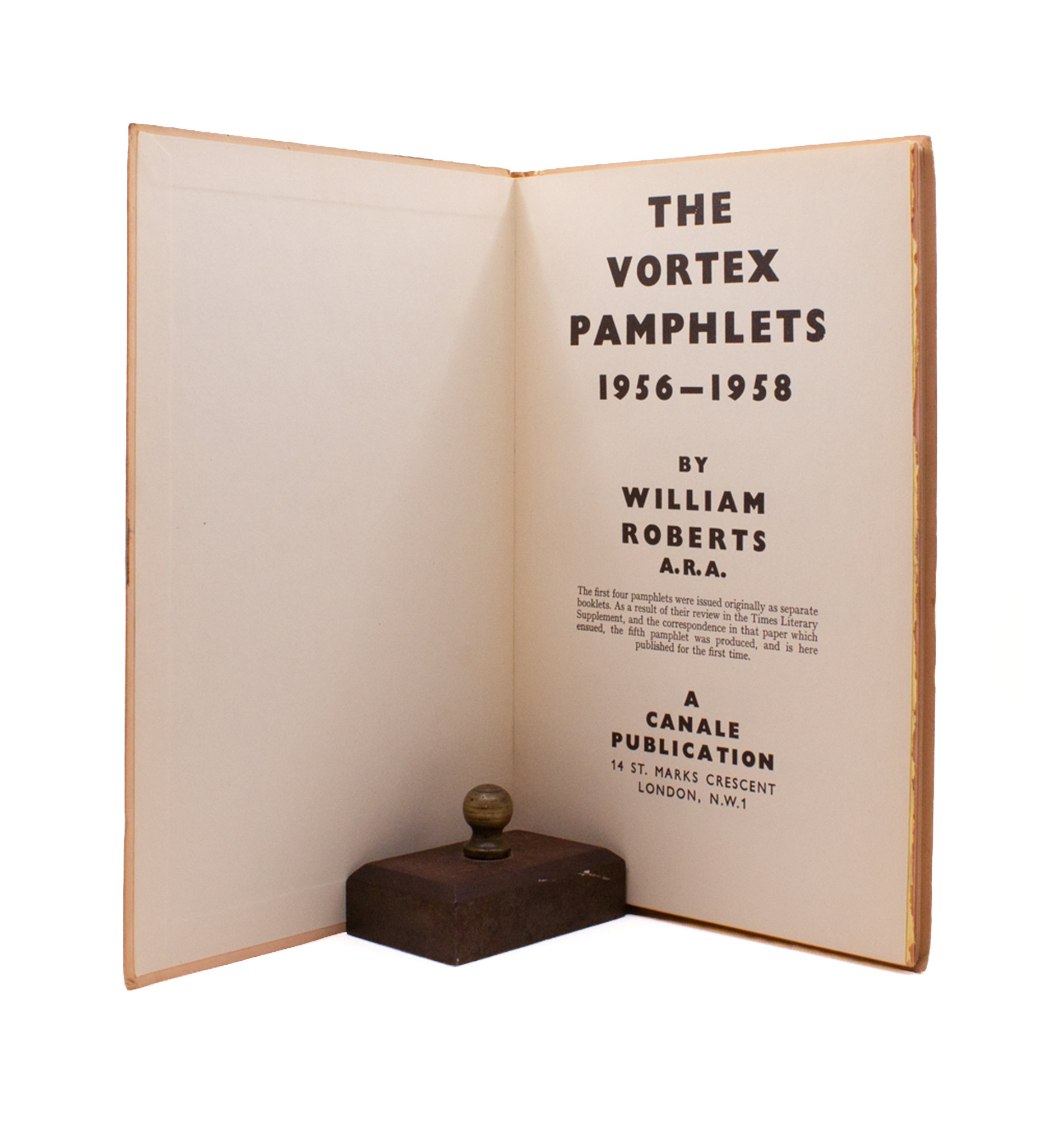
The Vortex Pamphlets, 1956-1958
William Roberts
Published London: A Canale Publication, 1956-1958
24ll. plus covers and flies; 22.2 x 14.7 cm. Salmon pink paper covered boards printed in black.
Five pamphlets issued by Vorticist painter William Roberts following an exhibition of Vorticism at the Tate Gallery, 1956, which he held exaggerated Wyndham Lewis’s responsibility for the movement. Each pamphlet bound in with their original wraps. Boards lightly rubbed and bumped with some discolouration to spine.
tap to cycle
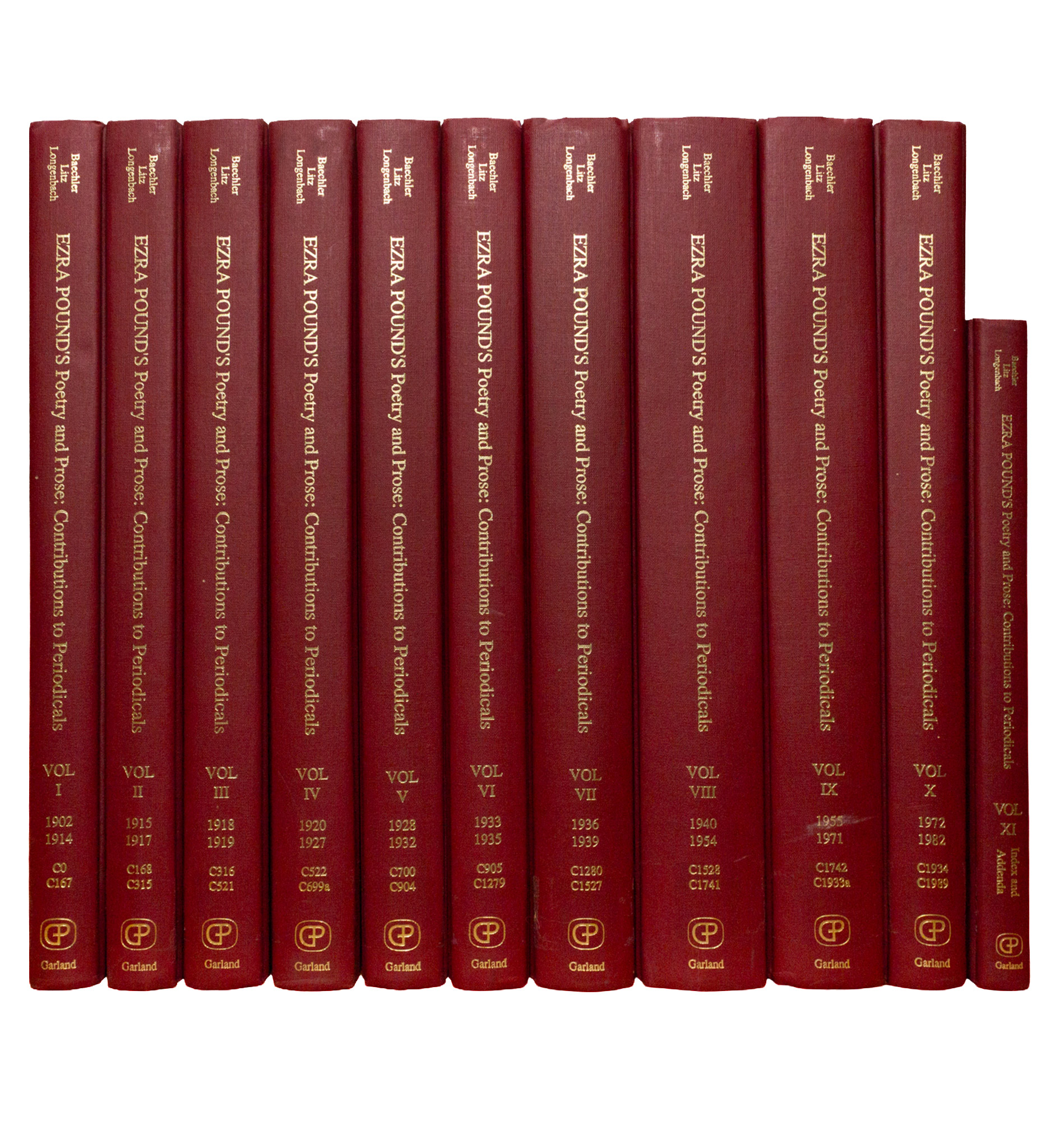
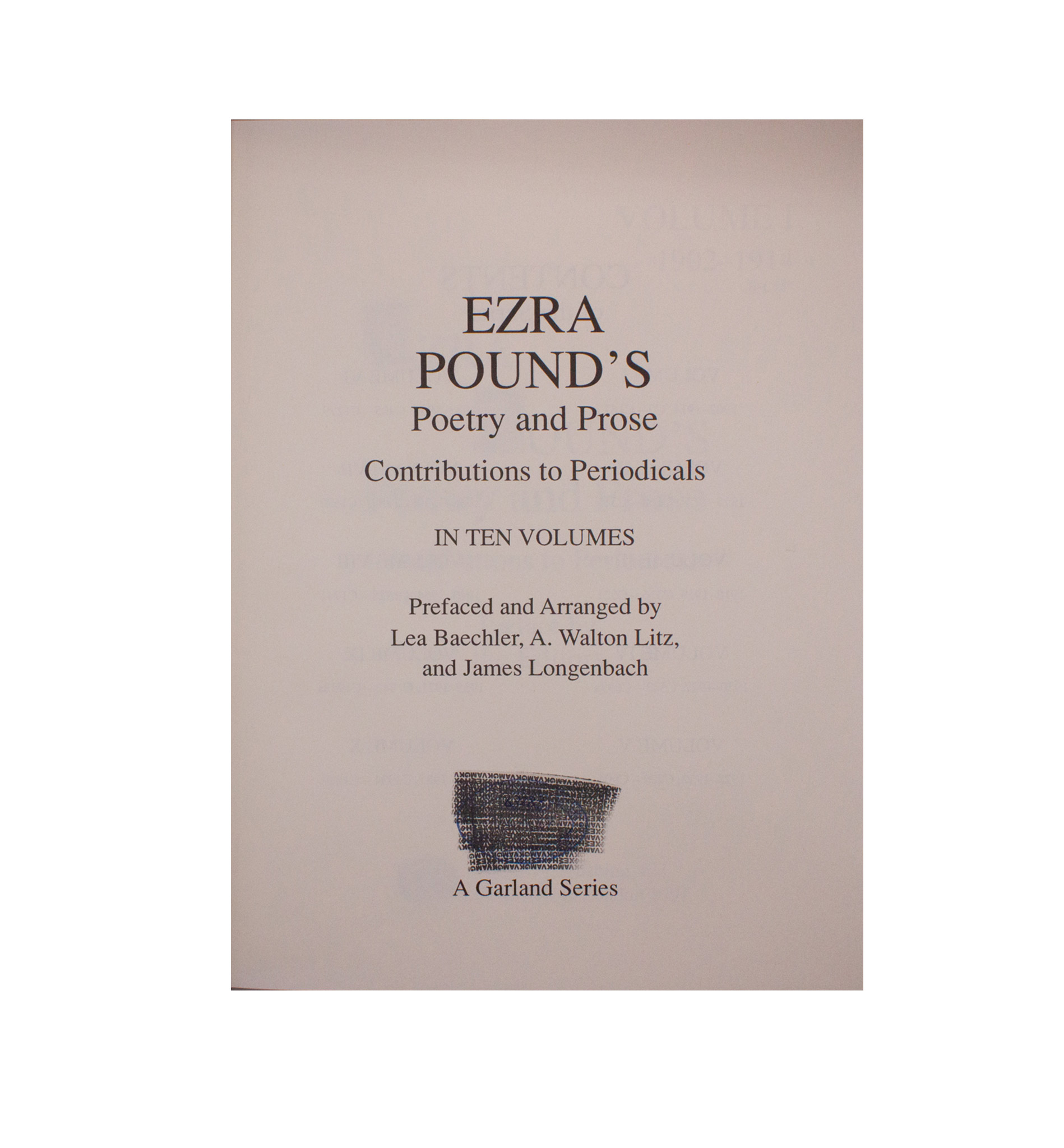
Ezra Pound’s Poetry and Prose: Contributions to Periodicals
Lea Baechler, A. Walton Litz and James Longenbach, editors
Published New York and London: Garland Publishing, Inc., 1991
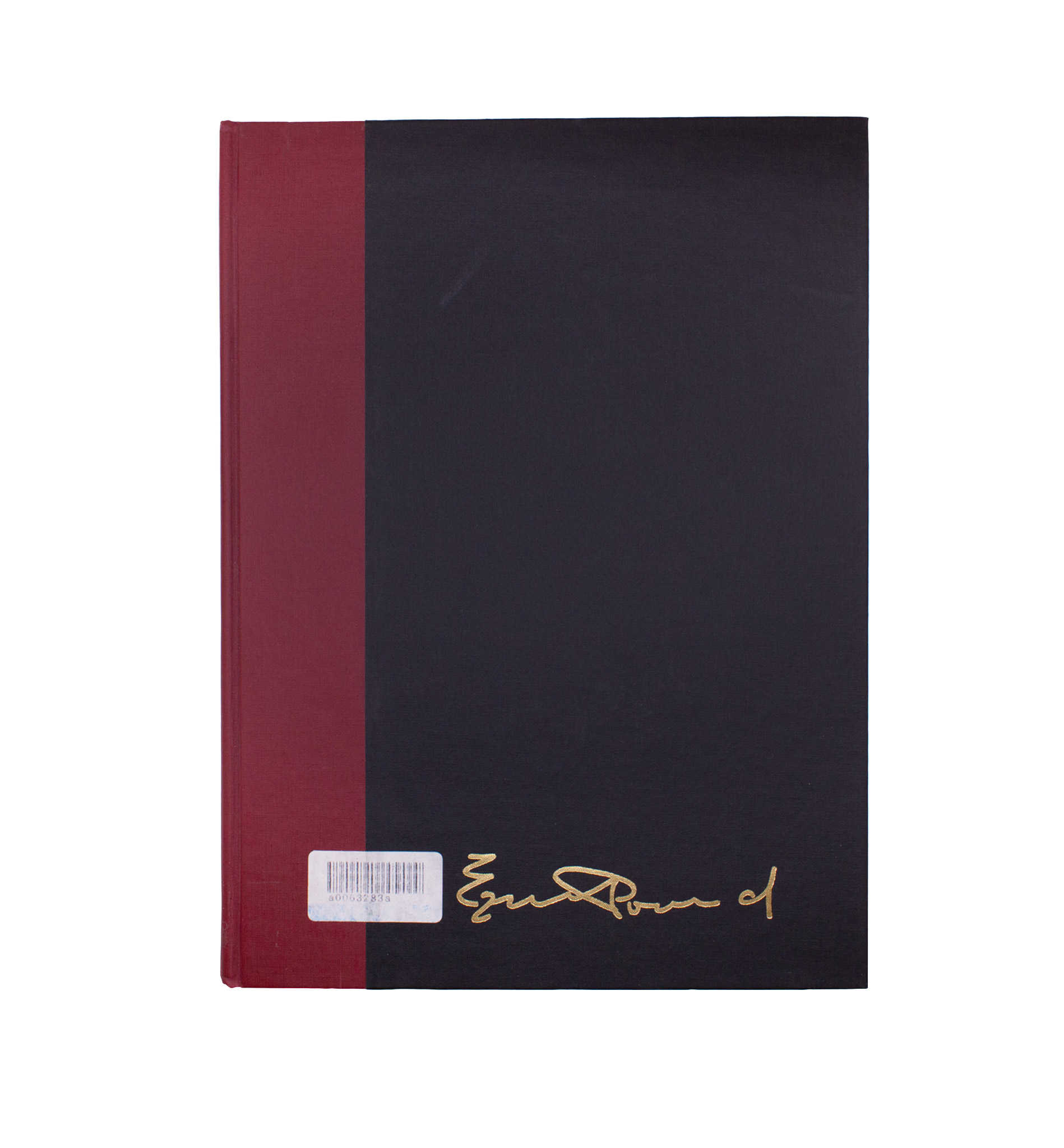
Vol. I-X: 4120pp. total; each c. 31 x 23.5 cm. Black paper cover boards printed in gold, backed in maroon cloth printed in gold down spine; maroon endpapers and pastedowns.
Vol. XI: 160pp.; 23.5 x 15.8 cm. idem.
A complete set of one of the most important resources in Pound studies, scans of very nearly every item indexed in Gallup C, over 2000 items.
This set comes from a Japanese university library and as such each volume has a few markings, being: a sticker to the front board; a small stamp and score of black marker to the top-edge; the university library’s stamp blacked out using further stamping to the title-page. At the back of each volume one finds a pretty withdrawal form, with no withdrawals issued. Internally fine throughout. Some light rubbing or suface marks and scuffs to the boards, each in at least very good condition.