de Beaumont Rares
debeaumontrares@gmail.com
Sources, I
Books Poundian by proxy, some quoted or alluded to in The Cantos and other poems.
4 February 26
tap to cycle
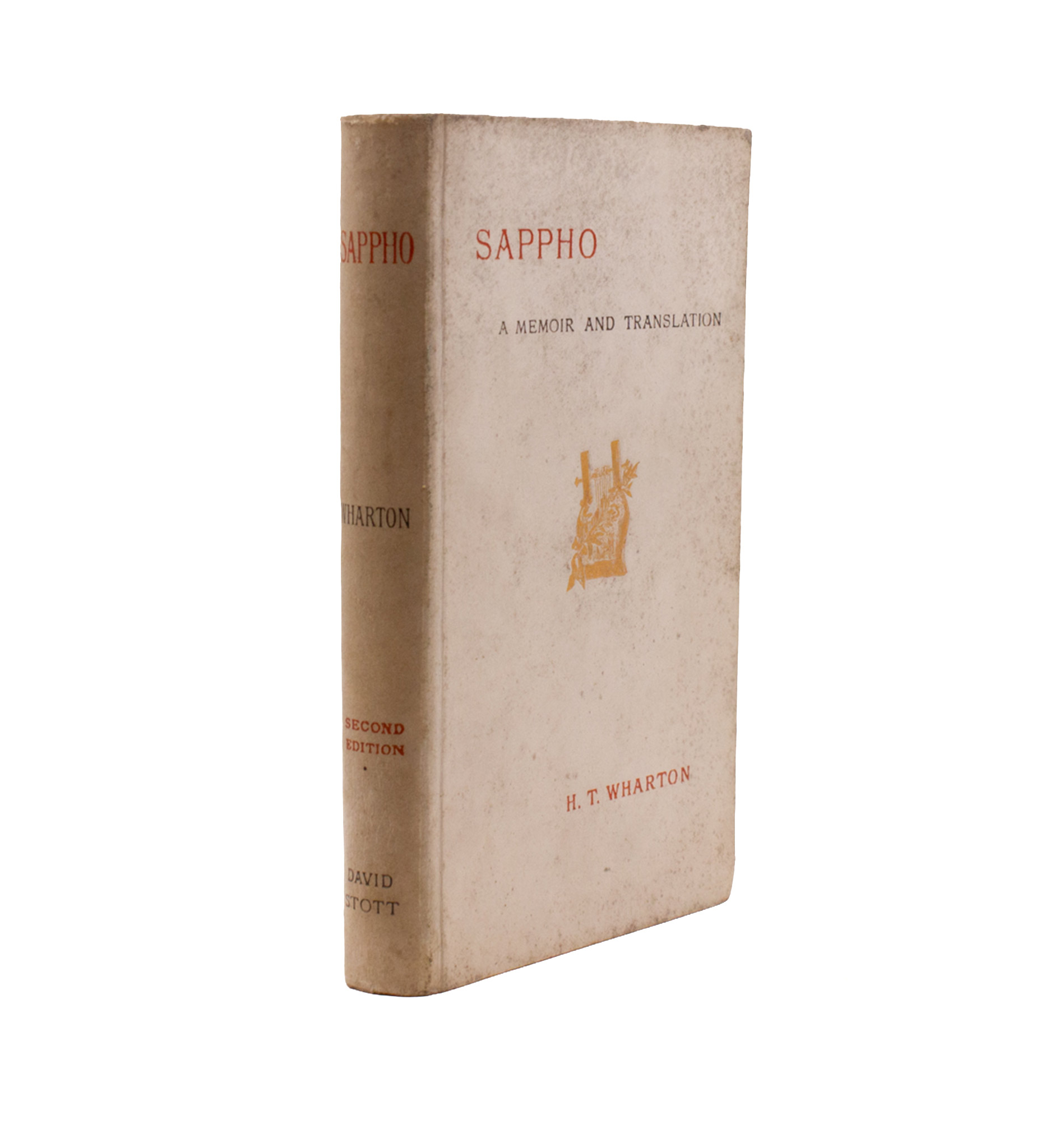
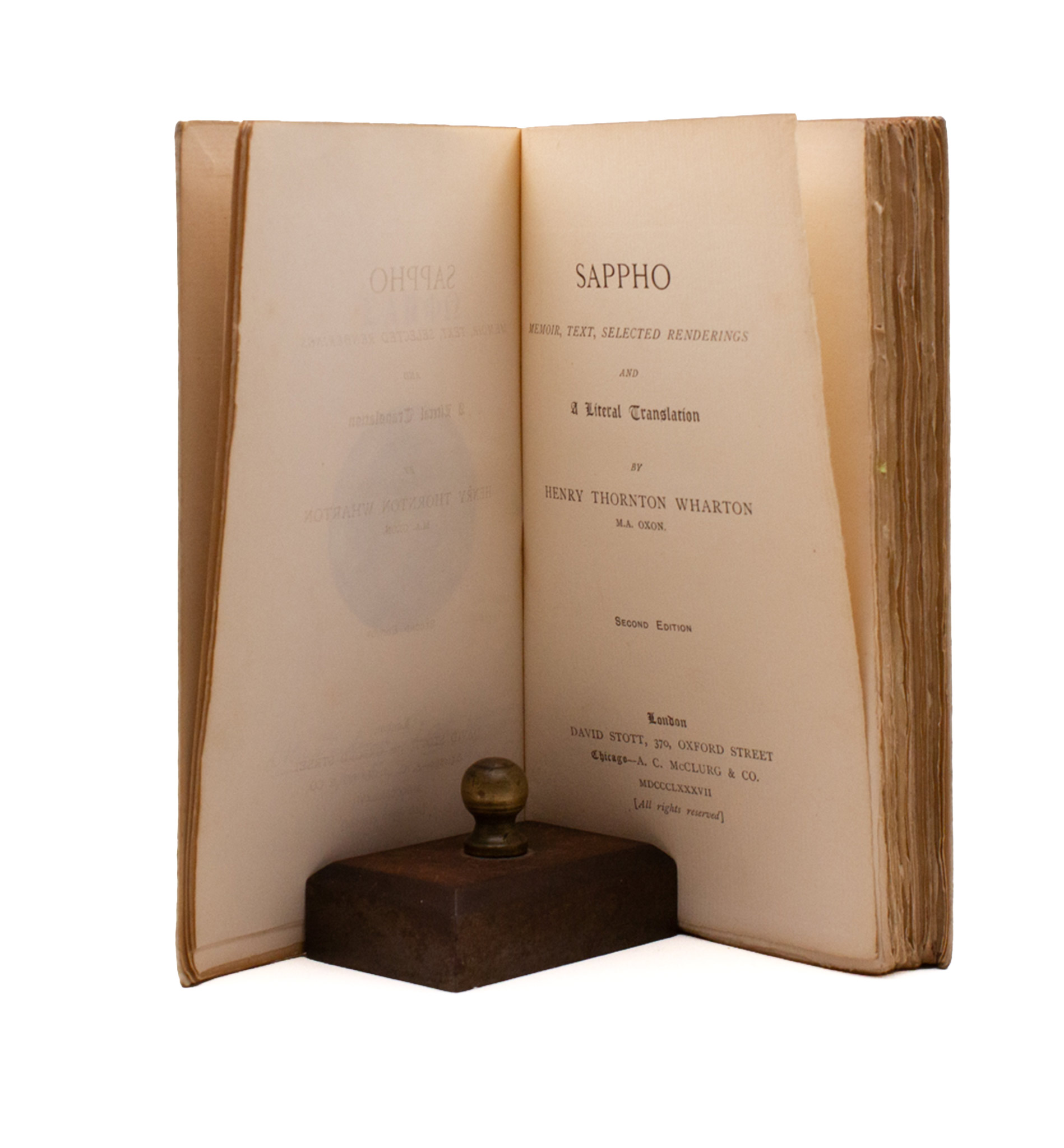
Sappho: Memoir, Text, Selected Renderings and A Literal Translation
Henry Thornton Wharton
Published London: David Stott and Chicago: A. C. McClurg & Co., 1887
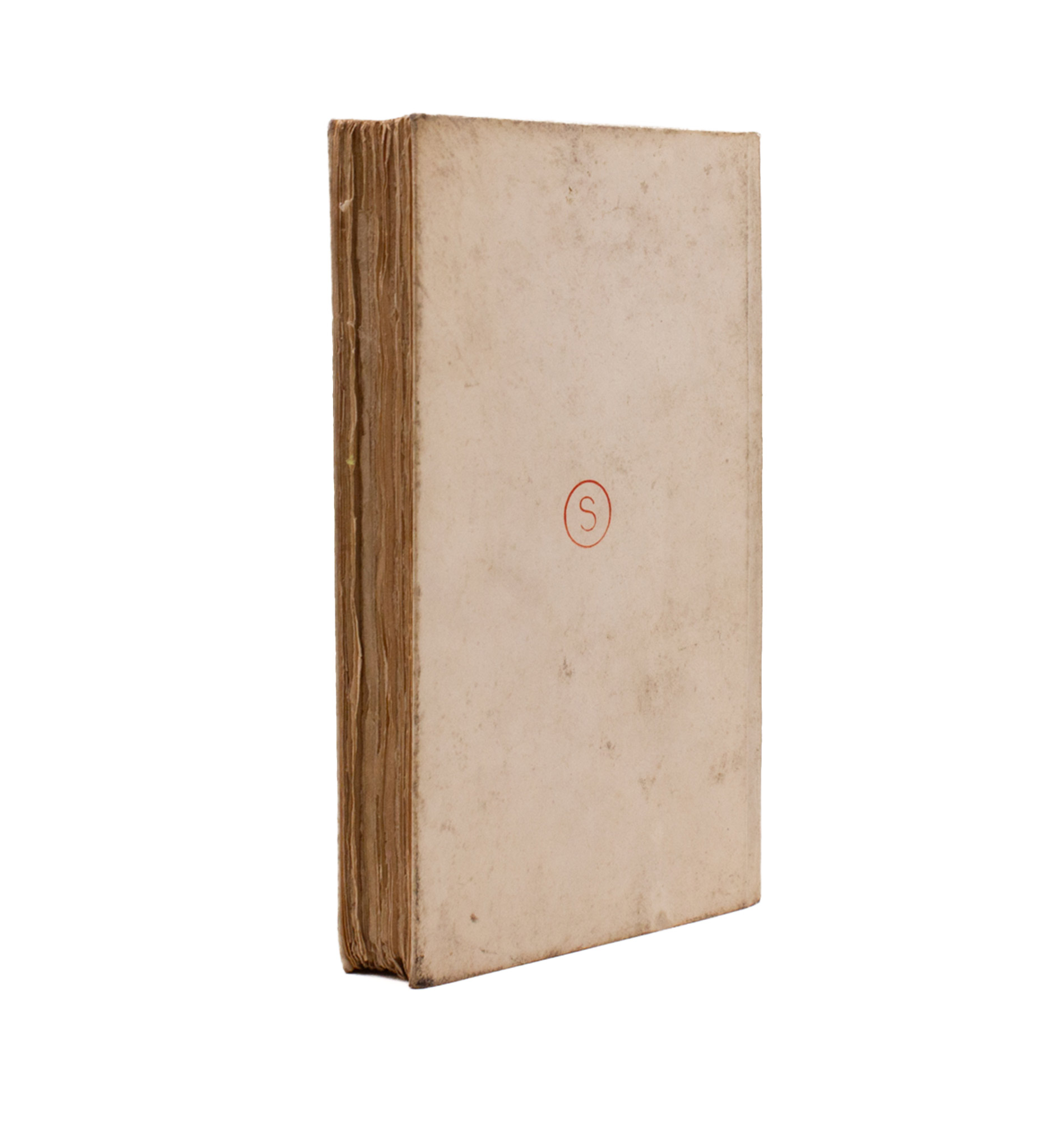
213pp.; 17.7 x 11.4 cm. Full vellum boards printed in red and black, with gilt device stamped to front. Top edge gilt, others roughly trimmed.
Wharton’s “Sappho” is the classic achievement. That you should find in any decent library.
— Pound in a letter to Iris Barry, 1916; Paige’s Letters of, p.87.
One hundred seventeen poems & fragments of Sappho’s, each with unstyled translations and editorial notes by Wharton, together with, where available, translations from other poets, such as Edwin Arnold, J. A. Symonds, Frederick Tennyson, Ben Jonson, Swinburne, Palgrave, D. G. Rossetti, etc. With an essay on and illustrations of the Fayum Fragments to rear, and a further inclusion of Sappho to Phaon from Alexander Pope’s translation of Ovid’s Heroic Epistle, XV (1707). Second edition, with prefaces for both the first and second. With woodblock ornaments throughout. Some pencil to fpd erased, one pencil note (a bit of Greek) to rpd remaining. Light wear to the vellum, mostly on the front cover, but a very smart copy.

tap to cycle
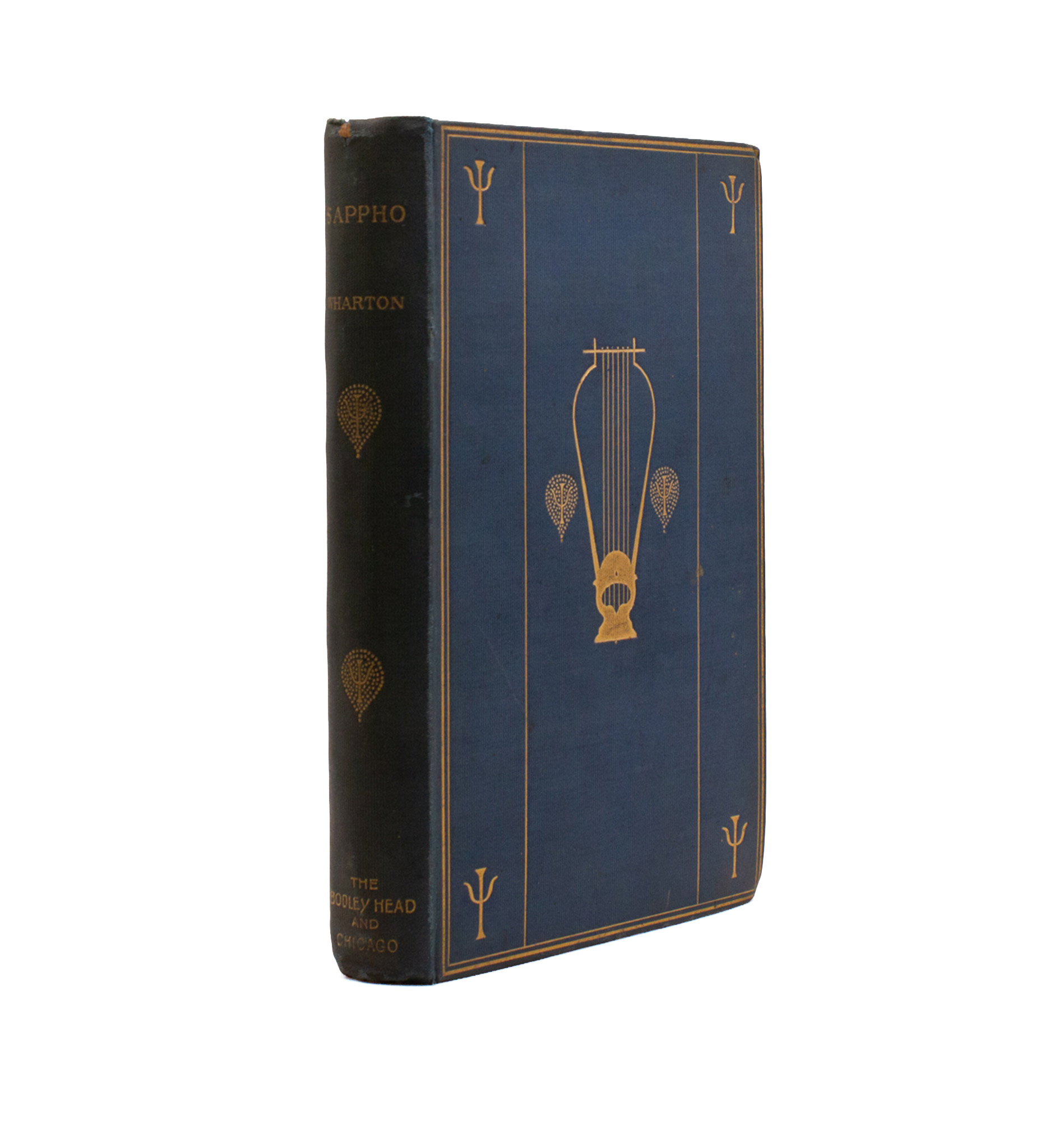
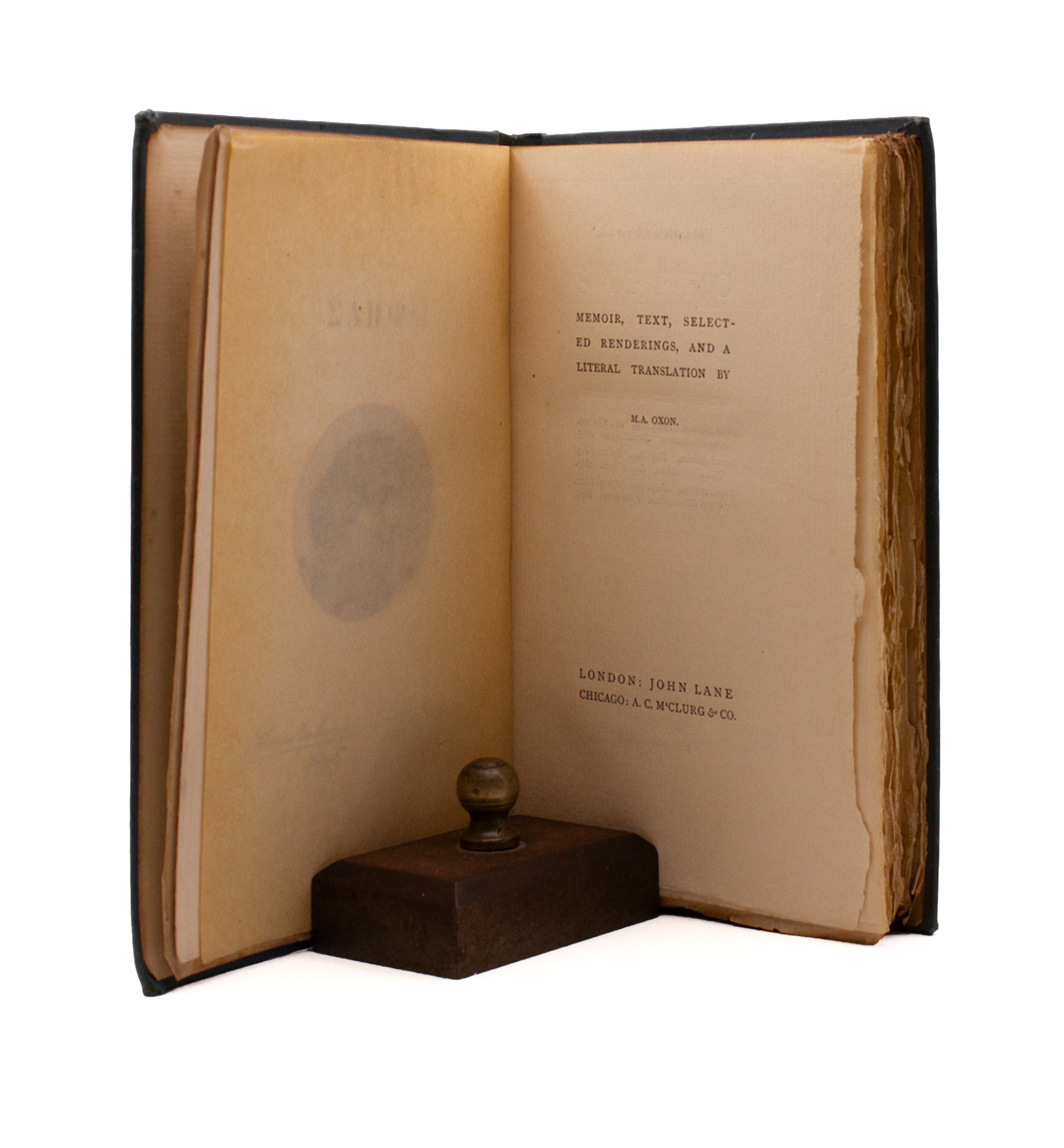
Sappho: Memoir, Text, Selected Renderings and A Literal Translation
Henry Thornton Wharton
Published London: John Lane and Chicago: A. C. McClurg & Co., 1895
217pp.; 18.1 x 12.3 cm. Blue cloth boards stamped in gold to front and spine, and in blind to rear. Top edge gilt, others roughly trimmed.
Another copy, third edition, with a new Preface to the Third preceding the first two prefaces, in attractive blue-gilt cloth with pages of varying cut; reading this copy is a darker and more enjoyable experience, in my opinion, than the second edition. An unusual copy which one may term defective: the printing of the title, “Sappho” and the date “MCCCXCV” to the title page have impressed without ink, rendering them nearly invisible. Bookseller’s label of Blackwell’s, Oxford to fpd. Light wear to the cloth with a few very small punctures around the spine.

tap to cycle
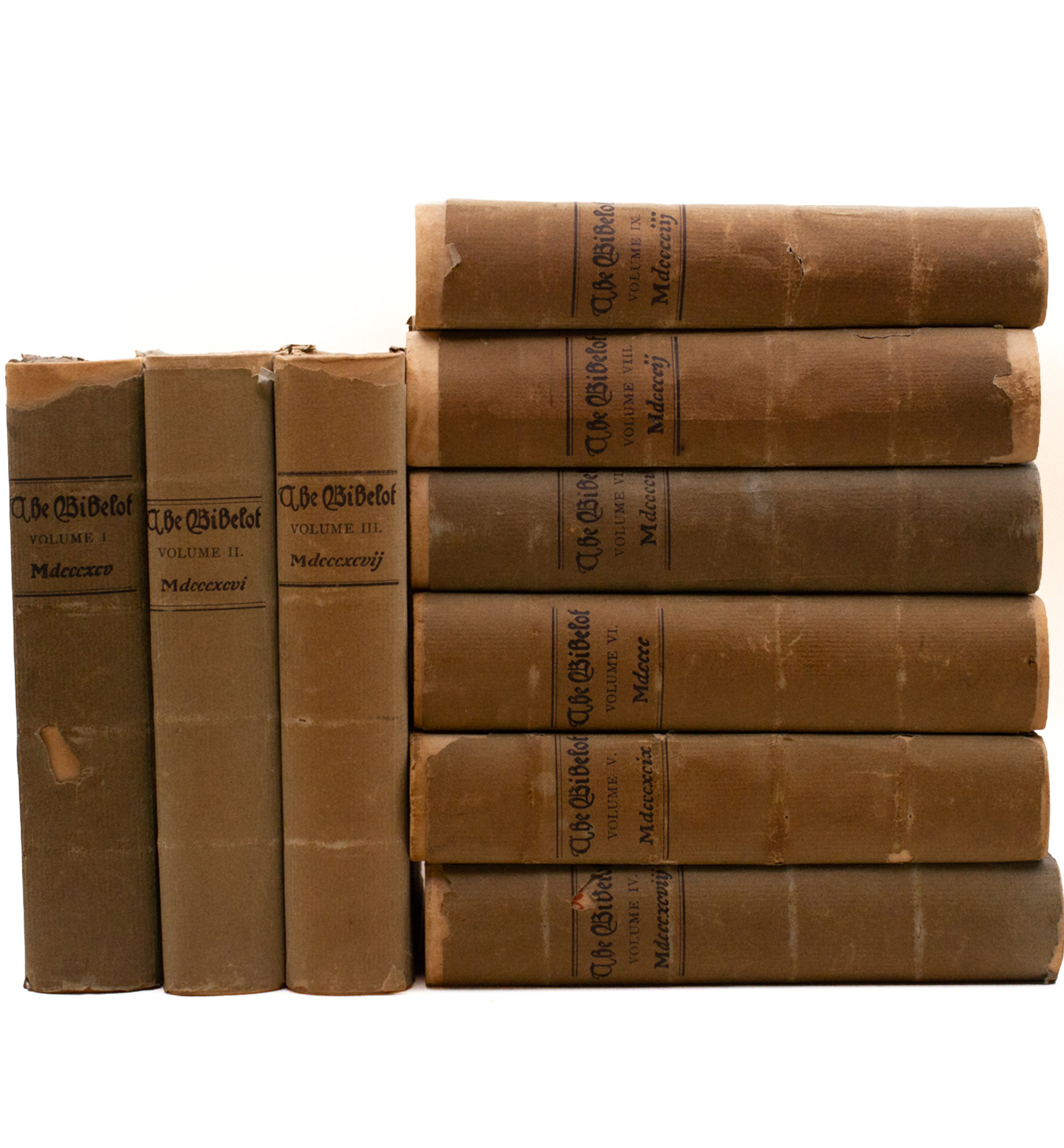
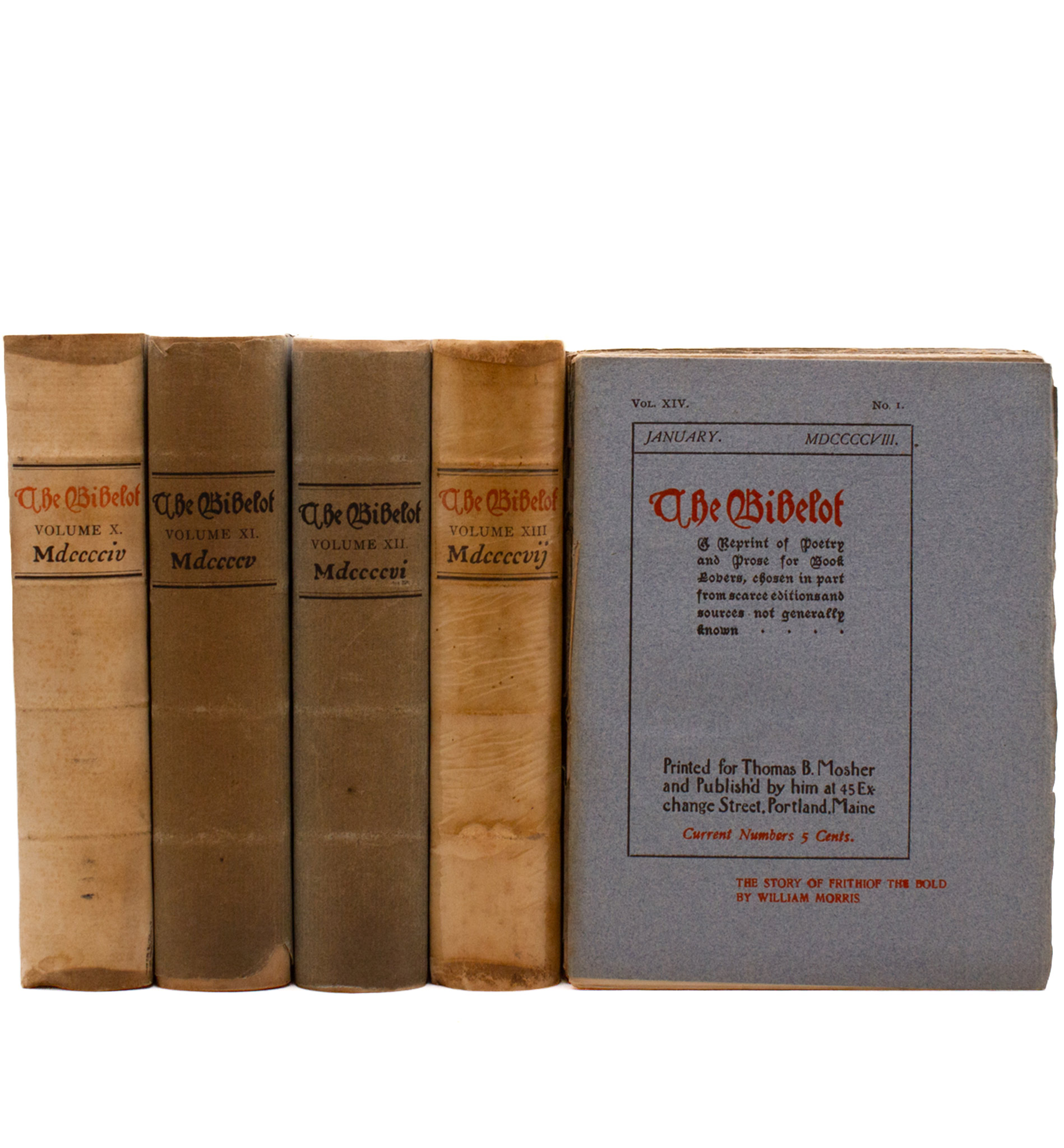
The Bibelot
Thomas B. Mosher, editor
Published Portland, Maine: Thomas B. Mosher, 1895
20 volumes, two as monthly issues, two rebound, thirteen of the remaining sixteen with dust-jackets.
From the library of A. David Moody
A Reprint of Poetry and Prose for Book Lovers, chosen in part from scarce editions and sources not generally known
The Bibelot was a monthly publication of literature curated by Thomas B. Mosher, each issue given to a single work or author, and generally of the highest quality. Volume 1, for example, contains Lyrics from William Blake; Ballades from François Villon; Fragments from Sappho; Hand and Soul: D. G. Rossetti, and so on. Running from 1895 to 1914, for a total of 20 volumes (all present), Ezra Pound was surely a subscriber to the magazine, receiving monthly recommendations and reading from the editor. Before leaving America for Italy in 1908, Pound approached Mosher with some fourty poems, hoping for publication. Mosher never printed Pound, those fourty later becoming A Lume Spento, but Pound, later recording his early reading and influences, wrote, “One was guided by Mr. Mosher.”
These are all first editions, as opposed to the 1925 Testimonial Edition reprint one will find more commonly on the market. The most original are the two volumes of individual monthly issues, which are Vol. XIV (1908) and Vol. XVI (1910). These, as noted, were Sold by Subscription only, thus available only to subscribers. Inside these issues can be found adverts for “Bound Volumes… 4to, antique boards,” which are what these other volumes are, not subscriber material but back-ordered. These 18 Bound Volumes are each year’s monthlies bound together, with volume-specific paper wraps enclosing the issues. The issues in the Bound Volumes, unlike in the monthlies, do not have their wraps bound in, nor their adverts, order forms, etc., but are simply divided by their half-titles. Thirteen of these Bound Volumes have retained their dust-jackets, two are accompanied by their slipcases, though the slipcase to Vol. VII needs repair, and that of Vol. IX has lost its top and bottom parts. Volumes XVIII and XX have been rebound, the first in an attractive green patterned cloth, the latter in red leather, both with gilt to spine, each without the printed wrappers; Vol. XX with the bookplate of Eleanor R. Brankin to fpd; Vols. VII, VIII & IX also with the bookplate of John Aldred to fpd. The condition of all is generally very good, some volumes, including the monthlies, are stunning; some with foxing or mild water damage (the minority); dust-jackets generally with minor edge-wear and the occasional break to spine, some cut short; some openings occasionally uncut, including in monthly issues. Without the index issue, but with a photocopy as replacement. With a note by A. David Moody laid into Volume VIII at the Essay on Percy Bysshe Shelley by Robert Browning.
A true source of Pound’s.
tap to cycle
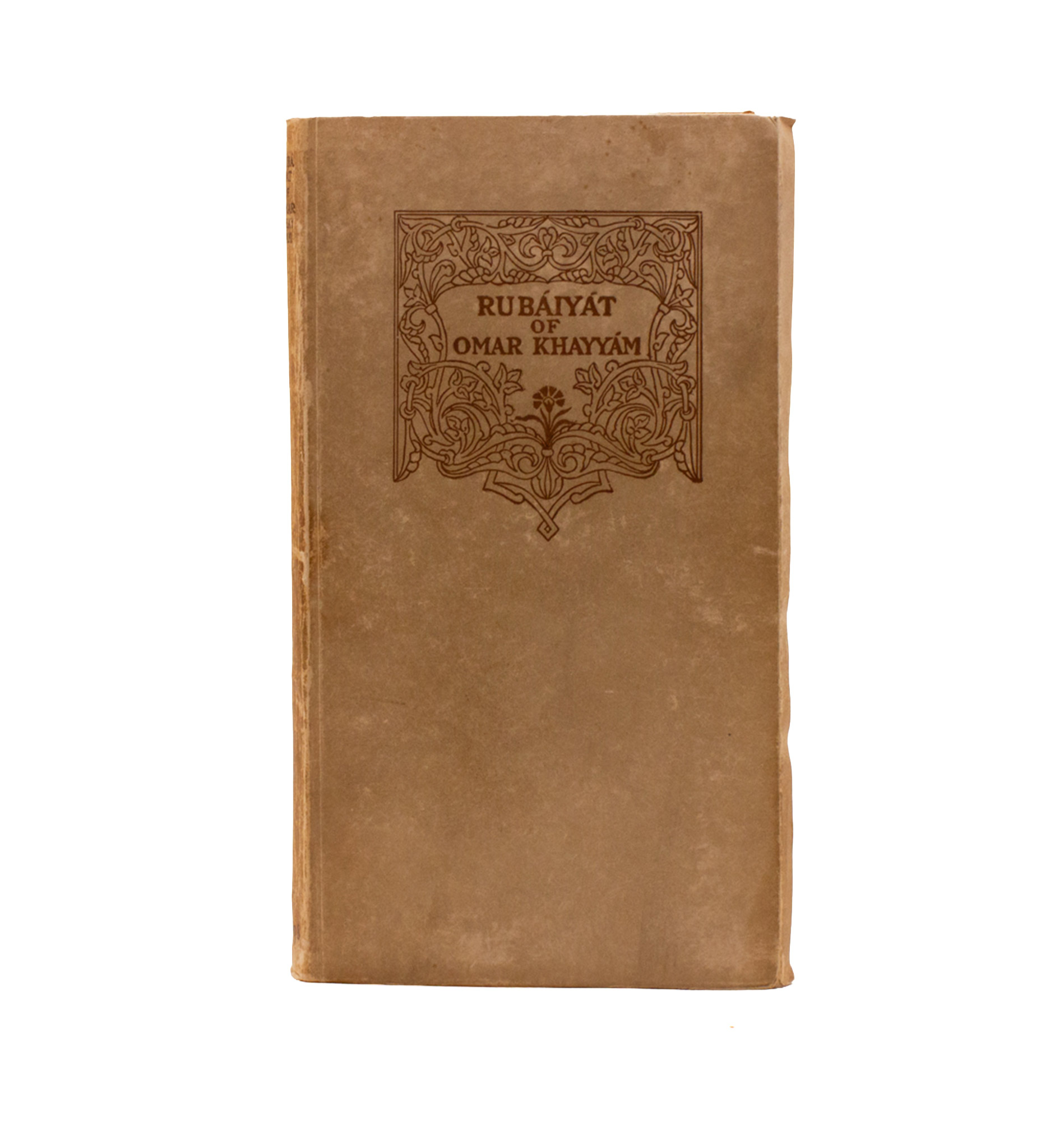
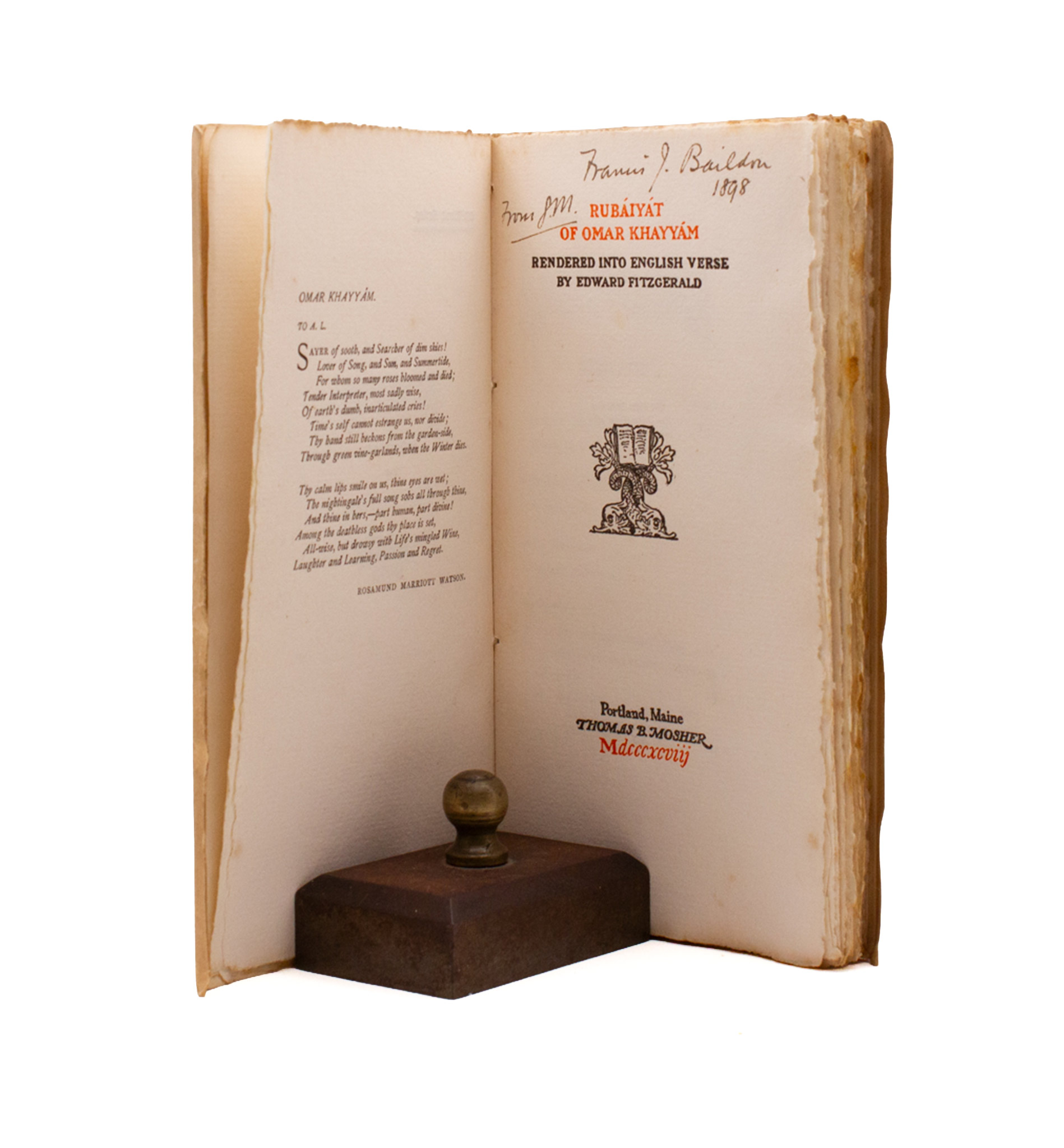
Rubáiyát of Omar Khayyám
Edward Fitzgerald, translator
Published Portland, Maine: Thomas B. Mosher, 1898
102pp.; 18.1 x 10.3 cm. Parchment binding with decorative front cover, printed in brown to front and spine; yapp fore-edge.
From the library of A. David Moody
Our contact with oriental poetry begins with Fitzgerald’s Rubáiyát.
— EP, How to Read
Fitzgerald’s translation from the Persian of Khayyám, a poem on dust, drink and death, made famous by D. G. Rossetti after his purchasing a copy from Bernard Quaritch. Its poetic qualities aside, the Rubáiyát has since performed as fodder in the book trade, with umpteen editions existing, variously bound and illustrated; it was a jewel clad copy designed by Sangorski & Sutcliffe that went down with the Titanic. This copy comes with a nice Poundian assocation, being published by Thomas B. Mosher (“One was guided by Mr. Mosher,” EP), who published The Bibelot and whom Pound tried as publisher for some fourty poems written in 1903 and 1904 before leaving for Venice where he would extend the collection into A Lume Spento.
Fifth edition on Van Gelder paper, one of 925 copies. With a neat, contemporary ink ownership inscription to title-page. Fine throughout, light rubbing to the front cover; spine darkened, with streaks resulting from leafing.

tap to cycle
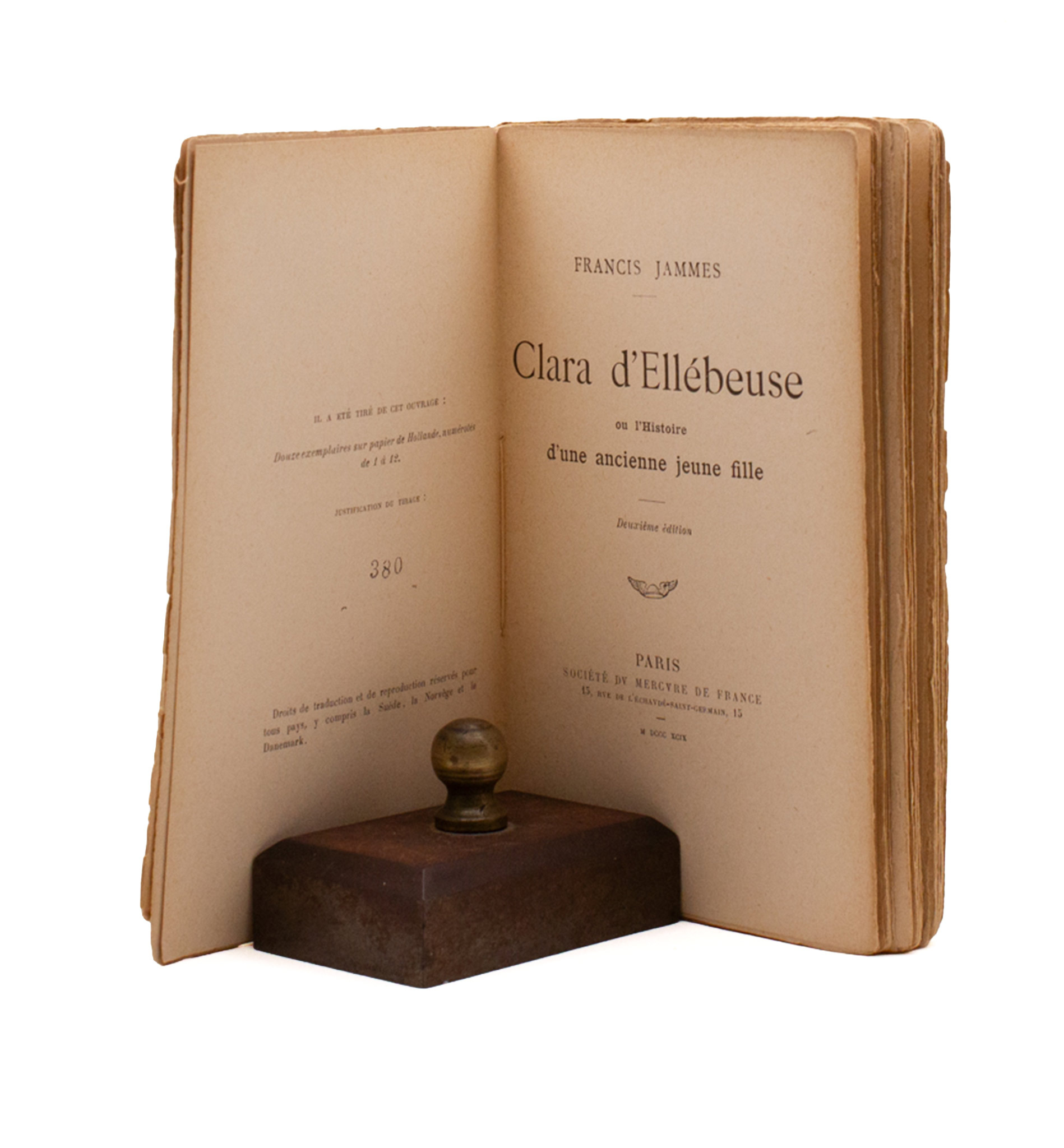
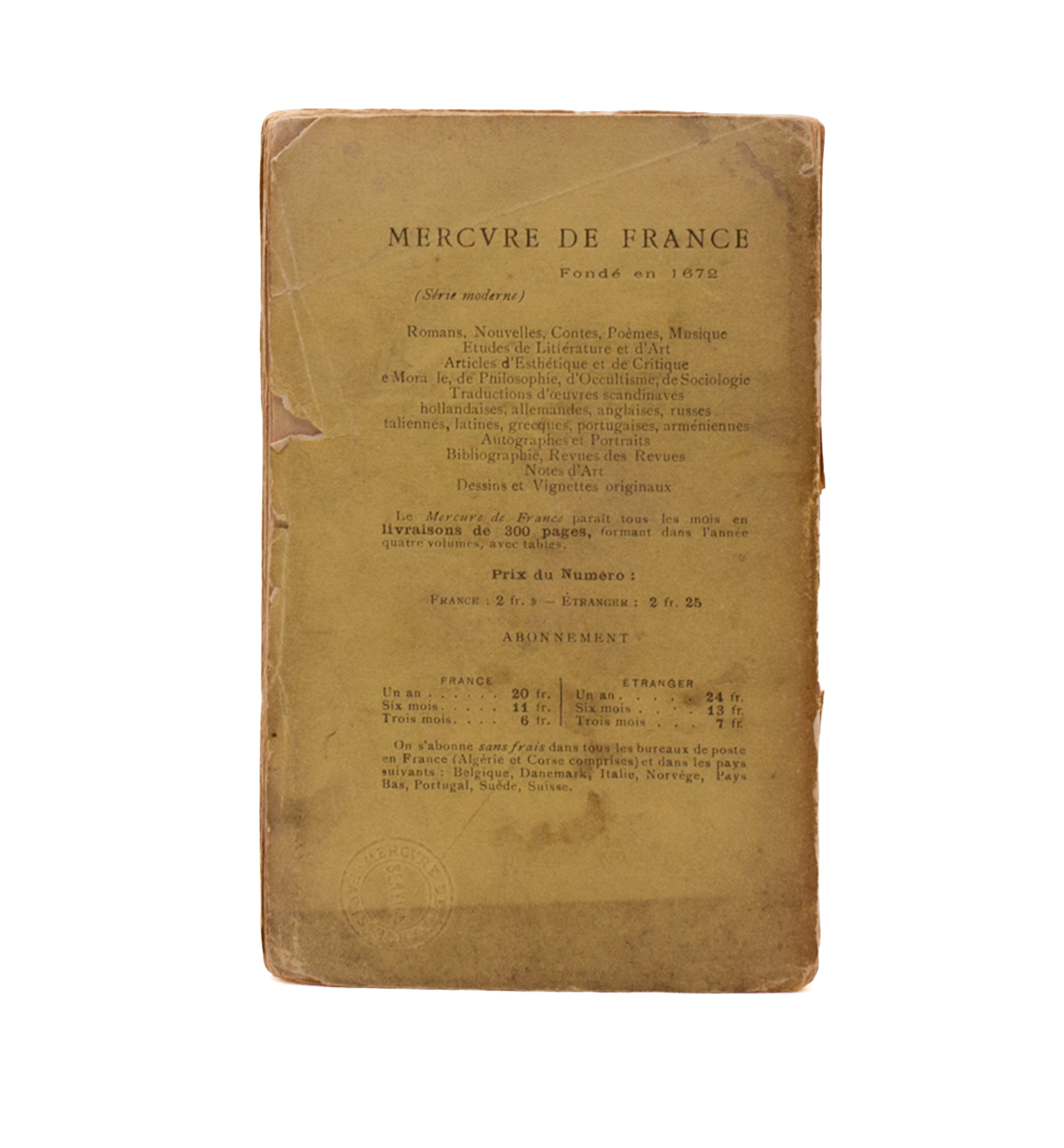
Clara d’Ellébeuse, ou l’Histoire d’une ancienne jeune fille
Francis Jammes
Published Paris: Société du Mercure de France, 1899
242pp.; 15.1 x 9.8 cm. Original publisher’s paper wraps printed in yellow and black.
From the library of A. David Moody
With an air of Clara d’Ellébeuse,
— Canto XXVII
Clara d’Ellébeuse wakes up yawning against her naked arm, eternally young and already dead; at 16 she commits suicide, an imitation & repeat of a family fate, driven by love and curiosity. A little music, Pound’s choice, as compliment. Possibly the first edition, a very French publication, pocketable in yellow wraps, but in rather fragile condition with the binding only just holding and significant chipping from the paper on the spine. With a small handwritten note laid-in from A. David Moody noting other works in which Jammes mentions Clara.

tap to cycle
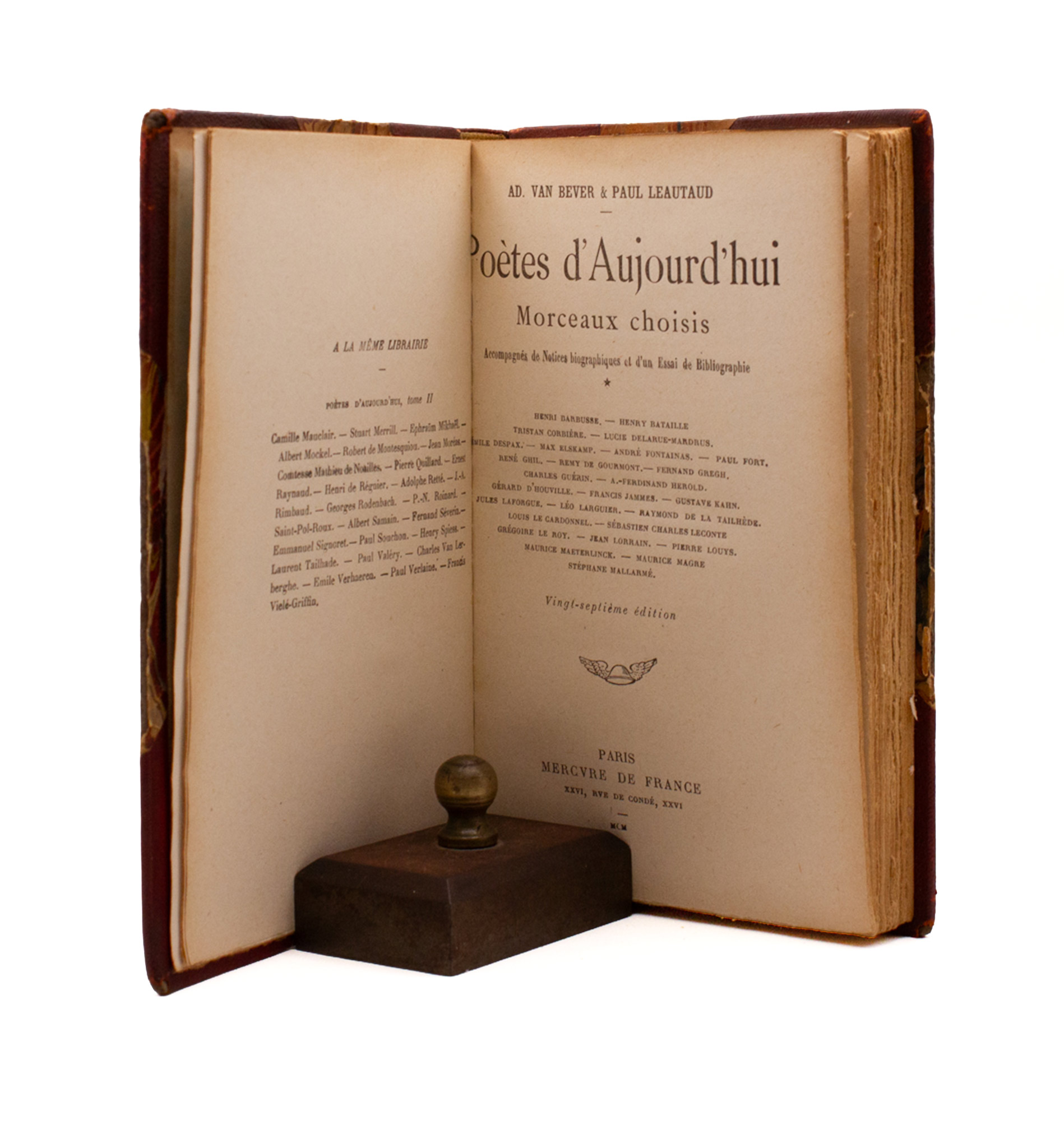
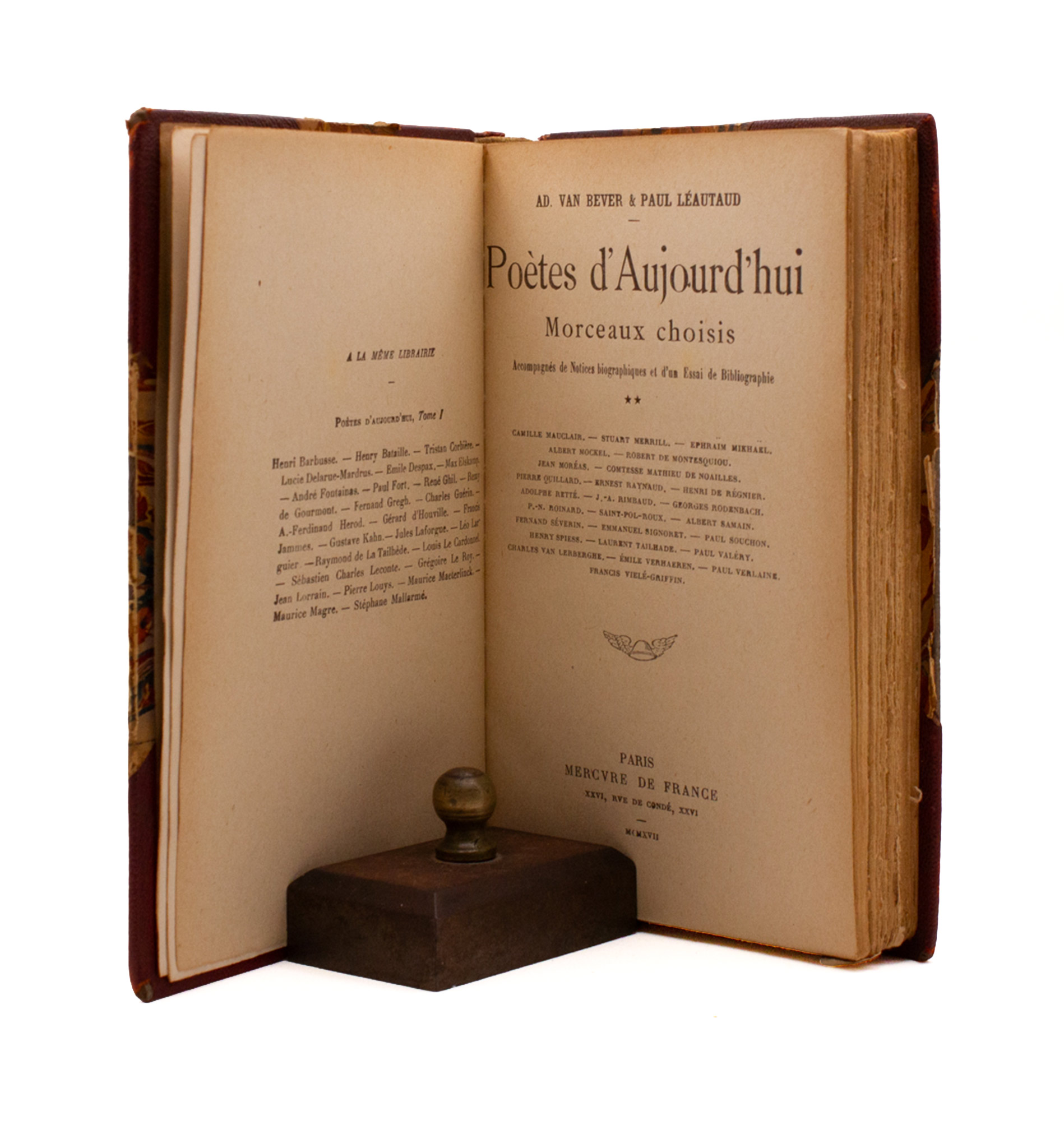
Poètes d’Aujourd’hui; 2 vols.
Adolph Van Bever & Paul Leautaud, editors
Published Paris: Mercure de France, 1900
358pp., 392pp.; 18.5 x 12.3 cm each. Three quarter red leather covered boards, decorated with marbled paper and gilt. Ornate gilt to banded spine. T.e.g., others roughly trimmed.
From the library of A. David Moody
A collection of French poets, including Remy de Gourmont, Arthur Rimbaud, Jules Laforgue, and so on. Published originally in paper wraps, this set rebound into three quater leather somewhat worn. With a pencil score toward the end of the inclusion from Francis Jammes in Volume 1, wherein are found mention Clara d’Ellébeuse.

tap to cycle
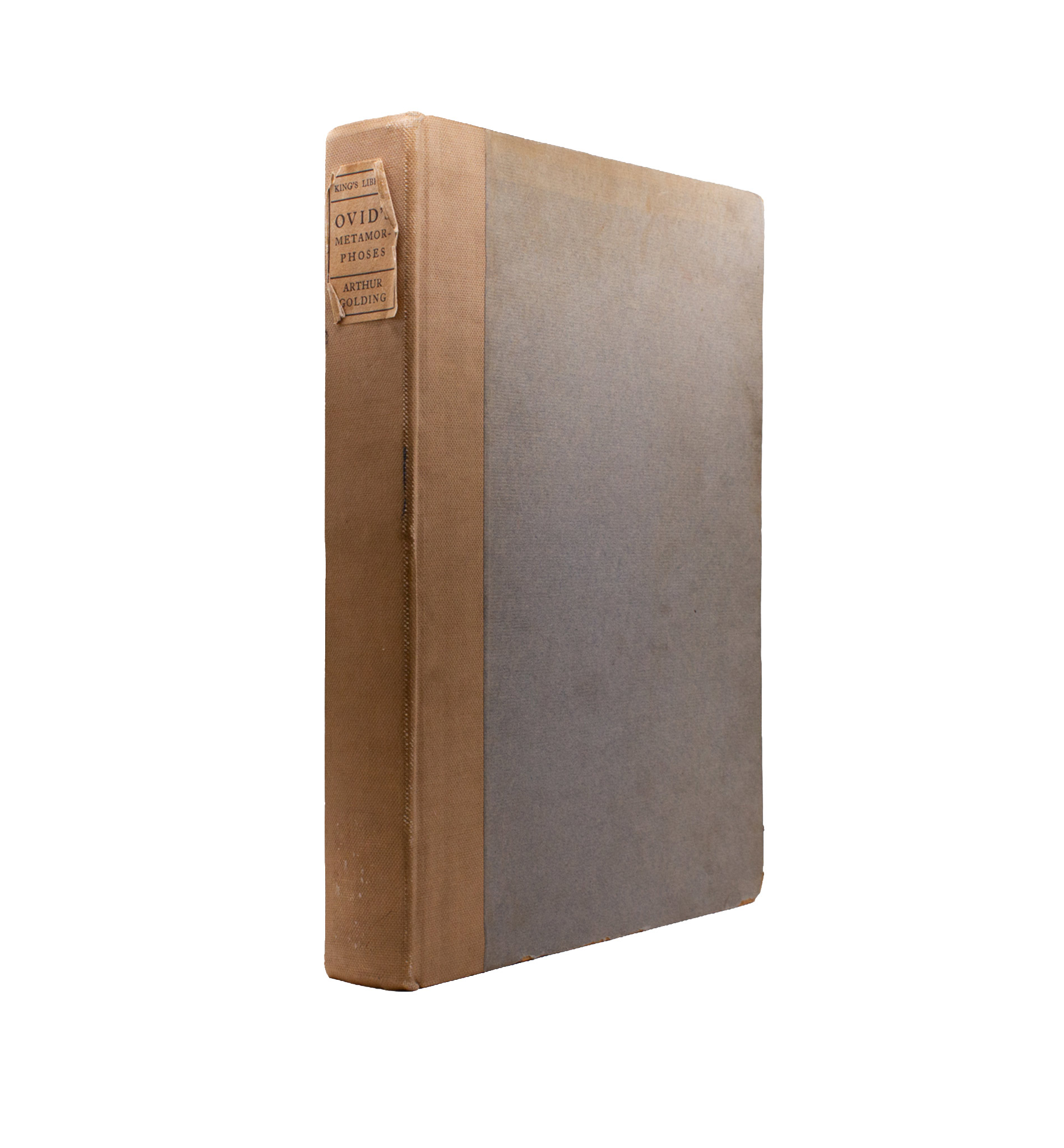
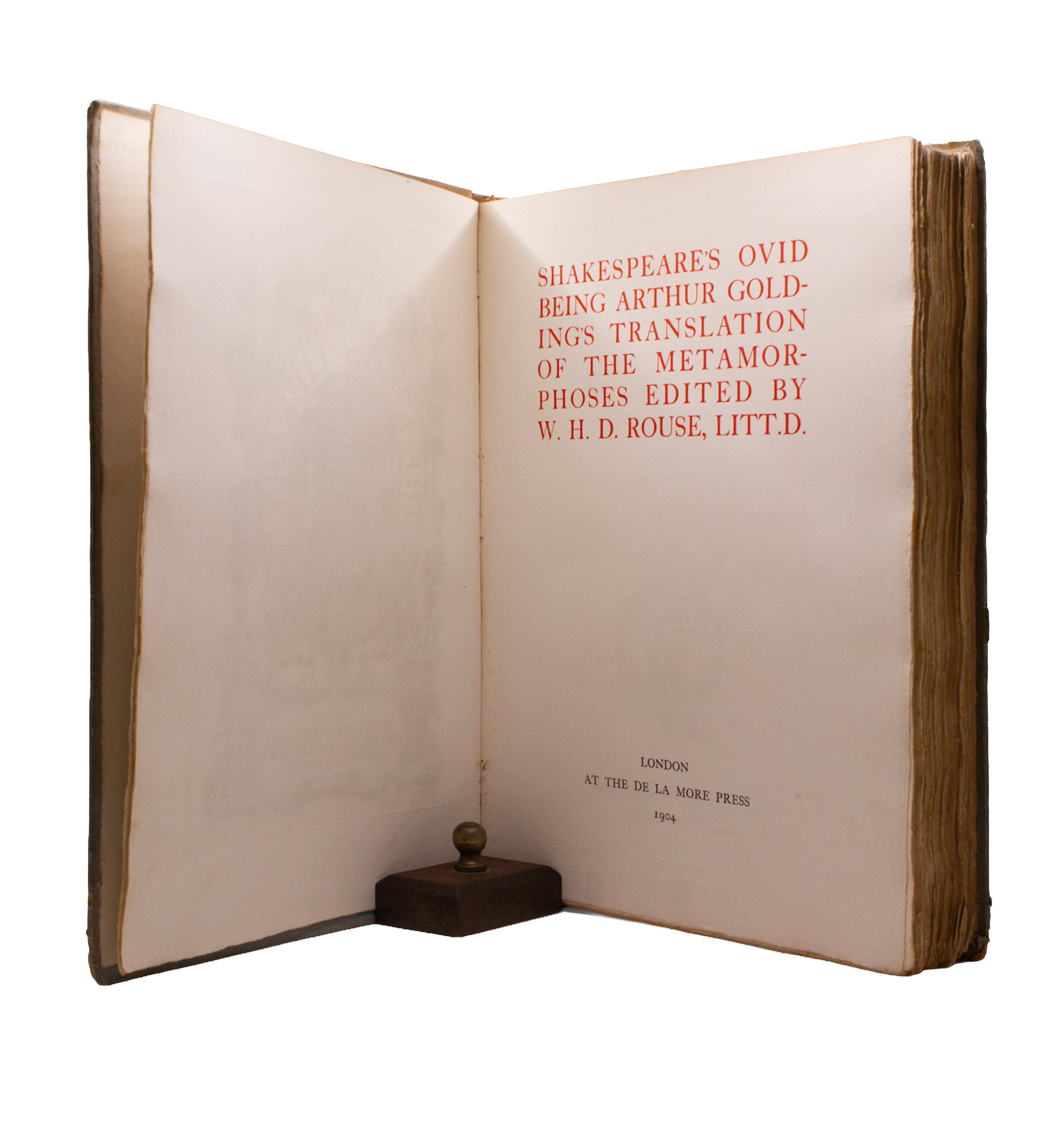
Ovid’s Metamorphoses
Arthur Golding, translator
W. H. D. Rouse, editor
Published London: The De La More Press, 1904
321pp.; 31 x 22.6 cm. Linen backed pale blue paper covered boards. Label printed in black pasted to spine.
“Though it is the most beautiful book in the English language, I am not citing it for its decorative purposes but its narrative quality.”
— EP, ABC of Reading
“Ezra Pound has written that he doesn’t think anyone can know anything at all about the art of lucid narrative in English if he hasn’t seen all fifteen books of Ovid’ Elizabethan translator, Arthur Golding. That is a good way of putting it, and yet I imagine Golding has rarely been read cover to cover.”
— Robert Lowell
One of the most appeasing editions of Golding’s Metamorphoses (a translation elsewhere known as Shakespeare’s Ovid for its noticeable influence on the Bard), no. 229 of 300 copies printed on hand-made paper by The De La More Press in London. A beautiful copy, light edge-wear and staining to the boards, the paper label on spine curling a bit, but inside fine & throughout. With the bookplate of Colin Stanley Crosse to ffep, and a further of the Royal College of Art, College Library to ffpd, with their crimp to the title page. A book that was for Pound, alongside Confucius, his religion, and an immensely important text for the reading of The Cantos.

tap to cycle
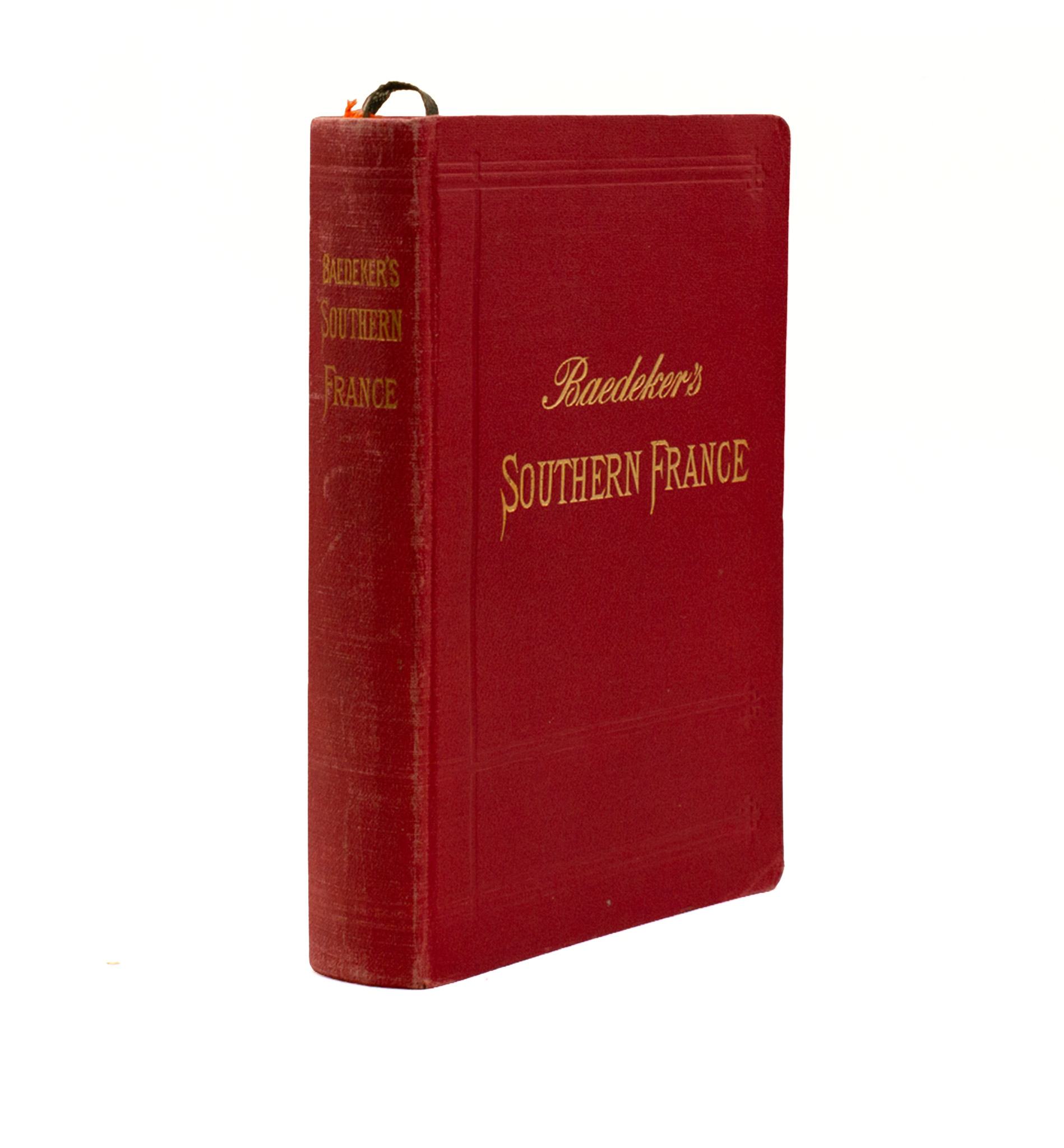
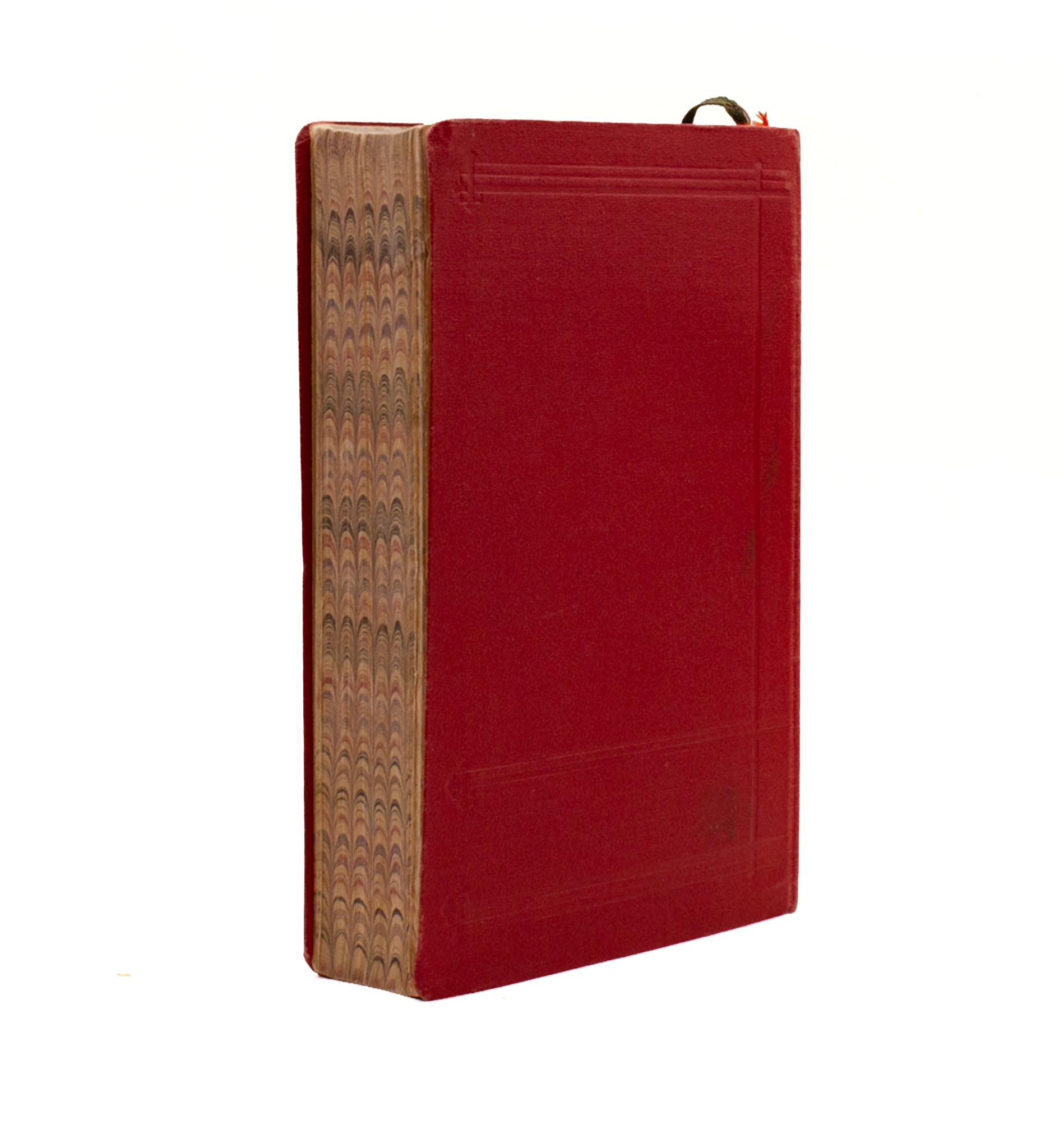
Baedeker’s Southern France
Karl Baedeker
Published Leipsic: Karl Baedeker, 1907
578pp.; 16.1 x 11.3 cm. Red cloth gilt and blind.
From the library of A. David Moody
I have said:
‘Here such a one walked.
‘Here Coeur-de-Lion was slain.
‘Here was good singing.
‘Here one man hastened his step.
‘Here one lay panting.’
— Provincia Deserta
One of the two books, alongside Justin Smith’s The Troubadours at Home, that directed Pound’s 1912 walking tour of Southern France; the Baedeker particularly used to plan his routes. Fifth edition, with 33 maps and 49 plans; some light wear to spine.
tap to cycle
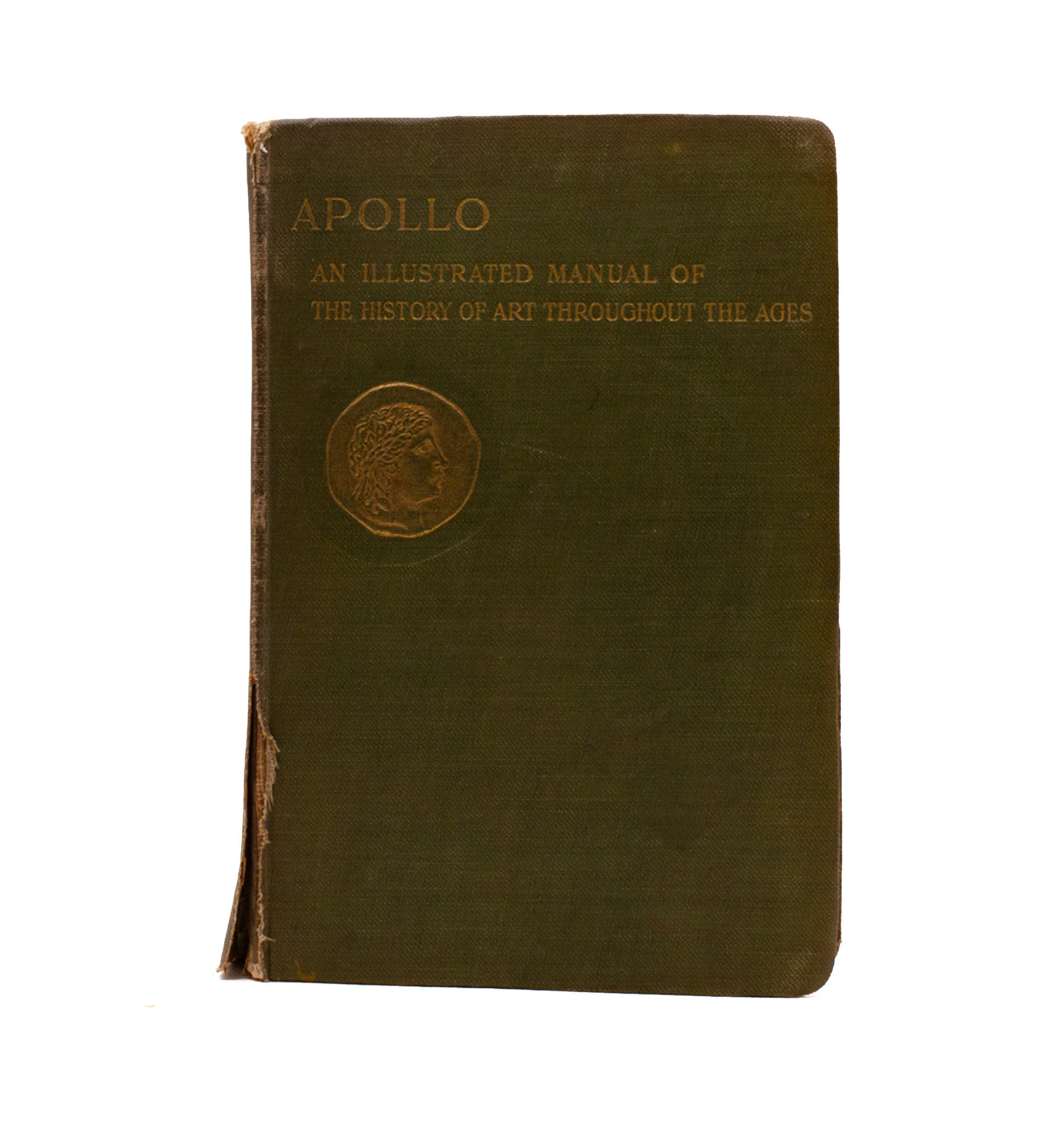
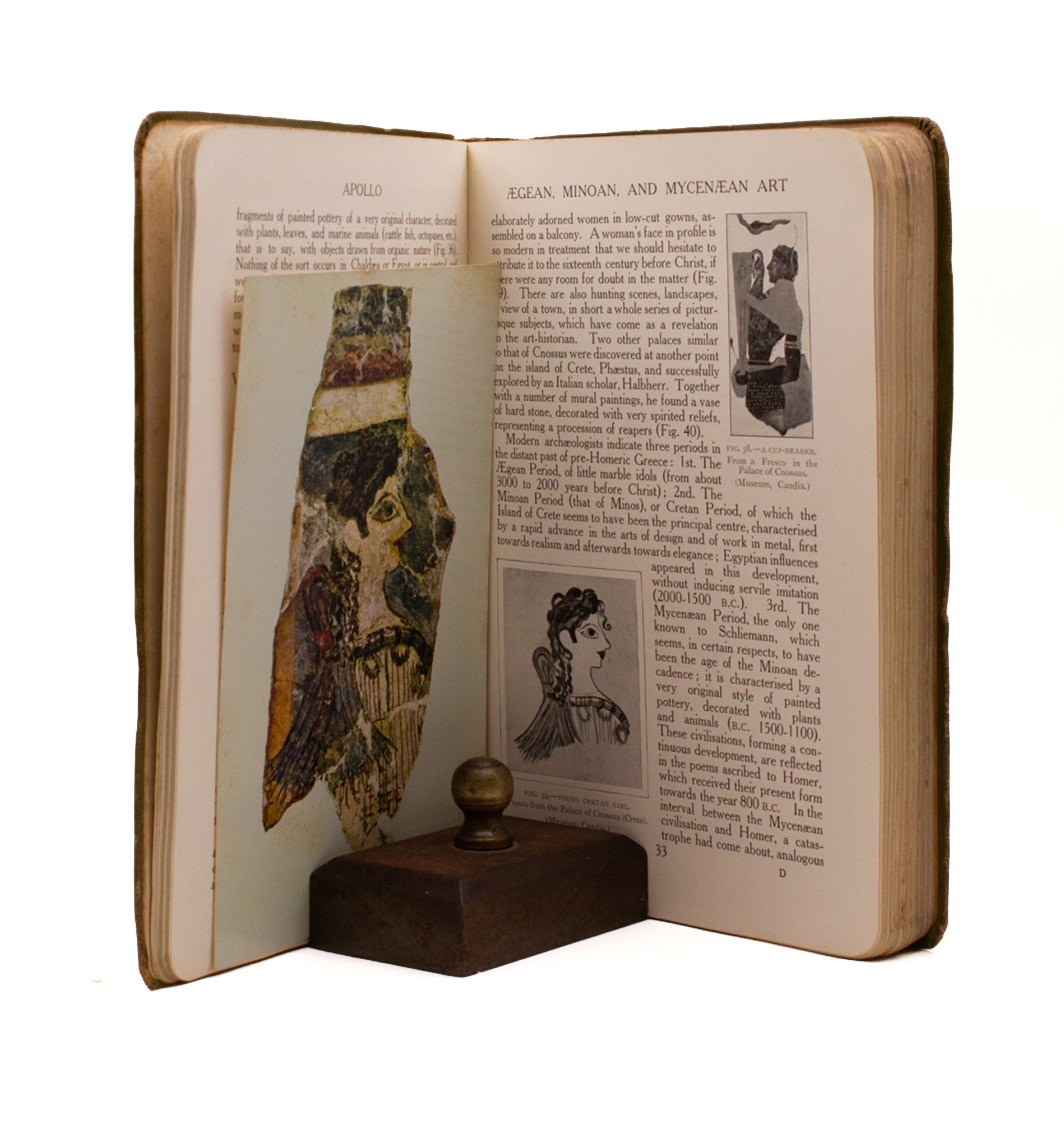
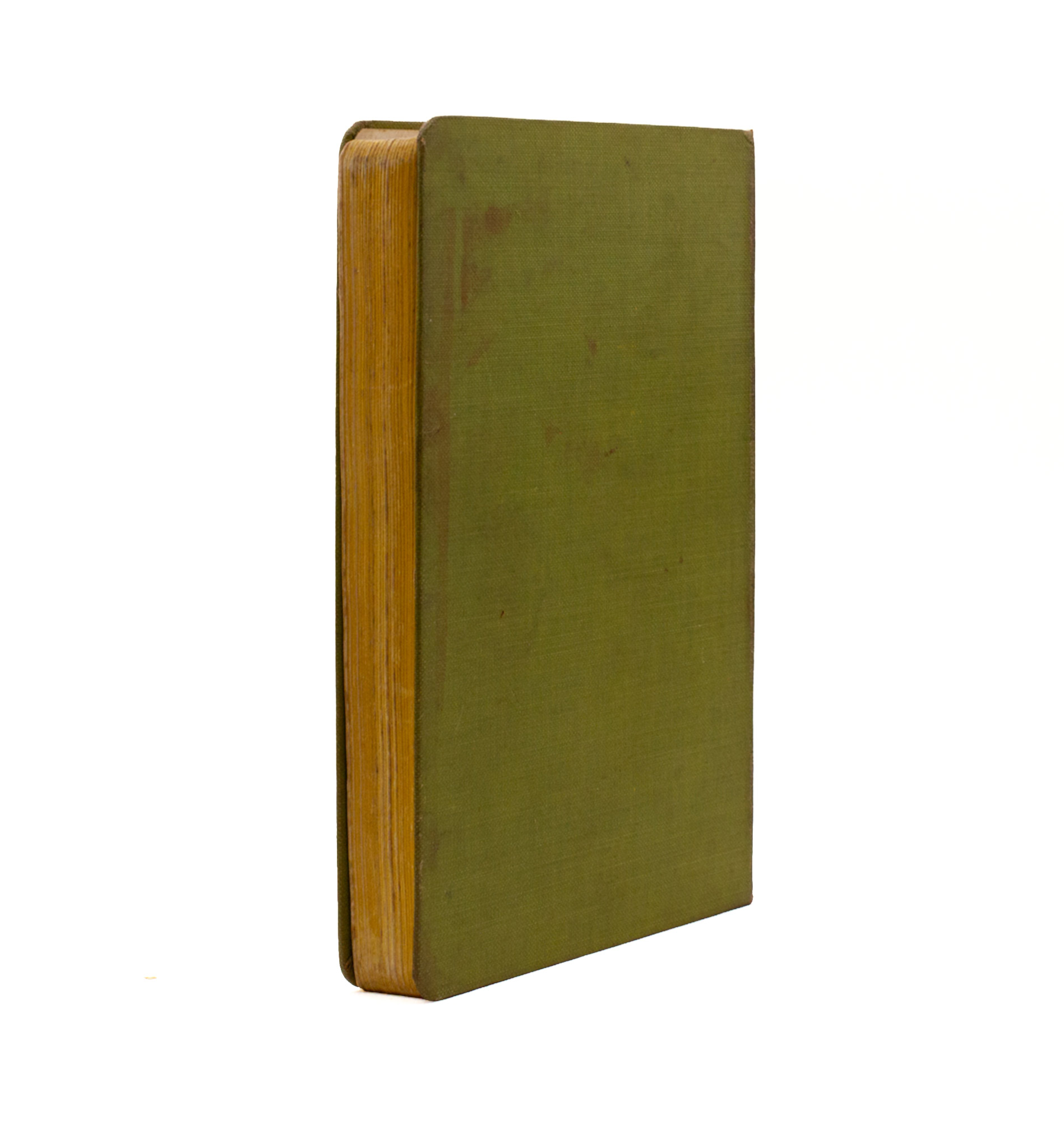
Apollo, An Illustrated Manual of the History of Art Throughout the Ages
Salomon Reinach
Florence Simmonds, translator
Published London: William Heinemann, 1907
351pp.; 18.5 x 12.7 cm. Dark greeen cloth boards lettered in gold to front and spine, with decorative medallion to front.
From the library of A. David Moody
First English translation of Salomon Reinach’s popular History of Art, with a postcard to A. David Moody laid-in, dated Crete 14.9.73, “to greet you with a sense of things Greek & peaceful,” from Joe Oldroyd, with the same illustration of a “Young Cretan Girl” found as a fresco in the Palace of Cnossus. Cloth to spine broken at the bottom, but otherwise a good copy.
tap to cycle
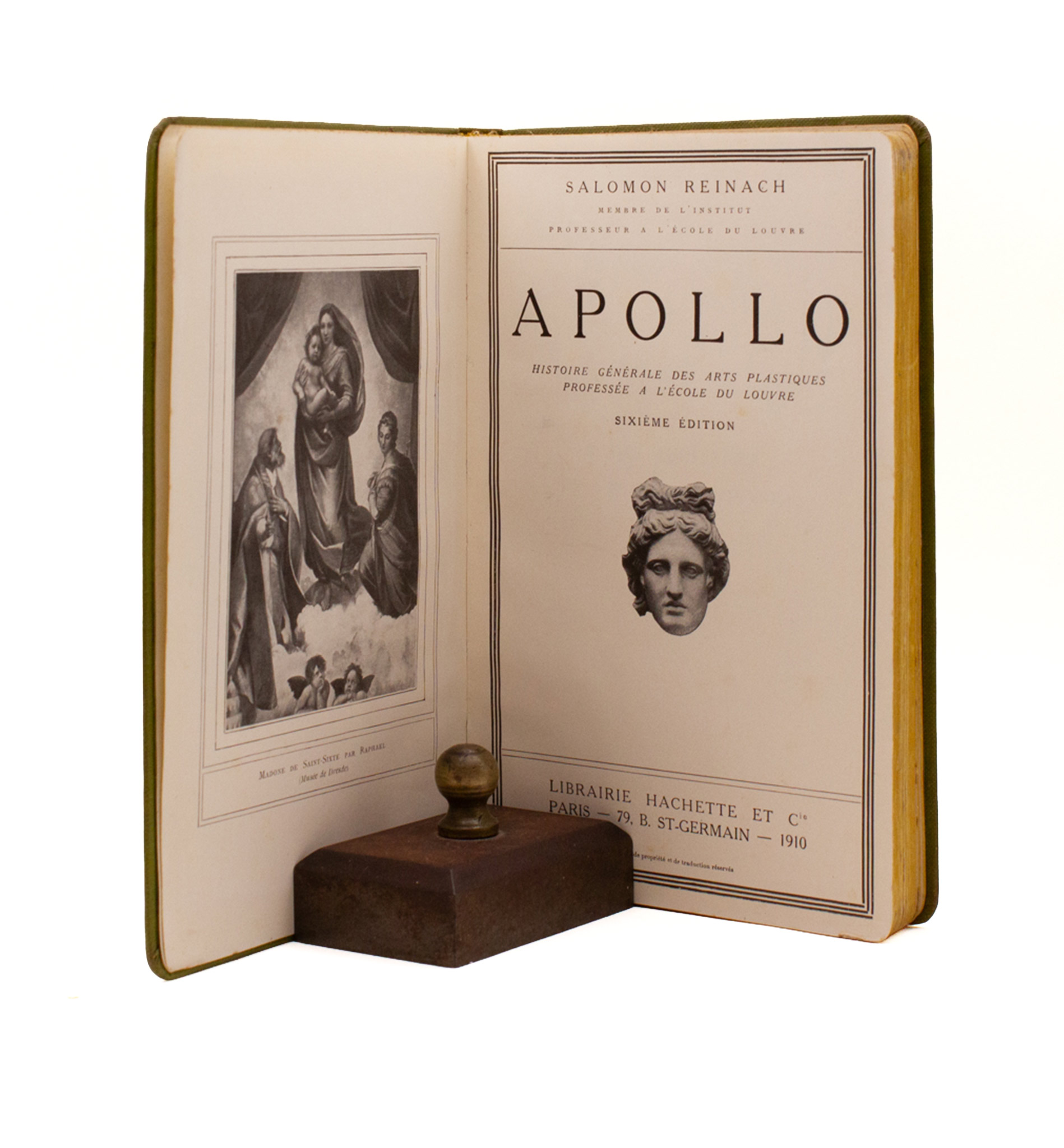
Apollo, Histoire Générale des Arts Plastiques
Salomon Reinach
Published Paris: Librairie Hachette et Cie, 1910
334pp.; 18.1 x 12 cm. Green cloth boards lettered & decorated in gold to front and spine.
From the library of A. David Moody
Sixth edition, in the original French. A very good copy, some marks to the boards. The naming of this book, Apollo, is a reference to an earlier text of Reinach’s, Minerva, but the content explores English, French, Italian and German art too.
tap to cycle
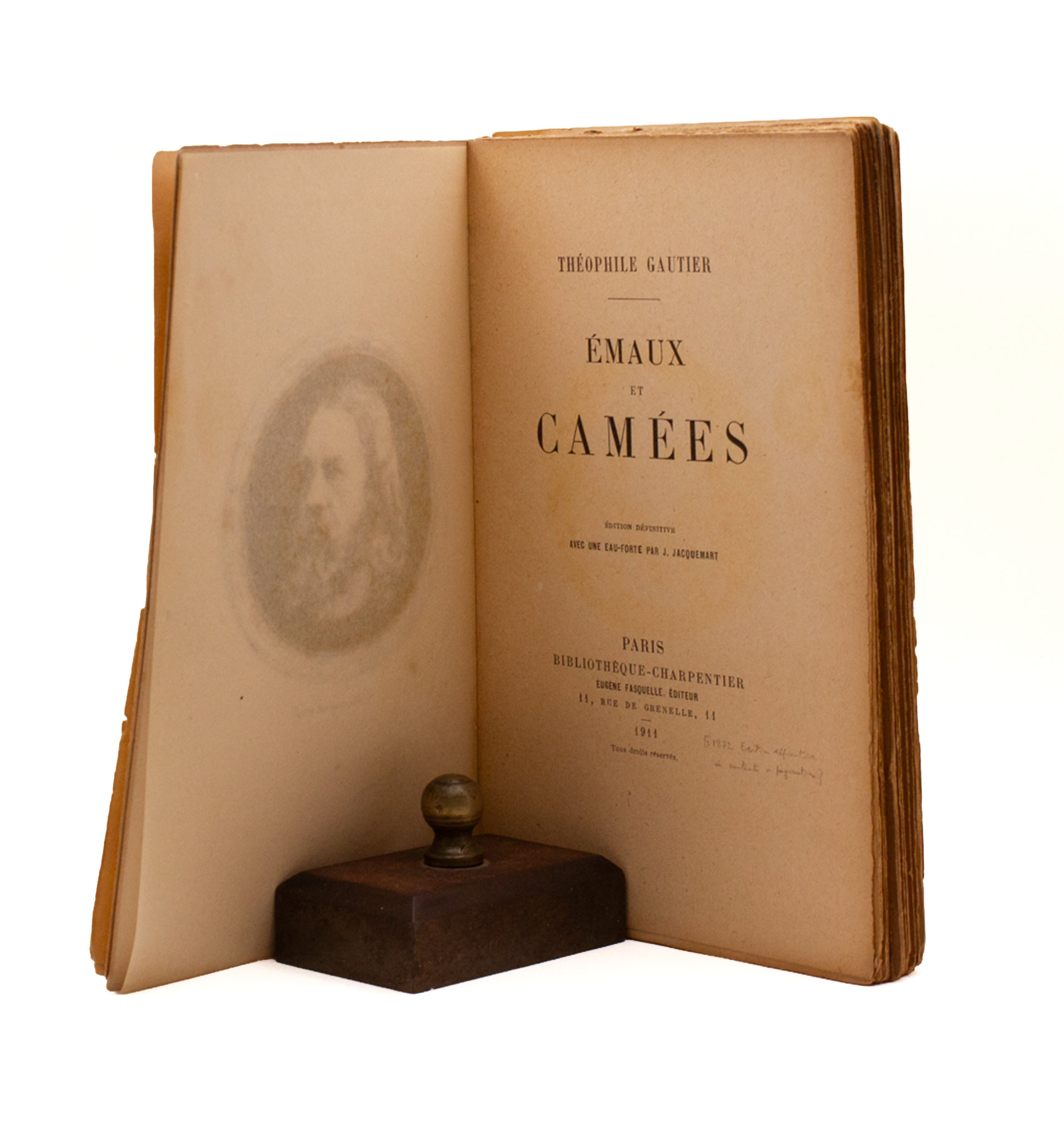
Émaux et Camées
Theophile Gautier
Published Paris: Bibliothèque Charpentier, 1911
226pp.; 18.7 x 12 cm. Paper wraps printed in black.
From the library of A. David Moody
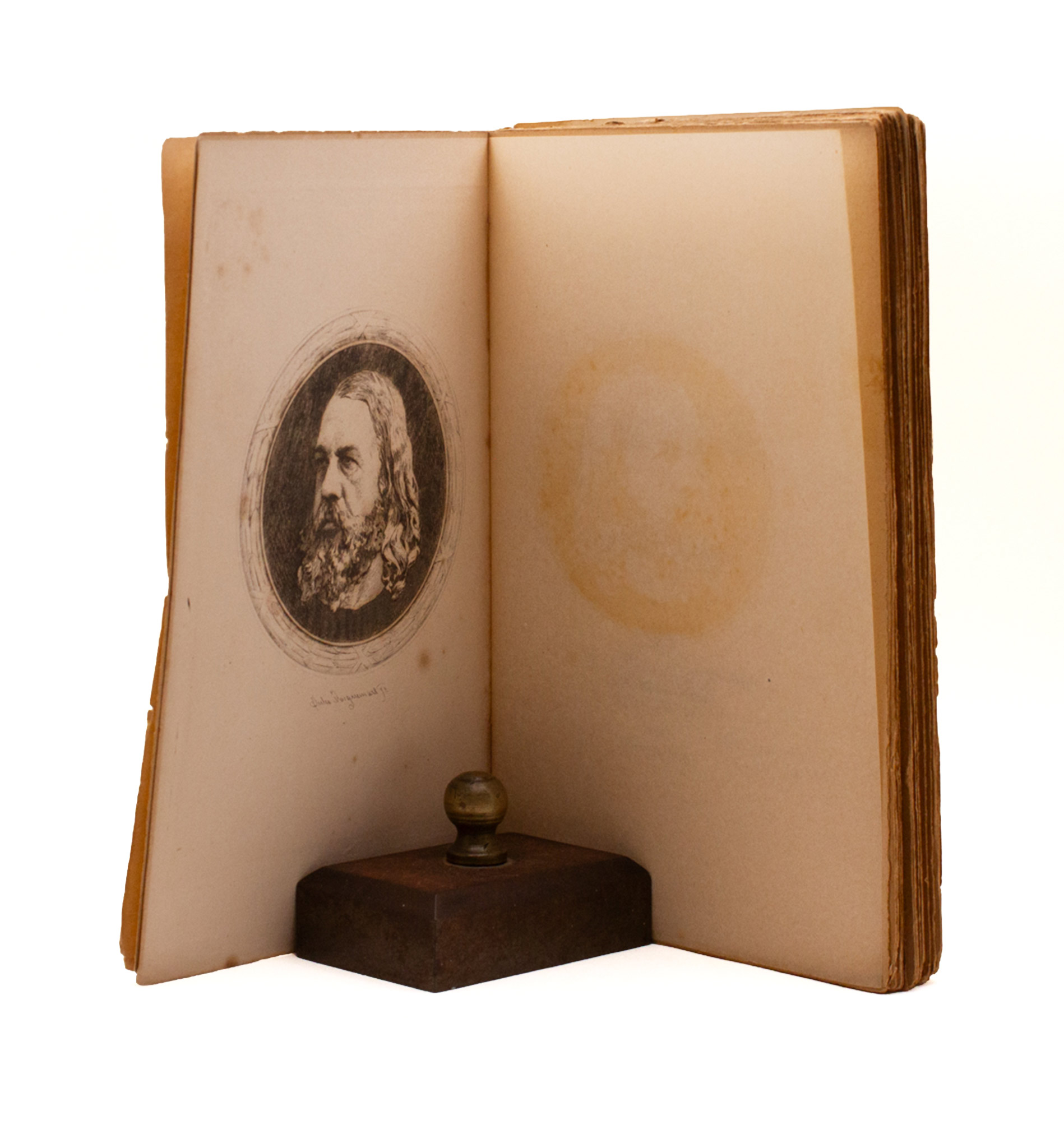
Turned from the “eau-forte
Par Jaquemart”
To the strait head
Of Messalina:
“His true Penelope
Was Flaubert,”
And his tool
The engraver’s.
— 1920 (Mauberley)
A later edition of the Édition Définitive (first in 1872) which carries this eau-forte by J. Jacquemart. With a note in pencil by A.D.M. to the title page to this effect. Lacking the front cover; some loss to the paper covering the spine, but sound. In a paper envelope with a note in ink referencing “Mauberley 1920.”
tap to cycle
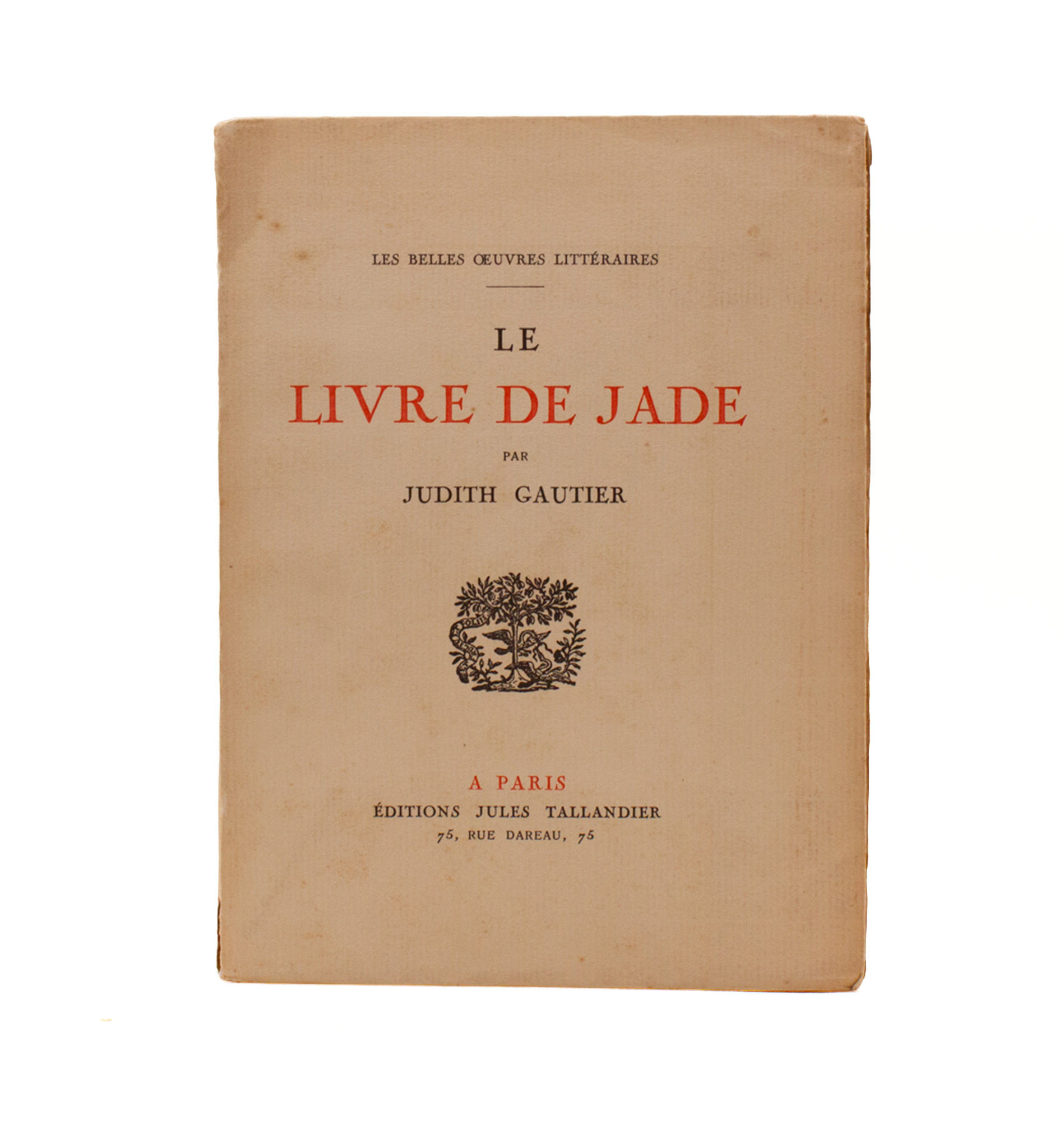
Le Livre de Jade
Judith Gautier
Published Paris: Éditions Jules Tallandier, 1928
263pp.; 19.2 x 14.5 cm. Heavy white paper wraps printed in black and stamped in red to front and spine.
From the library of A. David Moody
A collection of 71 poems by 23 poets from the Tang and Song dynasties, first published in 1867 by Judith Gautier, daughter of Théophile, painted by Sargeant, and inspiration for Wagner’s Tristan und Isolde. Hugh Kenner suggests Gautier might have been the first European to suspect that “there might be in Chinese modes of poetry never so much intuited by the West.” Contains translations before Pound of Li Bai’s “The Jade Staircase” and “Taking Leave of a Friend.” Split to the spine, resulting in the two parts of the book shifting a little, but sound and otherwise a nice copy with a little foxing.
tap to cycle
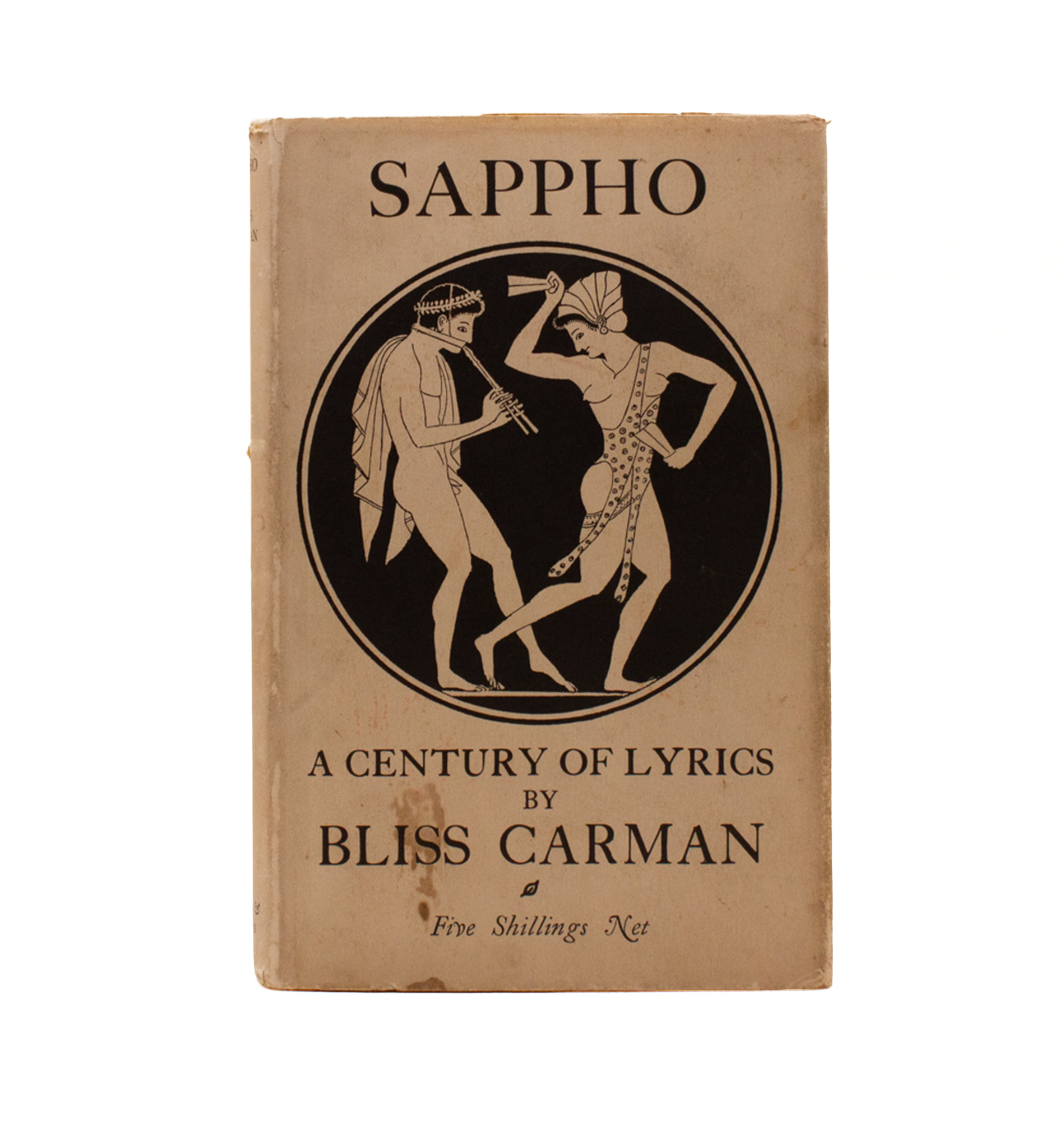
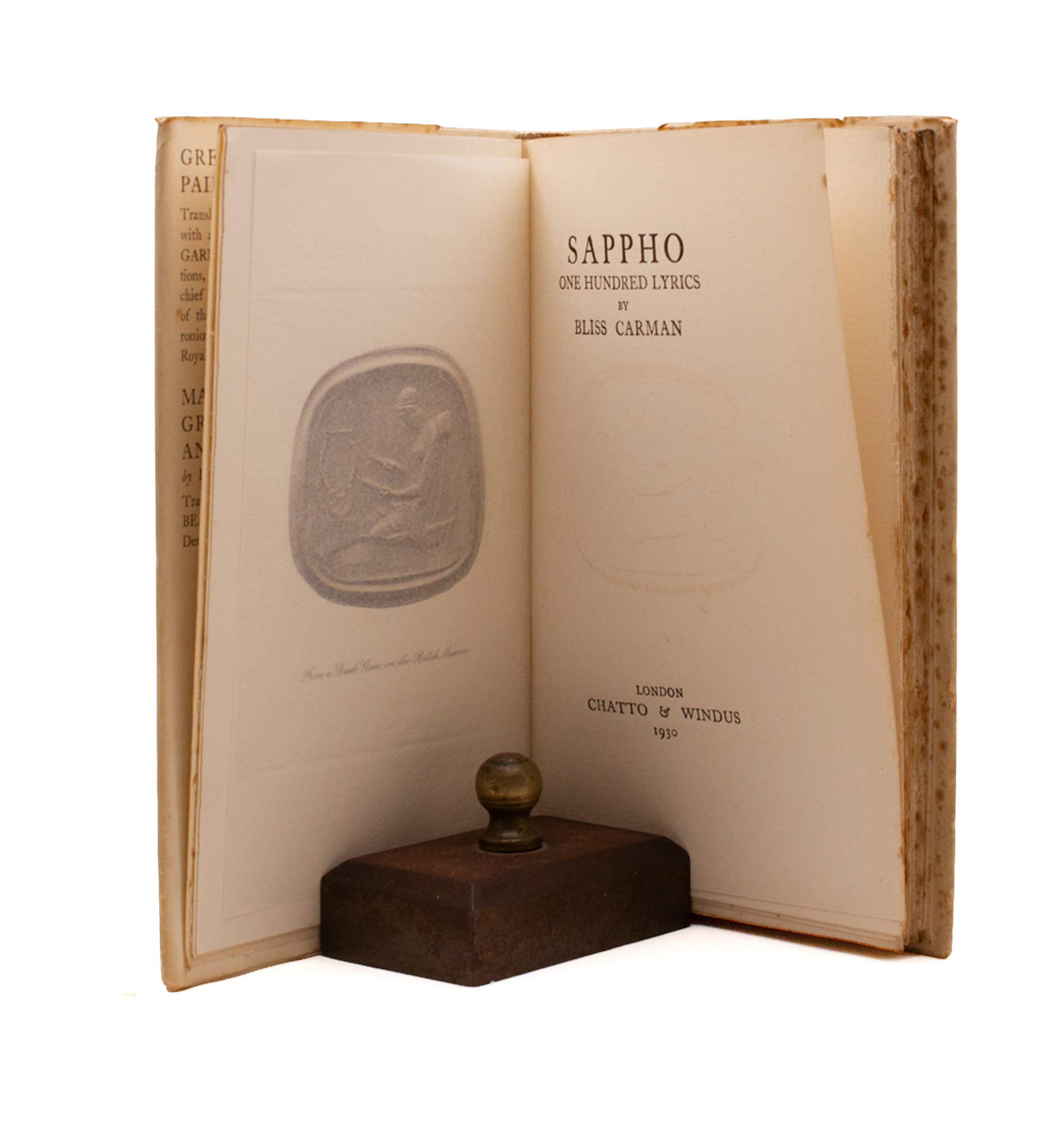
Sappho, One Hundred Lyrics
Bliss Carman
C. G. D. Roberts, introduction
Published London: Chatto & Windus, 1930
129pp.; 17.5 x 11.7 cm. White paper covered boards stamped in gold to front and spine. White dust-jacket printed in black.
From the library of A. David Moody
“The brief, crisp lyrics of the Sappho volume almost certainly contributed to the aesthetic and practice of Imagism.”
— D. M. R. Bentley, Minor Poets of a Superior Order
First published in 1904, Carman’s translation, which involved imagining greater poems from fragments, was an influential volume on modernist poets. The “brief, crisp lyrics,” without ornament, as D. M. R. Bentley, Professor in Canadian Literature at the University of Western Ontario, believes “almost certainly contributed to the aesthetic and practice of Imagism.” New impression, a fine copy in a lightly worn dust-jacket with an unfortunate stain to front cover. With an unascribed Christmas letter laid-in.
tap to cycle
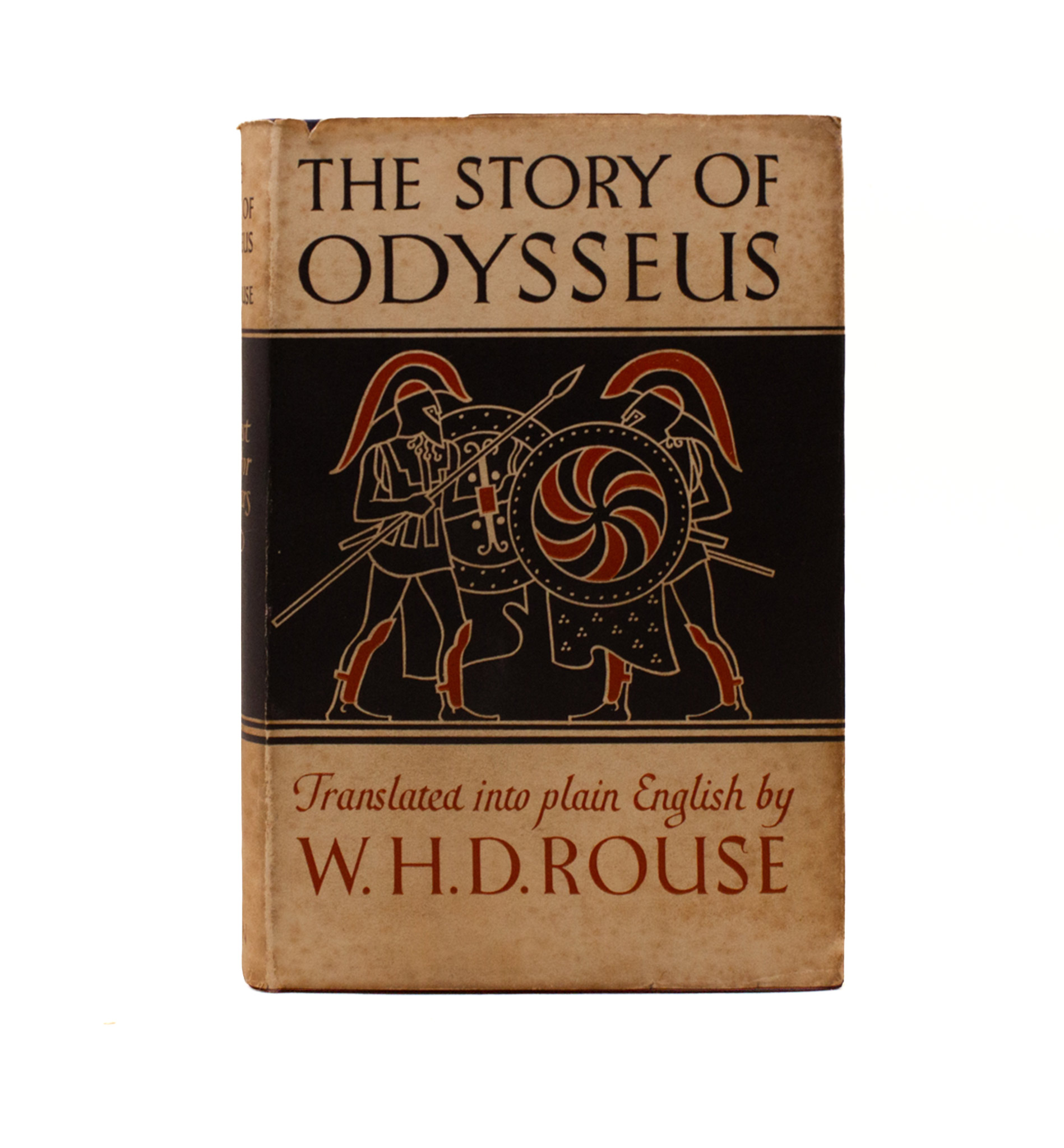
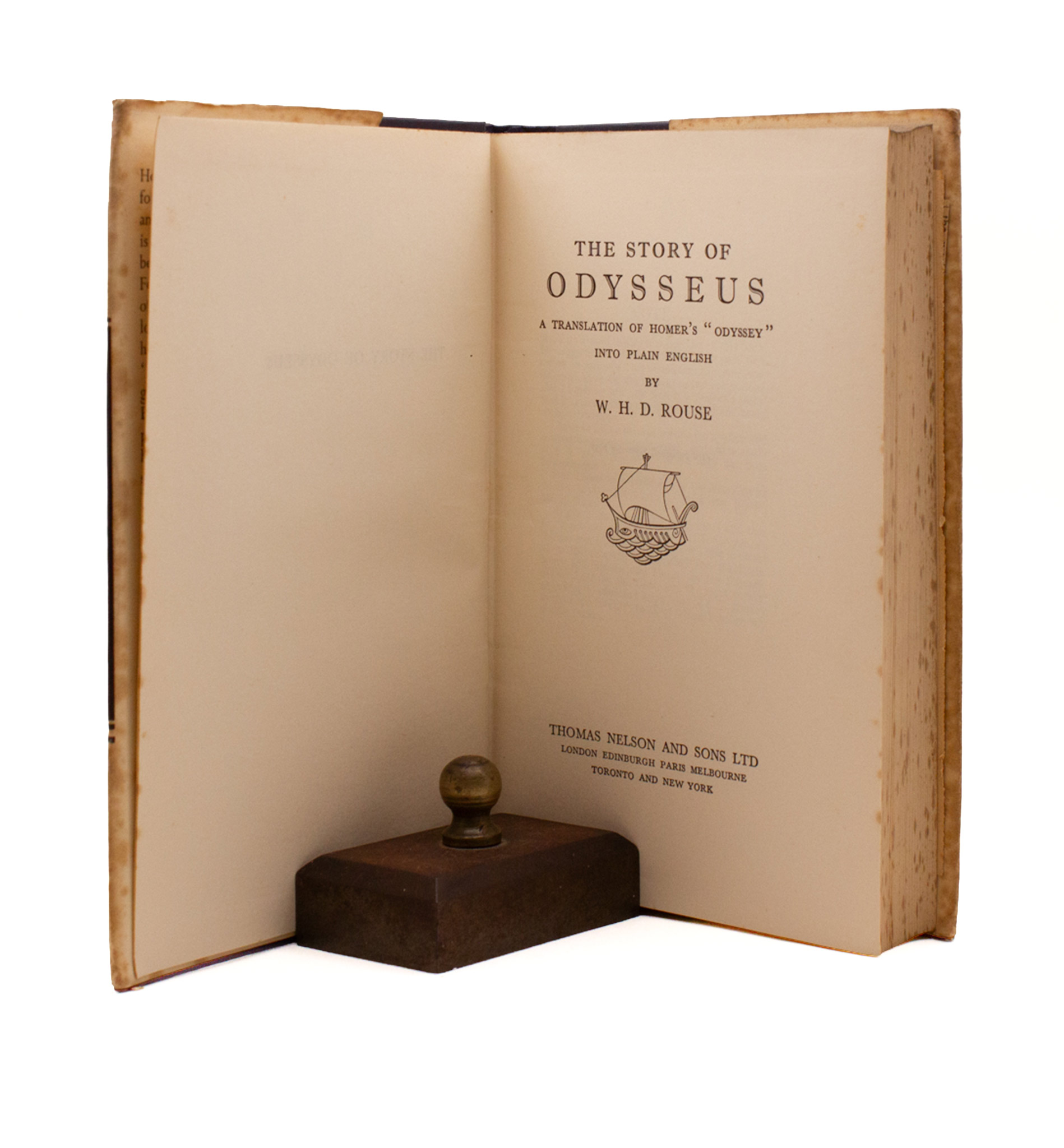
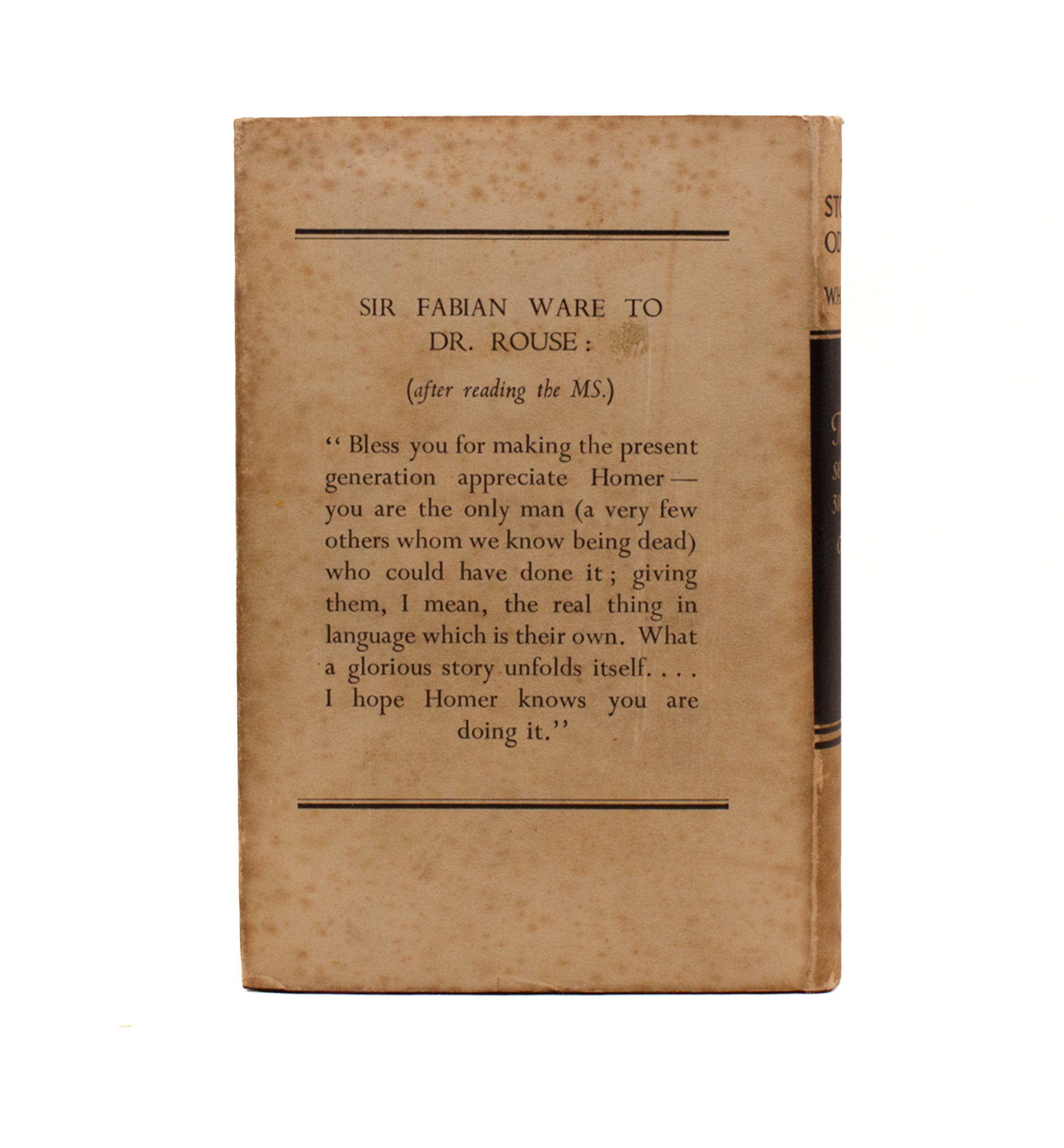
The Story of Odysseus
W. H. D. Rouse, translator
Published London: Thomas Nelson and Sons, 1937
463pp.; 18.9 x 13 cm. Blue cloth boards stamped in blind and gold to front, and in gold to spine. White dust-jacket printed in brown, red and black.
From the library of A. David Moody
“Mr. Ezra Pound is the onelie begetter of this book. He suggested it, and he read the first part with Odyssean patience; his trenchant comments, well deserved, gave me the courage of my convictions, and I hope he will now find it a readable story, that is, a story which can be read aloud and heard without boredom.”
— W. H. D. Rouse, p. v
Rouse’s modern prose translation of Homer’s Odyssey. First edition. A fine copy in a faded and spotted dust-jacket with a little edge-wear. Contemporary ink gift inscription to ffep. A number of contemporary newspaper clippings laid-in to the front and back of this book, each relating to either this translation, Rouse’s Story of Achilles, or other Homeric publications.


tap to cycle
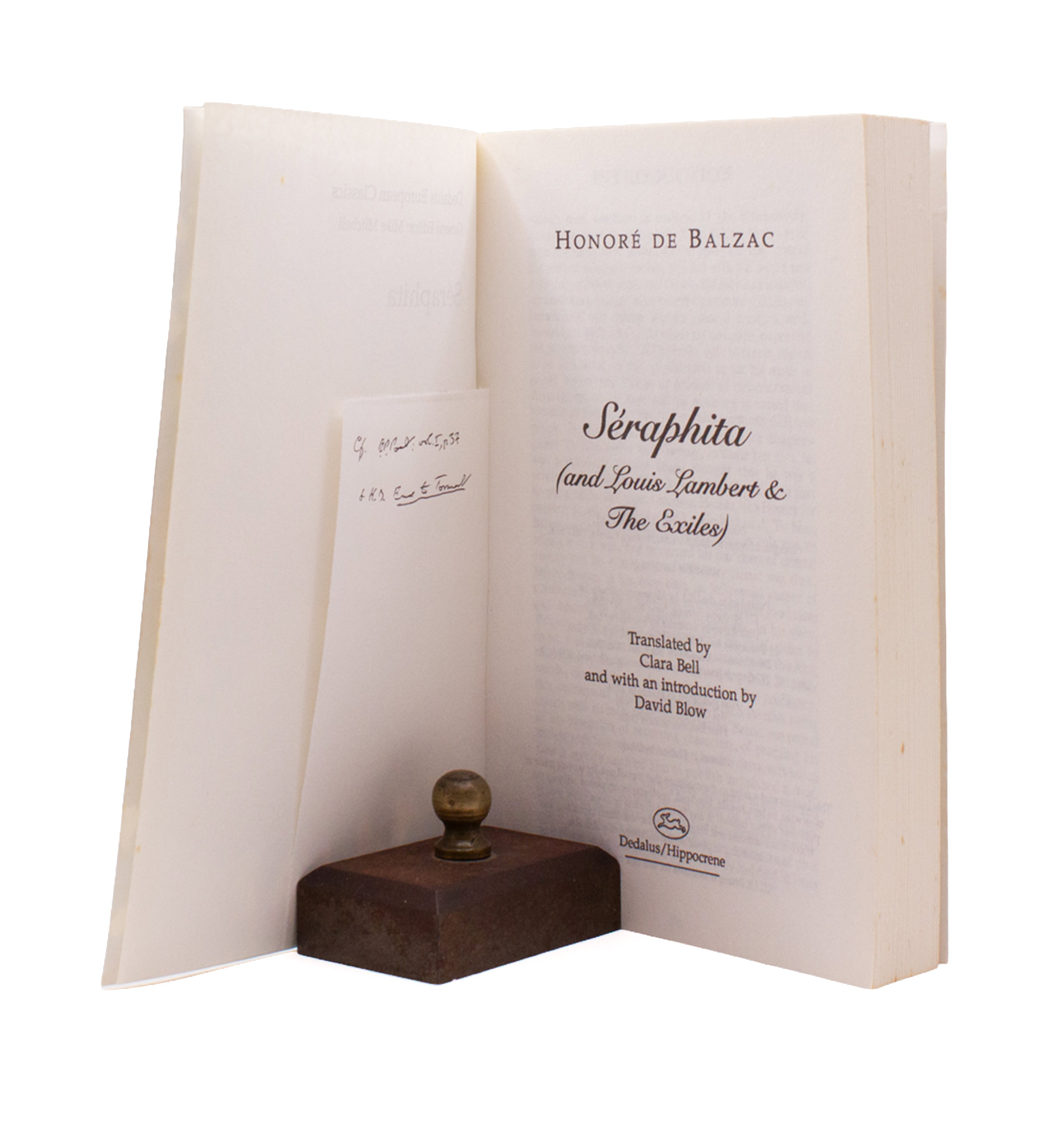
Séraphita (and Louis Lambert & The Exiles)
Honoré de Balzac
Clara Bell, translator
David Blow, introduction
Published Cambs: Dedalus, 1995
361pp.; 19.9 x 12.8 cm. Stiff white printed paper wraps.
From the library of A. David Moody
“Most of all they [EP & HD] read Balzac’s Swedenborgian romance Séraphita, about bringing the human soul fully alive by teaching it to see through earthly things to the divine goodness and beauty behind and beyond them. There may have been as much of Swedenborg as of Rossetti [La Vita Nuova and “The Blessèd Damozel”] behind ‘Hilda’s Book’. For Hilda, Ezra was at that time the very image of ‘adolescence in its Ariel, or Séraphita stage’.”
— A. David Moody, Ezra Pound: Poet, Volume 1
English translation, mass market paperback. With a laid-in note from A. David Moody referencing his own biography, and H.D.’s End to Torment.