de Beaumont Rares
debeaumontrares@gmail.com
Scholarship, III
Collections of scholarship, essays of great diversity from scholars whose names we know less.
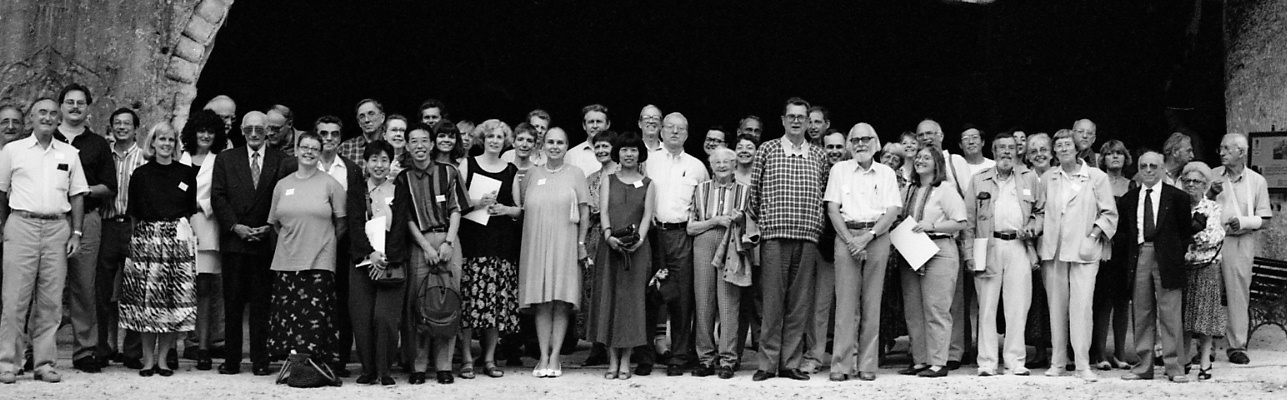
Cover photo courtesy of Walter Baumann, scholars at the Sixteenth Ezra Pound International Conference, Brantôme, 1995.
10 March 26
tap to cycle
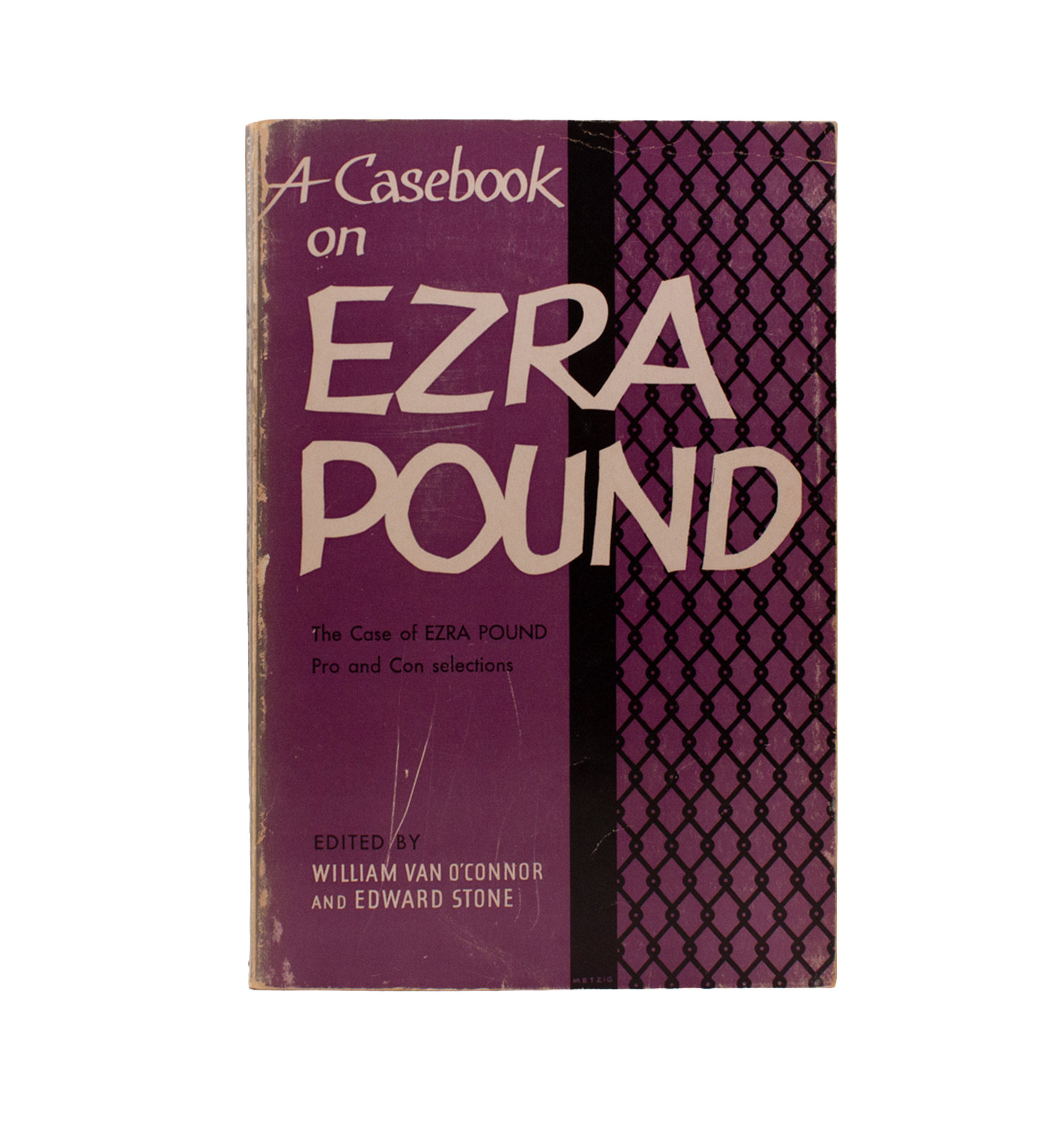
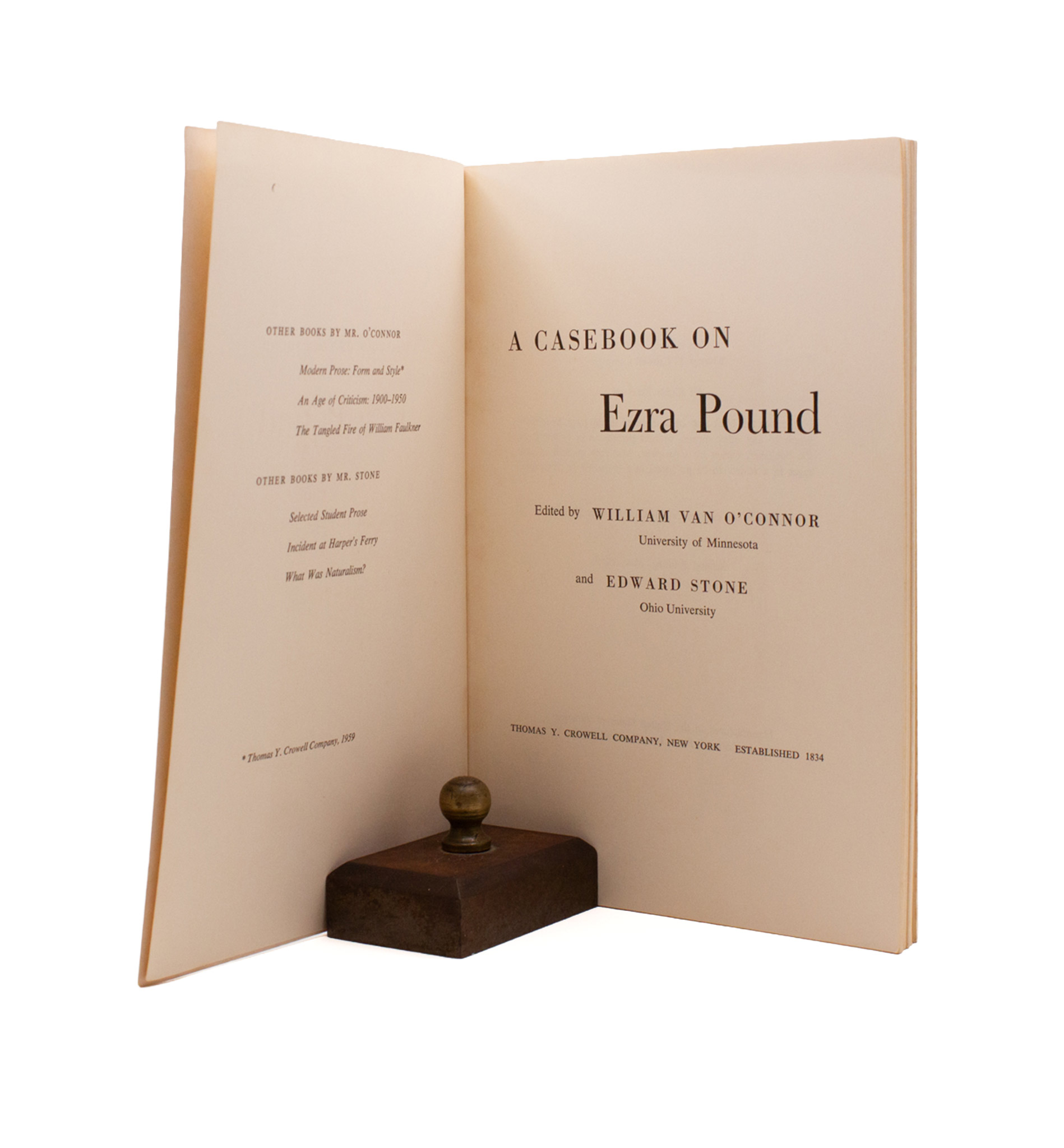
A Casebook on Ezra Pound
William Van O’Connor, Edward Stone, editors
Published New York: Thomas Y. Crowell Company, 1959
179pp.; 21.2 x 14.3 cm. White paper wraps printed in purple and black.
From the library of A. David Moody
A selection of material related to Pound’s reputation mainly in post-war America, with newspaper articles, medical reports, responses to the Bollingen Award, and reactions to Pound’s indictment. First edition, second printing, May 1959. Covers worn. With pencil annotations from David Moody throughout, and a newspaper cutting from The Guardian, Friday 11 April 2008, “Leader: Ezra Pound,” laid in.
Contents: “Citation with Honroary Degree from Hamilton College”; Nathaniel Weyl, “The Strange Case of Ezra Pound”; Time, “Treason”; Newsweek, “Impounded Records”; New York Times, ‘Pound’s Mind “Unsound”’; “Medical Report on Pound”; George Dillon, “A Note on the Obvious”; Book Review Digest, “Reviews of Cantos and Pisan Cantos”; Robert L. Allen, “The Cage”; David Park Williams, “The Background of The Pisan Cantos”; Library of Congress Press Release, “The Pisan Cantos Wins for Ezra Pound First Award of Bollingen in Poetry”; Dwight Macdonald, “Homage to Twelve Judges (an editorial)”; William Barrett, “A Prize for Ezra Pound”; W. H. Auden, Robert Gorham Davis, Clement Greenberg, Irving Howe, George Orwell, Karl Shapiro, Allen Tate, William Barrett, “The Question of the Pound Award”; Ray West, “Excerpts from a Journal: 1949”; Aline Louchheim Saarinen, “The State and Art”; Earle Davis, “Ezra Pound, Traitor and Poet”; Archibald MacLeish, “Poetry and Opinion”; Peter Viereck, “Pure Poetry, Impure Politics, and Ezra Pound”; David Rattray, “Weekend with Ezra Pound”; Jack LaZebnik, “The Case of Ezra Pound”; New York Times, “Ezra Pound May Escape Trial”; The Nation, “What the Pound Case Means (an editorial)”; New York Times, “U.S. Asked to End Pound Indictment”; Statement of Robert Frost; New York Times, “Court Drops Charge Against Ezra Pound”; New York Times, “New Canto for a Poet”; Washington Star, “Ezra Pound Still Sees Mad World Out of Step”; New York Times, “Pound to Live with Daughter”; New York Post, “Ezra Pound’s Canto to Run in Yale Mag”; Babette Deutsch, “The Teacher”; plus appendices, containing selections from cantos, from radio broadcasts, a primary and secondary bibliography, and research exercises for students.

tap to cycle
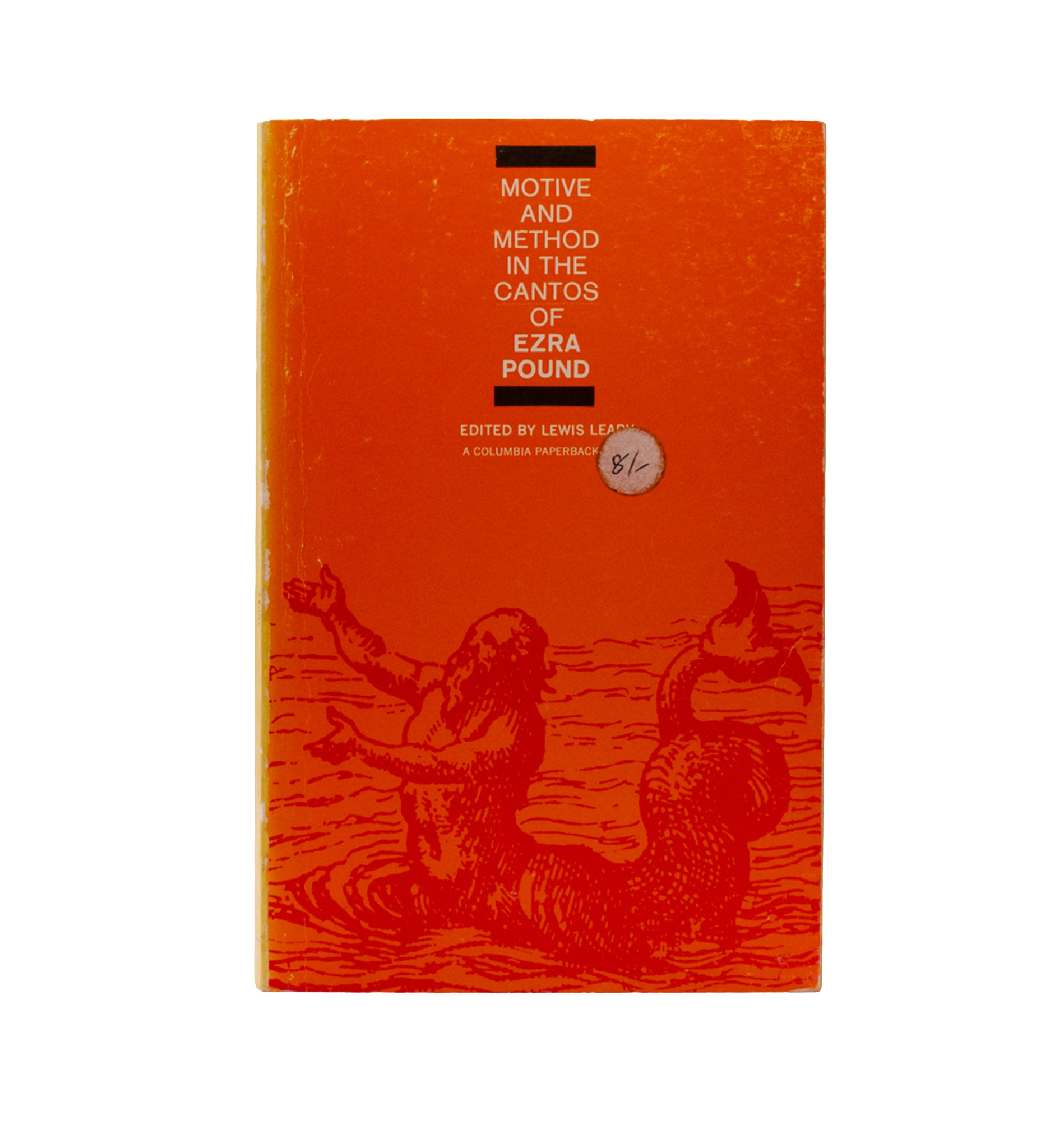
Motive and Method in The Cantos of Ezra Pound
Lewis Leary, editor
Published New York: Columbia University Press, 1961
123pp.; 20.3 x 13.3 cm. Stiff white paper wraps printed in orange and black.
From the library of A. David Moody
A small but essential collection of essays of The Cantos. First edition, second printing and paperback edition, 1961. Lightly browned at page edges; wraps worn, the spine sunned, with a price sticker to front cover.
Contents: Hugh Kenner, “The Broken Mirrors and the Mirror of Memory”; Guy Davenport, “Pound and Frobenius”; Sister M. Bernetta Quinn, O.S.F, “The Metamorphoses of Ezra Pound”; Forrest Read, Jr., “A Man of No Fortune.”


tap to cycle
Ezra Pound, A Collection of Critical Essays
Walter Sutton, editor
Published New Jersey: Prentice-Hall, 1963
184pp.; 20.4 x 13.9 cm. Stiff white paper wrappers printed in red and black.
From the library of A. David Moody
A selection of literary criticism on Pound, with first class contributors. First edition, paperback issue. Wraps lightly worn, spotting along the edges of the text-block, but otherwise a nice, clean copy.
Contents: Walter Sutton, “Introduction”; W. B. Yeats, “Ezra Pound”; W. C. Williams, “Excerpts from a Critical Sketch: A Draft of XXX Cantos by Ezra Pound”; T. S. Eliot, “Ezra Pound”; F. R. Leavis, “Ezra Pound”; Hugh Kenner, “Mauberley”; M. L. Rosenthal, “The Cantos”; Forrest Read[, Jr.], “A Man of No Fortune”; David W. Evans, “Ezra Pound as Prison Poet”; W. M. Frohock, “The Revolt of Ezra Pound”; Harold H. Watts, “Reckoning”; Earl Miner, “Pound, Haiku, and the Image”; Murray Schafer, “Ezra Pound and Music”; J. P. Sullivan, “Pound’s Homage to Propertius: The Structure of a Mask”; George P. Elliott, “Poet of Many Voices”; Roy Harvey Pearce, “Pound, Whitman, and the American Epic,” together with a chronology of important dates and a selected bibliography.
tap to cycle
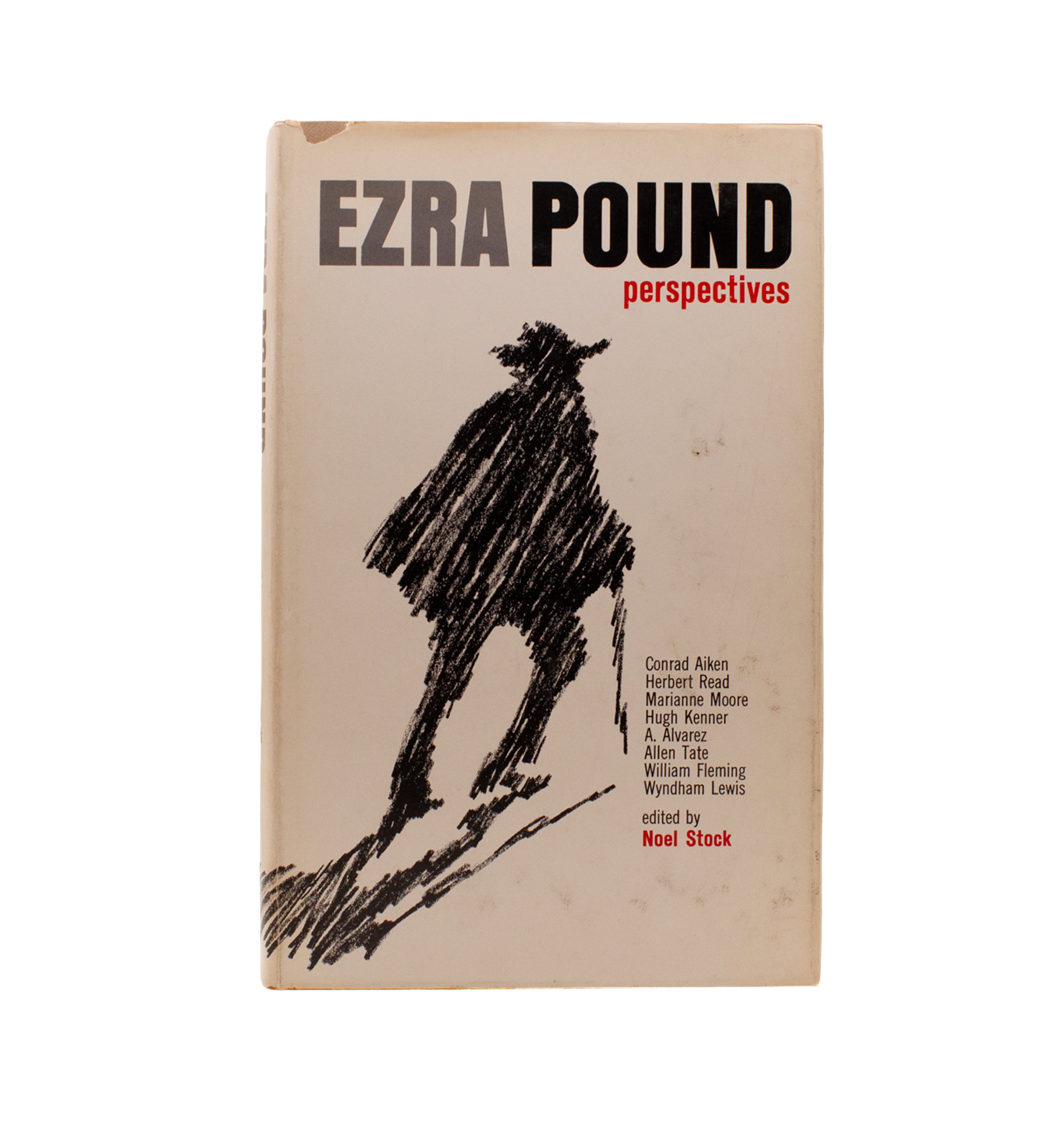
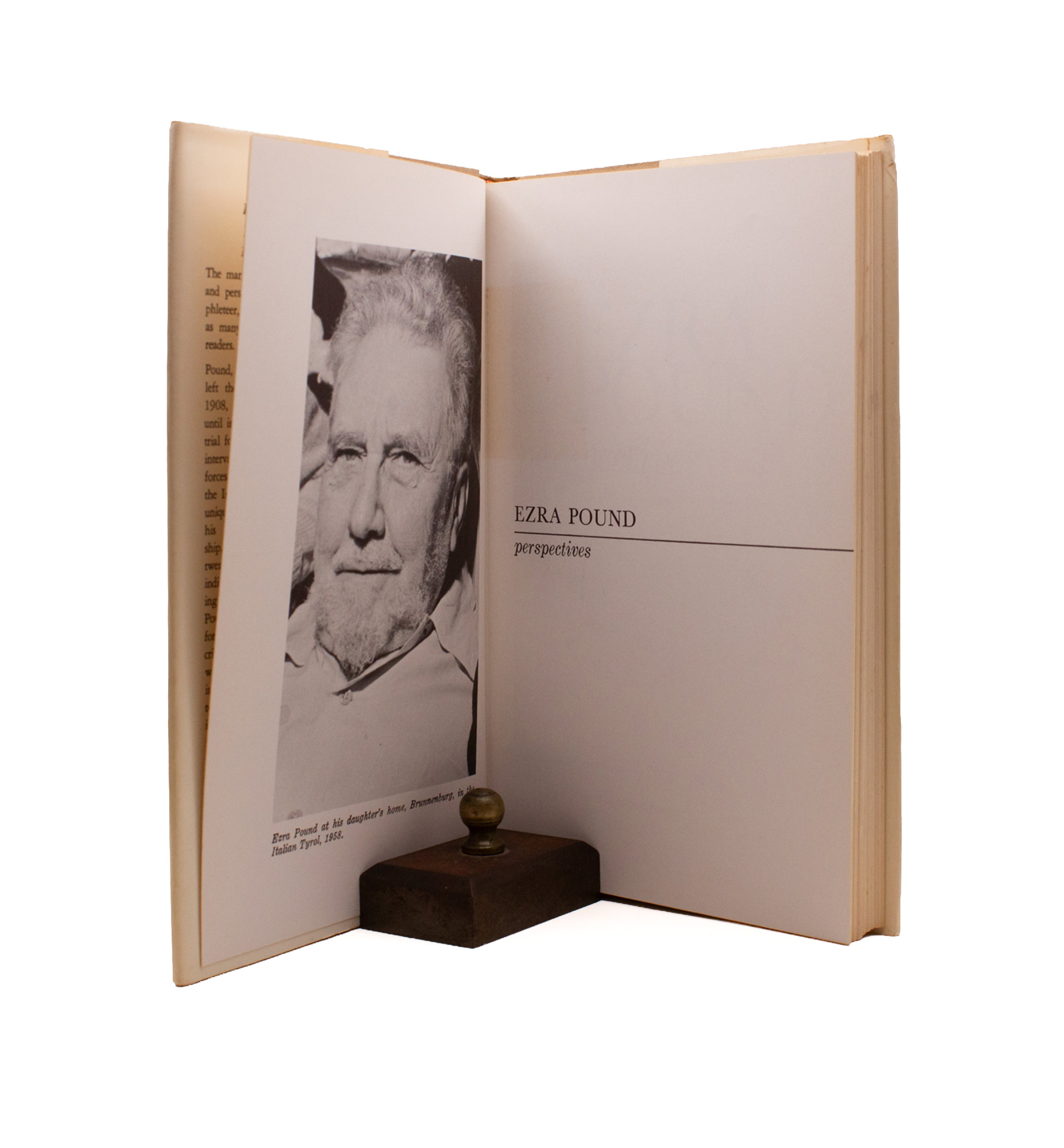
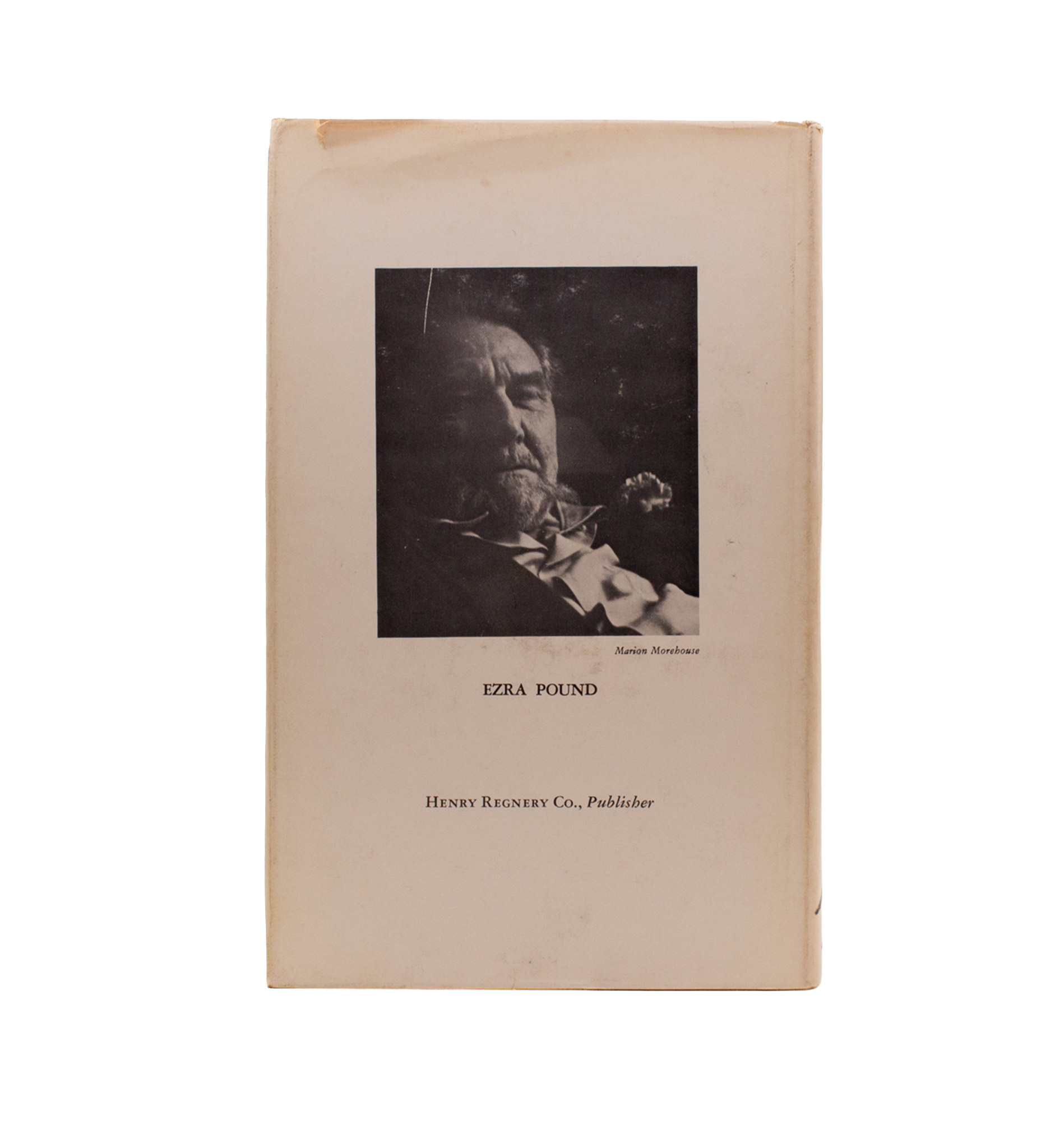
Ezra Pound, Perspectives
Noel Stock, editor
Published Chicago: Henry Regnery Company, 1965
219pp.; 24.2 x 15.7 cm. Tan cloth boards lettered in brown down spine. White dust-jacket printed in black and red.
From the library of A. David Moody
A compilation of personal reminiscences, analyses and commentaries; a tribute for the poet’s eightieth birthday. First edition. With numerous illustrations, including a number of manuscripts and the front wrapper of Orientamenti (1944), “one of the rarest of all Pound’s books.” The very occasional marginal note, and a note in ink laid in to rear from David Moody, referencing “the custodian of Ezra Pound’s papers,” which was how Stock was described on the rear flap before that being blacked out. A near fine book in a very good jacket, with a little rubbing, a small tear to the back, and a little loss to the front.
Contents: Noel Stock, “Introduction”; Conrad Aiken, “Ezra Pound: 1914”; Herbert Read, “Ezra Pound”; Marianne Moore, “Tribute”; Hugh Kenner, “Leucothea’s Bikini: Mimetic Homage”; A. Alvarez, “Craft and Morals”; Peter Whigham, “Ezra Pound and Catullus”; Donald Gallup, “The Search for Mrs. Wood’s Program”; Allen Tate, “Ezra Pound and the Bollingen Prize”; Hugh Mac Diarmid, “The Return of the Long Poem”; Rabindranath Tagore, T. S. Eliot, Wyndham Lewis, James Joyce, Marianne Moore, Henry Newbolt, W. B. Yeats, Richard Aldington, W. C. Williams, F. M. Ford, e. e. cummings, “A Bundle of Letters”; William Fleming, “Ezra Pound and the French Language”; Ernest Hemingway, “A Note on Ezra Pound”; Christine Brooke-Rose, “Piers Plowman in the Modern Wasteland”; Tom Scott, “An Appreciation”; Wyndham Lewis, “The Rock Drill”; Joseph Fetler Malof, “Ez Pound, Inc.”; Denis Goacher, “BBC THIRD PROGRAM: Ezra Pound—Translations from the Chinese.”
tap to cycle
New Approaches to Ezra Pound
Eva Hesse, editor
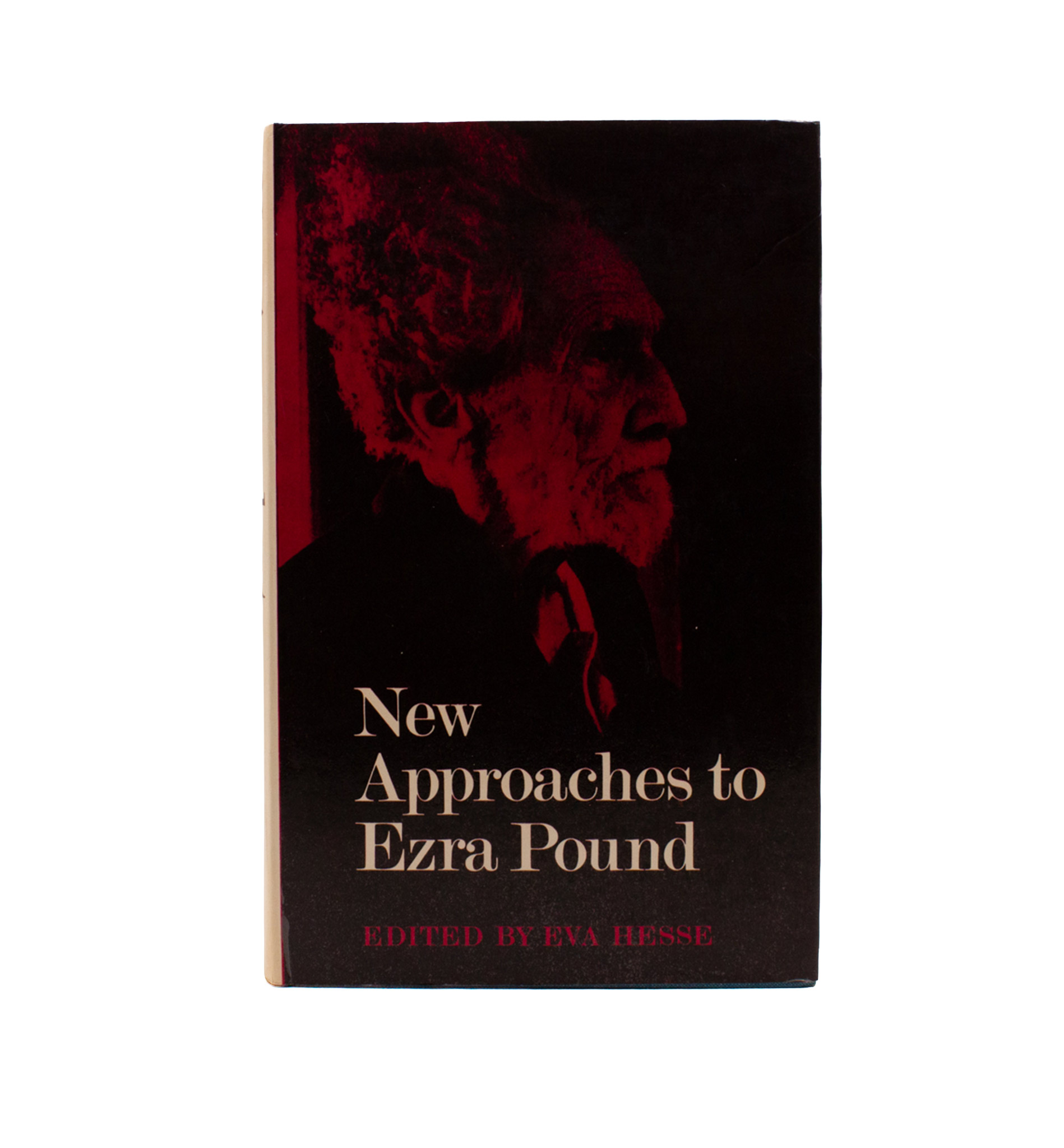
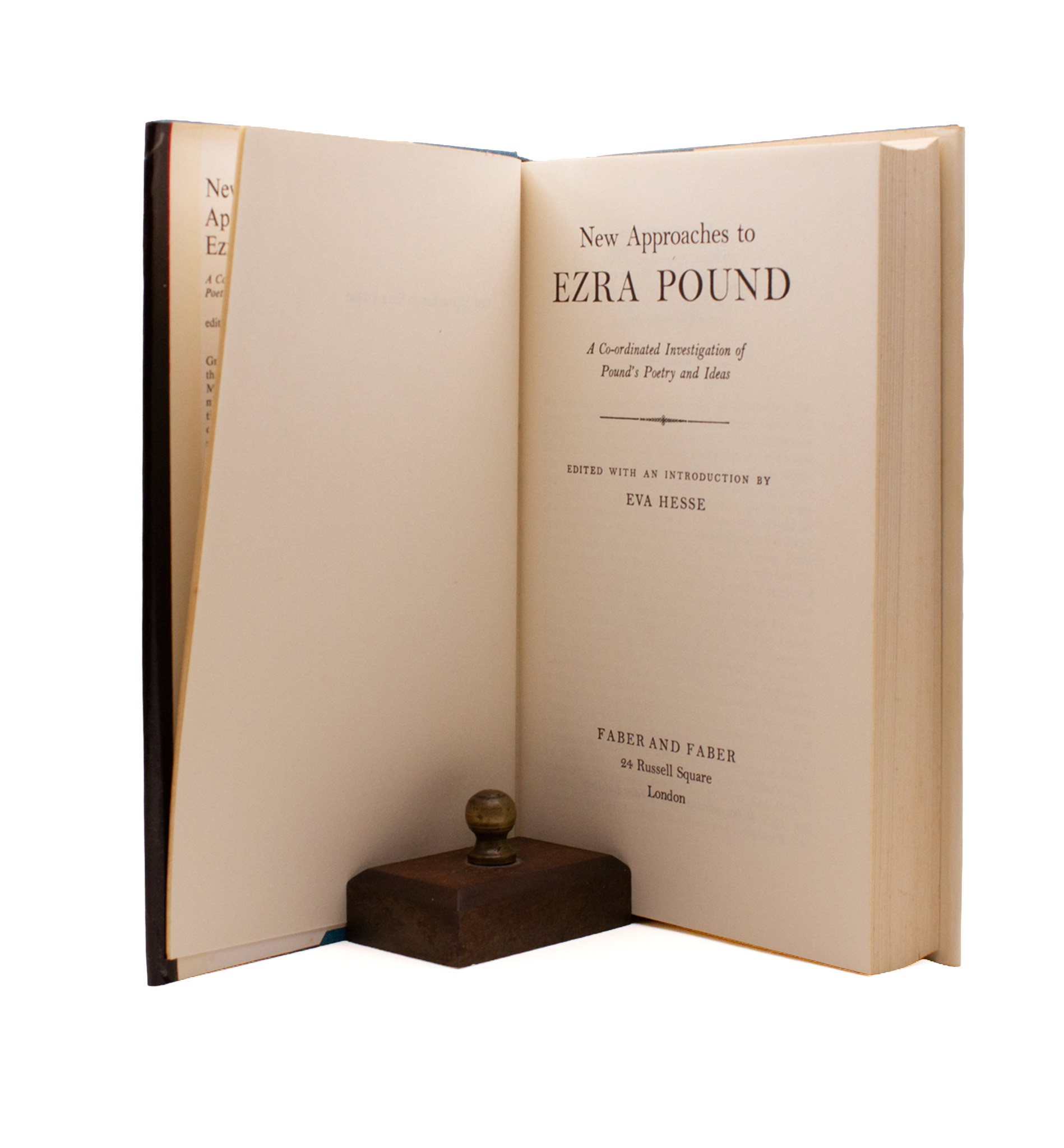
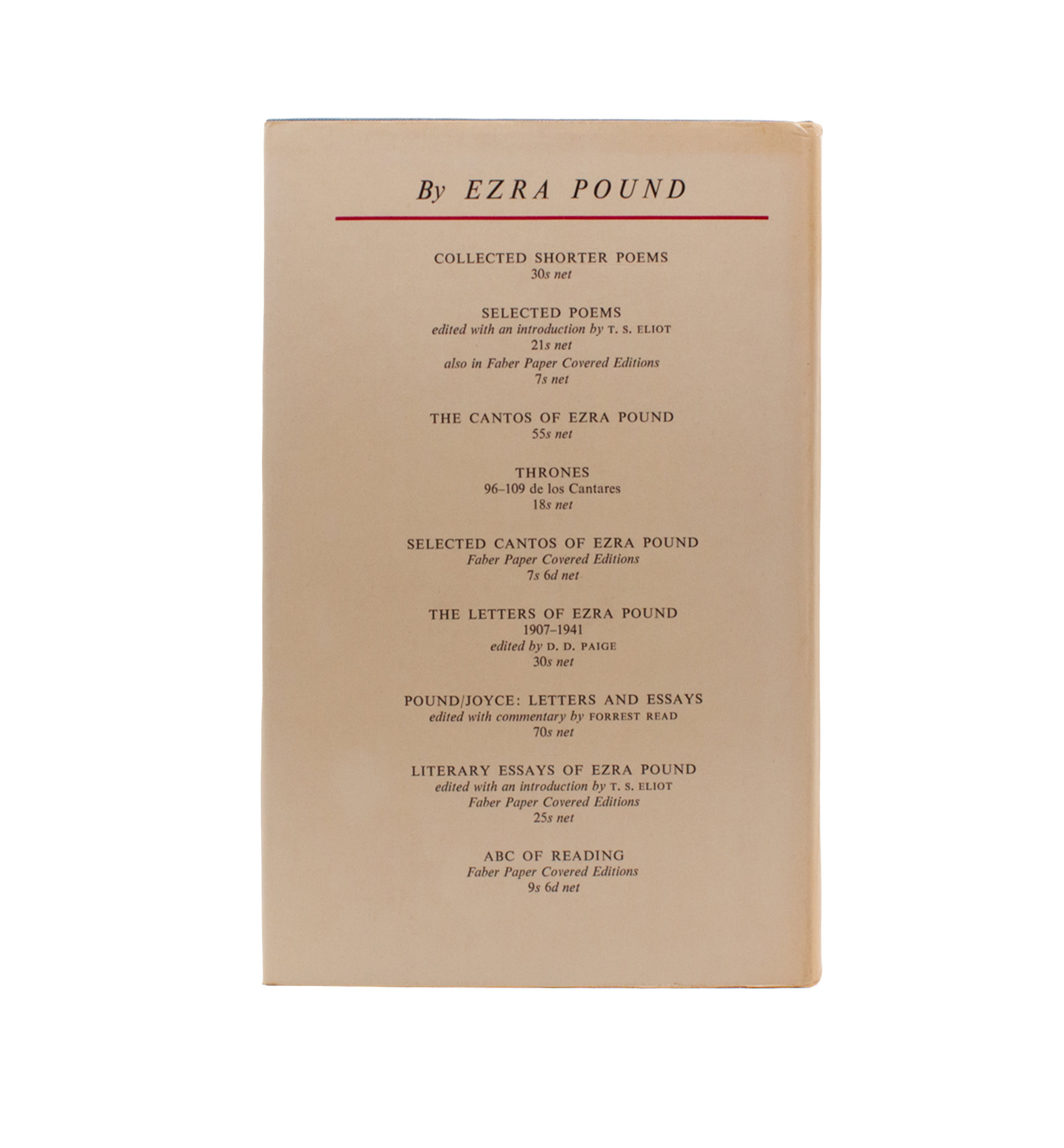
Published London: Faber and Faber, 1969
406pp.; 22.3 x 14.2 cm. Blue cloth boards lettered in gold on spine. White dust-jacket printed in black and red with a photograph of Pound by Lisetta Carmi-Genova to front.
From the library of A. David Moody
A collection of essays from an A-list line-up, most in the manner of the review appearing here for the first time. First edition. Near fine. The very occasional pencil annotation from David Moody.
Contents: Eva Hesse, “Introduction”; Richard Ellmann, “Ez and Old Billyum”; N. Christoph De Nagy, “Pound and Browning”; Forrest Read, “Pound, Joyce, and Flaubert: The Odysseans”; Guy Davenport, “Persephone’s Ezra”; Boris de Rachewiltz, “Pagan and Magic Elements in Ezra Pound’s Works”; Donald Davie, “The Poet as Sculptor”; J. P. Sullivan, “Ezra Pound and the Classics”; Christine Brooke-Rose, “Lay me by Aurelie: An Examination of Pound’s Use of Historical and Semi-Historical Sources”; George Dekker, “Myth and Metamorphosis: Two Aspects of Myth in The Cantos”; Walter Baumann, “Secretary of Nature, J. Heydon”; John Espey, “The Inheritance of Tò Kalón”; Hugh Kenner, “Blood for the Ghosts”; Albert Cook, “Rhythm and Person in The Cantos”; Leslie Fiedler, “Traitor or Laureate: The Two Trials of the Poet.”

tap to cycle
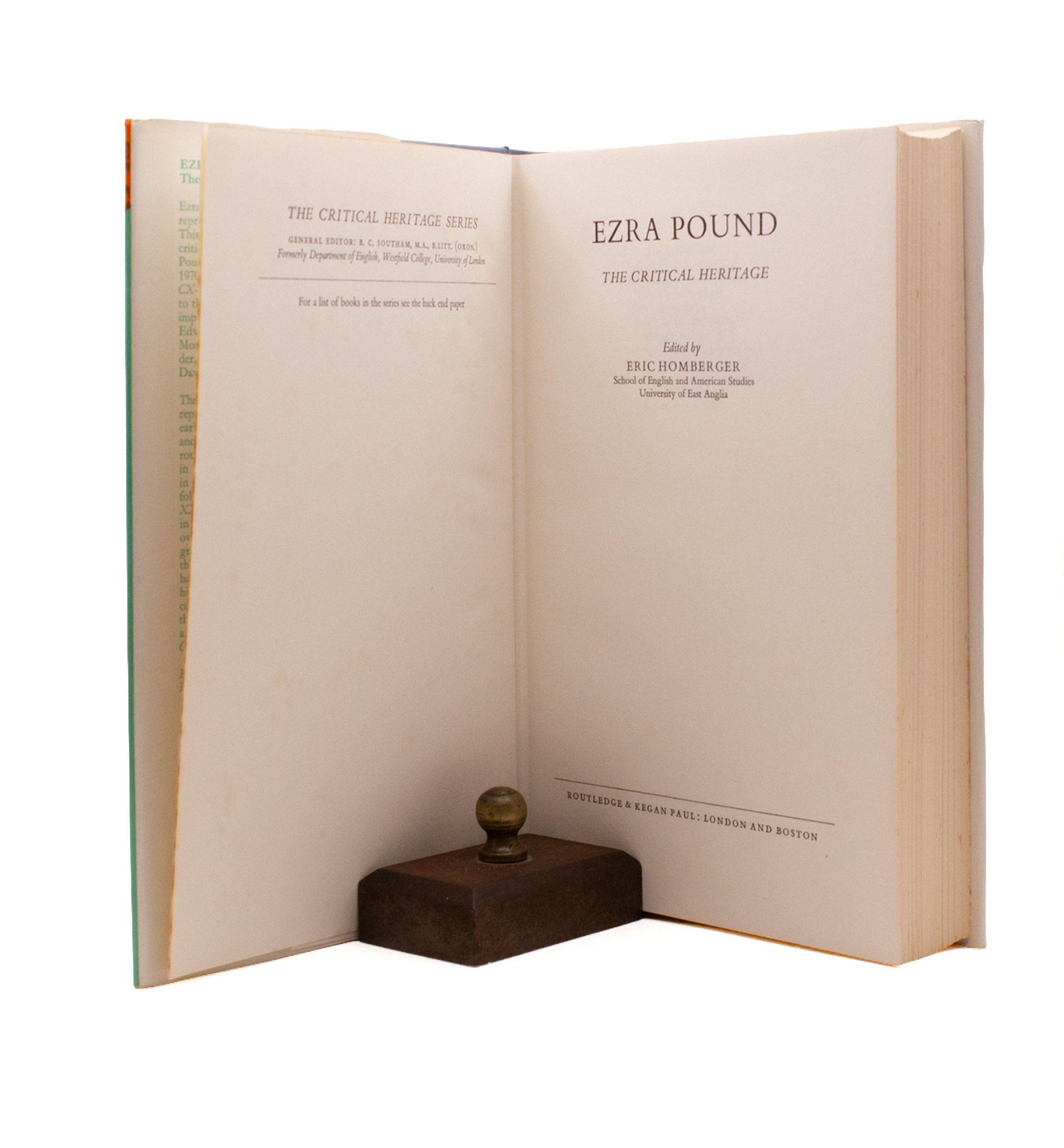
Ezra Pound, The Critical Heritage
Eric Homberger, editor
Published London and Boston: Routledge & Kegan Paul, 1972
500pp.; 22.2 x 14.7 cm. Blue cloth boards lettered in gold down spine. White dust-jacket printed in green and orange.
From the library of A. David Moody
A collection of critical reviews to Pound’s editions, as detailed as to include publications such as Sonnets and Ballate of Guido Cavalcanti (1912) and Instigations (1920), commencing with a number of written portraits of Pound, then passing from ALS right up to Drafts & Frags.; the contents too many to list. A number of pencil annotations from David Moody, some notably more extensive. First edition. Foxing to the prelims, very light edge-wear to the jacket, otherwise fine.

tap to cycle
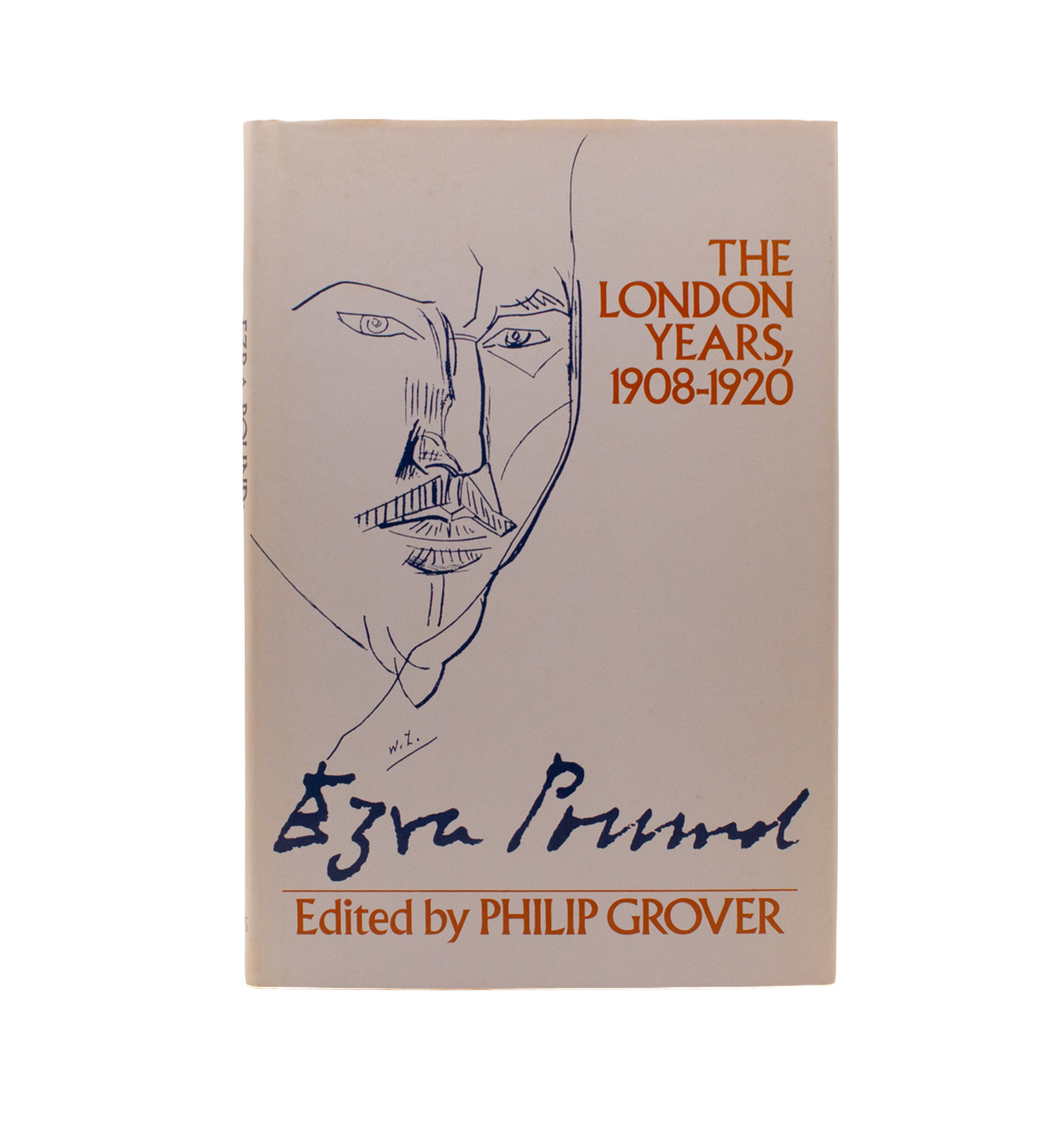
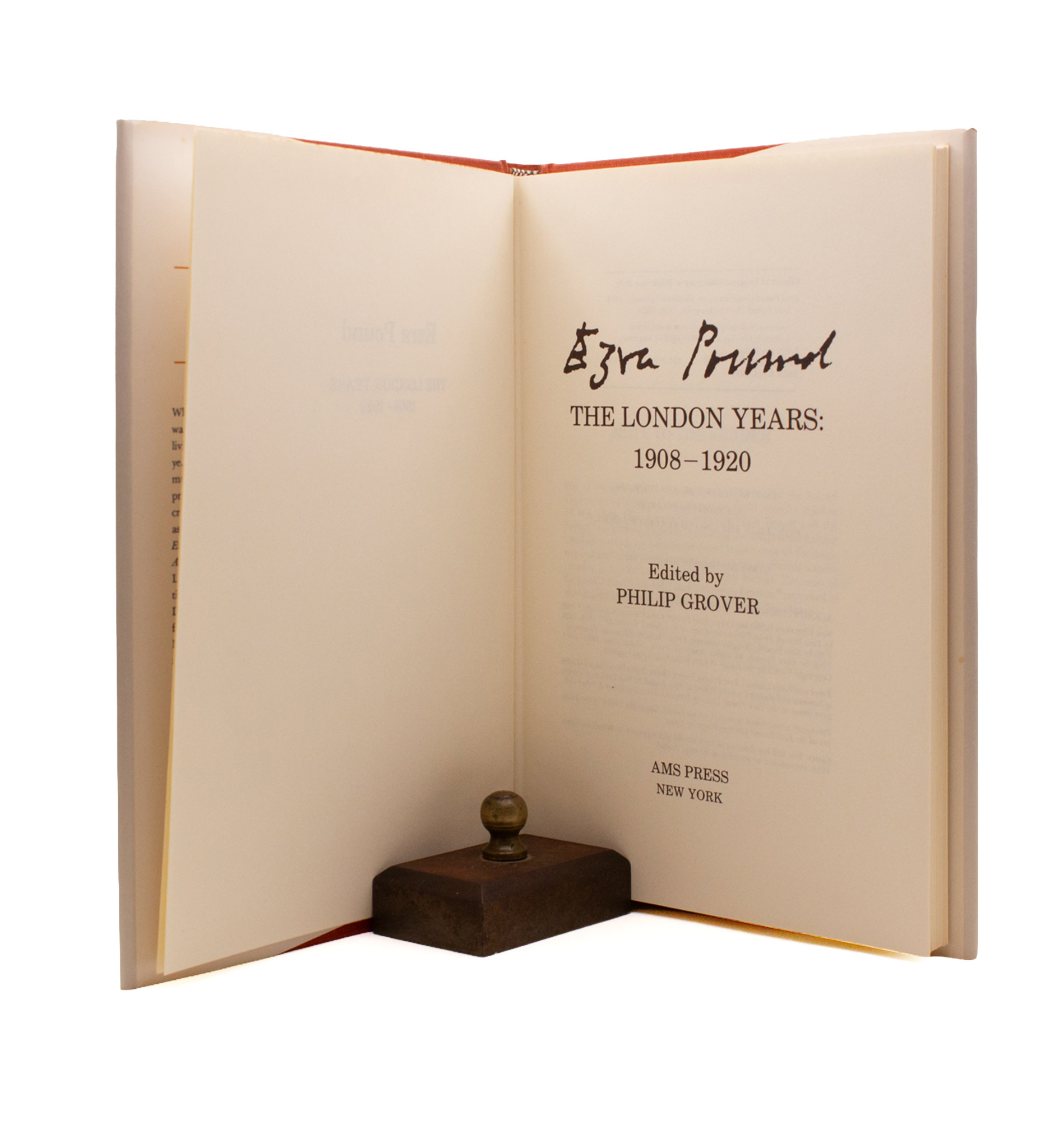
Ezra Pound, The London Years, 1908-1920
Philip Grover, editor
Published New York: AMS, 1978
166pp.; 23.6 x 16.1 cm. Red cloth boards lettered in black on spine. White dust-jacket printed in black, red and blue.
From the library of A. David Moody
A small collection of essays regarding Pound’s work in London, compiled from talks given at the first* Ezra Pound Conference, held in Sheffield 1976, at which an exhibition of materials was also shown, in collaboration with Omar Pound. First edition, a fine book in a near-fine jacket, and a beautiful production. With one ephemeral note in ink from David Moody laid into near the rear.
Contents: Eric Homberger, “Modernists and Edwardians”; William Pratt, “Ezra Pound and the Image”; Peter Makin, “Pound’s Provence and the Medieval Paideuma: An Essay in Aesthetics”; Donald Monk, “How to Misread: Pound’s Use of Translation”; Ian F. A. Bell, “Mauberley’s Barrier of Style”; Walter Baumann, “The Structure of Canto IV”; with a further “Catalogue of a Pound Exhibition (Sheffield University, 23 April 1976),” which, among other things, is a great resource for Pound’s trips to France at the time.
* The first actually seems to have been held in Orono, Maine, 1975, which Grover does not recognise.

tap to cycle
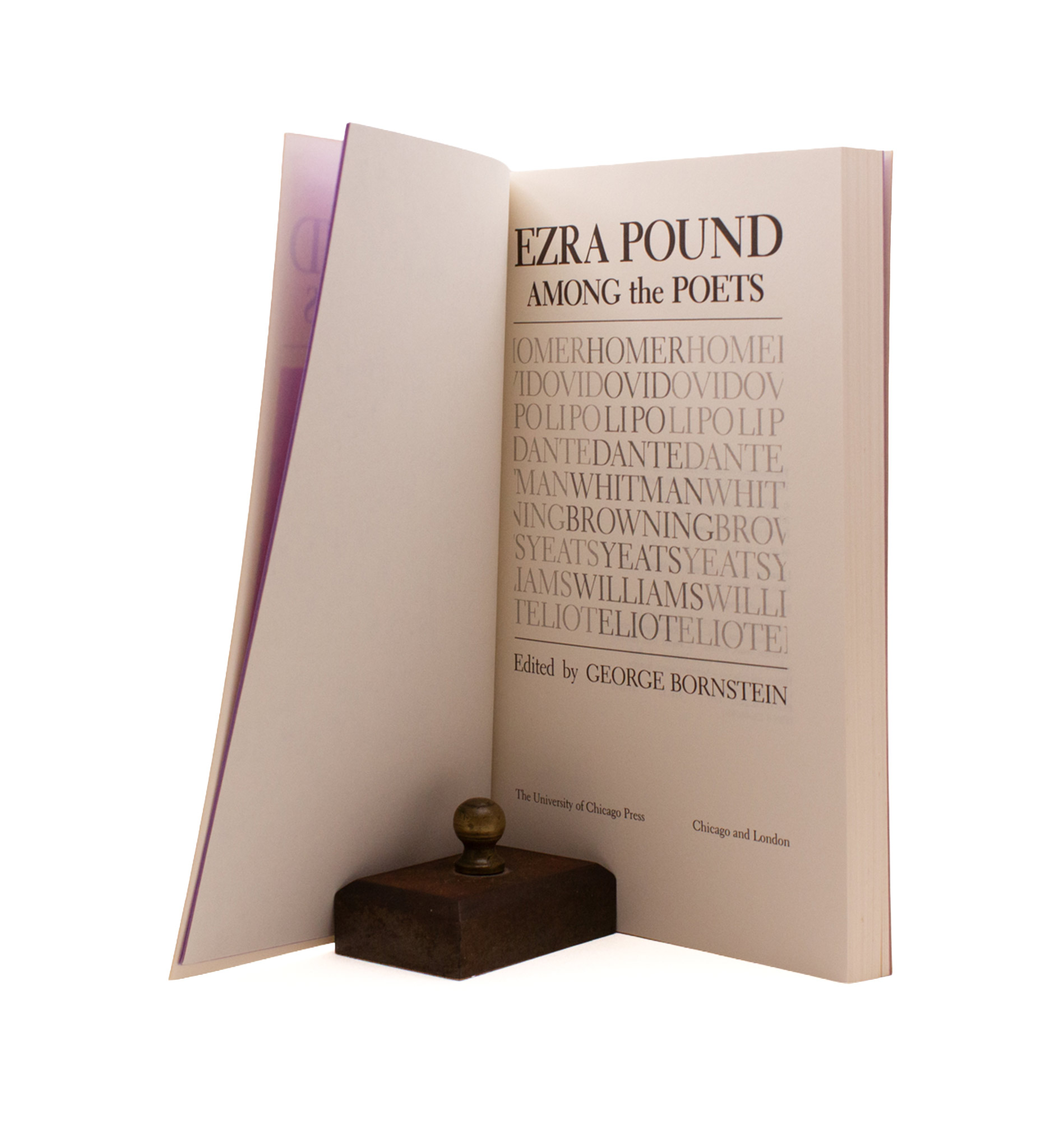
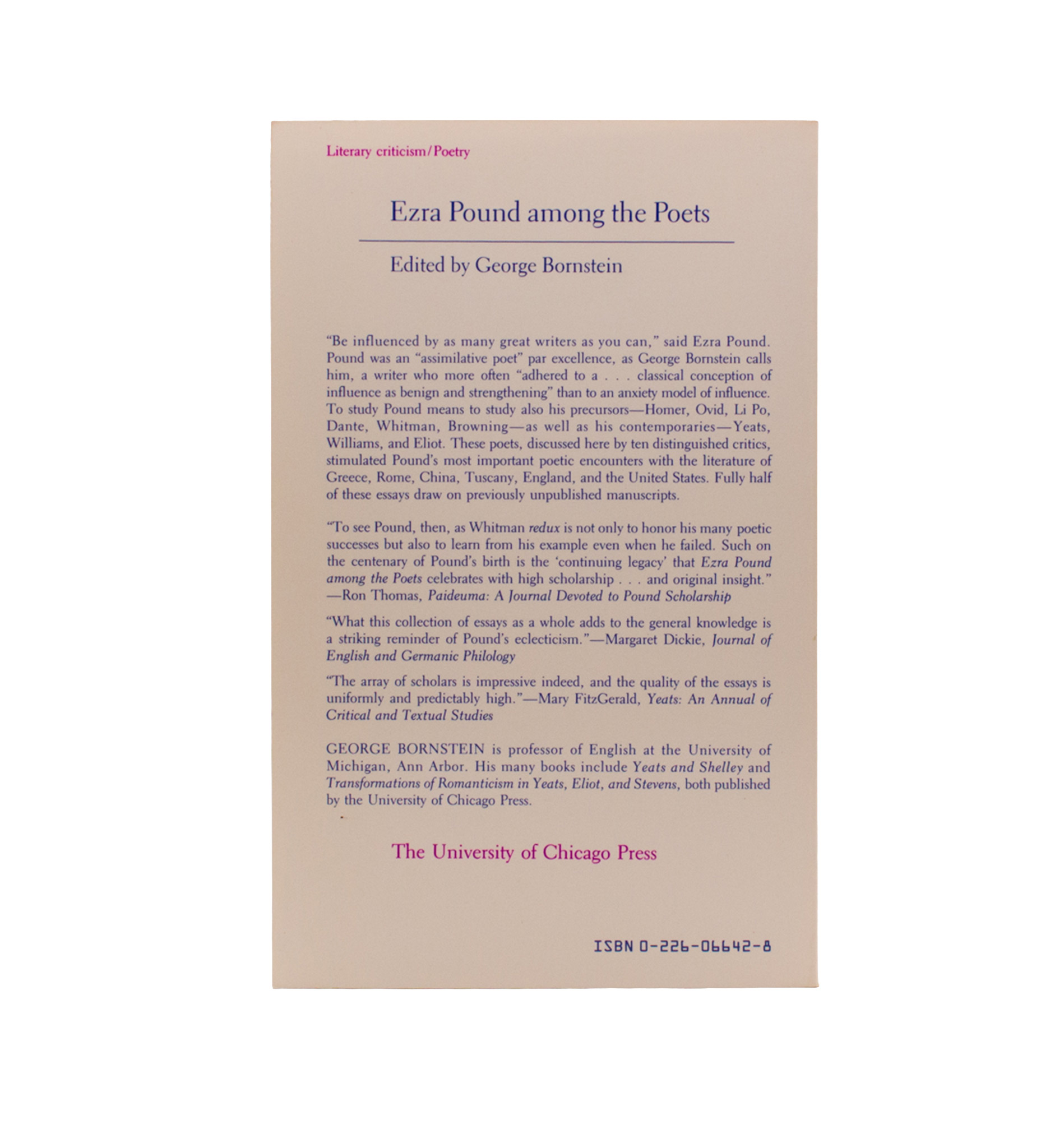
Ezra Pound Among the Poets
George Bornstein, editor
Published Chicago and London: The University of Chicago Press, 1985
238pp.; 20.6 x 13.7 cm. Stiff white papers wrappers printed in blue and pink.
From the library of A. David Moody
Pound and [Poet]; essays relating Pound’s relationships to other poets, prior or contemporary. Occasional pencil symbol from David Moody in the margin. First edition, paperback issue. A fine copy.
Contents: George Bornstein, “Introduction”; Hugh Kenner, “Pound and Homer”; Lillian Feder, “Pound and Ovid”; Ronald Bush, “Pound and Li Po: What Becomes a Man”; Stuart Y. McDougal, “Dreaming a Renaissance: Pound’s Dantean Inheritance”; Hugh Witemeyer, “Clothing the American Adam: Pound’s Tailoring of Walt Whitman”; George Bornstein, “Pound’s Parleyings with Robert Browning”; A. Walton Litz, “Pound and Yeats: The Road to Stone Cottage”; Thomas Parkinson, “Pound and Williams”; Robert Langbaum, “Pound and Eliot”; Marjorie Perloff, “The Contemporary of Our Grandchildren: Pound’s Influence.”

tap to cycle
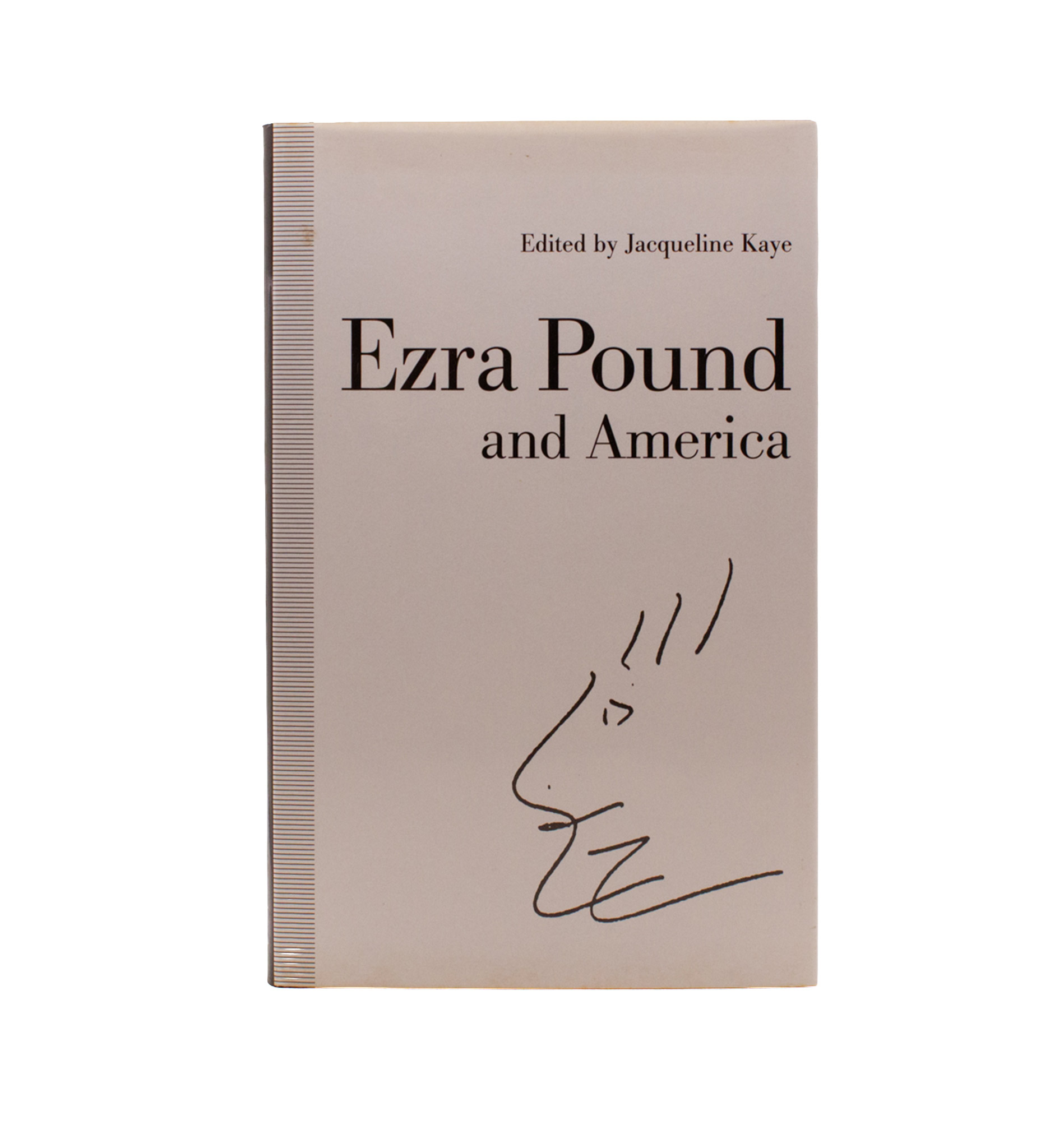
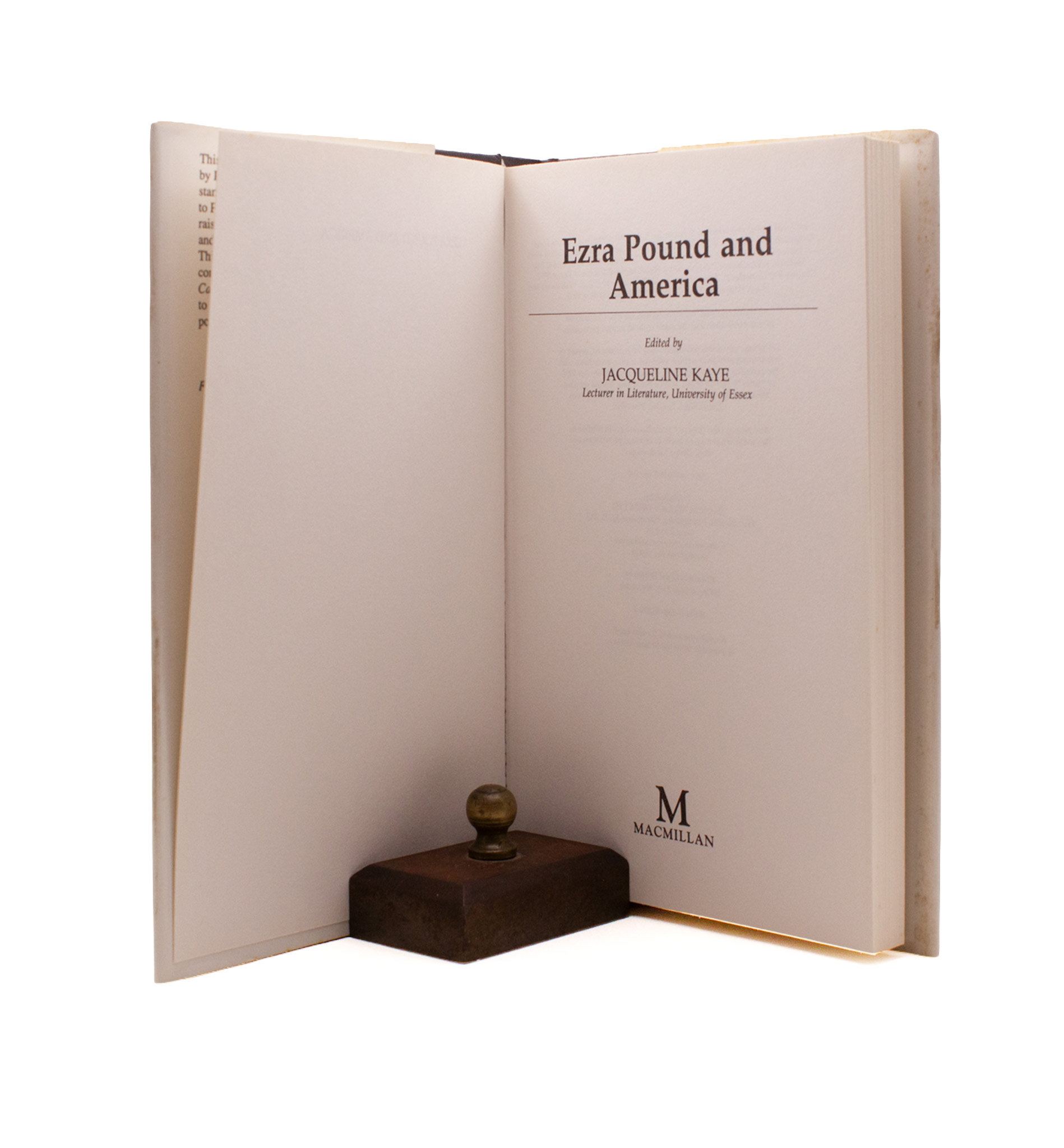
Ezra Pound and America
Jacqueline Kaye, editor
Published Macmillan, 1992
203pp.; 22.2 x 14.1 cm. Black cloth boards lettered in gold down the spine. White dust-jacket printed in black.
From the library of A. David Moody
Essays following talks from the 13th EPIC, “Pound and America,” held at the University of Essex, September 1989. With a contribution from Richard Dean Taylor who spent years in effort of constructing a Variorum for The Cantos (see The Tragi-Comical History of the Variorum Project and its Betrayal by Cambridge University Press here, and the prototype hypertext here). First edition, a fine copy in a near-fine jacket, back flap a little dirtied.
Contents: Maria Luisa Ardizzone, “Some Additions and Corrections to Ezra Pound e la scienza”; L. S. C. Bristow, “‘God, my god, you folks are DUMB!!!’: Pound’s Rome Radio Broadcasts”; Angelia Elliott, “The Eidolon Self: Emerson, Whitman and Pound”; Peter Makin, “Americanus Natione non Moribus”; A. D. Moody, “Composition in the Adams Cantos”; Eric Mottram, “Ezra Pound in his Time”; Nick Selby, “Revolutionary Figures in Canto XXXI”; Richard [Dean] Taylor, “Reconstructing Ezra Pound’s Cantos: Variorum Edition — Manuscript Archive — Reading Text”; Demetres P. Tryphonopoulos, “‘That Great Year Epic’: Ezra Pound, Katherine Ruth Heyman and H.D.”; E. P. Walkiewicz and Hugh Witemeyer, “Ezra Pound, Bronson Cutting and American Issues, 1930-5”; Stephen Wilson, “Pound’s American Revolutions.”


tap to cycle
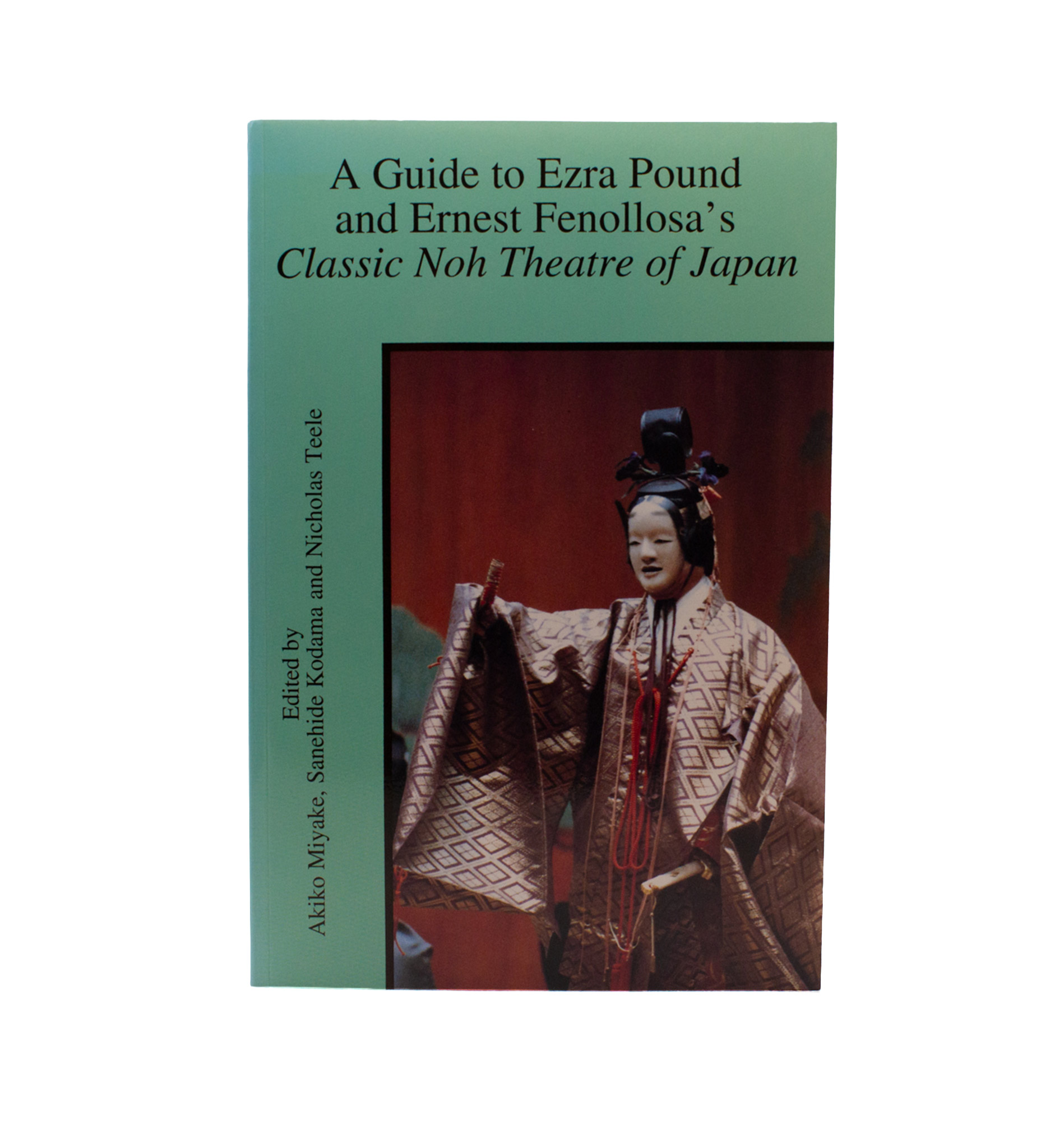
A Guide to Ezra Pound and Ernest Fenollosa’s Classic Noh Theatre of Japan
Akiko Miyake, Sanehide Kodama, Nicholas Teele, editors
Published Maine: The National Poetry Foundation and Shiga University: The Ezra Pound Society of Japan, 1994
453pp.; 22.8 x 15.2 cm. Stiff white paper wraps printed in green and black.
From the library of A. David Moody
A large collection of essays on Pound’s use of Fenollosa and his love and work on Noh. A fine copy, with the publisher’s advertisment for “New Titles - Autumn 1994,” and a postcard from an exhibition, “V O U: Visual Poetry of the Japanese Avant-Garde from the collection of John Solt, January 22 - June 10, 1990,” featuring a work by Kitasono Katue (Kit Kat, to Pound), night of figure (1975) laid-in.
tap to cycle
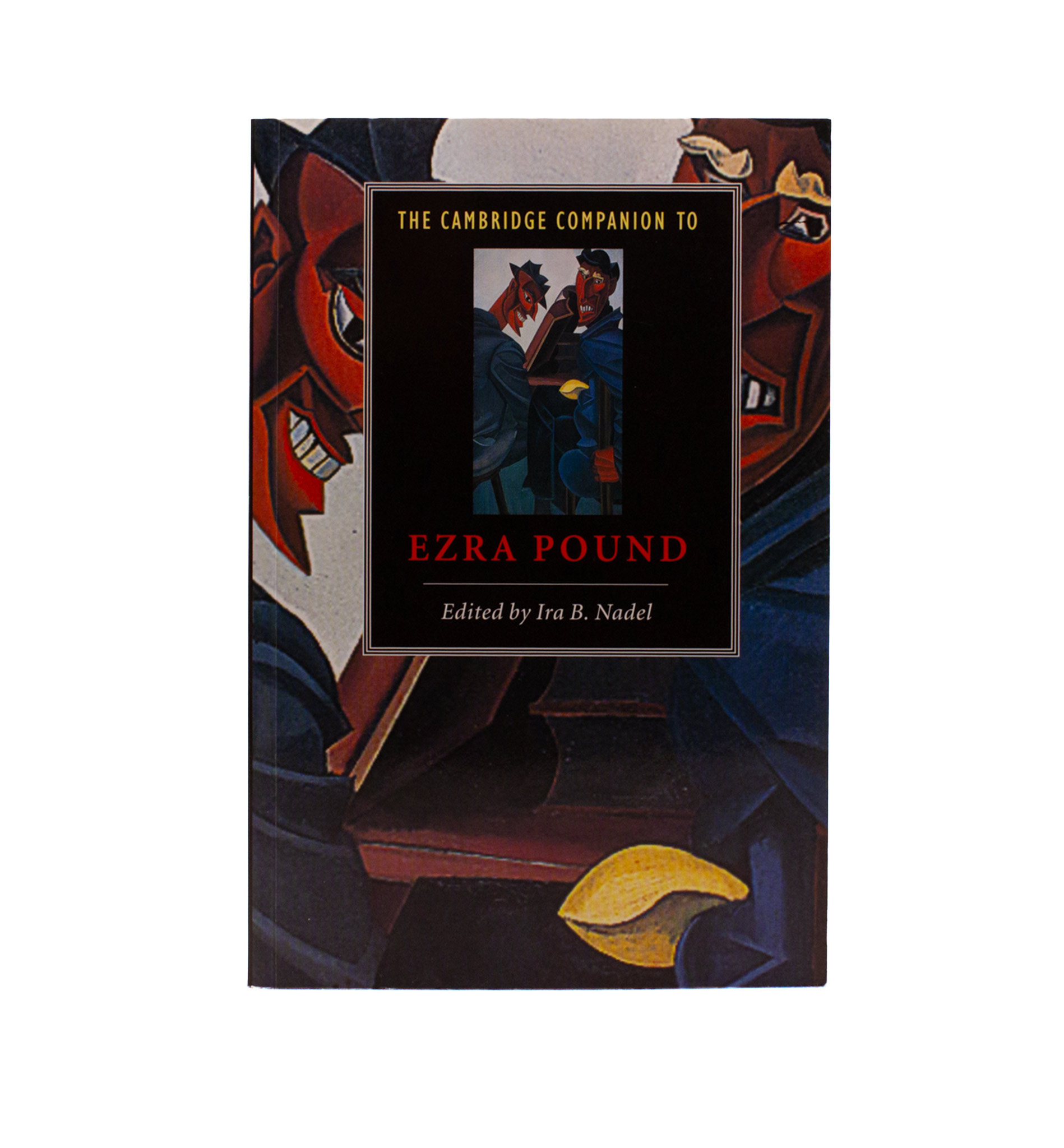
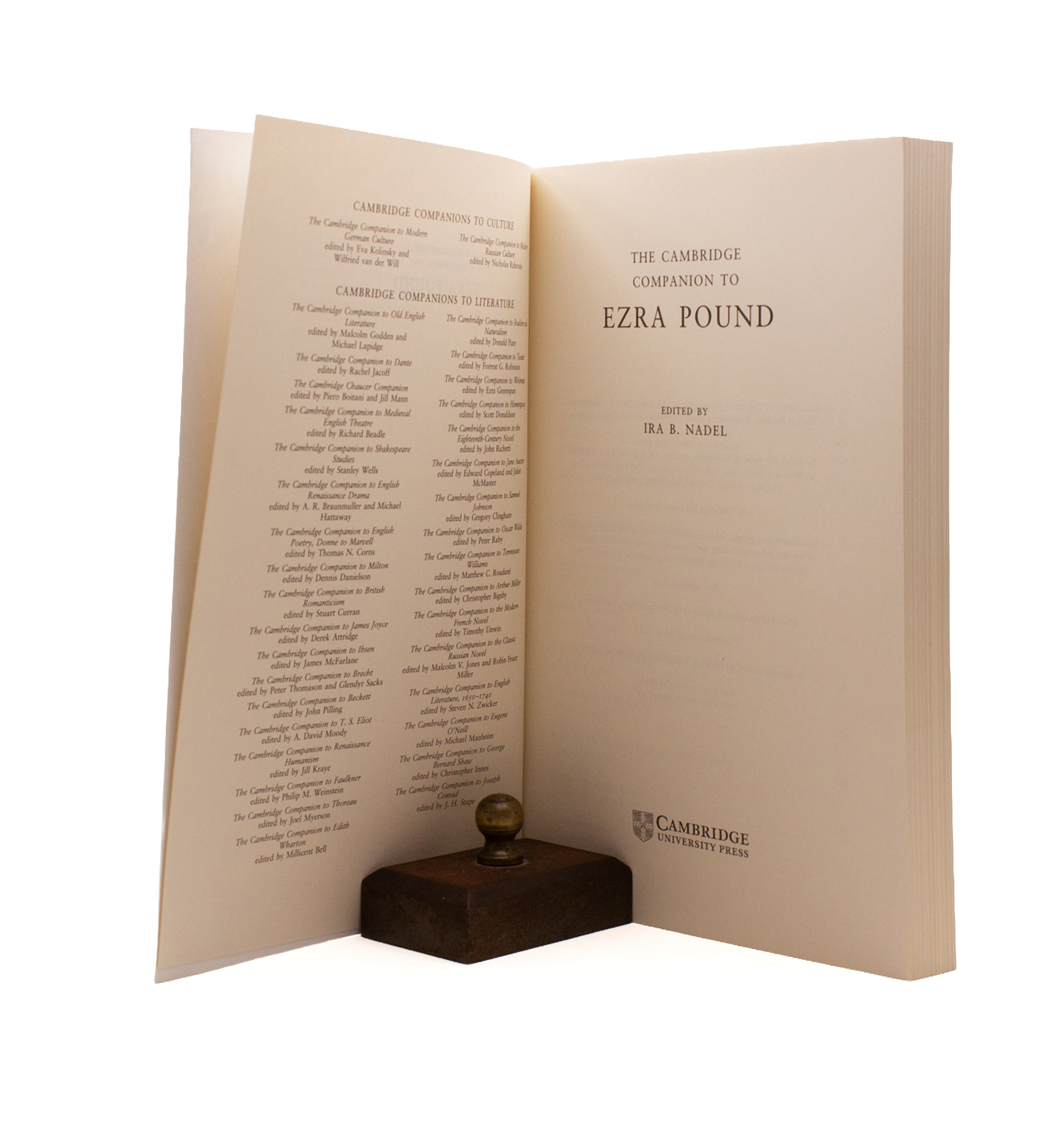
The Cambridge Companion to Ezra Pound
Ira B. Nadel, editor
Published Cambridge University Press, 1999
318pp.; 22.7 x 15.2 cm. Colour printed stiff white wrappers.
From the library of A. David Moody
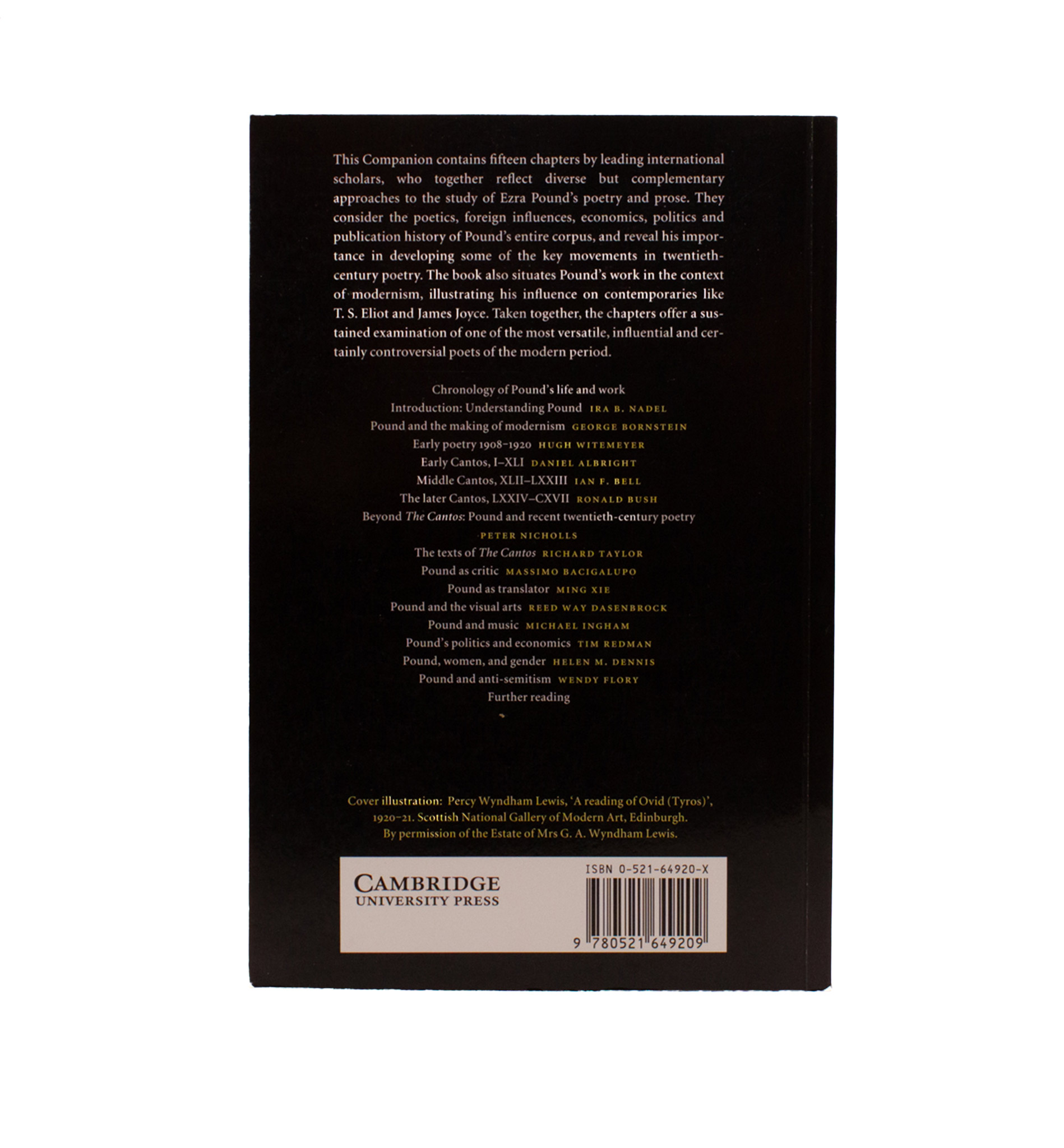
“This Cambridge Companion to Ezra Pound contains fifteen chapters by leading international scholars, who together reflect diverse but complementary approaches to the study of Ezra Pound’s poetry and prose. They consider the poetics, foreign influences, economics, politics and publication history of Pound’s entire corpus [!], and reveal his importance in developing some of the key movements in twentieth-century poetry. The book also situates Pound’s work in the context of modernism, illustrating his influence on contemporaries such as T. S. Eliot and James Joyce. Taken together, the chapters offer a sustained examination of one of the most versatile, influential and certainly controversial poets of the modern period.” First edition, paperback issue. A fine copy save the slightest edge wear to the back wrap. With the occasional pencil marginalia from David Moody, including lots of disagreement with Nadel’s Chronology.
Contents: Ira B. Nadel, “Introduction Understanding Pound”; George Bornstein, “Pound and the making of modernism”; Hugh Witemeyer , “Early poetry 1908-1920”; Daniel Albright, “Early Cantos I-XLI”; Ian F. A. Bell, “Middle Cantos XLII-LXXI”; Ronald Bush, “Late Cantos LXXII-CXVII”; Peter Nicholls, “Beyond The Cantos: Pound and American poetry”; Richard [Dean] Taylor, “The texts of The Cantos”; Massimo Bacigalupo, “Pound as critic”; Ming Xie, “Pound as translator”; Reed Way Dasenbrock, “Pound and the visual arts”; Michael Ingham, “Pound and music”; Tim Redman, “Pound’s politics and economics”; Helen M. Dennis, “Pound, women and gender”; Wendy Flory, “Pound and antisemitism.”
tap to cycle
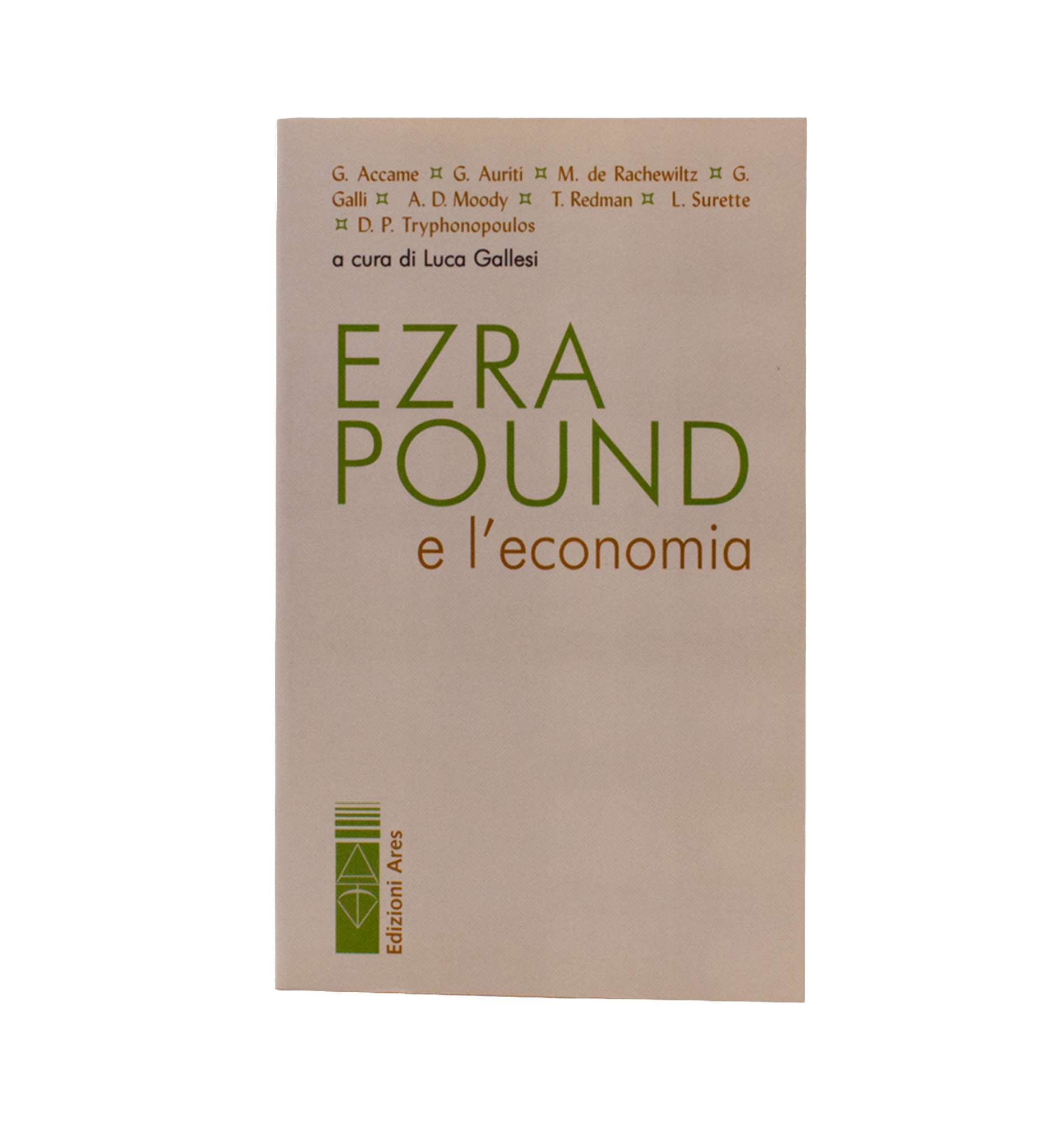
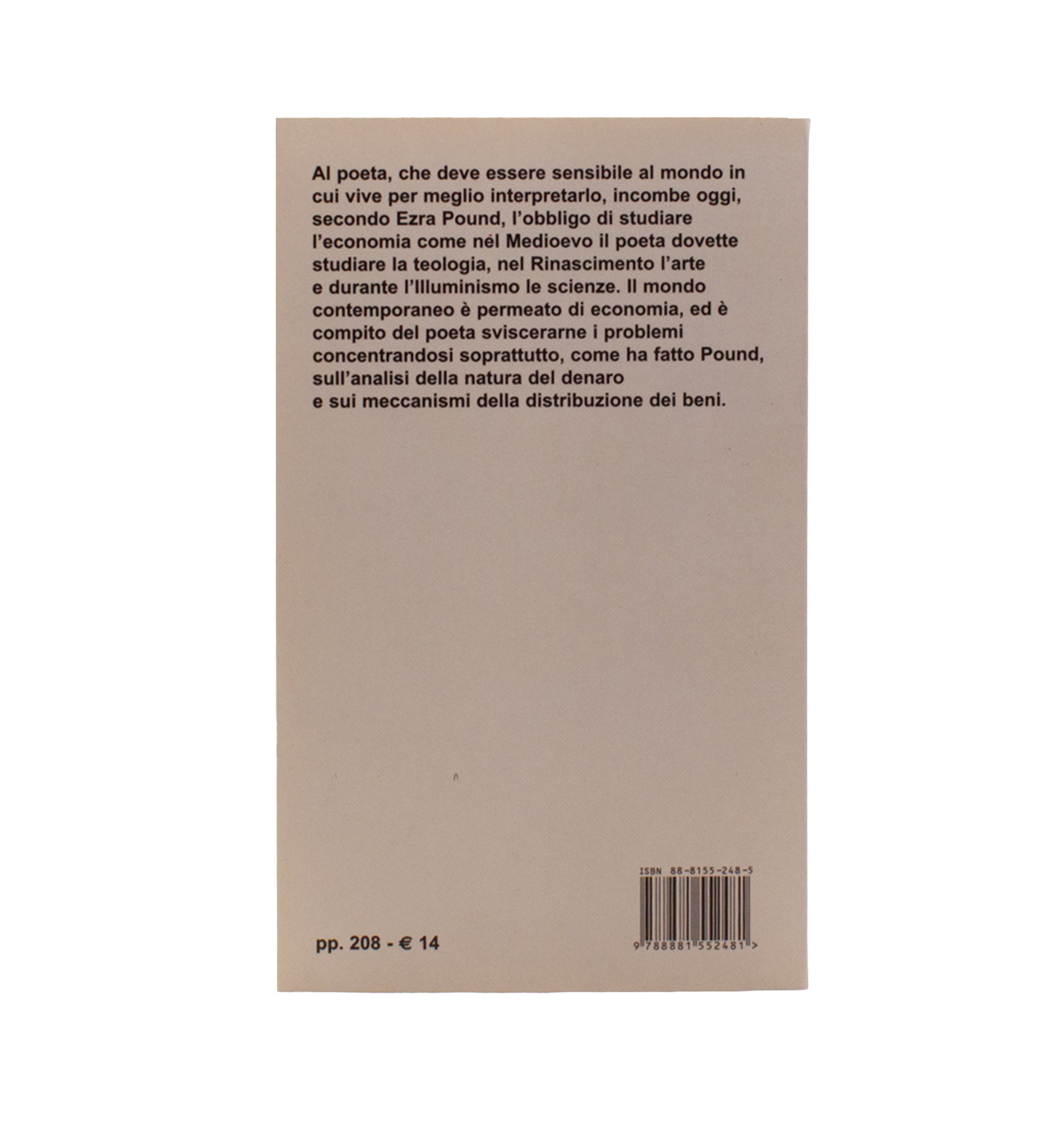
Ezra Pound e l’economia
Luca Gallesi, a cura di
Published Milan: Edizioni Ares, 2001
208pp.; 18.1 x 11 cm. Stiff white paper wraps printed in grey, green, black and bronze.
From the library of A. David Moody
A sweet little book containing essays in English and Italian on Pound’s economics, with political bent where applicable. A little aged but mostly fine.
Contents: Luca Gallesi, “Introduzione”; Giano Accame, “Attualità di Pound economista”; Giacinto Auriti, “L’anno sabbatico, valore indotto, valore creditizio e signoraggio”; Mary de Rachewiltz, “La virtù nell’economia di Ezra Pound”; Giorgio Galli, “Ezra Pound tra economia ed esoterismo”; David A. Moody, “Directio voluntatis. Pound’s economics in the Economy of The Cantos”; Tim Redman, “Opere recenti su Pound economista: Accame, Marsh e Surette”; Leon Surette, “A Dangerous Difference: Pound, Douglas & Proudhon”; Demetres P. Tryphonopoulos, “«The State Is Corporate / as with Pulse in its Body»: Ezra Pound’s Byzantine and Fascist Paradigms for an Economic Program.”

tap to cycle
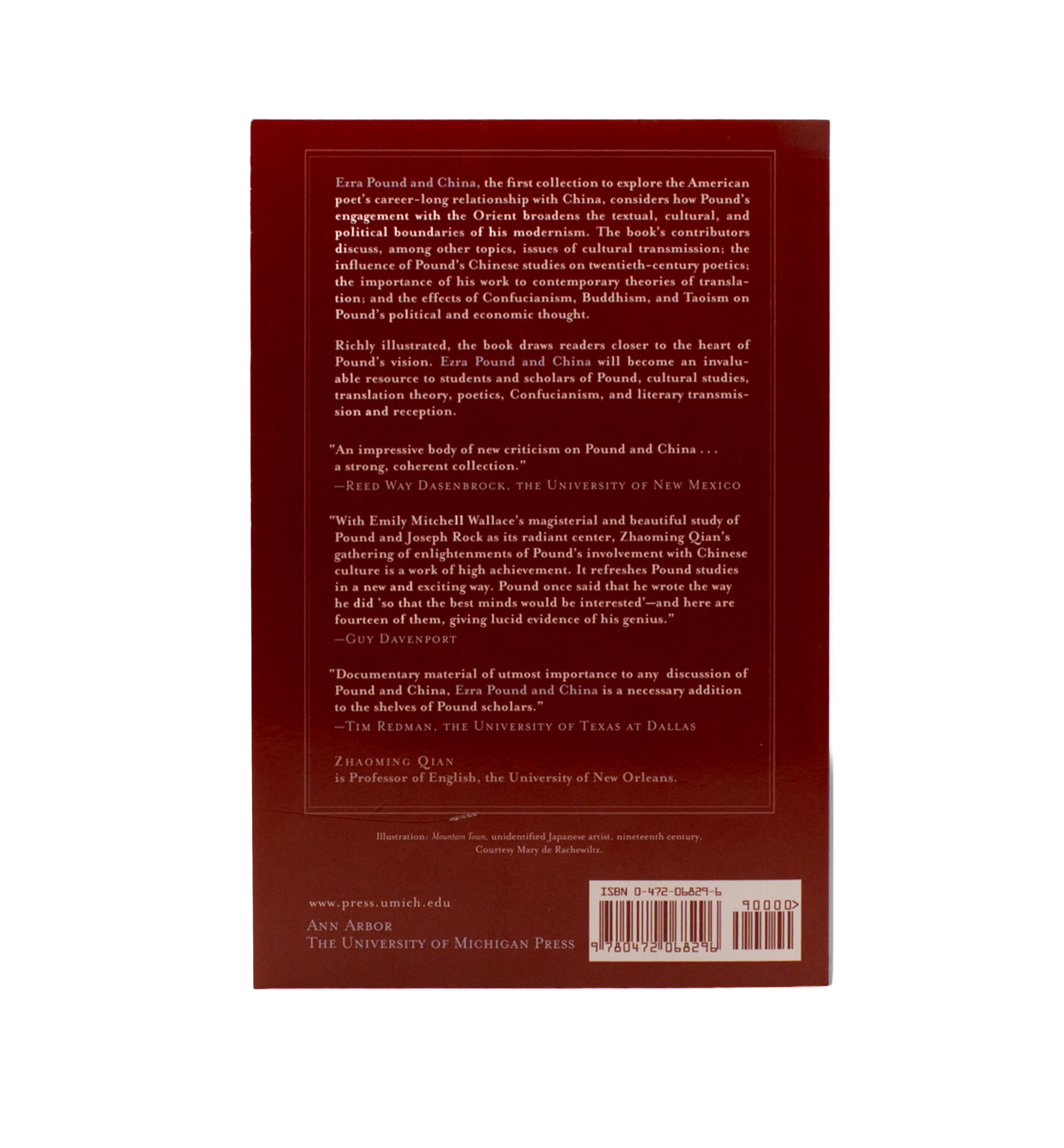
Ezra Pound and China
Zhaoming Qian, editor
Published Ann Arbor: The University of Michigan Press, 2003
297pp.; 22.5 x 15.1 cm. Stiff paper wraps printed in lilac and red.
From the library of A. David Moody
Essays after talks held at the 18th EPIC, Beijing, July 1999. A fine copy save a scratch to the back cover. With David Moody’s annotations to “Confucius and Confusion” and “Confucius Erased.”
Contents: Zhaoming Qian, “Introduction”; Ira B. Nadel, “Constructing the Orient: Pound’s American Vision”; Barry Ahearn, “Cathay: What Sort of Translation?”; Christine Froula, “The Beauties of Mistranslation: On Pound’s English after Cathay”; Peter Makin, ‘Ideogram, “Right Naming,” and the Authoritarian Streak’; Wendy Stallard Flory, “Confucius against Confusion: Ezra Pound and the Catholic Chaplain at Pisa”; Ronald Bush, “Confucius Erased: The Missing Ideograms in The Pisan Cantos”; Britton Gildersleeve, ‘“Enigma” at the Heart of Paradise: Buddhism, Kuanon, and the Feminine Ideogram in The Cantos”; Emily Mitchell Wallace, ‘“Why Not Spirits?”—“The Universe Is Alive”: Ezra Pound, Joseph Rock, the Na Khi, and Plotinus’; Patricia de Rachewiltz, Yang Lian, Kim Jong-Gil, “Poems”; Mary de Rachewiltz, “Afterword: Kung Is to Pound as Is Water to Fishes.”

tap to cycle
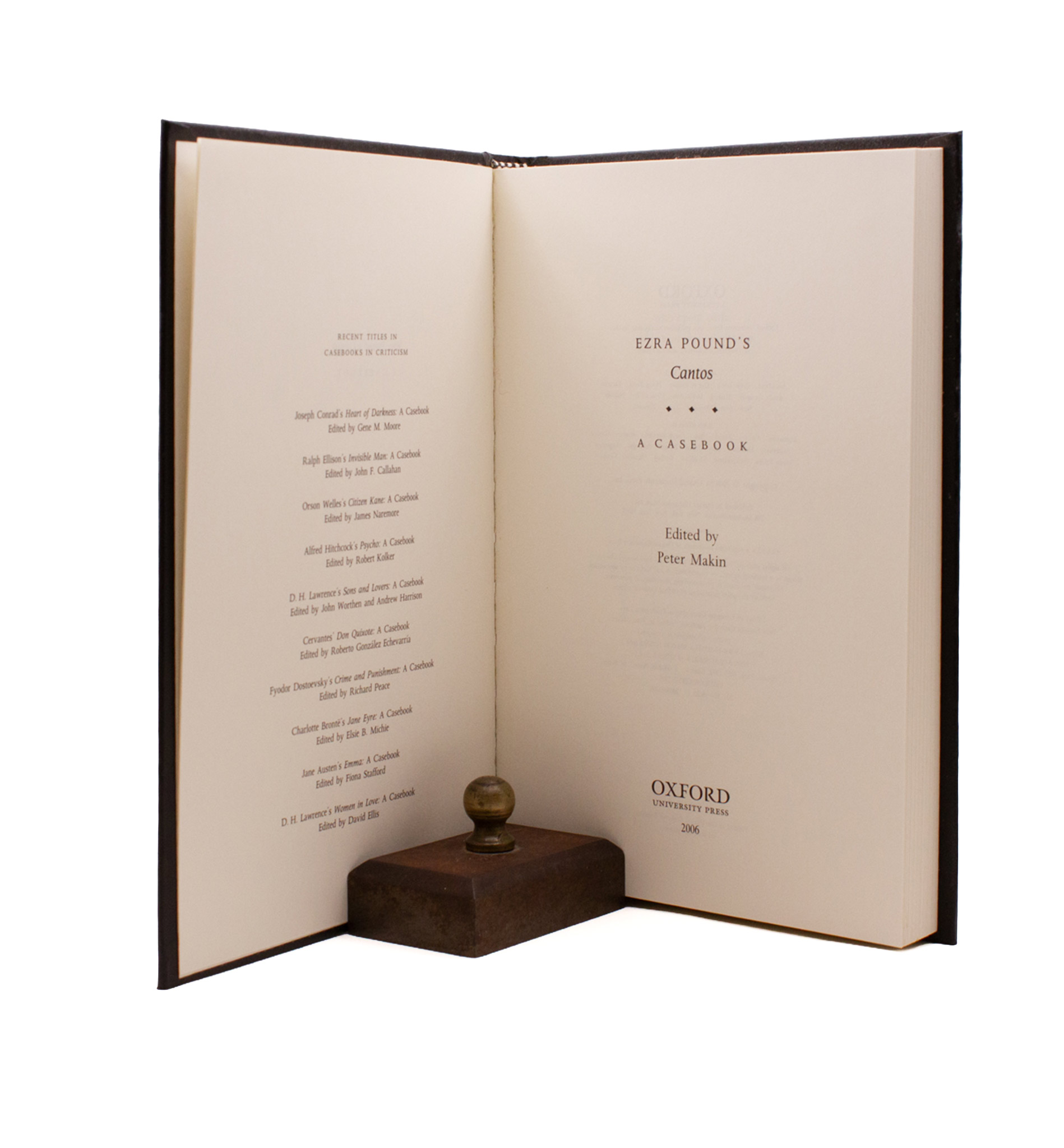
Ezra Pound’s Cantos, A Casebook
Peter Makin, editor
Published Oxford University Press, 2006
264pp.; 21.7 x 14.7 cm. Black paper covered boards lettered in silver to front and down spine.
From the library of A. David Moody
A range of essays on The Cantos showcasing the numerous aspects by which the poem can be approached. With an unusual contribution against the Commedia as model. First edition, the only available in hardback. With a little light wear to the boards. David Moody’s annotations, mostly to Makin’s introduction.
Contents: Peter Makin, “Introduction”; Hugh Kenner, “Ezra Pound”; Guy Davenport, “Persephone’s Ezra”; Girolamo Mancuso, “The Ideogrammic Method in The Cantos”; Reed Way Dasenbrock, “Why the Commedia Is Not the Model for The Cantos and What Is”; Peter Makin, “History and Money, Fact and Hysteria”; Massimo Bacigalupo, ‘“Safe with My Lynxes”: Pound’s Figure in the Carpet?’; Kevin Oderman, “Extracts from Ezra Pound and the Erotic Medium”; Peter Nicholls, “A Metaphysics of the State”; Hugh Kenner, “Inventing Confucius”; D. S. Carne-Ross, “The Music of a Lost Dynasty: Pound in the Classroom”; Donald Davie, “Res and Verba in Rock-Drill and After”; Ronald Bush, ‘“Unstill, Ever Turning”: The Composition of Ezra Pound’s Drafts & Fragments’; D. G. Bridson, “An Interview with Ezra Pound”; Donald Hall, “Ezra Pound: An Interview.”

tap to cycle
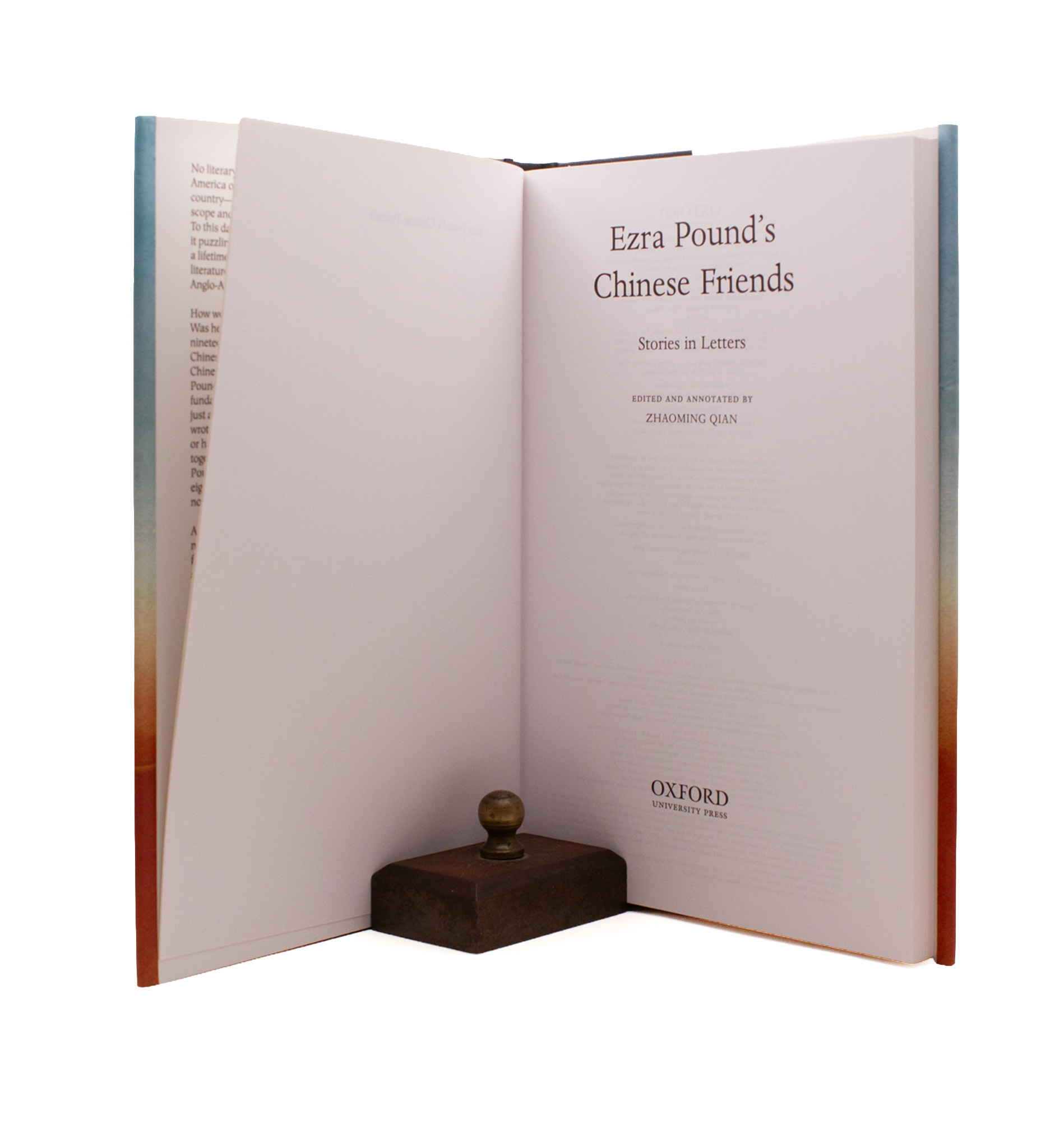
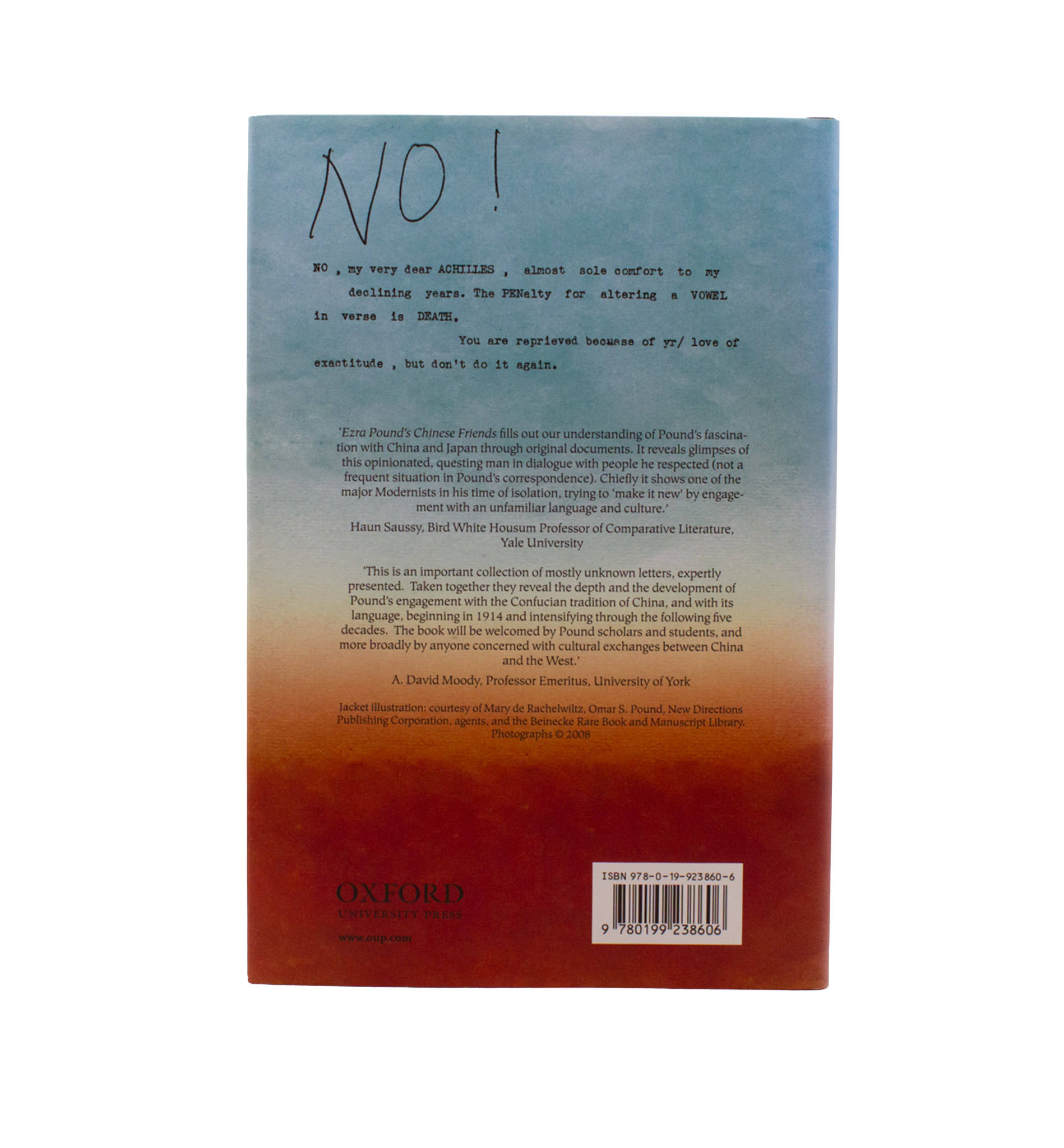
Ezra Pound’s Chinese Friends
Zhaoming Qian, editor
Published Oxford University Press, 2008
242pp.; 24.1 x 16.2 cm. Black cloth boards stamped in gold down spine. White dust-jacket printed in black, red and blue.
From the library of A. David Moody
Not of contributors, but Qian’s compilation of materials (mostly letters, annotated) relating Pound and his correspondents and colleagues in China. First edition. A fine copy, one bump to the jacket, with the occasional pencil and note laid-in from David Moody.


tap to cycle
Ezra Pound in Context
Ira B. Nadel, editor
Published Cambridge University Press, 2010
497pp.; 23.5 x 15.9 cm. Black cloth boards stamped in gold down spine. White dust-jacket printed in yellow and black.
From the library of A. David Moody
A three part collection being “Biography and Works,” “Historical and Cultural Context,” and “Critical Reception,” with contributions from a number of contemporary scholars. First edition, a fine copy in a near fine jacket, with a bookmark laid in at John Gery’s Venice.


tap to cycle
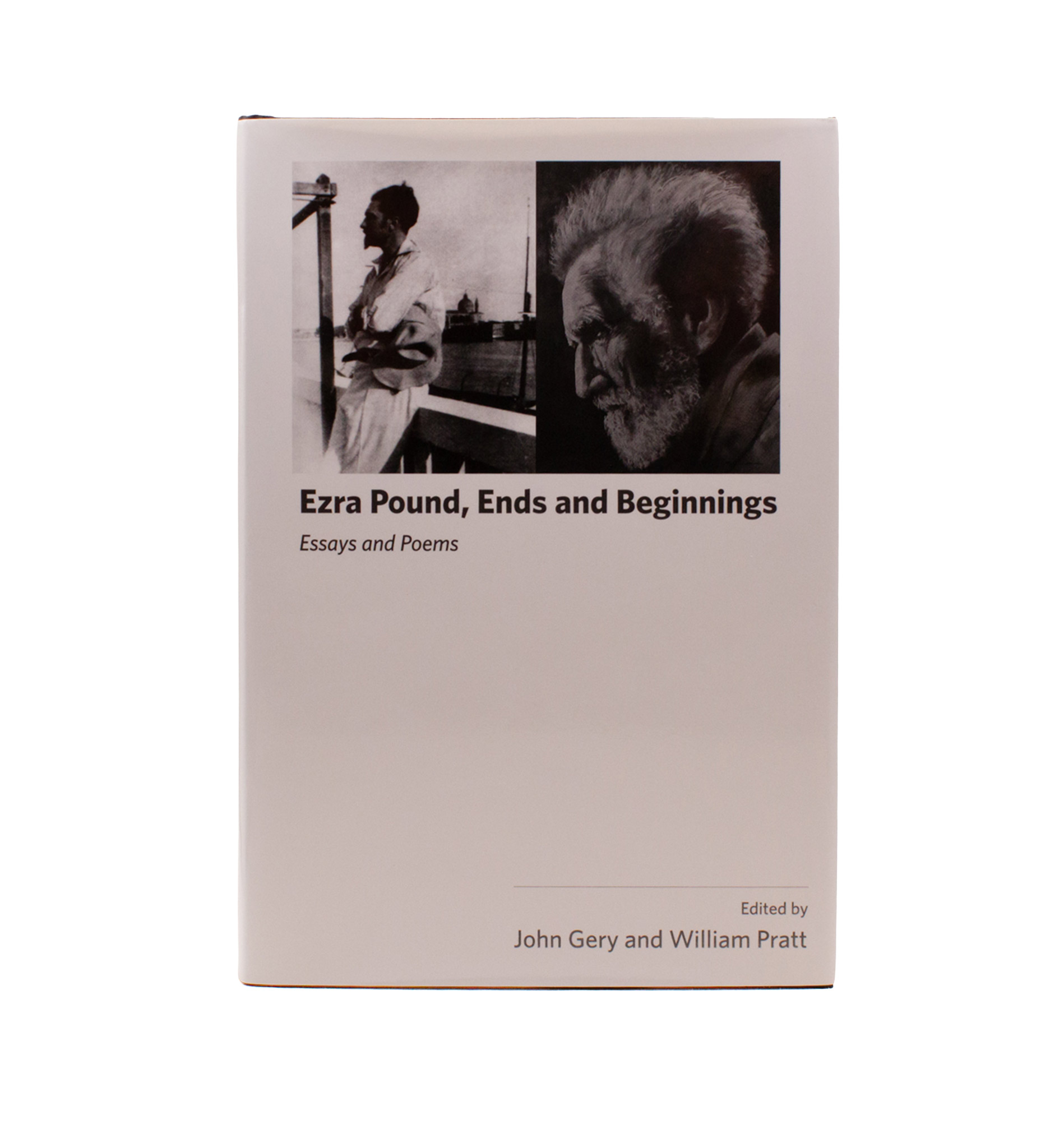
Ezra Pound, Ends and Beginnings: Essays and Poems from the Ezra Pound International Conference, Venice, 2007
John Gery, William Pratt, editors
Published New York: AMS Press, Inc., 2011
234pp.; 23.5 x 16.2 cm. Black cloth boards stamped in gold down spine. White dust-jacket printed in black.
From the library of A. David Moody
A four part compilation after talks given at the 22nd EPIC. First edition, a fine copy, and a beautiful production.
Contents: Part I, Pound in Venice: Tim Redman, “Mussolini’s First Years and Last Months: What Did Pound Know about Il Duce’s Beginning and End?”; David Barnes, “‘Ct/Volpe’s Neck’: Re-approaching Pound’s Venice in the Fascist Context”; Massimo Bacigalupo, “City vs. Country in Pound: Venice, Fortuna, and John Law”; Anne Conover, “Deliverance! Ezra Pound’s Last Days”; Part II, Pound’s Poetry: Réka Mihálka, “Appropriate Orientation: Whistler and Pound”; Peter Liebregts, “‘Bricks thought into being ex nihil’: Ezra Pound and Creation”; Helen May Dennis, “Primitivism in Poundian Poetics: The Modernist Quest for Ancient Wisdom”; Peter Nicholls, “Beginning the End: Ezra Pound and the Poetics of Survival”; Robert Rehder, “The End of The Cantos”; Part III, Pound’s Legacy: William Pratt, “Beyond Modernism: Pound as Vatic Poet”; H. R. Stoneback, “‘I Would … Be Hanged with You’: Ernest Hemingway and Ezra Pound”; Ian S. MacNiven, “Poetry and/or Publishing: Pound, Stein, and the Evolution of James Laughlin’s New Directions”; Peggy L. Fox, “Mission Impossible: James Laughlin, Ezra Pound, and the Founding of New Directions”; Part IV, Poems in Honor of Pound: Patricia de Rachewiltz, “Sumer 1958”; Robert Rehder, “Entropy”; Robert Rehder, “The Surface of the Water”; Biljana D. Obradović, “Lunch in Venice”; Biljana D. Obradović, “Evening Light”; Hoshang Merchant, “Tagore Meets Pound VIII”; Kevin Kiely, “Mary Pound de Rachewiltz”; John Gery, “Il Redentore”; John Gery, “Miracoli”; H. R. Stoneback, From “For EP: In Our Time”; Mary de Rachewiltz, “I Was There.”

tap to cycle
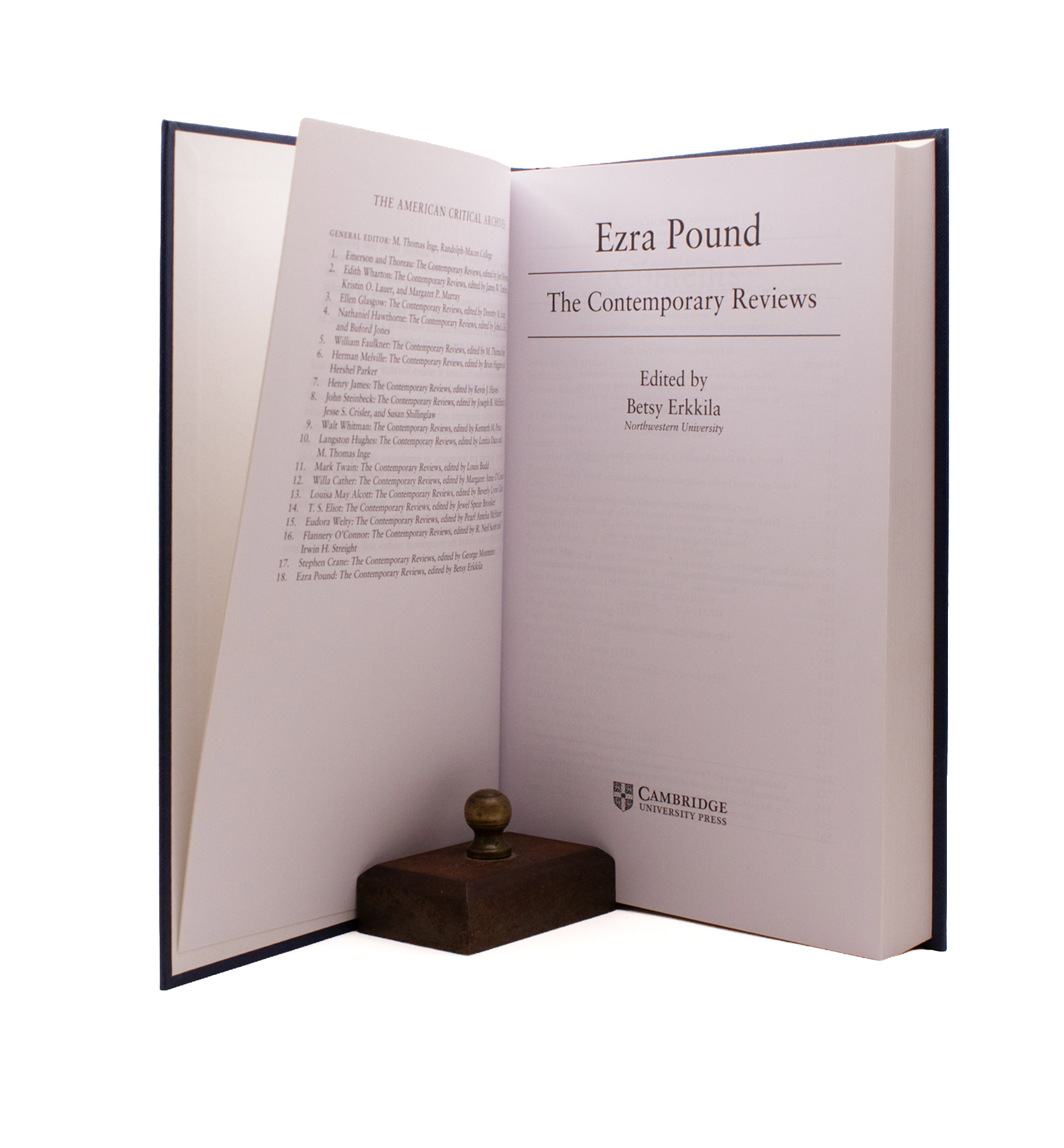
Ezra Pound, The Contemporary Reviews
Betsy Erkkila, editor
Published Cambridge University Press, 2011
418pp.; 23.5 x 15.8 cm. Blue cloth boards stamped in gold to front and spine.
From the library of A. David Moody
A compilation of reviews, either from newspapers or little mags, of an amazing c. 37% of Gallup A items (later limited editions and Italian publications certainly omitted). Printed in an appeasing double-column format. First edition, without jacket as issued. A fine copy save a couple of spots of white paint on the back. A couple of marginal notes from David Moody.

tap to cycle
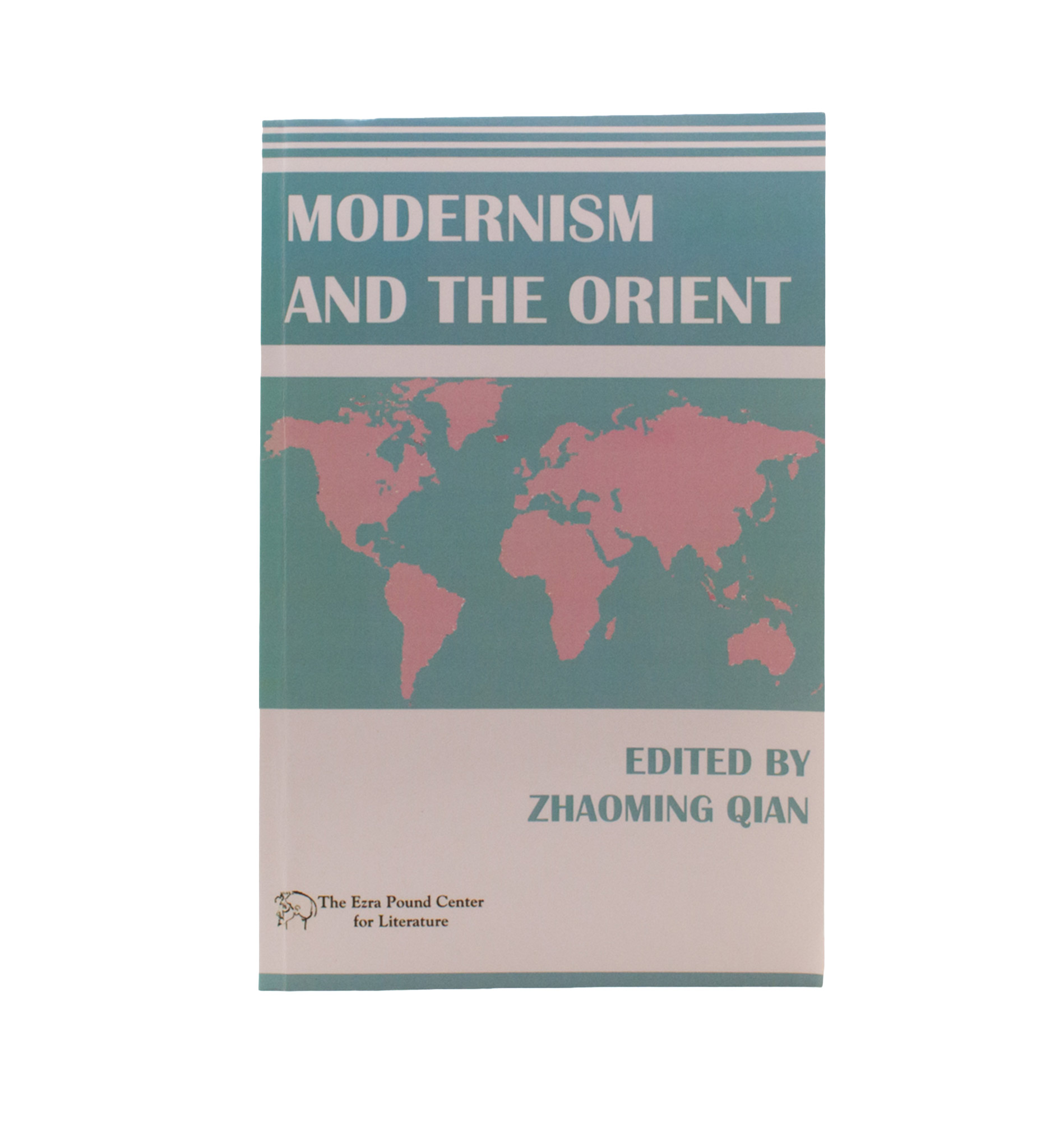
Modernism and the Orient
Zhaoming Qian, editor
Published University of New Orleans Press, 2012
294pp.; 21.7 x 14.1 cm. Stiff white paper wrappers printed in black, green and pink.
From the library of A. David Moody
Volume 4 in the The Ezra Pound Center for Literature Series, edited by John Gery. A selection of essays on a range of Modernist writers in their relation to China. First edition, an uncommon publication. A fine copy, the front cover slightly lifting.
Contents: Zhang Longxi, “Elective Affinities? On Wilde’s Reading of Zhuangzi”; Sabine Sielke, ‘“Orientalizing” Emily Dickinson and Marianne Moore—Complicating Modernism?’; Daniel Albright, “The Flute—East/West—in Modernist Music and Poetry”; Christine Froula, “Proust’s China”; Qiping Yin, “Chu Shi and Ru Shi: Robert Frost in Taoist Perspective”; Ira B. Nadel, “The Modernist Page: Joyce and the Graphic Design of Chinese Writing”; Fen Gao, “Virigina Woolf’s Truth and Zhenhuan in Chinese Poetics”; Christian Kloeckner, “Re-Orienting Impersonality: T. S. Eliot and the Self of the Far East”; Ronald Bush, ‘“Young Willows” in Pound’s Pisan Cantos: “Light as the Branch of Kuanon”’; Zhaoming Qian, “Mai-mai Sze, The Tao, and Late Moore”; Richard Parker, “Louis Zukofsky’s American Zen”; Tony Lopez, “The Orient in Later Modernist English Poetry.”
tap to cycle
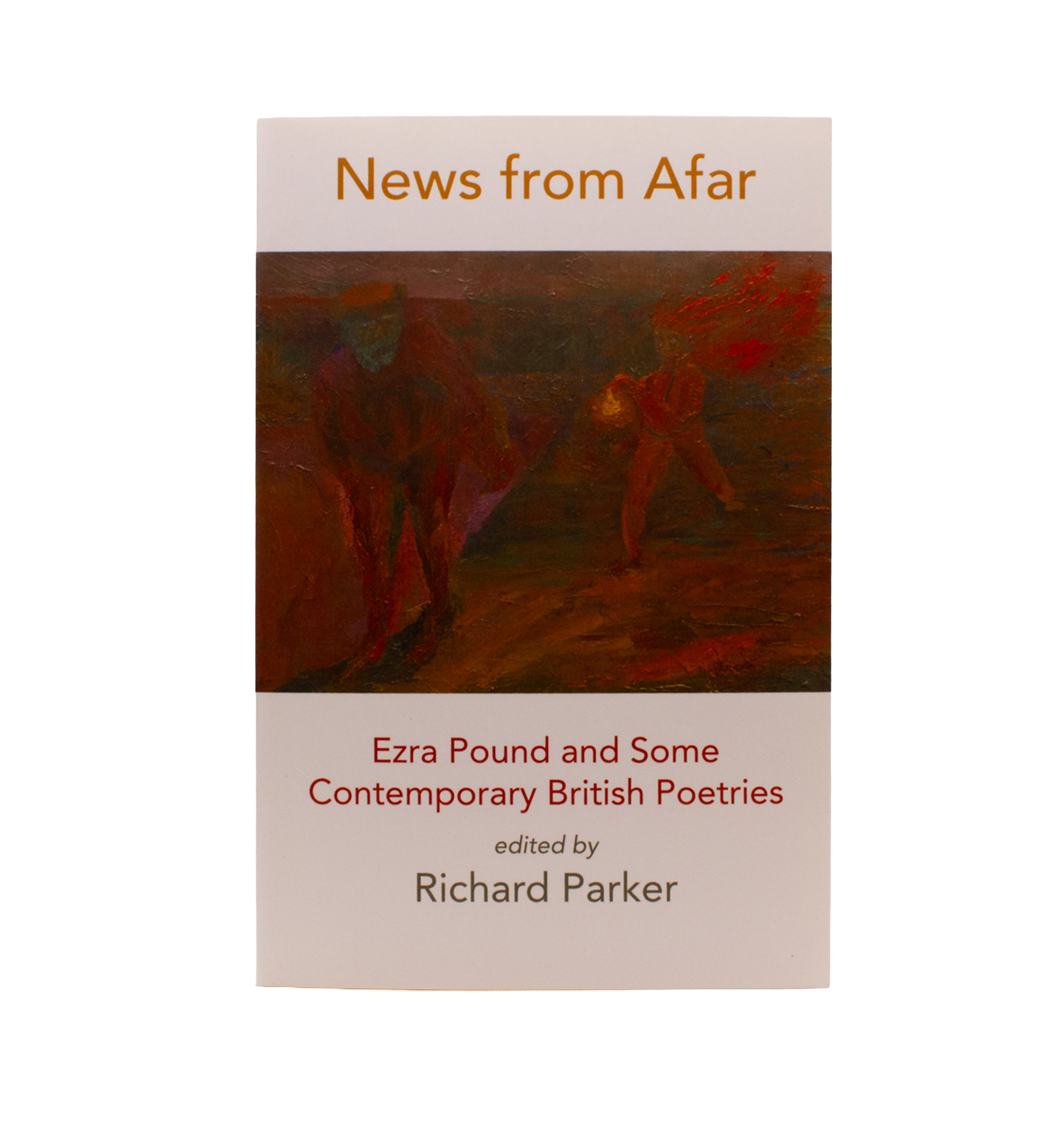
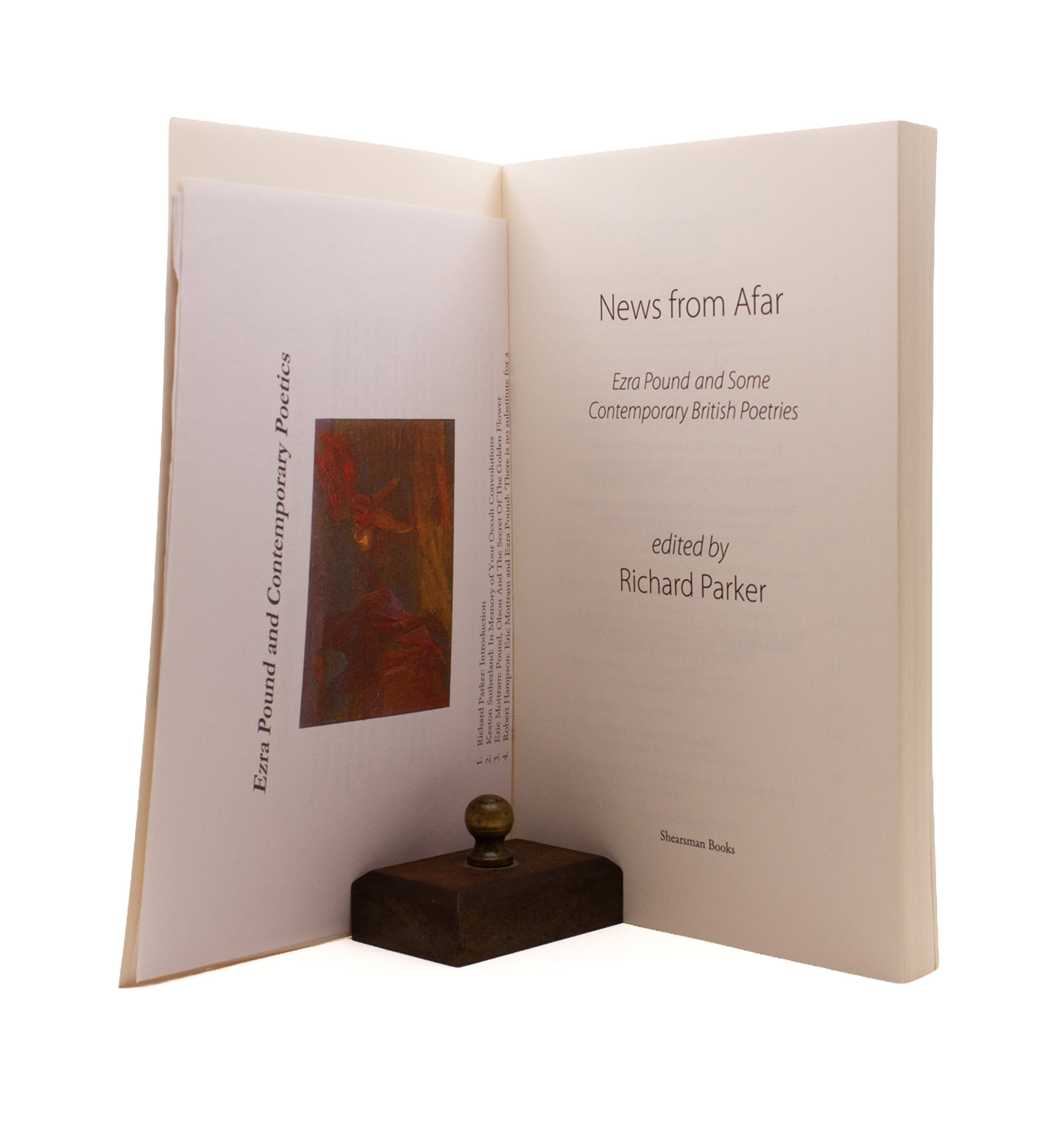
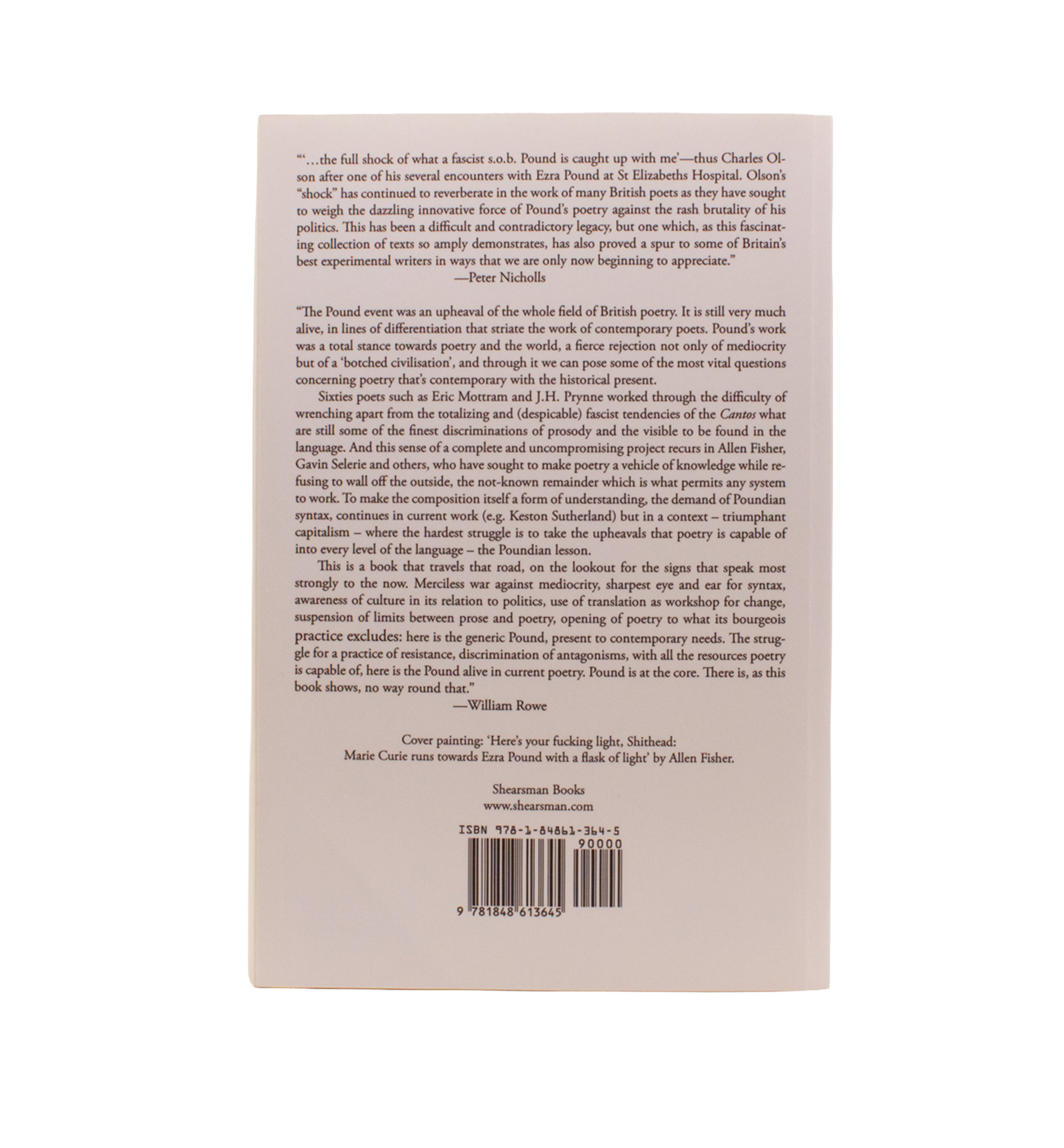
News from Afar: Ezra Pound and Some Contemporary British Poetries
Richard Parker, editor
Published Bristol: Shearsman Books, 2014
328pp.; 23 x 15.3 cm. Stiff white printed paper wraps printed, illustrated with oil on canvas by Allen Fisher, “Here’s your fucking light, Shithead: Marie Curie runs towards Ezra Pound with a flask of light.”
From the library of A. David Moody
An ecclectic and modern compilation of essays in relation to Pound and contemporary British poets, a sequel to Sons of Ezra: British Poets and Ezra Pound (McGonigal and Alexander, ed., 1995). First edition, review copy with an A4 folded leaf from the publisher laid-in. A fine copy. With a number of pencil highlights in the margin from David Moody.
Contents: Richard Parker, ‘“Here’s Your Fucking Light Shithead”: Ezra Pound and Contemporary British Poetry”; Keston Sutherland, “In Memory of Your Occult Convolutions”; Amy Evans, ‘“So I think a beginning has been made”: Ezra Pound, Robert Duncan and Eric Mottram”; Eric Mottram (ed. Amy Evans), “Pound, Olson and The Secret of the Golden Flower”; Robert Hampson, ‘Eric Mottram and Ezra Pound: “There is no substitute for a life-time.”’; Alexander Howard, “Compacts, Commerce, and a Few Remarks Concerning Andrew Crozier”; Mark Scroggins, ‘The “half-fabulous field-ditcher”: Ruskin, Pound, Geoffrey Hill’; Josh Kotin, “Blood-Stained Battle-Flags: Ezra Pound, J.H. Prynne and Classical Chinese Poetry”; Ryan Dobran, “Myth, Culture and Text: Ezra Pound’s Homer and J.H. Prynne’s Aristeas”; Gareth Farmer, ‘“Obstinate Isles” and Rhetorical Sincerity: Veronica Forrest-Thomson and Ezra Pound”; Laura Kilbride, ‘“Real Games With Books”: On Anna Mendelssohn and Ezra Pound”; Allen Fisher, “Atkins Stomp”; Juha Virtanen, ‘Allen Fisher Reading: Facture, “Atkins Stomp” and Ezra Pound’; Gavin Selerie, “Pound and Contemporary British Poetry: The Loosening of Form”; Gavin Selerie, “Poems from Hariot Double”; David Vichnar, “P.S.: Pound and Sinclair’s Intertextual Ley Lines”; Harry Gilonis, “Second Heave — Fracture Syntax”; Tony Lopez, “Darwin in Rome: Pound and Stein”; Tony Lopez, “From Darwin, a section of Only More So”; Robert Sheppard, “The Li Shang-yin Suite”; Sean Pryor, “Some Thoughts on Refrigiration”; Danny Hayward, “Or Storming the Shopping Centre: Poetry, Competition, Pound, Quid”; Alex Pestell, ‘“All in for folly and mustard”: Pound, Zukofsky and Word is Born”; Tim Atkins, “Happiness / The Art of Poetry Being a translation of the 10 Buddhist Ox-Herding Poems.”


tap to cycle
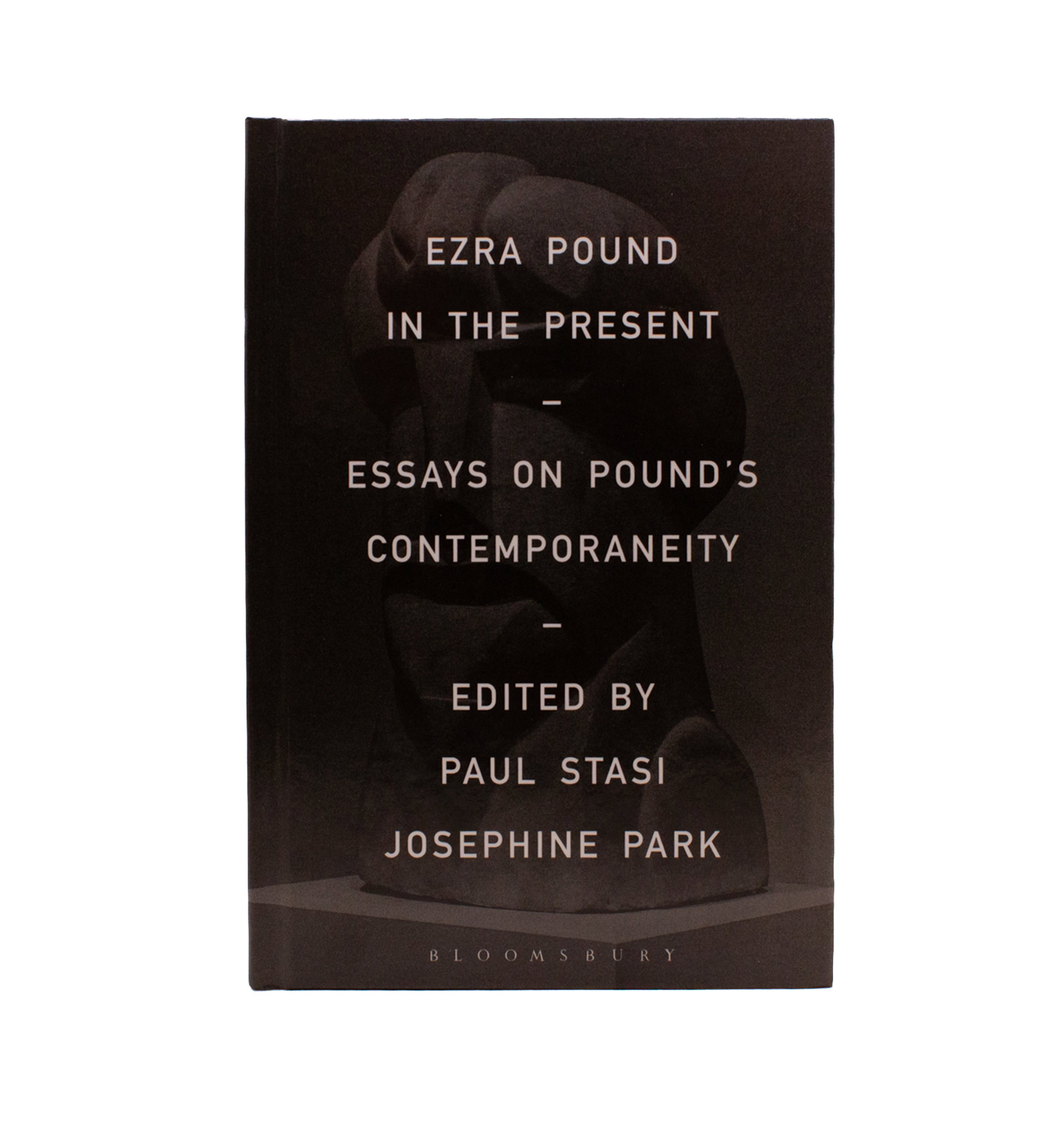
Ezra Pound in the Present; Essays on Pound’s Contemporaneity
Paul Stasi and Josephine Park, editors
Published London: Bloomsbury, 2016
251pp.; 23.6 x 16.3 cm. White paper covered boards printed in grey.
From the library of A. David Moody
Essays upon Pound’s relevance Today (2016). First edition, a fine copy, with David Moody’s marginalia to the introduction.
Contents: Part I, Pound’s Methods: Charles Altieri, “Why Pound’s Imagist Poems Still Matter”; Josephine Park, “Not-So-Distant Reading”; Aaron Jaffe, “Paleolithic Media: Deep Time and Ezra Pound’s Methods”; Part II, Pound’s Worlds: Christopher Bush, ‘“I am all for the triangle”: The Geopolitical Aesthetic of Pound’s Japan’; Jean-Michel Rabaté, “Ezra Pound and the Globalization of Literature”; Christine Froula, “Ezra Pound and the Comparative Literature of the Present, or, Triptych Rome/London/Pisa”; Part III, Pound’s Values: Paul Stasi, “Ezra Pound and the Critique of Value”; C. D. Blanton, “Ezra Pound’s Effective Demand: Keynes, Causality, and The Cantos.”